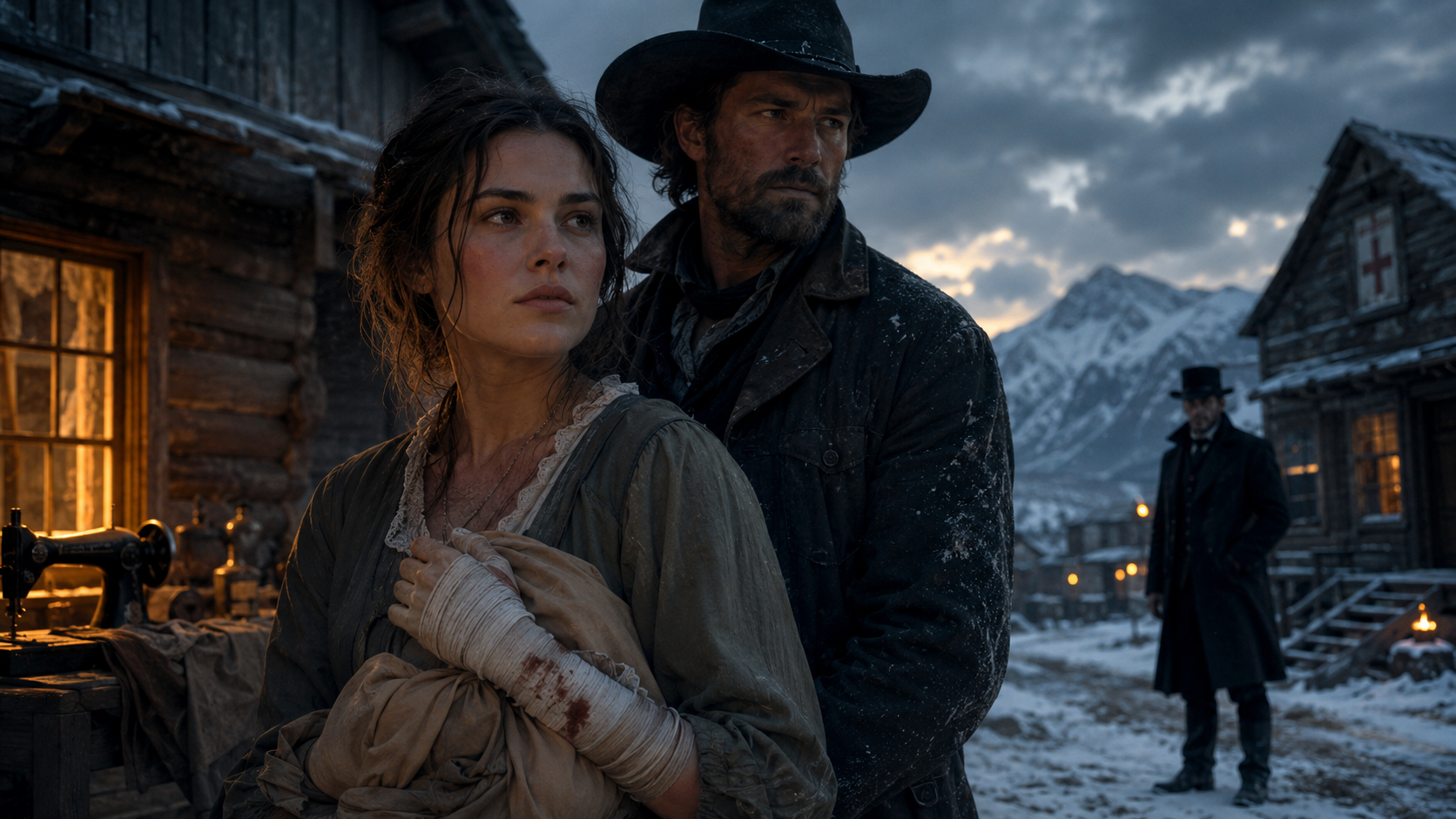
Now she climbed toward his cabin because she had nowhere else to go.
The trail punished her for every step. Snow slid under her boots. Pines scraped at her sleeves. Once, she fell hard against a rock and lay there laughing because it seemed absurd that a woman could be rejected by a whole town and still be defeated by a root.
Near dusk, when the sky had gone violet and the cold had begun to sharpen, a voice spoke from the trees.
“Stop moving.”
Mara froze.
A horse snorted somewhere to her left.
Caleb Rusk stepped out from behind a pine with his rifle lowered but ready. He was taller than she remembered, lean as a fence rail, with a brown coat dusted in snow and a face made of hard weather. His eyes went first to her hands, then to her boots, then to the trail behind her.
“No one followed you?” he asked.
Her lips were too cold for easy speech. “Would anyone?”
He did not smile.
“You bleeding?”
“Not more than usual.”
“That supposed to be funny?”
“I’m too tired to know.”
His gaze moved over her face. “You’re Mara Voss.”
“I was.”
He stepped closer. “Who told you to come up here?”
“No one.”
“Then why did you?”
She lifted her wrapped hands. “Because the town says I’m a monster.”
Caleb looked at the stained bandages, then at her face.
“Then show me the monster.”
The words should have sounded cruel. They did not. They sounded like a challenge to the lie, not to her.
Mara swayed. He caught her before she hit the snow.
When she woke, she was on a narrow bed beneath a bearskin blanket. Firelight moved across a timber ceiling. The room smelled of cedar smoke, leather, bitter herbs, and coffee. Her boots were off. Her coat hung near the stove. Her hands rested on top of the blanket, still wrapped, but someone had loosened the cloth.
Caleb sat at a table grinding dried leaves in a black stone bowl.
Mara tried to sit up.
“Don’t,” he said.
She stopped.
“You always command strangers in your house?”
“Only when they nearly die on my trail.”
“I didn’t nearly die.”
“You nearly froze. That counts.”
“I should go.”
“Where?”
The question closed around her like a trap.
Mara looked away.
Caleb set down the pestle, stood, and came to the bedside. He moved with the calm precision of a man who wasted no motion. Without asking, he pointed to the bandages.
“May I?”
Mara hesitated.
Dr. Pike had not touched her. No one had touched her in weeks.
Caleb noticed the hesitation and waited.
That made her trust him more than any kind word would have.
“Yes,” she whispered.
He unwrapped the cloth slowly. The linen stuck where dried blood had hardened. Mara clenched her jaw until her teeth hurt. Caleb did not murmur sympathy. He dipped the bandage in warm water first, worked it loose, then exposed her hands to the firelight.
They looked terrible.
The skin between her fingers was raw. Her knuckles were swollen. The cracks at her palms were deep and angry. Red patches climbed her wrists and disappeared beneath her sleeves.
Caleb studied them without disgust.
“Does the itching worsen after washing wool?”
Mara blinked.
“What?”
“Does it get worse after washing wool, dyeing cloth, handling blue powder, green salts, wet hides, strong soap, anything caustic?”
She stared at him.
“No one asked me that.”
“I am asking.”
“Yes,” she said slowly. “After dyeing. After lye soap. After damp wool. The blue dye burns worst.”
He lifted one of her hands closer to the lamp. His touch was firm and careful.
“Did Pike examine the rash?”
“He saw it.”
“That’s not what I asked.”
“No.”
“Did he take your pulse?”
“No.”
“Ask about your work?”
“No.”
“Ask what you ate?”
Mara laughed once, dryly. “People who think you are a plague do not ask what you had for supper.”
Caleb’s face hardened.
“You are not a plague.”
The room seemed to tilt.
Mara waited for more. For a softer version. For uncertainty. For the knife hidden inside mercy.
Caleb only said, “You are poisoned by your work and weakened by starvation. Your skin is inflamed, cracked, and infected in places. Painful, ugly, dangerous if left alone. But it is not a town-killing sickness.”
Mara stared at him until the fire blurred.
“That cannot be true.”
“Why?”
“Because Dr. Pike said—”
“Pike is wrong.”
The certainty in his voice frightened her worse than doubt.
“He told them not to come near me.”
“I know.”
“He told them to burn my work cloths.”
“I heard.”
“He told the church I should not sit among people.”
Caleb’s jaw tightened. “That sounds like him.”
Mara’s throat closed. “Why would he do that?”
“Because fear obeys faster than truth.”
He turned away before she could answer and began taking jars from a shelf. Some held dried roots. Some held powders. Some held oils sealed with wax.