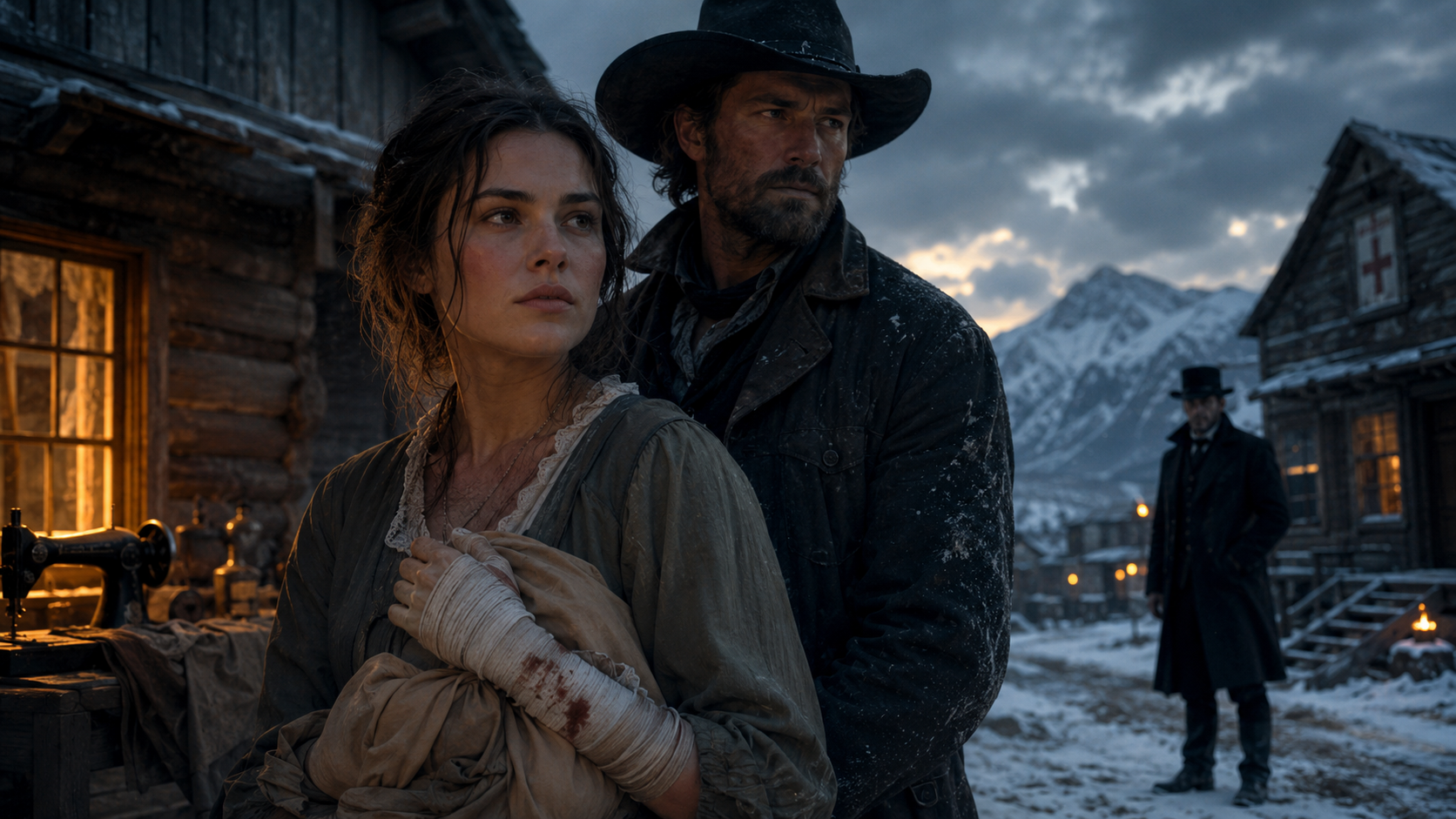
By the time Mara Voss reached the upper trail, the town of Raven Creek had already decided she was no longer a woman.
She was a warning.
That was what people became when fear grew teeth. A sick woman was not a neighbor. A coughing child was not a child. A man with blood on his hand was not injured. People did not need proof when terror gave them a shape to hate.
Mara had watched it happen slowly at first, then all at once.
Two months earlier, she had been the best stitcher in Raven Creek, the only woman in three valleys who could mend a bridal gown so cleanly the tear looked like a memory. She could dye cotton the color of river moss, turn plain wool into midnight blue, cut curtains from flour sacks, and make a widow’s old black dress fit her daughter without wasting an inch of cloth. People came to her with torn cuffs, birth gowns, Sunday coats, and secrets.
Then the rash began.
It came as heat between her fingers. Then small red blisters along her wrists. Then cracks that opened when she bent her hands. She wrapped them in linen and kept working. A seamstress who stopped using her hands might as well stop breathing.
At first, the women clucked their tongues and told her to rest. Then Mrs. Vale from the store asked if the sores were “safe.” Then children stopped coming near her porch. Then Dr. Ambrose Pike stood three steps inside her workroom, never closer, and declared the marks a wasting infection he had seen once during the war.
He had not touched her.
He had not asked what she handled.
He had not looked at the jars of dye, the mordants, the lye soap, the damp wool stacked by the stove.
He only lifted a handkerchief to his mouth and told her she must isolate for the good of the town.
After that, Raven Creek became very good at doing harm politely.
Neighbors left bread on her fence post and would not meet her eyes. Mothers pulled children across the street. The church locked the side door she used when her hands hurt too much to grip the front latch. Someone painted a black cross on her workshop door. Someone else threw stones through the window.
The worst of it was not hunger or cold or pain.
The worst was that people apologized while abandoning her.
“We’re praying for you, Mara.”
“We have families to think of.”
“Dr. Pike knows best.”
“Don’t make this harder.”
By the time snow crusted the road and her pantry was down to two onions and a heel of stale bread, Mara had begun to believe the town was right. Perhaps she had become something dangerous. Perhaps the woman she had been was already dead, and all that remained was a body too stubborn to lie down.
Then the fever came.
Not a true fever, though she did not know that then. Her skin burned from infection, from scratching, from hunger, from nights without sleep. Her hands swelled until she could not button her coat. Her mouth tasted of iron. She wrapped herself in a shawl and stumbled toward Pike’s clinic because fear had stripped away pride.
He would not let her inside.
Dr. Pike opened the clinic door only wide enough for his pale face and silver beard.
“Mara,” he said, with the sorrowful voice he used at funerals, “you should not be here.”
“I need help.”
“You need obedience.”
“My hands are splitting open.”
“You were told to remain indoors.”
“I have no food.”
“I will ask the council to arrange supplies.”
“They stopped coming.”
His eyes moved over her bandaged hands, then to the street behind her, where three people had paused to watch.
“You must go home,” he said more loudly.
“I can’t live like this.”
His expression softened in a way that made her stomach turn. “My dear, you may not live at all.”
The words should have broken her. Instead, they emptied her.
Mara turned from the clinic without another plea. She walked through the center of town while doors closed and curtains shifted. At the edge of Raven Creek, where the road split between the cemetery and the mountain trail, she chose the mountains.
People said no one lived above the north ridge except wolves, ghosts, and Caleb Rusk.
Caleb Rusk was not a ghost, though Raven Creek had done its best to make him one. He came down twice a month with mule hides, dried herbs, and the silent stare of a man who had learned that speech was usually wasted in town. He had once been a cavalry surgeon, or an outlaw, or a grave robber, depending on which porch told the story. He wore a dark hat, carried a rifle with a polished stock, and rode a chestnut horse that obeyed him better than most husbands obeyed Scripture.
Children called him the mountain cowboy.
Women pretended not to look at him.
Men looked too long and then looked away.
Mara had mended one of his coats the year before. He had paid her twice what she asked and said only, “Good work should not have to beg.”
That was the longest conversation they had ever had.
Now she climbed toward his cabin because she had nowhere else to go.
The trail punished her for every step. Snow slid under her boots. Pines scraped at her sleeves. Once, she fell hard against a rock and lay there laughing because it seemed absurd that a woman could be rejected by a whole town and still be defeated by a root.
Near dusk, when the sky had gone violet and the cold had begun to sharpen, a voice spoke from the trees.
“Stop moving.”
Mara froze.
A horse snorted somewhere to her left.
Caleb Rusk stepped out from behind a pine with his rifle lowered but ready. He was taller than she remembered, lean as a fence rail, with a brown coat dusted in snow and a face made of hard weather. His eyes went first to her hands, then to her boots, then to the trail behind her.
“No one followed you?” he asked.
Her lips were too cold for easy speech. “Would anyone?”
He did not smile.
“You bleeding?”
“Not more than usual.”
“That supposed to be funny?”
“I’m too tired to know.”
His gaze moved over her face. “You’re Mara Voss.”
“I was.”
He stepped closer. “Who told you to come up here?”
“No one.”
“Then why did you?”
She lifted her wrapped hands. “Because the town says I’m a monster.”
Caleb looked at the stained bandages, then at her face.
“Then show me the monster.”
The words should have sounded cruel. They did not. They sounded like a challenge to the lie, not to her.
Mara swayed. He caught her before she hit the snow.
When she woke, she was on a narrow bed beneath a bearskin blanket. Firelight moved across a timber ceiling. The room smelled of cedar smoke, leather, bitter herbs, and coffee. Her boots were off. Her coat hung near the stove. Her hands rested on top of the blanket, still wrapped, but someone had loosened the cloth.
Caleb sat at a table grinding dried leaves in a black stone bowl.
Mara tried to sit up.
“Don’t,” he said.
She stopped.
“You always command strangers in your house?”
“Only when they nearly die on my trail.”
“I didn’t nearly die.”
“You nearly froze. That counts.”
“I should go.”
“Where?”
The question closed around her like a trap.
Mara looked away.
Caleb set down the pestle, stood, and came to the bedside. He moved with the calm precision of a man who wasted no motion. Without asking, he pointed to the bandages.
“May I?”
Mara hesitated.
Dr. Pike had not touched her. No one had touched her in weeks.
Caleb noticed the hesitation and waited.
That made her trust him more than any kind word would have.
“Yes,” she whispered.
He unwrapped the cloth slowly. The linen stuck where dried blood had hardened. Mara clenched her jaw until her teeth hurt. Caleb did not murmur sympathy. He dipped the bandage in warm water first, worked it loose, then exposed her hands to the firelight.
They looked terrible.
The skin between her fingers was raw. Her knuckles were swollen. The cracks at her palms were deep and angry. Red patches climbed her wrists and disappeared beneath her sleeves.
Caleb studied them without disgust.
“Does the itching worsen after washing wool?”
Mara blinked.
“What?”
“Does it get worse after washing wool, dyeing cloth, handling blue powder, green salts, wet hides, strong soap, anything caustic?”
She stared at him.
“No one asked me that.”
“I am asking.”
“Yes,” she said slowly. “After dyeing. After lye soap. After damp wool. The blue dye burns worst.”
He lifted one of her hands closer to the lamp. His touch was firm and careful.
“Did Pike examine the rash?”
“He saw it.”
“That’s not what I asked.”
“No.”
“Did he take your pulse?”
“No.”
“Ask about your work?”
“No.”
“Ask what you ate?”
Mara laughed once, dryly. “People who think you are a plague do not ask what you had for supper.”
Caleb’s face hardened.
“You are not a plague.”
The room seemed to tilt.
Mara waited for more. For a softer version. For uncertainty. For the knife hidden inside mercy.
Caleb only said, “You are poisoned by your work and weakened by starvation. Your skin is inflamed, cracked, and infected in places. Painful, ugly, dangerous if left alone. But it is not a town-killing sickness.”
Mara stared at him until the fire blurred.
“That cannot be true.”
“Why?”
“Because Dr. Pike said—”
“Pike is wrong.”
The certainty in his voice frightened her worse than doubt.
“He told them not to come near me.”
“I know.”
“He told them to burn my work cloths.”
“I heard.”
“He told the church I should not sit among people.”
Caleb’s jaw tightened. “That sounds like him.”
Mara’s throat closed. “Why would he do that?”
“Because fear obeys faster than truth.”
He turned away before she could answer and began taking jars from a shelf. Some held dried roots. Some held powders. Some held oils sealed with wax.
“We clean the wounds tonight. Then salve. Then cotton wrappings, not wool. No dye, no lye, no damp cloth. Food every few hours. Broth first. You will sleep. Tomorrow we see whether fever has settled in the blood.”
Mara listened as if he were speaking from underwater.
“You can fix it?”
“I can help your body remember how to fight.”
That was not the same as hope.
But it was close enough that she began to cry.
Caleb paused with a clean cloth in his hand.
“I do not have soft words,” he said.
“I noticed.”
“This will hurt.”
“Everything hurts.”
“This pain will have a direction.”
Mara held out her ruined hands.
“Then start.”
He cleaned the wounds one by one. The wash burned so fiercely she saw white sparks at the edges of her vision. Twice she cursed him. Once she tried to pull away, and he let her, waiting until she gave her hand back by choice. He cut away dead skin, treated the deepest cracks, wrapped her fingers loosely, and made her drink broth so rich her empty stomach trembled around it.
When it was done, she lay exhausted and shaking.
Caleb sat back. “Still feel like a monster?”
Mara looked at her bandaged hands.
“I feel like a person who has been very badly lied to.”
“That is a beginning.”
In the morning, snow had sealed the world in silence.
Mara woke to the smell of coffee and onions frying in fat. Her hands throbbed, but the burning had lessened. She watched Caleb move around the cabin. He wore his hat indoors, which should have been rude, but on him seemed like part of the architecture. A revolver hung from a peg near the door. Medical books sat beside saddle oil and rope. Dried plants hung from rafters. A human skull rested on a shelf beside a jar of peppermint.
She stared at it.
Caleb followed her gaze. “Teaching skull.”
“Does it have a name?”
“No.”
“That seems impolite.”
He glanced at the skull. “Mr. Price.”
Despite herself, Mara smiled.
It hurt her face.
Caleb placed a bowl of eggs and beans in her lap.
“I cannot pay you,” she said.
“I did not ask.”
“I do not take charity.”
“This is not charity. You heal, you work.”
“With these?” She lifted her wrapped hands.
“You still have feet. You can sweep later.”
“You are a terrible nurse.”
“I was worse as a soldier.”
She looked at him more carefully. “Were you truly a surgeon?”
“For a time.”
“And then?”
“And then I became tired of men calling butchery noble.”
Mara did not ask more.
Over the next days, the cabin became a place of pain, food, and unwanted honesty.
Caleb changed the wrappings twice daily. He brewed teas bitter enough to make her threaten murder. He made her eat eggs, beans, greens from jars, venison stew, and broth with marrow. When she tried to apologize for being a burden, he ignored the apology completely. When she tried to help too soon, he took the broom from her and pointed to the chair without speaking.
At night, wind battered the shutters. Mara lay awake listening to the fire and the quiet breathing of the man sleeping on the floor because he had given her the only bed.
The thought that she might live became more frightening than dying.
Dying had been simple. It required only surrender.
Living demanded decisions.
On the sixth day, she asked, “Why does Raven Creek hate you?”
Caleb was sharpening a knife by the hearth. The stone paused once against the blade, then continued.
“They don’t hate me.”
“They speak of you as if you eat children.”
“Children are stringy.”
Mara rolled her eyes.
Caleb tested the knife edge against his thumb. “Raven Creek dislikes any man it cannot use.”
“And you cannot be used?”
“Not by Pike.”
The name changed the air.
Mara sat straighter. “You know him.”
“I know what he is.”
“A doctor?”
“A dealer in fear wearing a doctor’s coat.”
She waited.
Caleb looked toward the fire. “Years ago, a miner named Abel Creed came to me with tremors, belly pain, blue lines on his gums. Pike called it drunken madness. I said it was lead poisoning from the smelting pit. Pike laughed in public. Abel died in winter. Six more men followed.”
“Why did no one listen?”
“Because Pike owned shares in the pit.”
Mara felt cold beneath the blanket.
“And now?”
“Now the dye shop uses chemicals shipped through Pike’s brother. The store sells them. The women handle them. The doctor blames the women when their bodies object.”
Mara looked down at her hands.
“My dyes came through Pike’s store.”
“I suspected.”
“Then I was not just unlucky.”
“No.”
“Was he trying to kill me?”
Caleb’s eyes met hers.
“I do not know. But I know he preferred you silent.”
The words settled between them like ash.
Mara thought of Dr. Pike standing in her doorway, handkerchief raised. His sorrowful voice. His careful distance. His certainty. His refusal to look closely.
She thought of the questions she had asked before everything changed.
Why did the blue powder smell sharp enough to sting the nose?
Why did Mrs. Arden’s daughter faint after helping at the dye pots?
Why did the store remove labels from chemical jars?
Why did Dr. Pike say women worried too much?
Mara’s hands curled inside the bandages.
“I asked him whether the dye could be making people sick,” she said.
Caleb nodded as though a missing piece had clicked into place.
“There it is.”
“What?”
“The reason he needed you to become the disease.”
On the twelfth morning, Caleb unwrapped her hands and said nothing for so long Mara stopped breathing.
“Well?” she demanded.
He turned her palms toward the window.
New skin showed beneath old damage. Pink. Tender. Scarred. Alive.
Mara pressed her mouth shut, but a sound escaped anyway.
Caleb looked up. “Better?”
She nodded.
“Use your voice.”
“Yes,” she said. “Better.”
“Good. Do not mistake better for healed.”
“You ruin every pleasant moment.”
“Pleasant moments are where fools get careless.”
He stood and reached for his coat.
Mara’s stomach tightened. “Where are you going?”
“Town.”
“No.”
He lifted an eyebrow.
“You cannot go to Raven Creek.”
“I need clean cotton, salt, lamp oil, and flour.”
“They will ask about me.”
“They already are.”
Mara rose too fast. The room swayed. “What did you hear?”
Caleb hesitated, which told her more than words.
“Tell me.”
He took his hat from the peg. “Pike says I stole you.”
A laugh broke from her, sharp and humorless. “From what? My own grave?”
“He says you are delirious. Says if I keep you hidden, I put the whole valley at risk.”
“He knows that is a lie.”
“Yes.”
“Then why say it?”
“Because a lie shouted by a doctor sounds like medicine.”
Mara sat back down slowly.
“What will you tell them?”
Caleb opened the door. Cold light cut across the floor.
“That you are alive.”
He returned near sunset with supplies, a split lip, and blood on his collar.
Mara stood from the table so fast the chair scraped backward.
“What happened?”
“Town happened.”
“Sit down.”
“I am fine.”
“Sit down, Caleb.”
The command surprised them both.
He sat.
Mara wet a cloth and dabbed at his lip with hands still clumsy from healing. He allowed it, watching her with an expression she could not read.
“Who hit you?” she asked.
“Sheriff’s brother.”
“Why?”
“He objected to my description of Pike.”
“What description?”
“Fraud.”
Mara pressed the cloth too hard. Caleb winced.
“Good,” she said.
He almost smiled.
Then his eyes moved to the window.
“They are coming,” he said.
The first riders arrived two days later.
Mara saw them from the porch: six men moving up the trail, dark shapes between the pines. Dr. Ambrose Pike rode at the front on a gray horse, straight-backed and elegant in a black coat too fine for the mountain cold. Behind him came Sheriff Orlan Deeds, two miners, the storekeeper’s son, and Harlan Thatch, who had once brought Mara a torn shirt and stayed too long at her door.
Caleb stepped beside her with the rifle in one hand.
“Inside,” he said.
“No.”
“Mara.”
“No.”
The riders entered the clearing.
Dr. Pike smiled as if he had found a lost lamb.
“Miss Voss,” he called. “Thank heaven you are still with us.”
Mara felt the old fear rise. It knew the shape of his voice. It knew how easily a crowd could become a weapon.
Caleb stood slightly ahead of her.
Pike’s smile thinned. “Rusk. You have interfered in a medical quarantine.”
“You made a quarantine out of ignorance.”
Sheriff Deeds shifted in his saddle. “Doc says she’s contagious.”
“She isn’t,” Caleb replied.
Pike gave a gentle sigh. “You see? This is why dangerous men should not play physician. Miss Voss is confused, vulnerable, and gravely ill. I have come to return her to proper care.”
Mara stepped around Caleb.
Her legs shook.
She stepped anyway.
“I was under your care,” she said. “That was the problem.”
Pike’s eyes flicked to her bandaged hands. “My dear, you are not well enough to understand.”
“I understand perfectly.”
“Mara,” Sheriff Deeds said, not unkindly, “folks are scared.”
“So was I.”
Pike lifted his chin. “Fear is reasonable in the presence of infection.”
Mara began unwrapping one hand.
Caleb said quietly, “You do not have to.”
“Yes,” she said. “I do.”
The cloth fell away.
Cold air touched her scarred palm.
She held it up.
The men stared.
The wounds were not gone, but they were closing. The swelling had faded. Her fingers moved. Her skin, damaged but living, told the truth more plainly than any speech.
Pike’s face tightened.
Mara’s voice shook at first, then grew stronger.
“You told them I was dying. You told them I was dangerous. You told them not to touch me, feed me, hire me, pray beside me, or let me stand in the church. You said it was mercy. But you never examined me.”
“I made the safest judgment available.”
“You made the easiest one.”
One of the miners looked at Pike. “Doc?”
Pike’s eyes hardened.
“Do not be fooled by temporary improvement. Disease can retreat before it consumes. She must be isolated properly.”
Caleb raised the rifle—not to aim, but enough for everyone to remember it existed.
“No one takes her.”
Sheriff Deeds put a hand near his pistol. “Careful, Rusk.”
Caleb’s voice stayed low. “That is what I am being.”
Pike looked past him to Mara.
“You do not know what kind of man protects you.”
Mara’s answer came before fear could stop it.
“I know exactly what kind. The kind who looked.”
Silence spread through the clearing.
Harlan Thatch spat into the snow. “We riding all this way for a woman with sore hands?”
Pike snapped, “She is more dangerous than she appears.”
“No,” Mara said. “You are.”
The words struck harder than she expected.
Even Caleb looked at her.
Pike’s face changed. For the first time since she had known him, the sorrowful mask slipped, and behind it she saw something small and furious.
“This is not finished,” he said.
Mara lifted her chin.
“It is beginning.”
The riders left without her.
That night, Caleb cooked stew thick with potatoes and venison. Mara sat by the fire with her hands in her lap, still shaking from the confrontation.
“You stood well,” he said.
“I nearly vomited.”
“Standing does not require elegance.”
She looked at him. “Were you afraid?”
“Yes.”
That surprised her.
“Of them?”
“Of what they might make me do.”
The fire cracked.
Mara understood then that Caleb’s restraint was not gentleness. It was discipline built over something violent.
“Thank you,” she said.
“For not shooting anyone?”
“For seeing me.”
He stirred the stew.
“You were there to be seen.”
“Not to them.”
Caleb looked at her then, and the room seemed to grow quieter around his gaze.
“They were not looking.”
Spring came late to Raven Creek.
Snow retreated from the trails in dirty ribbons. Creek water ran high and brown. Shoots of grass appeared between stones. Mara’s hands healed slowly, leaving scars that shone silver in certain light. She learned which cloth she could touch, which soaps to avoid, how to mix salves, how to clean wounds, how to tell fever from heat, infection from irritation, fear from fact.
Caleb taught like a man throwing stones through windows.
“What are the bones of the wrist?”
“I am stirring beans.”
“Beans will forgive ignorance. Bones will not.”
“I hate you.”
“Name them.”
She named them.
He made her read medical books until her eyes ached. He quizzed her while she swept. He corrected her bandaging until she wanted to throw the whole basket at his head. He taught her how to listen to lungs, how to smell rot in a wound, how to boil instruments, how to ask questions before pretending to have answers.
At first she thought he was training her to help him.
Then she realized he was training her to return.
“I cannot go back,” she said one evening.
Caleb was mending a bridle. “You can.”
“They will not want me.”
“That is different.”
“They will call me diseased.”
“Some will.”
“They will believe Pike.”
“Some will.”
“Then why would I return?”
He looked up. “Because some will not.”
A week later, the first visitor came.
It was Mrs. Arden’s daughter, Lottie, seventeen years old and pale as candle wax. She arrived with her mother at dusk, wrapped in a shawl, trembling from more than cold.
Mrs. Arden would not step inside at first.
Caleb stood in the doorway. “Either come in or freeze politely outside. I charge extra for nonsense.”
Mara bit the inside of her cheek.
Mrs. Arden entered.
Lottie’s hands were hidden in gloves.
Mara knew before the girl removed them.
Redness. Cracks. Blisters between the fingers. Not as severe as Mara’s had been, but familiar enough to make the room narrow around her.
Mrs. Arden began crying.
“Dr. Pike said it was nerves,” she whispered. “Then he said perhaps she had caught your sickness before you left town.”
Mara looked at the girl’s hands, then at the mother’s frightened face.
“What has she been handling?”
Lottie stared at Mara.
No doctor had asked her either.
“Blue dye,” the girl said.
Mara closed her eyes.
Caleb’s voice came from behind her. “Ask the rest.”
So Mara did.
She asked about soap, wool, gloves, food, sleep, water, the workroom, the powder jars, the labels scraped clean. She cleaned Lottie’s hands herself. She showed Mrs. Arden how to boil cloth and apply salve. She wrote down instructions with stiff fingers.
When they left, Mrs. Arden paused at the door.
“Mara,” she said, voice breaking, “I am sorry.”
The apology did not repair anything.
But it did not mean nothing.
By month’s end, more women came.
A laundress with cracked arms.
A boy from the dye shed with nosebleeds.
A miner with blue gums.
A baby with a rash from blankets washed in harsh soap.
They came secretly at first, then openly. Some apologized. Some did not. Some still looked at Mara’s scars before meeting her eyes. Caleb treated the worst cases. Mara treated the ones she could. Together they wrote notes, kept jars, marked symptoms, collected scraps of dyed cloth, and saved labels from shipments that were not supposed to have labels.
The truth grew slowly.
Then it grew teeth of its own.
At the summer council meeting, Raven Creek gathered in the church hall because the courthouse roof leaked. Dr. Pike stood at the front beside the mayor, silver beard trimmed, black coat brushed, hands folded over his cane. He looked calm. He always looked calm when others were afraid.
Mara entered through the front door.
The hall quieted.
Caleb walked beside her, but not in front of her.
That mattered.
Sheriff Deeds rose. “This meeting is for town business.”
Mara held up a ledger.
“So is this.”
Pike sighed. “Miss Voss, whatever grievance you believe—”
“Not grievance,” she said. “Evidence.”
The word moved through the hall like a match flame.
She laid the ledger on the table. Beside it, Caleb placed jars, cloth scraps, shipping tags, copied invoices, and written statements from twelve workers.
Mara faced the room.
“I am not contagious. I never was. Lottie Arden was not contagious. Nor Ruth Bell, nor Samuel Price, nor the mill boy, nor the miners from the east pit. We were exposed to chemicals sold without warning, handled without protection, and dismissed by a doctor who profited from keeping the cause hidden.”
Pike’s face went still.
Mayor Fenn cleared his throat. “That is a serious accusation.”
“It is a serious crime,” Caleb said.
Pike laughed softly. “A mountain recluse and a hysterical seamstress. Is this what passes for law now?”
Mara opened the ledger.
“You signed the shipment receipts.”
Pike’s smile weakened.
“You billed the mine for treatment of symptoms you blamed on drink.”
A murmur rose.
“You advised the store to remove labels from dye jars after I complained of burns.”
The storekeeper stood abruptly. “Now wait—”
“You diagnosed me from across a room because if I was sick, no one had to ask why.”
Pike struck his cane against the floor.
“Enough.”
The sound cracked through the hall.
For a moment, everyone obeyed him.
Mara felt the old instinct too. Be quiet. Lower your eyes. Let the doctor speak. Let the men decide the shape of truth.
Then Lottie Arden stood.
“She asked me what I touched,” the girl said.
Mrs. Arden rose beside her. “Dr. Pike did not.”
Then Ruth Bell stood, sleeves rolled to show healing arms.
Then Samuel Price’s widow stood with her husband’s old work cap clenched in her hands.
Then one of the miners.
Then another.
The room changed.
Not all at once. Truth never moved as quickly as fear. But it moved.
Sheriff Deeds stepped toward Pike. “Doctor, I think you should come with me.”
Pike looked around the hall, searching for obedience and finding faces.
His gaze landed on Mara.
For one brief second, she saw hatred without disguise.
“You think this makes you clean?” he asked her. “They will always remember what they thought you were.”
Mara’s scars tightened as her hands curled.
“Yes,” she said. “And I will remember what I survived.”
Caleb moved, but she did not need him to.
Pike was taken out through the side door, the same door the church had once locked against her.
No one cheered.
That was not how healing sounded.
Healing sounded like Mrs. Arden weeping into her gloves. Like Mayor Fenn asking for the ledger in a voice gone hoarse. Like Sheriff Deeds unable to look at Mara. Like the first low, uncertain apology from the back of the hall.
Healing sounded ugly.
But it had begun.
By autumn, Raven Creek had changed just enough to prove change was possible and not enough to call itself forgiven.
The dye shed closed for inspection. The mine changed suppliers. The store put labels back on jars. The church opened both doors and pretended it always had. Dr. Pike awaited trial in the county jail, where rumor said he had developed a rash from the prison soap and complained bitterly that no one took his suffering seriously.
Mara did not laugh when she heard.
Not much.
She reopened her workshop, though it no longer looked the same. One side held cloth, thread, needles, and dresses waiting to be altered. The other held clean bandages, salves, soap, gloves, and Caleb’s spare medical books. Women came for hems and stayed to ask about burns. Men came pretending to need buttons sewn and left with instructions for infected cuts. Children came because Mara kept peppermint drops in a jar and Caleb pretended not to know.
Caleb still lived above the ridge.
He still came down twice a month.
Then once a week.
Then whenever the weather looked poor, or good, or like it might change.
One evening, as rain tapped against the workshop windows, he found Mara labeling jars.
“You spelled calendula wrong,” he said.
She did not look up. “You have terrible handwriting and no moral authority.”
He hung his hat by the door.
On her table lay a new sign she had painted herself. No fancy lettering. No gold leaf. Just plain black words on white board.
Mara Voss
Stitching, Dressmaking, Bandages, and Practical Care
Caleb studied it.
“No doctor?”
She capped the ink bottle. “No.”
“No healer?”
“No.”
“What then?”
Mara flexed her scarred hands. They ached when storms came. They would always ache. She no longer hated them for telling the truth.
“Someone who looks,” she said.
Caleb’s expression softened in the small, almost invisible way she had learned to read.
“That will do.”
Outside, Raven Creek smelled of wet earth and chimney smoke. The town had not become kind overnight. No town did. There were still whispers. Still sideways glances. Still people who preferred the comfort of old lies because truth required them to remember their own cruelty.
But children crossed the street to wave at Mara now.
Women came through her front door.
The church ladies asked her to mend the altar cloth, and she charged double.
Once, near dusk, a little boy with a scraped knee stared at the pale scars on her hands and asked, “Did a monster do that?”
Mara looked toward the mountain, where Caleb’s horse waited by the rail.
Then she looked at the boy.
“Yes,” she said. “But not the kind you think.”
The boy’s eyes widened.
“Did you kill it?”
Mara knelt, opened her care box, and cleaned the dirt from his knee.
“No,” she said. “I learned its name.”
“What was it?”
She wrapped the bandage neatly.
“Fear.”
The boy considered this with grave seriousness.
“Can fear die?”
Mara tied the bandage and smiled.
“Not all at once.”
Caleb stood in the doorway, hat low, watching the rain.
The boy ran off.
Mara packed away the clean cloths and closed the care box. Her hands hurt. Her heart did too sometimes, in places no salve could reach. But pain was no longer proof that she was cursed. Pain was only a message, and messages could be read.
At the door, Caleb offered his arm.
She looked at it, then at him.
“Are you escorting me, Mr. Rusk?”
“Road is muddy.”
“I crossed worse alone.”
“I know.”
She took his arm anyway.
Together they stepped into the rain, past the workshop window where lamplight glowed warm against the glass, past the street that had once emptied at the sight of her, past the clinic whose sign had been taken down and left leaning against a wall.
Raven Creek watched them pass.
This time, Mara did not lower her eyes.
And this time, when the mountain cowboy walked beside her, no one wondered where the monster was.
They had already seen it.
They had called it doctor.
And Mara Voss, scarred hands and all, had lived long enough to call it by its true name.

