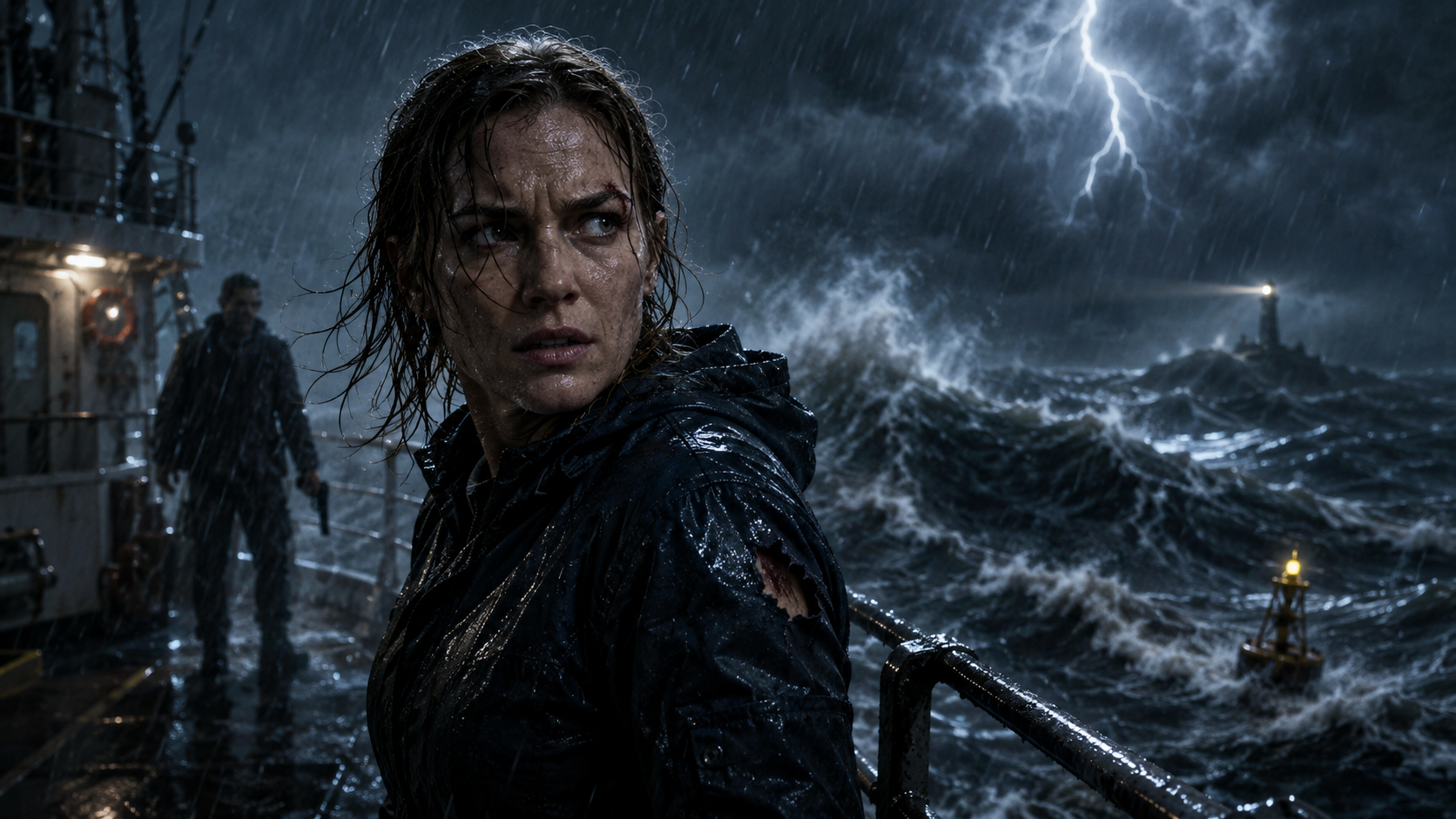
The storm arrived without warning.
At sunset, the Atlantic had been a sheet of dark silver beneath the research vessel Calypso. By midnight, the ocean had become a moving wall of black water, rising and falling around the ship as though something enormous were breathing beneath it.
Rain struck the steel deck hard enough to sting exposed skin. Wind screamed through the antennas. Every few seconds, lightning revealed the vessel suspended between mountains of foam.
Dr. Lena Marrow stood alone near the stern, one hand wrapped around the safety rail.
Her waterproof jacket was torn at the shoulder. Blood ran from a shallow cut above her eyebrow, disappearing into the rain.
Twenty feet away, Elias Crane watched her with a pistol pressed against his thigh.
Lena had once believed Elias possessed the kindest eyes she had ever seen.
She had trusted those eyes when he invited her to join Blue Meridian, the private oceanographic company he had inherited from his father. She had trusted them when he promised that their research would protect endangered marine life. She had trusted them when he asked her to marry him beneath the glass ceiling of the Lisbon Aquarium.
Now his eyes were empty.
Beside him stood Captain Owen Reddick, commander of the Calypso. His broad hands rested calmly behind his back, as if he were supervising an ordinary safety drill.
“Give me the drive,” Elias said.
His voice was nearly lost beneath the storm.
Lena tightened her grip on the railing.
“You already searched my cabin.”
“We found the copies.”
“Then you found everything.”
“We found what you wanted us to find.”
Lightning flashed behind Elias, turning him into a black silhouette.
He took another step toward her.
“You were always too careful, Lena. That was one of the things I admired about you.”
“Admired?”
Her laugh sounded unfamiliar to her.
“You mean exploited.”
Captain Reddick glanced toward the bridge.
“We need to finish this. The storm is moving faster than predicted.”
Elias did not look away from Lena.
“Where is the original recording?”
Lena could still hear it in her mind.
The low mechanical pulse captured by her hydrophones.
The distant concussion of explosives beneath the seabed.
The voices recorded inside the restricted communications room.
Coordinates.
Payments.
Names of government officials.
Orders to destroy fishing boats that approached the mining zone.
Blue Meridian had not been studying whale migration.
It had been using its research fleet to locate and extract deposits of cobalt and rare minerals from protected waters. The company’s ships had detonated charges along the ocean floor, destroying breeding grounds and poisoning entire ecosystems.
When local fishermen protested, their boats disappeared.
When environmental inspectors asked questions, reports were altered.
When Lena discovered the acoustic evidence, Elias told her the sounds came from underwater landslides.
She had wanted to believe him.
Then she heard her own research codes spoken during a secret meeting.
Her algorithms had been used to identify the richest mineral fields.
Her work had built their map.
Her name had protected their operation.
For three weeks, Lena pretended she knew nothing.
She smiled at Elias over breakfast.
She attended meetings.
She continued collecting data.
And every night, she copied files from the company servers onto a compact encrypted drive.
She had planned to leave the ship when they reached Reykjavík.
They had changed course before dawn.
By evening, there had been no land on the radar.
By midnight, Elias had come to her cabin carrying a pistol.
“The recording is already beyond your reach,” Lena said.
Elias shook his head.
“You don’t trust the authorities. You never have. You wouldn’t send it without controlling what happened next.”
“You don’t know me as well as you think.”
“I know exactly how you think.”
“No,” Lena replied. “You know the woman I allowed you to see.”
Something changed in his expression.
Not anger.
Fear.
Captain Reddick stepped forward.
“Enough.”
He grabbed Lena by the arm and pulled her away from the rail.
She twisted sharply, driving her elbow into his ribs.
Reddick grunted but did not release her.
Elias raised the pistol.
“Stop fighting.”
Lena stared at him through the rain.
“What are you going to tell people?”
“That you were swept overboard.”
“No one will believe you.”
“They’ll believe the captain. They’ll believe the crew. They’ll believe the distress report showing that you ignored safety procedures during a storm.”
“You falsified the report.”
“The report already exists.”
The meaning struck her with greater force than the wind.
This had not been improvised.
Her death had been prepared.
Reddick dragged her toward the open equipment platform at the stern. The vessel rolled violently, throwing all three of them sideways.
Beyond the rail, the sea was almost invisible.
Only white foam marked the edges of the waves.
Lena’s breathing quickened.
She had spent most of her life studying the ocean from laboratories, control rooms and reinforced observation decks. She understood pressure, temperature and current systems better than nearly anyone aboard the ship.
But knowledge did not make the water less terrifying.
The temperature was below ten degrees Celsius.
Cold shock could paralyze her breathing within seconds.
Without a flotation device, exhaustion would follow.
In waves this high, rescue would be almost impossible.
Elias approached slowly.
“I never wanted this.”
“Then lower the gun.”
“You should have ignored the files.”
“You used my work to destroy everything I was trying to protect.”
“I built an empire.”
“You built a graveyard.”
His jaw tightened.
“You always needed the world to be simple. Innocent scientists on one side. Corrupt businessmen on the other. But nothing survives without compromise.”
“Is that what you called the fishermen?”
He said nothing.
“Their families still wait for them.”
Captain Reddick forced Lena against the stern rail.
Elias’s face softened for one brief moment.
It was the face she remembered.
The man who had brought her coffee during overnight experiments.
The man who had listened to whale songs with her in the dark.
The man who had promised that they would grow old beside the sea.
Then the softness disappeared.
“Where is the original recording?”
Lena leaned closer.
“You’re listening to it.”
Elias froze.
A tiny green light blinked beneath the torn fabric of her jacket.
A transmitter.
Not a storage drive.
A live emergency beacon.
Captain Reddick tore the device from her clothing and crushed it beneath his boot.
“You have no idea whether it connected,” Lena said.
Elias looked toward the communications mast.
Reddick shouted something into his radio.
Only static answered.
For the first time that night, their control began to break.
Lena smiled.
Elias saw it.
His fear turned into fury.
“Throw her over.”
Reddick lifted her from the deck.
Lena struck at his face, but he turned away and drove his shoulder into her stomach.
The world tilted.
She felt the rail against the backs of her legs.
Then there was nothing beneath her.
For a fraction of a second, she was suspended in the rain.
The ship’s lights burned above her.
Elias stood at the rail, watching.
Then the ocean took her.
The impact was like hitting concrete.
Cold forced the air from her lungs. Salt water filled her mouth. Darkness closed around her before she could understand which direction she was falling.
She tried to breathe.
Water entered her throat.
Panic exploded through her body.
Lena kicked upward, but her boots and heavy clothing dragged her down. She tore at the zipper of her jacket. Her fingers felt distant and clumsy.
She saw a pale glow above her.
The surface.
She pulled free of the jacket and kicked again.
Her lungs burned.
The glow seemed impossibly far away.
Then her head broke through the water.
She inhaled rain and air together.
A wave struck her face before she could call out.
The Calypso was already moving away.
Its stern lights rose and vanished behind the waves.
Lena tried to scream Elias’s name.
The wind swallowed her voice.
Another wave lifted her high enough to see the vessel turning east.
No rescue boat was being launched.
No searchlight swept the water.
They were leaving her to die.
The cold began working immediately.
Her arms stiffened.
Her jaw shook uncontrollably.
She forced herself to think.
The current was moving southwest.
The storm wind was pushing surface debris in the opposite direction.
Three hours earlier, the crew had deployed a network of autonomous acoustic buoys. Each buoy carried emergency flotation equipment, a radio marker and a small maintenance compartment.
The nearest unit had entered the water less than a kilometer from the ship’s current position.
Manta Seven.
Lena had programmed its drift model herself.
She turned until the wind struck the left side of her face.
Then she began swimming.
She did not swim toward safety.
There was no visible safety.
She swam toward mathematics.
Twenty strokes.
Rest.
Breathe with the waves.
Do not fight the water.
Use the rising current.
Protect the core.
Keep moving.
Her muscles soon felt as if they were being cut open from the inside.
She lost one boot.
Then the other.
A wave twisted her beneath the surface, and for several seconds she no longer knew which way to turn.
When she emerged, the Calypso had vanished.
There was no ship.
No horizon.
No world beyond the storm.
Lena remembered Elias standing above her.
Not shouting.
Not hesitating.
Watching.
The memory became heat.
She swam harder.
Minutes became meaningless.
Her arms weakened.
Her fingers curled against her palms.
She thought of the missing fishermen.
She thought of the whales she had found floating near the restricted zone, their bodies damaged by pressure waves.
She thought of the research papers she had published using corrupted data.
Her work.
Her name.
Her silence.
A yellow light appeared between the waves.
At first, she believed it was an illusion.
Then it flashed again.
Three short pulses.
Manta Seven.
Lena tried to shout, but only a broken sound left her throat.
She changed direction and swam toward it.
The buoy disappeared every time a wave passed between them. Each time it returned, it seemed no closer.
Her right arm stopped responding.
She rolled onto her back and kicked.
The yellow light continued blinking.
Three pulses.
Darkness.
Three pulses.
Darkness.
When she finally reached the buoy, her hand slid across its wet metal shell.
She almost drifted past it.
Her fingers found a maintenance grip.
She wrapped her arm through the loop and held on as the buoy rose and fell.
The emergency compartment was secured by a manual latch.
Lena tried to open it.
Her hand would not move properly.
She struck the latch with her palm.
Nothing.
Again.
Nothing.
A wave dragged her beneath the buoy.
The grip tore skin from her wrist.
She surfaced coughing and reached for the latch a third time.
It opened.
Inside was an inflatable thermal hood, a signal flare, a compact radio and a narrow harness designed for technicians working beside the buoy.
Lena pulled the harness around her chest.
She activated the thermal hood and dragged it over her head.
The material trapped a thin layer of air around her neck and shoulders. It did not make her warm, but it slowed the cold.
She reached for the radio.
The battery indicator flashed red.
She pressed the transmission switch.
“This is Dr. Lena Marrow from the research vessel Calypso. Man overboard. Attempted murder. Repeat, attempted murder.”
Static.
She tried again.
No answer.
The radio had been damaged during deployment.
Lena closed her eyes.
The storm continued around her.
But she was no longer sinking.
That was enough.
For the next four hours, she remained attached to the buoy.
She counted flashes to stay conscious.
She recited current equations.
She named every whale species she had recorded during her career.
Whenever her eyes closed, she saw Elias at the rail.
Near dawn, the storm weakened.
The waves remained high, but the rain became lighter.
A low engine sound reached her through the water.
Lena lifted her head.
A rust-covered trawler moved slowly between the swells.
Two people stood at its bow, pointing toward the buoy.
Lena tried to raise her arm.
The world turned white.
When she woke, she was inside a narrow cabin.
A heater rattled beside the bed. Blankets covered her body. Her hands were wrapped in bandages.
An older woman sat nearby, holding a metal cup.
“You were dead when we pulled you out,” the woman said.
Lena tried to speak.
Her throat produced only a whisper.
“Not completely.”
The woman smiled.
“My name is Sora Venn. This is my boat.”
Lena turned her head toward the round cabin window.
Morning light reflected from a quieter sea.
“How long?”
“Nearly ten hours since we found you.”
“My ship?”
“We saw nothing.”
Lena attempted to sit up.
Pain moved through every muscle.
“I need a satellite phone.”
Sora’s expression became cautious.
“We heard the emergency announcement. A scientist from the Calypso disappeared during the storm.”
“What else?”
“The company says you entered the outer deck alone and were swept overboard.”
Lena closed her eyes.
They had begun building the lie before her body was cold.
Sora placed the cup beside the bed.
“Who tried to kill you?”
“My fiancé.”
The older woman studied her face.
Then she nodded as if she had heard stranger answers at sea.
“Do you want the authorities?”
“Not yet.”
“That is usually what people say before making another mistake.”
“The company has people inside the maritime authority. Possibly inside the coast guard. Elias will learn I survived before anyone can protect me.”
“What do you want, then?”
Lena looked at her bandaged hands.
“I want him to believe the storm finished his work.”
Forty-eight hours later, Blue Meridian announced Lena Marrow’s death.
The company released a statement praising her scientific achievements and describing the accident as an unbearable tragedy.
Photographs appeared across news channels.
Lena smiling beside a hydrophone array.
Lena speaking at an environmental summit.
Lena and Elias at their engagement celebration.
Elias stood before cameras wearing a black suit.
He spoke quietly.
He paused at the correct moments.
He looked like a man struggling not to collapse.
“Lena believed the ocean connected every living thing,” he told reporters. “Her work will continue through all of us.”
From the cabin of Sora’s trawler, Lena watched the broadcast.
Sora turned off the screen.
“He is very convincing.”
“He practiced convincing me for four years.”
Lena’s encrypted files had not been lost.
Before the confrontation, she had hidden the original storage capsule inside Manta Seven. The damaged radio could not transmit a voice signal, but the buoy’s scientific data channel was still functioning.
Every recording had been uploaded automatically to an independent university server.
Elias did not know that Lena had retained access to it.
For two days, she and Sora sorted through the evidence.
They found shipping manifests disguised as biological surveys.
Payments to harbor officials.
Satellite images of illegal extraction platforms.
Audio recordings of underwater detonations.
A conversation in which Captain Reddick discussed the destruction of a fishing vessel.
And one voice Lena had not expected to hear.
Professor Adrian Voss.
Her former mentor.
The founder of the acoustic research program that had launched her career.
Voss had encouraged Lena to join Blue Meridian. He had introduced her to Elias. He had personally recommended that her mapping system be installed across the company’s fleet.
Lena listened to the recording three times.
Voss’s voice remained unmistakable.
“The northern field must be cleared before the inspection team arrives,” he said.
Elias answered, “The marine life surveys will expose the blasting.”
“Then alter the survey.”
“Lena will notice.”
A pause followed.
Then Voss spoke again.
“If she notices, Crane, you know what must happen.”
Lena removed the headphones.
The cabin seemed suddenly too small.
Elias had betrayed her love.
Voss had designed it.
Sora sat across from her.
“You know this man?”
“He taught me everything.”
“No,” Sora said. “He taught you what he needed you to know.”
Lena sent fragments of the evidence to three independent journalists, an international environmental court and a prosecutor known for investigating maritime corruption.
She did not send everything.
Not yet.
At noon the following day, Elias received an anonymous audio message.
At first, there was only the sound of waves.
Then Lena’s voice emerged through the static.
“You forgot that the ocean records everything.”
Elias canceled the company memorial that afternoon.
Captain Reddick attempted to leave Iceland using a false passport.
He was arrested at the airport.
Blue Meridian’s servers were seized before midnight.
Two extraction vessels were intercepted in protected waters. Investigators discovered explosive charges, falsified research permits and biological samples labeled for destruction.
Elias remained inside his coastal estate, protected by private security.
He claimed the recordings were fabricated.
Then Lena appeared alive during an international press conference.
She wore no makeup.
The cut above her eyebrow was still visible.
For several seconds, the room remained completely silent.
“They expected the storm to erase their crime,” she said. “But sound travels farther through water than through air. Every explosion, every engine and every human voice leaves a trace.”
Behind her, technicians played the recordings.
Elias ordering the ship away from the search area.
Reddick describing the false accident report.
Voss authorizing the destruction of evidence.
The empire began collapsing before Lena finished speaking.
Elias was arrested that night.
Blue Meridian’s assets were frozen.
Officials resigned.
Families of the missing fishermen finally received confirmation of what had happened to their relatives.
For the first time since the storm, Lena allowed herself to believe it was over.
Then Sora disappeared.
The trawler was found drifting ten miles from shore.
There was blood inside the wheelhouse.
The satellite equipment had been removed.
A small waterproof speaker rested on the captain’s chair.
When Lena entered the boat, the speaker activated automatically.
Professor Voss’s voice filled the cabin.
“You were always my finest student.”
Lena stood completely still.
A second voice followed.
Sora.
Weak, but alive.
“Don’t give him anything.”
The recording ended with the sound of a blow.
Then Voss returned.
“Midnight. Saint Orin Lighthouse. Bring the master archive and come alone. If you involve the authorities, Captain Venn will disappear beneath the same water that returned you.”
Saint Orin Lighthouse stood on an abandoned island thirty kilometers from the coast.
The facility had once guided cargo vessels through a field of volcanic rock. Modern navigation systems had made it unnecessary, and the structure had been empty for more than twenty years.
Lena informed the prosecutor about the message.
But she did not give him the correct island coordinates.
Voss had trained government investigators. He had advised military research programs. She did not know how many people still answered to him.
Instead, Lena contacted the engineers who maintained the Manta buoys.
She requested three units for an unofficial recovery mission.
At eleven thirty, a small maintenance vessel approached Saint Orin Island without lights.
Lena stood alone at the bow.
A waterproof case hung from her wrist.
The lighthouse rose above the cliffs like a broken bone.
No movement was visible in its windows.
Lena left the boat and climbed the stone path.
Wind pulled at her coat.
Far below, waves struck the rocks with slow, heavy force.
The lighthouse door was open.
Inside, portable lamps illuminated the circular chamber.
Sora sat tied to a chair near the central staircase. Dried blood covered one side of her face.
Professor Adrian Voss stood beside her.
He looked exactly as Lena remembered him from the university.
Silver hair.
Straight posture.
Calm blue eyes.
He wore a dark wool coat and leather gloves.
No weapon was visible.
“You came,” he said.
Lena lifted the case.
“You asked for the archive.”
Voss smiled.
“I knew reason would eventually defeat emotion.”
“You kidnapped the wrong woman if you expected me to be reasonable.”
Sora looked toward Lena.
“Leave.”
Voss placed one hand on her shoulder.
“Captain Venn has been extremely uncooperative.”
“Let her go.”
“After I verify the archive.”
Lena stepped into the center of the chamber.
“Why did you choose me?”
“I did not choose you. I created you.”
“You taught me to study sound.”
“I taught you to find what other people could not see. Mineral fields. Submarine routes. Structural weaknesses. The whale research was an elegant source of funding.”
“People died.”
“People always die when the world changes.”
“You sent me onto that ship knowing what Elias would do.”
“I expected him to control you.”
“He tried.”
“And failed. That is why he never deserved the company.”
Lena watched Voss carefully.
“You sacrificed him.”
“Elias was useful because he believed wealth made him powerful. Men like that are easy to direct.”
“What about Reddick?”
“A tool.”
“The officials?”
“Tools.”
“And me?”
Voss’s expression softened.
“You were supposed to become my successor.”
Lena almost laughed.
“You ordered my death.”
“I ordered Elias to contain a threat. His methods were disappointingly primitive.”
“He threw me into the Atlantic.”
“And yet here you are.”
Voss stepped closer.
“The experience improved you. The woman who attended my lectures wanted to save the world. The woman standing here understands that survival belongs to those willing to control it.”
“You still think this is a lesson.”
“Everything is a lesson.”
Lena raised the case.
“Then learn this one.”
She dropped it.
The waterproof shell struck the stone floor.
Voss glanced downward.
There was no archive inside.
Only an acoustic transmitter.
Three green lights activated.
A deep pulse moved through the lighthouse.
It was too low to hear clearly, but the metal staircase began to vibrate.
Voss’s calm expression vanished.
“What did you do?”
“The lighthouse foundation extends below the waterline. It turns the entire structure into a resonance chamber.”
Another pulse passed through the floor.
Hidden locks inside Sora’s chair released.
She pulled one arm free.
Voss reached beneath his coat.
Lena moved first.
She drove her shoulder into his chest.
The pistol left his hand and slid across the floor.
Sora kicked it toward the staircase.
Voss struck Lena across the face and threw her against the wall.
He was stronger than his age suggested.
He grabbed the empty case and smashed the transmitter.
The green lights went dark.
“You still confuse intelligence with power,” he said.
Lena wiped blood from her mouth.
“No.”
She looked toward the open doorway.
“I confuse neither.”
Outside the lighthouse, three Manta buoys surfaced around the island.
Their transmitters had captured every word spoken inside the chamber.
The confession was being broadcast simultaneously through maritime emergency frequencies, university servers and the communication channels of every coast guard vessel in the region.
Voss heard approaching engines.
He turned toward the window.
Searchlights appeared beyond the cliffs.
“You lied about the coordinates,” he said.
“I lied about which authorities I contacted.”
He ran for the door.
Lena followed him into the wind.
Voss descended the cliff path toward a speedboat hidden in a narrow inlet.
Sora emerged from the lighthouse behind them, holding the pistol.
“Stop!” she shouted.
Voss reached the boat and started the engine.
The searchlights were still several kilometers away.
He pushed the throttle forward.
The speedboat launched into the channel.
For a moment, it appeared he might escape.
Then the first Manta buoy activated its emergency anchor.
A heavy cable rose from beneath the surface directly across the channel.
Voss saw it too late.
The speedboat struck the cable and turned sideways.
A wave lifted the vessel and threw it against the rocks.
Voss disappeared into the water.
Lena reached the edge of the inlet.
The sea below was black.
For one terrible moment, she was back beneath the Calypso, surrounded by cold and darkness.
Then Voss surfaced.
He clung to a section of the damaged boat.
His face showed no wisdom.
No superiority.
Only fear.
“Help me!” he shouted.
Sora stopped beside Lena.
Neither woman moved.
Another wave pulled Voss away from the rocks.
A coast guard rescue craft entered the inlet.
Its crew dragged him from the water before the current could take him.
Voss was placed in handcuffs while still coughing seawater from his lungs.
As the rescue team climbed toward the lighthouse, Sora looked at Lena.
“You knew they would save him.”
“Yes.”
“Were you certain?”
“No.”
Sora considered this.
Then she smiled.
“Good.”
Months later, the northern extraction fields were placed under international protection.
Blue Meridian was dismantled.
Elias Crane received a life sentence for attempted murder, conspiracy and the deaths of the missing fishermen.
Captain Reddick testified against dozens of officials in exchange for a reduced sentence.
Professor Adrian Voss refused every interview request.
He spent most of his trial staring at Lena.
She never looked away.
Lena returned to the university, but she did not resume her old position.
Instead, she founded an independent ocean surveillance network operated jointly by scientists, fishing communities and environmental investigators.
The first permanent listening station was installed near Saint Orin Island.
Sora attended the activation ceremony.
As evening fell, they stood together above the cliffs.
The sea appeared calm.
Lena knew better than to trust appearances.
Through the station headphones, she could hear distant whales calling across hundreds of kilometers.
Each voice traveled through the dark water.
Nothing written.
Nothing visible.
Nothing truly lost.
“Do you still hate the ocean?” Sora asked.
Lena removed the headphones.
“I never hated it.”
“It almost killed you.”
“No. People did that.”
Below them, a wave broke against the rocks.
Lena looked toward the horizon, where the last light of day rested on the water.
“The ocean kept me alive long enough to tell the truth.”
“And now?”
Lena listened as another whale answered from somewhere beyond the horizon.
“Now I make sure the truth is never silent again.”

