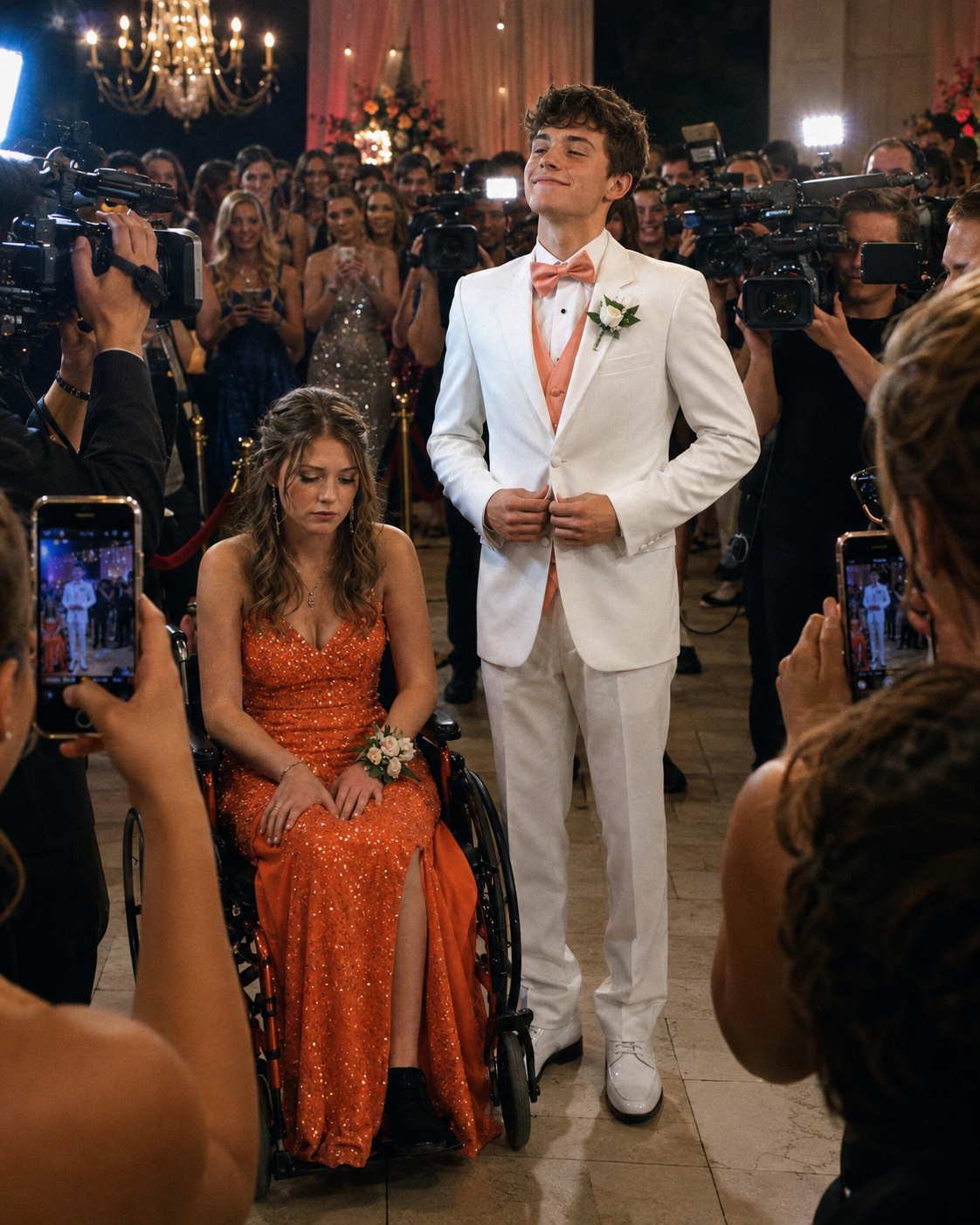
After my accident, Douglas made me feel chosen when he asked me to prom. Everyone praised him for his kindness, and I tried to believe it was real. But when the cameras stopped flashing, I overheard the truth behind his perfect smile.
The first time Douglas touched my wheelchair, everyone clapped like he’d done something brave.
That should have warned me.
But I was 17, five months out from the accident, and tired of being a sad story with wheels. So when the principal’s son smiled at me in the hallway and asked me to prom, I didn’t hear the cameras waiting behind his kindness.
I only heard myself say yes.
I was 17, five months out from the accident.
Five months earlier, I’d been carrying groceries up Mrs. Bell’s porch steps when the world tilted sideways.
One second, she was calling me “too sweet for my own good.” The next, I woke up in a hospital bed with Mom crying beside me and a doctor explaining that my spine was fractured.
Walking again wasn’t guaranteed.
By the time I came back to school, I was in a wheelchair. Nobody bullied me, which almost would’ve been easier. Instead, people stepped aside too fast, spoke too softly, and looked at the chair first.
Walking again wasn’t guaranteed.
My friend Grace was the only one who still acted normal.
Almost.
“They’re staring again,” Grace muttered after third period.
“Ignore them.”
“I can’t. You don’t have to smile just because they’re uncomfortable.”
“If I don’t smile, they look scared.”
“Let them be scared,” she said. “You’re not a ghost.”
“They’re staring again.”
I laughed, but it came out thin. “Sometimes I feel like one.”
Before she could answer, the hallway shifted. People stopped talking over each other. A girl near the lockers whispered, “Oh my gosh.”
Douglas was walking toward us.
He was our principal’s son, with perfect hair, perfect grades, and the kind of smile adults mistook for character.
When he stopped in front of me, I thought I was blocking his way.
Douglas was walking toward us.
“Willa,” he said.
“Douglas,” I said. “Am I in trouble, or are you lost?”
He laughed. Not fake. That was the first thing that got me.
“Neither,” Douglas said. “I wanted to ask you something.”
Grace shifted beside me, her sneaker brushing my wheel.
Douglas noticed, smiled, then lowered himself until we were eye level.
“Am I in trouble, or are you lost?”
“Would you go to prom with me?”
For a second, I thought I’d misheard him.
“With you?”
“Yeah,” he said. “With me.”
People were watching. Someone near the lockers had a phone out.
“Are you serious?”
“Would you go to prom with me?”
“I wouldn’t joke about this,” he said. “I think we’d have a really good time.”
I wanted to be careful. But mostly, I wanted to feel like a girl again.
Not a patient, not an accident. Just chosen.
So I said yes.
Douglas smiled. “Great. I’ll text you tonight.”
After he walked away, I turned to Grace. “Did that really happen?”
Her mouth was tight. “It felt rehearsed.”
“I think we’d have a really good time.”
“Grace.”
I looked down at my lap. “Can you let me have one nice thing?”
That night, Douglas texted me.
At first, it was normal. Dress color. Pickup time.
Then came the strange questions.
Douglas: “What’s been the hardest part since the accident?”
Me: “People pretending not to stare.”
“Can you let me have one nice thing?”
Douglas: “That’s powerful.”
Not “I’m sorry.” Not “That sounds hard.”
Powerful.
Still, loneliness makes you answer people who seem to care.
Me: “I miss feeling normal. I’m tired of looking like an apology.”
Douglas: “What would make you feel included again?”
“Loneliness makes you answer people.”
The next day at lunch, Grace leaned over my phone.
“What did he ask this time?”
I showed her.
She exhaled. “Willa, he’s interviewing you.”
“He’s trying to understand.”
“I saw him with a freshman on crutches,” she said. “Noah was filming.”
“Noah films everything.”
“Willa, he’s interviewing you.”
“He kept turning toward the camera.”
I pushed my tray away. “Grace, please. I just want prom to be good.”
She studied me, then nodded. “Then I hope I’m wrong.”
Three days later, Mom took me dress shopping. Grace came too because Mom needed emotional support, and I needed someone honest.
Mom held up a navy dress.
Grace wrinkled her nose. “That one says assistant principal at a winter fundraiser.”
“I hope I’m wrong.”
Then I saw the green dress near the end of the rack.
It was bright without being too much.
Mom touched the sleeve. “It’s bold.”
“Good,” I said. “I’m tired of looking like an apology.”
Grace cleared her throat. “Then green wins.”
“It’s bold.”
On prom night, Douglas showed up in a black suit and a green tie that matched my dress. He held a corsage and smiled like he’d practiced that too.