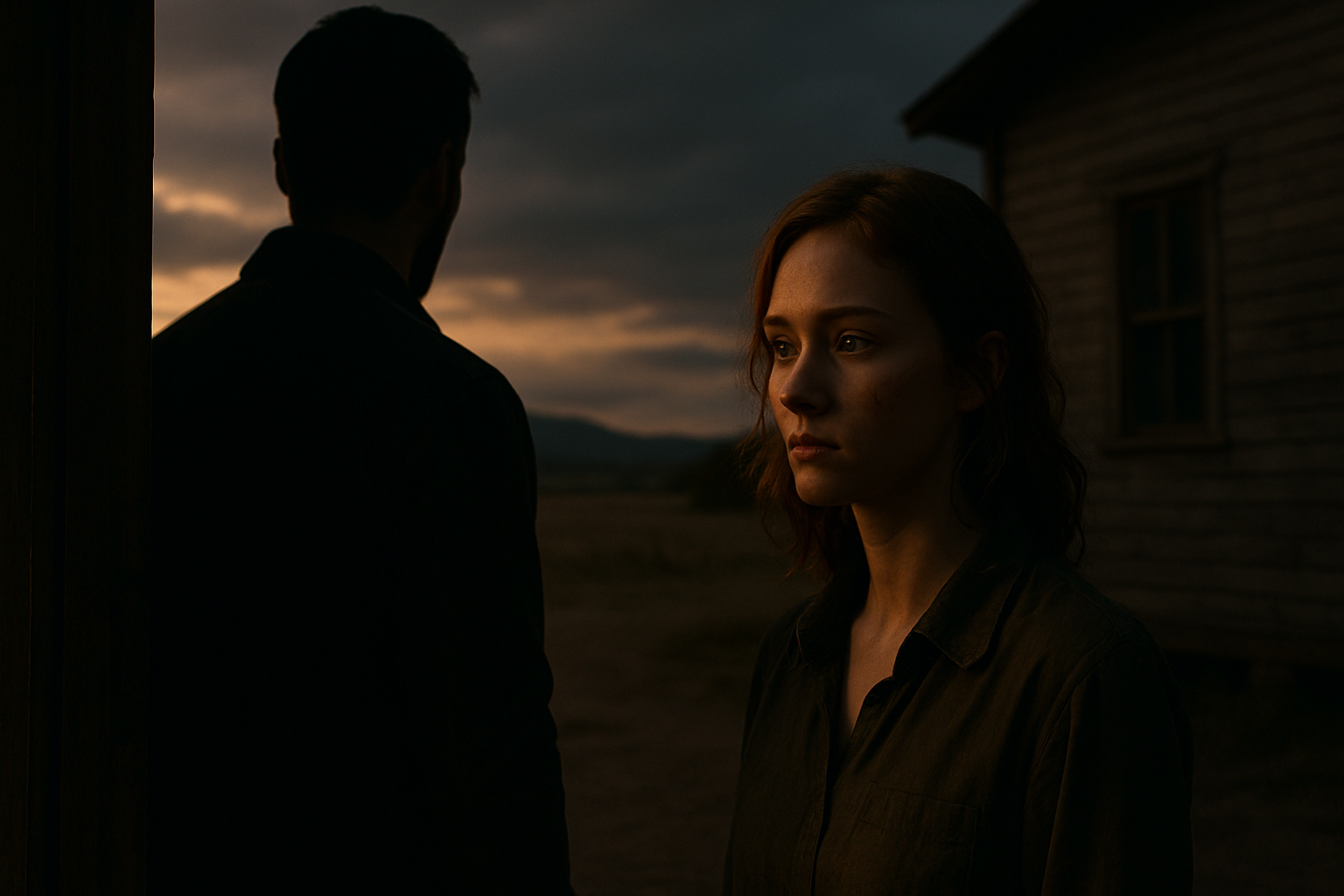
“Eli.”
The man looked back.
Wyatt reached into his pocket and closed his fingers around the broken half-moon buckle. He did not pull it out. Not yet. Some evidence was better kept until the right man was cornered by it.
“Tell him I remember.”
Eli’s face lost color.
Sheriff Pike saw it.
That mattered.
Maybe not enough, but enough to plant a seed.
When the men rode off, the night closed around the house again, deeper than before.
Wyatt stood in the yard until the hoofbeats faded.
Willa remained on the porch beside him, arms wrapped around herself. June had gone back in, but her shadow lingered in the window, unmoving.
“You claimed us,” Willa said.
Wyatt did not look at her. “Should’ve asked first.”
“Yes.”
“I’m sorry.”
The wind moved over the dry grass. Somewhere in the dark, a coyote called.
Willa breathed out slowly. “I didn’t hate it.”
Wyatt’s throat tightened.
He nodded because he could not trust words.
After a while, Willa said, “Mama said your eyes were kind before the fire.”
Wyatt huffed once. “Fire didn’t change my eyes.”
“No,” she said. “But pain can teach a man to look away.”
He turned then.
She was watching the darkness beyond the barn, not him. Her profile in the lamplight was Caroline and not Caroline. Softer in some places, harder in others. A life made without him, standing beside him anyway.
“I looked away from a lot,” Wyatt said.
“Don’t anymore.”
It was not a plea.
It was a condition.
Then she went inside.
That night, no one slept easily.
June took the bed because Willa insisted and Wyatt backed her before June could protest herself into martyrdom. Willa slept on the settee under both quilts, one hand tucked beneath her cheek like a child’s. Wyatt laid his bedroll by the stove again, boots on, shotgun within reach.
The fire burned low.
The house breathed.
Sometime past midnight, Wyatt woke to June crying.
Not loudly. She was trying to swallow each sob before it became sound. That made it worse.
He sat up.
Across the room, Willa stirred, but Wyatt lifted a hand in the dark. Let me.
He rose and went to the doorway of the little bedroom.
June sat on the edge of the bed, Caroline’s letter open in her lap, shoulders shaking.
Wyatt knocked softly on the frame.
She wiped her face with both hands. “I’m sorry. Did I wake you?”
“Yes.”
“Oh.”
“But I was tired of sleeping.”
That earned the smallest broken laugh.
He stayed in the doorway. “May I come in?”
June looked surprised by the question. Then she nodded.
Wyatt sat in the chair near the bed. It was Caroline’s old chair, though he had not known it when he bought it years ago at an estate sale in town. Maybe everything circled back if a man lived long enough.
June folded the letter carefully. “I keep thinking if I read it enough, it’ll feel real.”
“Does it?”
“No.” She touched the paper’s edge. “Mama being gone feels real. Everything else feels like something happening to people in a story.”
Wyatt understood that too well.
“I used to make up what you looked like,” June said.
His hands tightened on his knees.
“When I was little. Willa said it was foolish, but she did too. We’d see a man at church or in town and wonder. Maybe him. Maybe that one. I gave you a black beard once.” She glanced at his scarred jaw, embarrassed. “And a horse.”
“I had a horse.”
“Really?”
“Meanest mare in three counties.”
June smiled through tears. “Mama said you hated carrots but liked apple pie.”
“She remembered wrong. I like carrots fine.”
“She said you sang when you worked.”
Wyatt looked toward the dark window. “Not anymore.”
“Why?”
“People stopped listening kindly.”
June’s smile faded.
He regretted the answer. It was too sharp, too naked.
But June did not retreat from it. She looked down at her hands, twisting in her lap. “People weren’t always kind to Mama either.”
“I know.”
“She got tired near the end. Not just sick tired. Soul tired.” June swallowed. “She kept apologizing when she thought we were asleep.”
Wyatt closed his eyes.
“I was angry with her,” June whispered. “Then she died and the anger had nowhere to go.”
“It can sit here awhile,” Wyatt said.
She looked up.
He tapped his chest once. “I’ve got room.”
June cried harder then, silently, her face crumpling in a way that made her look very young.
Wyatt did not know what a father would do. He only knew what a decent man might. He held out one hand, palm up, giving her the choice.
After a long moment, June placed her hand in his.
Her fingers were cold.
He folded his scarred hand gently around them and sat there until her crying eased, until the fire in the stove settled, until the house no longer felt like three strangers hiding from the same storm but something more fragile and dangerous.
A beginning.
Morning came gray and hard.
So did Deke Barlow.
He arrived after breakfast with six riders behind him, all mounted, all armed, all wearing the dead-eyed confidence of men paid to let another man’s conscience rot in their place.
Wyatt saw them from the barn, where he had been pitching hay.
Willa stood near the pump with a bucket in hand.