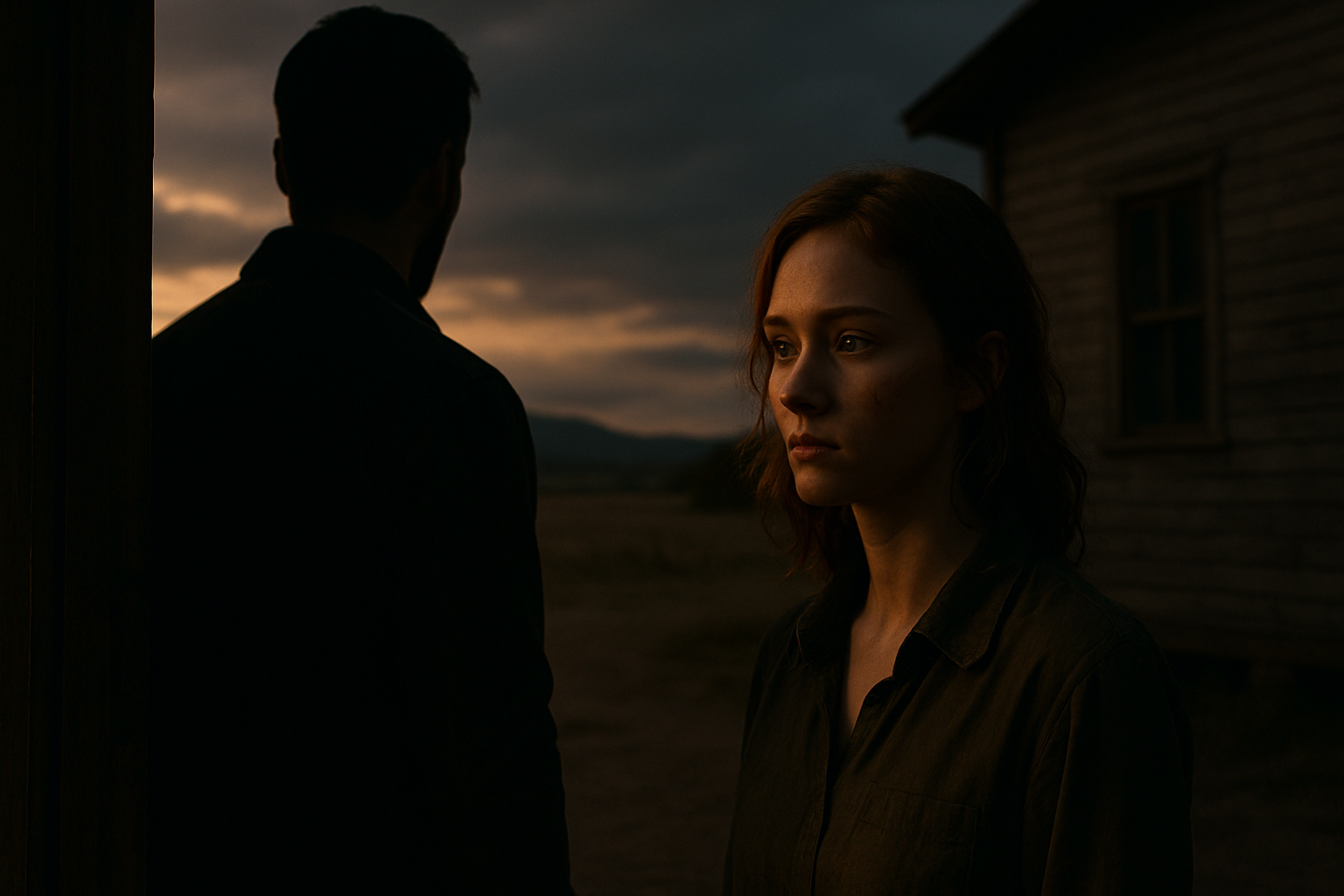
Willa looked from Deke to Wyatt.
June drew back inside the truck, one hand pressed to her belly.
Wyatt turned.
“Deke.”
“Been a while.” Deke’s eyes slid over the truck, the supplies, then the two women. They stopped on Willa a fraction too long. Something changed behind them. Recognition, maybe. Calculation, certainly. “I heard you’d brought strays into town.”
Willa went pale, then red.
Wyatt’s voice dropped. “Careful.”
Deke laughed. “Still touchy. Twenty-two years and you still can’t take a little conversation.”
“Wasn’t aware we were conversing.”
“Oh, I think we ought to.” Deke stepped down from the boardwalk. “Seems Mercy Ridge has questions. Folks see you coming in with two women nobody knows, buying half of Harlan’s store, acting like some wounded patriarch. Makes a man wonder.”
Wyatt did not move, but the world inside him tilted.
Wounded patriarch.
Deke knew enough to aim.
“Wondering is free,” Wyatt said. “Speaking can get costly.”
The smile thinned on Deke’s mouth.
His gaze shifted to Willa again. “You Caroline’s?”
Willa did not answer.
June made a small sound.
The entire street seemed to draw one breath and hold it.
Wyatt felt the old scar under his ribs burn hot beneath his shirt.
Deke’s smile returned, slower this time. “Well now.”
Wyatt stepped between him and the truck.
“Get out of our way.”
“Our.” Deke tasted the word. “That’s new.”
Wyatt came close enough to see the thin red veins in Deke’s eyes. “Move.”
For a second, Deke looked like the younger man from Wyatt’s nightmares, the one he could not quite remember until Caroline’s letter had given him shape. The one with smoke behind him. The one with a belt buckle curved like a half moon. The one who had stood between Wyatt and the barn while Thomas Vale burned.
Then Deke tipped his hat.
“Enjoy your homecoming, ladies,” he said. “Mercy Ridge has a long memory.”
Wyatt did not trust himself to answer.
He climbed into the truck, closed the door, and started the engine with hands that wanted to shake and refused.
No one spoke until Main Street fell behind them and the town shrank in the rear window.
Then Willa said, “That was him.”
Wyatt watched the road. “Yes.”
“The man Mama wrote about.”
“Yes.”
“He knew her.”
“Yes.”
Willa’s breathing changed. “He knew us.”
Wyatt tightened his grip on the wheel.
June’s voice was small. “Did he really start the fire?”
Wyatt saw flames in his mind. Heard wood bursting. Heard Thomas shouting his name. Heard his own breath tearing raw through smoke. For years the memory had ended in failure. Now there was a shape inside it that did not belong to smoke or guilt.
“I aim to find out,” he said.
Willa turned from the window. “How?”
Wyatt touched the pocket where the brass key rested like a live coal. “We start in the barn.”
The north beam had not changed much in twenty-two years.
The barn itself had aged around it. Boards had warped. Hinges had rusted. Swallows had nested and left. Hay dust lay golden in the thin winter light, and the air smelled of old animals, weathered wood, and the dry sweetness of stored grass. But the north beam still stood thick and dark, scarred by time, holding the roof the way stubborn men held grief: without grace, without complaint.
Wyatt carried a lantern. Willa carried a crowbar from the tool wall. June followed with Caroline’s letters folded in both hands as if they might run away if she loosened her grip.
“Loose stone,” Willa said, scanning the wall. “Under the north beam.”
“There.” Wyatt crouched.
At the base of the wall, half hidden by a broken feed sack, one foundation stone sat different from the others. Its edge had a notch worn into it. Not by weather. By fingers.
Wyatt brushed away dirt.
His hand trembled then.
He hated that both women saw it.
Willa knelt beside him without speaking and set the crowbar down.
Together they worked the stone free.
Behind it was a hollow lined in oilcloth. Inside sat a small iron lockbox, black with age, its corners rusted but intact.
June whispered, “Thomas put it there?”
Wyatt lifted it out. It was heavier than it looked.
“Caroline said he did.”
“Why would he hide it in your barn?” Willa asked.
Because Thomas trusted me, Wyatt thought.
The answer hurt so badly he almost could not breathe.
He set the box on an overturned crate and took out the brass key. It fit the lock with a tiny metallic certainty.
For a moment, no one moved.
Then Wyatt turned it.
The lock opened.
Inside were papers, tied in bundles with string. Deeds. Maps. Receipts. A water claim filed under Thomas Vale’s name and Caroline Ward’s as witness. A second document transferring partial interest to Wyatt Calder, signed three days before the fire.
Willa read over his shoulder.
“What does it mean?” June asked.
“It means Thomas bought land that needed water to matter,” Willa said slowly, her eyes moving across the lines. “And the water rights made it valuable.”
Wyatt lifted another paper.
There was a survey map, the ink faded but legible. A creek line crossed the north range, then dipped toward land now fenced under the Barlow name.