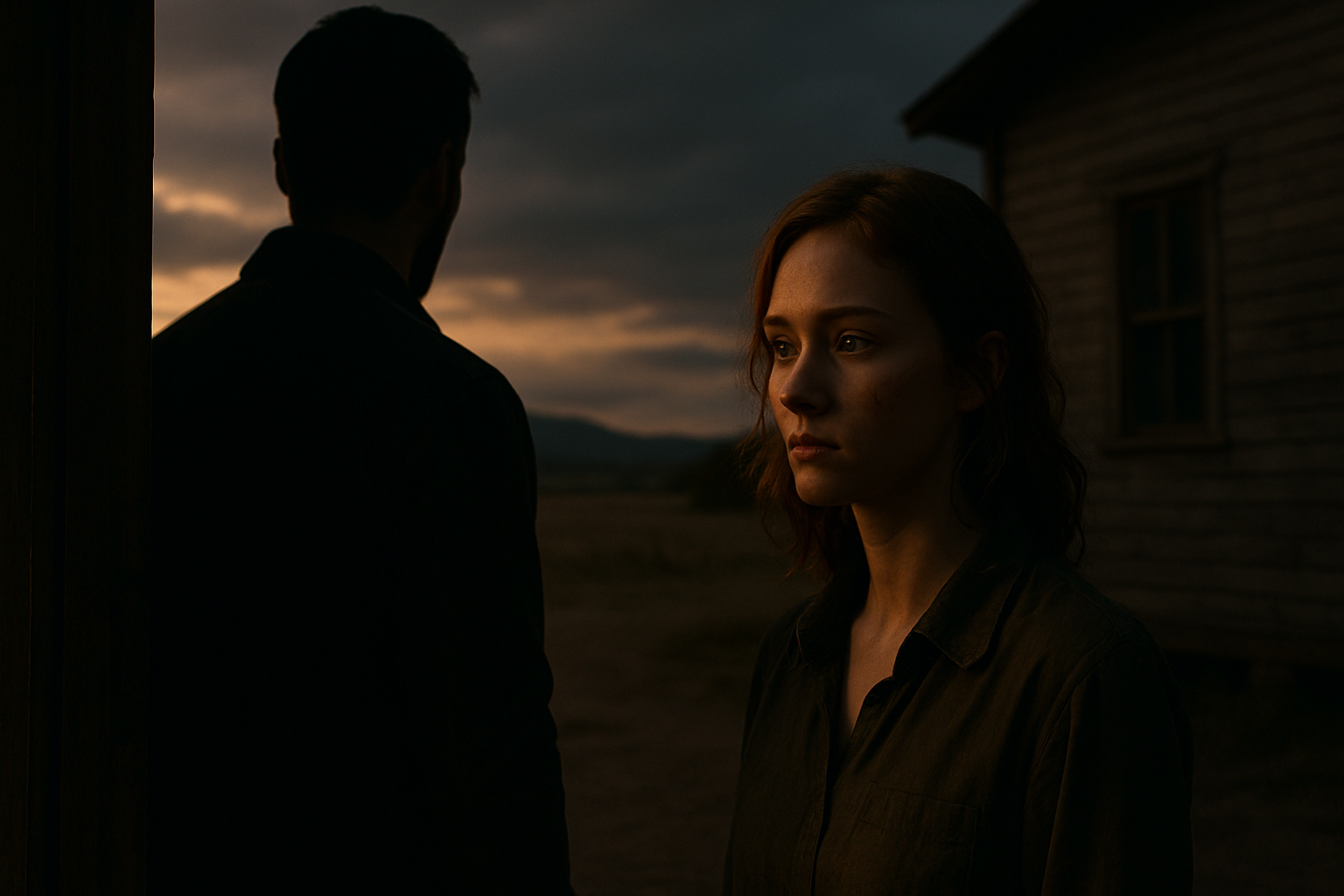
Not because love had died in him, exactly, but because the part of him that might have offered itself freely had been buried with Seraphine and did not wish to be disturbed. He raised Liora instead. Poorly at times. Tenderly at others. Honestly, when he could bear it, and even when he could not.
When Liora was seven, she asked why people left yellow roses at her mother’s grave.
Cassian told her.
When she was nine, she asked why Grandmother Isolde never visited.
Cassian told her.
When she was twelve, sharp-eyed and fierce, she asked about the scar.
Cassian took her to the cemetery with Seraphine’s letter, sat beside her beneath the yew trees, and told her everything.
Liora did not cry at first.
She listened with her hands folded in her lap, her face pale and still.
Then she stood, walked to the grave, and placed her palm flat against the carved name.
“I won’t inherit it,” she said.
Cassian’s throat tightened.
“No,” he said. “You won’t.”
But Liora looked back at him, and in her gray eyes he saw not Seraphine’s sorrow, but her fire.
“No one should,” she said.
By sixteen, Liora was working in the west wing beside Dahlia, teaching letters to children who arrived afraid to speak their own names. By twenty, she argued law before magistrates who had once bounced her on their knees at banquets. By twenty-five, she had turned the House of Seraphine into three houses, then five, each one beyond the reach of men who thought charity should be obedient.
Cassian lived long enough to see it.
Long enough to see his daughter become the answer to the letter Seraphine had left behind.
Long enough to understand that forgiveness was not a door Seraphine owed him from the other side of death. It was something he had to build in the world without demanding she return to admire it.
On the last autumn of his life, when his hair had gone white and his hands shook too much to fasten his own cuffs, Cassian asked Liora to take him to the cemetery.
She knew which day it was.
She brought yellow roses.
The grave was older now, softened by moss at the base, the angel’s cracked wing silvered by weather. Seraphine’s name remained clear. Beloved Mother. Beloved Truth.
Cassian lowered himself with difficulty onto the bench Liora had installed years before.
For a while, father and daughter sat in companionable silence.
Then Cassian drew something from his pocket.
A small ring.
Not the Veyr signet. That had been melted down decades earlier and made into hinges for the front door of the House of Seraphine, so that every opening and closing would put the old power to better use.
This was Seraphine’s wedding ring.
Plain gold, worn thin.
Cassian had kept it all those years, not on a chain, not displayed, not as a claim. Wrapped in cloth. Hidden in the drawer beside her letters.
“I think,” he said slowly, “she should have this back.”
Liora watched him place the ring at the foot of the stone.
The wind stirred the roses.
“She never stopped being your wife,” Liora said softly.
Cassian looked at the grave.
“No,” he said. “But I stopped being worthy of being her husband.”
Liora’s eyes filled, but she did not deny it. He loved her more for that.
Instead, she took his hand.
“And still,” she said, “you became my father.”
Cassian closed his eyes.
There it was.
Not absolution.
Something humbler.
Something he could carry.
When he died three months later, they did not bury him beside Seraphine.
He had requested that.
Some people whispered it was strange. Romantic stories wanted the husband and wife reunited under one stone, wanted death to tidy what life had shattered.
Liora knew better.
She buried him beneath the old cedar at the edge of the cemetery, close enough that the yellow roses on Seraphine’s grave could be seen in summer, far enough that her mother’s resting place remained wholly her own.
On Cassian’s stone, Liora chose the inscription herself.
CASSIAN V EYR
HE LEARNED TOO LATE.
HE TOLD THE TRUTH AFTER.
And beneath that, in smaller letters:
MAY THAT STILL MATTER.
Every year, on the first bright morning after the winter rains, children from the House of Seraphine walked up the hill carrying yellow roses.
They laid them on her grave not because she had been perfect, nor because suffering had made her sacred, but because she had refused to let cruelty have the final word.
The scar went with her into the earth.
But the truth did not.
It rose.
It rooted.
It bloomed.
And long after the Veyr name lost its power to frighten anyone, people in the valley still spoke of Seraphine—not in whispers, not with pity, and not as a ruined woman who had died beneath the weight of a family’s lies.
They spoke her name in doorways where frightened women were welcomed.
In courtrooms where forged papers were challenged.
In nurseries where daughters were taught that love must never require their silence.
And in the cemetery beyond the yew trees, where yellow roses returned every spring, bright as little flames against the stone.