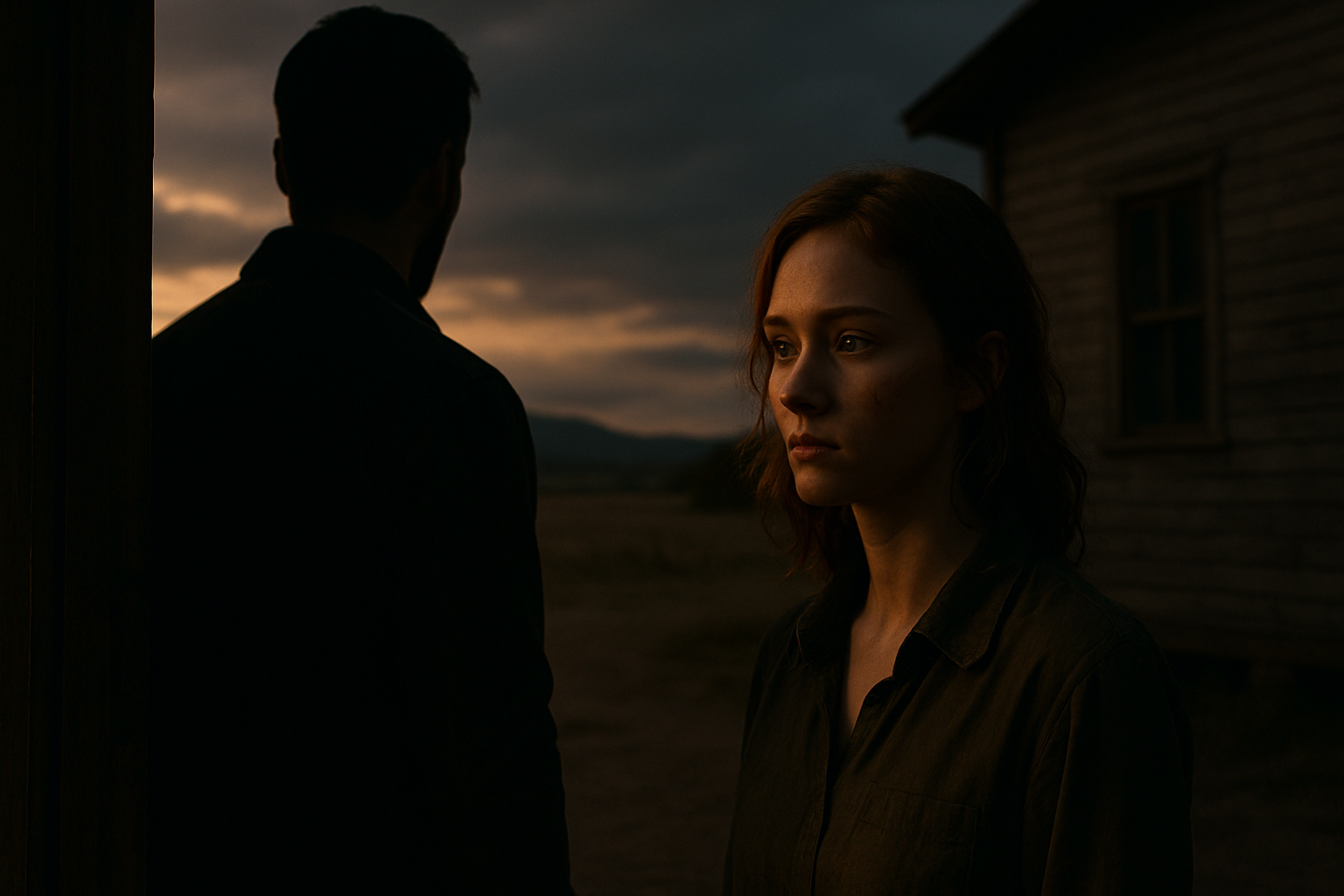
Wyatt unfolded deed records, survey maps, receipts, letters with signatures cramped by haste. Willa stood over his shoulder, reading fast. June sat with the blue baby blanket in her lap, one hand resting on it as if it might disappear if she did not keep watch.
Thomas Vale had discovered what no poor man was ever meant to prove.
Before Deke wore a badge, before he became the county’s law and the county’s threat in one body, he had been working with a cattle company to forge claims on small ranches with water access. Parcels had been misrecorded. Boundary lines shifted. Taxes “lost” in transit. Deeds copied incorrectly and filed under names that belonged to no one living.
It was not theft done with a gun.
It was theft done with ink.
Cleaner. Safer. Easier to deny.
The adjoining parcel north of Wyatt’s ranch held a spring that fed three seasonal creeks. In dry years, that spring was the difference between holding cattle and selling them off rib by rib. Thomas had bought the land quietly, intending to sell half to Wyatt and Caroline after their wedding. The deed had been recorded properly.
Then Thomas had noticed the maps changing.
A creek moved on paper.
A boundary line bent.
A legal description altered by two words.
Two words, and a man’s land became vulnerable.
Thomas had started copying everything. Dates. Names. Payments. Initials in margins. He had written down conversations, described meetings, listed cattle company men and county clerks and one name that appeared again and again like rot blooming through a wall.
Deke Barlow.
The night of the fire, Thomas had planned to ride to Billings with the evidence.
He never made it.
The fire took him first.
Or men did, and the fire finished the lie.
Deke became sheriff two years later.
The cattle company dissolved, then reappeared under another name: Barlow Land & Feed, operated by a cousin who had never had the brains to build anything but had always possessed a talent for standing where money fell.
And Wyatt Calder became the town’s favorite cautionary tale.
The coward who lived.
The man who crawled out while another burned.
The drunk with scars.
The fiancé who survived his bride’s grief and then vanished into bitterness.
The story had been useful.
A ruined man made a poor witness.
By midnight, the rain came in earnest.
At first it tapped gently on the roof, a scattering of fingers. Then it hardened into a steady drumming that filled the silences between them. Water rushed from the eaves and beat the packed earth outside into mud. The kitchen windows reflected the lamplight and the three figures around the table: Wyatt with the documents spread before him; Willa standing until exhaustion forced her into a chair; June across from him with red eyes and Caroline’s blanket folded now beside the peppermint tin.
Wyatt should have felt vindicated.
He had imagined, in some bitter corner of himself, that truth would arrive like lightning. Bright. Cleansing. Final.
It did not.
It came like rain on ashes.
It darkened everything it touched.
Twenty-two years did not come back because the truth finally found a voice. Caroline did not come back. Thomas did not come back. The wedding that never happened did not bloom again in reverse. The babies born in secrecy did not become newborns in his arms. He did not hear their first cries. He did not watch Willa take her first step, stubborn even then. He did not hear June speak her first word. He did not sit in school auditoriums, embarrassed and proud. He did not stand over fever beds. He did not build doll cradles or teach them to ride or scare off boys or mend their hearts when the world first broke them.
Birthdays had passed.
Nightmares had passed.
Years had passed.
All of them without him.
“I don’t expect you to forgive me,” Wyatt said.
His voice sounded strange in the rain-heavy kitchen.
Willa looked up sharply. “For what?”
“For not finding you.”
June’s face crumpled as if he had reached across the table and touched a bruise.
Willa’s eyes flashed. “You didn’t know.”
“I should have.”
“That’s not fair.”
“No,” Wyatt said. “It isn’t.” He looked down at his scarred hands, at the dirt in the cracks of his knuckles, at the life he had spent surviving instead of living. “Most true things aren’t.”
Willa pushed back from the table so hard the chair legs scraped the floor.
“I spent my whole life being angry at a blank space,” she said.
Wyatt did not move.
He let her stand over him with all of it.
“Do you understand that?” she demanded. “Other girls had fathers who embarrassed them at school dances or yelled too loud at softball games. Fathers who sat in trucks outside movie theaters. Fathers who forgot birthdays, or remembered them wrong, or bought ugly flowers because they didn’t know what else to do.”
Her voice shook harder with every word.
“We had a story. That’s all. Mama said you were good. Aunt Ruth said good men didn’t vanish. Kids at school said we were bastard cows.” Her mouth twisted around the words as if they still tasted foul. “Teachers heard it and said nothing. Men looked at us like our bodies were permission to be cruel. Women looked at Mama like grief was something shameful she’d gotten on her dress.”