“Only once?”
She smiled.
Silas reached into his jacket and removed a black jewelry case.
Evelyn’s smile disappeared.
“Do not kneel.”
“I had not planned to.”
“Good.”
“I dislike predictable staging.”
He opened the case.
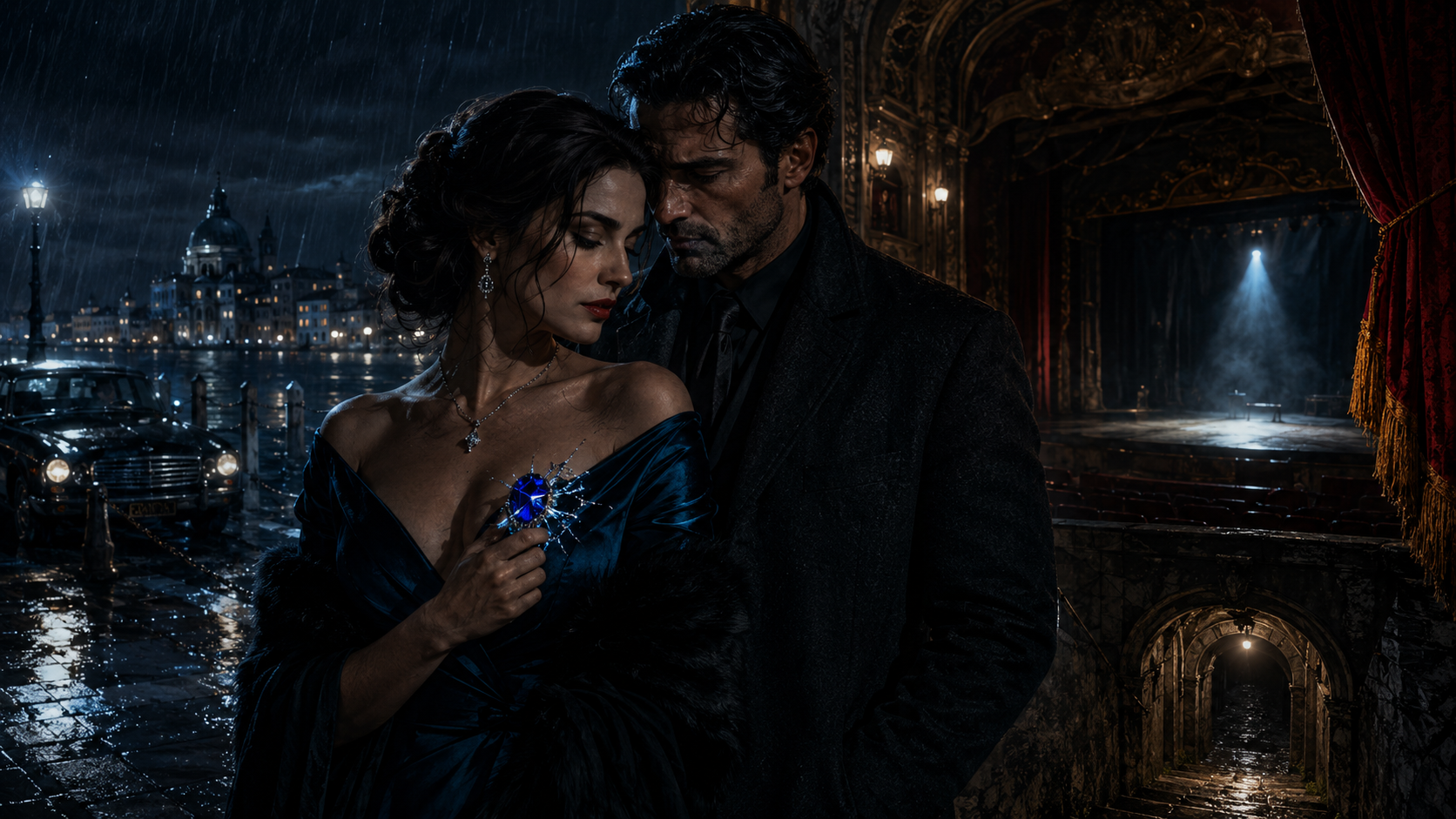
Her grandmother’s sapphire lay inside, restored but not altered. The pale fracture still crossed the blue stone.
Evelyn touched it.
“You kept it all this time.”
“I bought it legally.”
“At a moment when I had no alternative.”
“Yes.”
“So it was not an ethical purchase.”
“No.”
“You are agreeing too quickly.”
“I have attended several courses.”
“Court-ordered?”
“Some.”
She laughed.
Silas removed the brooch from the case.
“I want to return it.”
Evelyn did not take it.
“As a gift?”
“As property that should never have left you.”
“You paid for it.”
“You paid more.”
“How?”
“You showed me the difference between protecting a person and controlling her.”
“That lesson was expensive.”
“Most useful lessons are.”
He held the brooch out.
Evelyn closed his fingers around it instead.
“Keep it until opening night.”
His gaze searched hers.
“Why?”
“Because I need something from you.”
“What?”
“Come to Florence.”
“With you?”
“With the theater company. We are presenting the restoration project.”
“I know.”
“You could help negotiate the international tour.”
“I could.”
“You understand ports, contracts, insurance, difficult officials, and frightening wealthy people.”
“I am one of the frightening wealthy people.”
“Less wealthy now.”
“That was unnecessarily cruel.”
“You survived.”
He placed the sapphire back in its case.
“Is this a professional invitation?”
“Partly.”
“And the other part?”
Evelyn looked toward the stage where work lights illuminated a half-built set.
For months, Silas had waited.
He had not demanded forgiveness.
He had not asked her to forget Daniel, excuse the past, or ignore the violence that had shaped him. He simply appeared when invited, left when asked, and told the truth even when truth made him look worse.
Trust had not returned like lightning.
It had accumulated quietly.
A repaired window.
A disclosed account.
A question asked instead of an order given.
A hand offered and not imposed.
“The other part,” Evelyn said, “is that I am tired of nearly.”
Silas went still.
She stepped closer.
“I nearly left Greyhaven with you. You nearly told me the truth. We nearly spent our lives believing the worst versions of each other.”
“What are you proposing?”
“For once, Silas, do not turn everything into a contract.”
“I find contracts reassuring.”
“I know.”
She placed one hand against his chest.
His heart beat fast beneath her palm.
The most feared man in Greyhaven was afraid to move.
Evelyn rose onto her toes and kissed him.
For a moment, he remained perfectly still.
Then one hand settled carefully at her waist, as though he understood that strength was not permission. His other hand touched her face.
The kiss was not the kiss they had almost shared behind the stage door twelve years earlier.
That kiss would have belonged to two young people who believed escape could solve everything.
This one belonged to two adults who had learned that love did not erase grief, guilt, history, or consequence.
It merely made honesty worth the cost.
When they separated, Silas rested his forehead against hers.
“I have wanted to do that since I was nineteen.”
“You had several opportunities.”
“I was attempting restraint.”
“You were attempting cowardice.”
“That too.”
She touched the scar beside his eyebrow.
“What happens now?”
“We go to Florence.”
“And after Florence?”
“We negotiate an international tour.”
“After that?”
He looked at her.
“We decide together.”
It was the right answer.
Chapter Ten
Opening Night
One year later, the Lyric Theatre reopened with every seat occupied.
The ceiling had been restored. The gold leaf shone beneath new lights. The velvet curtains were deep blue, chosen to match the sapphire Evelyn wore at her shoulder.
The first production was not a tragedy.
Evelyn had insisted Greyhaven had experienced enough of those.
Instead, the company performed a new comedy about a corrupt king who disguised himself as a baker and discovered that flour frightened him more than assassins.
Silas claimed the story was unrealistic.
Evelyn claimed the resemblance was accidental.
Milo, now enrolled in drama school, played the king.
He was terrible at kneading dough and excellent at delivering threats.
During the final scene, the false bakery collapsed in a cloud of flour. The audience rose in applause.
Evelyn stood in the wings with tears in her eyes.
Silas appeared beside her wearing a black evening suit without a tie.
“You should go onstage,” he said.
“The actors earned the applause.”