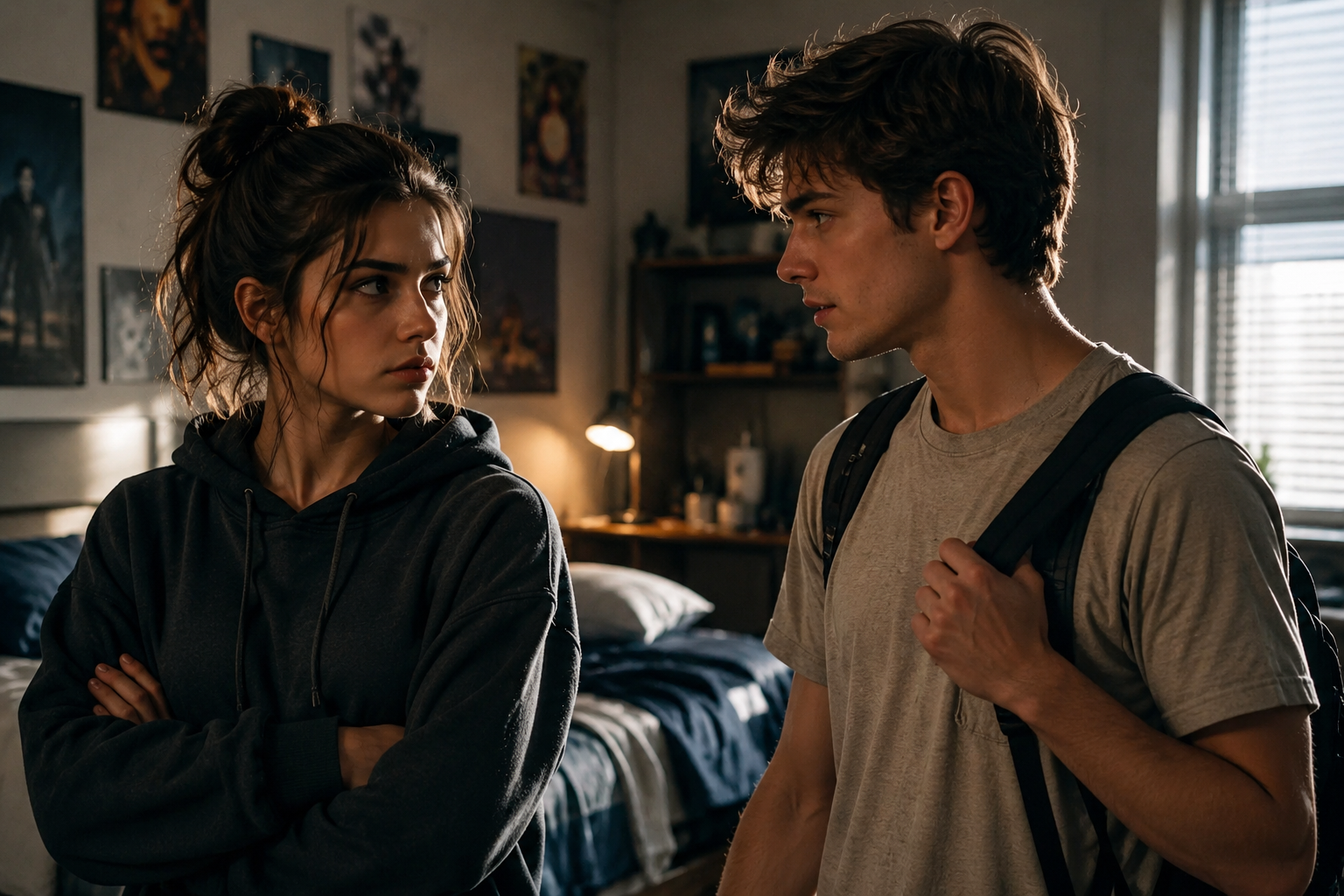
But after that, tiny things began appearing between them like cautious lights.
A note on the coffee pot: Meeting until noon. Don’t commit crimes against caffeine.
An extra towel left near the bathroom after he came home soaked from work.
A text at 7:14 p.m.: If you buy crackers, not the rosemary ones. They taste like a candle pretending to be dinner.
Julian replied: What crackers taste like emotional stability?
Mara: None. That’s why society is collapsing.
He found himself smiling at his phone in the editing studio, surrounded by waveforms and stale coffee and people saying things like “Can we make this silence feel more premium?”
Mara stayed in his head.
Not romantically at first. Or at least, not in any way he trusted.
She was brilliant and difficult and funny in the way knives were shiny. She had a way of making apology feel unnecessary when respect would do. She hated pity so intensely that kindness had to approach sideways and identify itself at the door.
One Thursday night, Julian came home late and found her on a video call, her voice sharp enough to cut wire.
“No,” she said. “I am not putting a smiling volunteer beside the wheelchair entrance.”
A man’s voice crackled through the laptop. “Mara, the donor board wants warmth.”
“The donor board wants evidence that disabled visitors are being lovingly managed by able-bodied saints.”
“That’s not fair.”
“It’s accurate, which is why you don’t like it.”
Julian tried to slip quietly toward his room.
Mara pointed at him without looking away from the screen. “You. Soup in the fridge. Eat it before it becomes science.”
He pointed at himself.
She mouthed, “You.”
The man on the call sighed. “We’re just trying to make accessibility feel welcoming.”
“Then make it actually welcoming,” Mara snapped. “A ramp that leads to a locked side door is not welcome. A quiet room used for storage is not welcome. A map that assumes everyone can read tiny gray print under theatrical lighting is not welcome. Don’t photograph gratitude. Fix the route.”
Julian froze in the hallway.
That was the first time he saw the fire beneath her sarcasm. It was not bitterness. It was fury with a blueprint.
After the call ended, she shut the laptop.
“Bad meeting?” he asked.
“Bad assumptions.”
“Worse.”
She looked at him. “You heard that.”
“You were loudly educational.”
“I was angry.”
“Those can overlap.”
Mara studied him like she was searching for the hidden condescension. He gave her none.
Finally, she said, “Eat the soup.”
He ate the soup.
A month passed.
Then came the envelope.
Julian found it on the kitchen island beneath Mara’s hand. Thick cream paper. Gold seal. Expensive in the way that wanted to be noticed. She sat in front of it without moving, her face stripped of its usual armor.
He set down the grocery bags carefully. “Do you want me to pretend I didn’t see that?”
“Yes.”
“Done.”
He put away the food, making sure nothing went above the shelves she used most. Then he walked to his room and left the door partly open—not an invitation, exactly. More like a light left on.
Fifteen minutes later, she appeared in the hallway.
“My ex is getting honored,” she said.
Julian looked up from untangling a microphone cable. “Honored?”
“At a museum gala.”
“That sounds punishable.”
“It should be.”
She rolled into the room but stopped near the doorway, the envelope balanced on her lap like evidence.
“His name is Adrian Vale,” she said. “He used to be a curator at the North Harbor Museum. He’s being awarded for his work on accessible public art programming.”
Julian waited.
Mara laughed once, flat and humorless. “Funny, right?”
“Depends how much of the work was yours.”
Her silence answered.
Julian felt anger rise in him, hot and immediate, but he kept his voice steady. “How much?”
“The original program design. The visitor route models. The sensory room concept. The community advisory plan. The part where the museum stopped treating access as a special request and started treating it like infrastructure.”
“That seems like more than a little.”
“I was consulting for them before the accident.”
He had known there had been an accident. Not details. Just the way people in the building sometimes lowered their voices around Mara when mentioning winter, hospitals, or the intersection at Calvert and King.
She looked at the envelope.
“Two years ago, a delivery truck ran a red light. I woke up after surgery and learned my spine had become the most interesting thing about me.”
Julian’s chest tightened. “I’m sorry.”
Her eyes snapped to him.
He held up one hand. “Not like you died. I’m sorry something violent happened and people made you carry the meaning of it.”
The sharpness in her face softened by half a degree.
“Better,” she said.
He nodded.