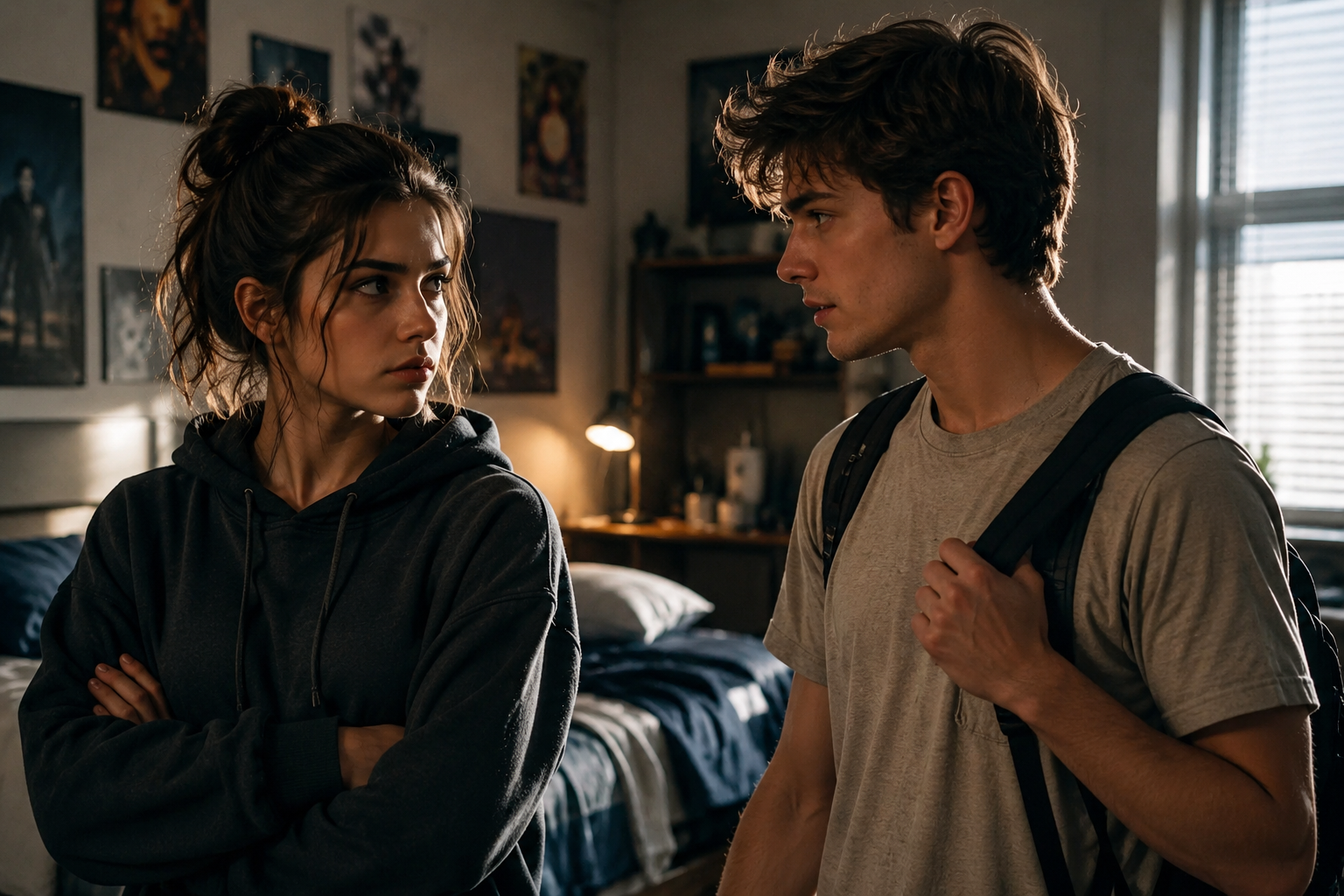
By eight-thirty on his first night in apartment 4B, Julian Hart had learned three things.
First, old buildings made noises that sounded personal.
Second, carrying six boxes up four flights of stairs in the rain was a choice made by a man who had overestimated his own character.
Third, his new roommate, Mara Venn, had no interest in pretending she was happy he existed.
She watched him from the kitchen doorway while he dragged the last box inside, his hoodie soaked through, one shoelace untied, and a streak of dust across his cheek that made him look like he had lost a quiet battle with a basement.
“You know,” she said, “most people ask about elevator access before signing a lease.”
Julian dropped the box by his bedroom door and tried to breathe like a person who still had lungs. “The listing said fourth floor.”
“It did.”
“It also said charming walk-up.”
“That means inconvenient with moldings.”
He looked around. The apartment was narrow but warm, with tall windows facing a wet Baltimore street, bookshelves bolted to brick walls, low kitchen cabinets, and a hallway so carefully clear it looked less decorated than negotiated. A strip of dark green tape ran along the floor near the kitchen island.
Julian pointed at it. “Is that decorative?”
“No.”
“Warning line?”
“Yes.”
“For what?”
“For people who enjoy keeping their kneecaps.”
Mara rolled farther into the kitchen, her wheelchair moving with smooth, practiced precision. She had cropped black hair, sharp eyes, and the kind of posture that made every silence feel supervised. She wore a charcoal sweater and loose linen pants, and she looked at Julian as if he were a complicated appliance she had not requested.
He picked up one of his bags. “I can move this stuff out of the hallway.”
“You can and you will.”
“Great. I love a roommate relationship built on mutual confidence.”
“Don’t mistake instructions for confidence.”
Julian smiled despite himself. “Fair.”
Mara’s expression did not change, but something in her eyes flickered. Not amusement exactly. More like she had noticed he was not instantly offended, and that information had been filed somewhere.
On the kitchen counter sat two paper containers of hot food. Steam curled from under the lids. Julian had not eaten since noon, unless three gas station crackers counted as food, which he privately believed they did not.
Mara tapped one container with a fork. “Vegetable curry. Unless you hate coconut, in which case tonight becomes a tragedy.”
Julian blinked. “You ordered for me?”
“No. I ordered too much and decided waste was immoral.”
“That sounds suspiciously like kindness wearing a disguise.”
“That sounds suspiciously like you want to sleep in the stairwell.”
He took the container. “Curry is perfect.”
“Of course it is. I have taste.”
They ate at the island with the green tape between them. The rain hit the windows in soft, restless lines. Below, a bus sighed at the curb. Somewhere in the building, a child laughed once, then someone told him to brush his teeth like it was a legal emergency.
For a while, neither of them spoke.
Julian liked silence when it was comfortable. This was not comfortable. It had corners.
Finally, Mara said, “You have income?”
He looked up. “That’s a very romantic first dinner question.”
“It’s not dinner. It’s a lease survival interview.”
“I edit audio for documentaries. Mostly podcasts. Sometimes corporate training videos when I’ve angered God.”
“Stable?”
“Stable enough to pay rent. Unstable enough to have opinions about microphone placement.”
She considered him. “So you make people sound smarter than they are.”
“Only if they pay extra.”
“That explains the headphones.”
He smiled. “You say that like headphones once betrayed you.”
“Men with headphones block doorways and call it focus.”
“I promise not to block doorways.”
Mara leaned back. “You promise too early.”
“I’m trying to start strong.”
“You won’t last a week.”
There it was. Not a joke. Not exactly a threat either. A warning, offered flatly, like weather.
Julian held her gaze. “Living with you?”
“Living here.”
“Because of the stairs?”
“Because of the rules.”
“I can follow rules.”
“Everyone says that before the rules apply to them.”
“That sounds like it comes from experience.”
“It does.”
He waited.
Mara did not continue.
Julian knew how to recognize a locked door. His mother had raised three sons and one private grief; his older brother had survived a war and returned allergic to questions; his last relationship had ended with a woman telling him he was kind, which somehow felt worse than being called selfish. He knew that not every silence wanted to be rescued.
So he only nodded. “Then I’ll try not to become everyone.”
Mara looked at him for a long second.
“Put your boxes inside your room before midnight,” she said. “I don’t want to discover your biography with my wheels.”