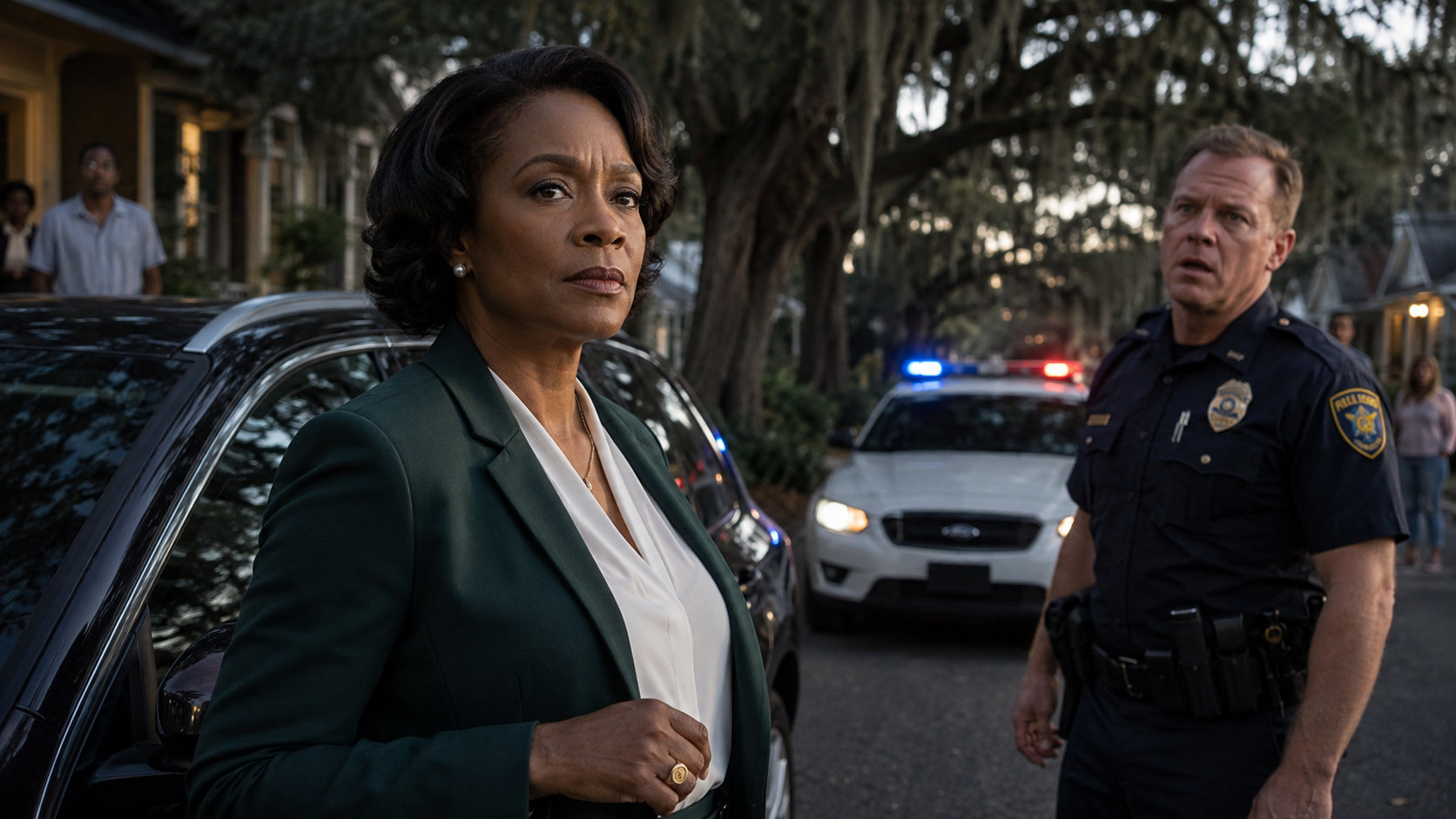
“Five minutes ago you didn’t know what that ring represented. You didn’t know my rank. You didn’t know where I worked. You didn’t know what I had done with my life.”
Her voice remained controlled.
“And none of those things should have mattered.”
Nobody interrupted.
“You should not need a prestigious title before deciding to treat someone with dignity.”
Rourke looked away.
Evelyn continued.
“If I had been unemployed, would your behavior have been acceptable?”
No answer.
“If this SUV had been twenty years old?”
Silence.
“If nobody had been recording?”
Rourke swallowed.
Evelyn nodded once.
“That is the question you should be worried about.”
Two additional police vehicles arrived without sirens.
A captain stepped out and immediately began speaking with Mercer.
Rourke was instructed to surrender his keys and move away from Evelyn.
This time he followed the order without argument.
Evelyn returned to her SUV.
The woman with the bicycle approached carefully.
“Dr. Carter?”
Evelyn turned.
“I’m sorry that happened.”
“Thank you.”
“I have the recording. If you need it, I’ll give it to the department.”
Evelyn nodded.
“Please keep the original copy.”
The woman smiled slightly.
“You sound like you’ve done this before.”
“No.”
Evelyn looked toward Rourke.
“But I have spent most of my life preparing for situations where panic makes everything worse.”
The gardener crossed the street carrying the hose nozzle he had finally remembered to shut off.
“General?”
Evelyn smiled tiredly.
“Evelyn is fine.”
He nodded toward her pocket.
“My father had one of those rings. Naval Academy.”
“That explains why you recognized it.”
“I recognized the design. Your officer over there apparently didn’t.”
“He didn’t need to.”
The man considered that.
Then nodded.
“No. I guess he didn’t.”
When Evelyn finally reached her sister’s house, dinner had gone cold.
Her sister opened the door, looked at the police vehicles still visible down the street, and stared at her.
“What happened?”
Evelyn stepped inside.
“It’s a long story.”
“Are you okay?”
“Yes.”
That answer was technically true.
But she didn’t sleep much that night.
Not because she had been afraid.
That bothered her less than something else.
She kept returning to the moment Rourke noticed the ring.
The instant change in his voice.
The sudden politeness.
The hesitation.
He had not become respectful because he understood that his behavior was wrong.
He had become respectful because he realized she had power.
And Evelyn understood that power protected only the people who possessed it.
That thought stayed with her.
The investigation began Monday.
Body-camera footage was preserved.
The neighbors submitted their recordings.
Dispatch records were reviewed.
The initial report showed no traffic offense preceding the stop.
Additional complaints involving Officer Rourke were reopened after investigators discovered similarities in previous encounters.
Evelyn refused nearly every interview request from television stations.
She declined to become the center of a spectacle.
But several weeks later, she agreed to speak at a public city meeting reviewing policing procedures.
The room was packed.
Reporters waited at the back.
Residents filled every chair.
Evelyn stood at the microphone wearing a simple dark suit.
No uniform.
No medals.
And no Academy ring.
She had deliberately left it at home.
A council member introduced her with every title he could find.
Doctor.
Hospital executive.
Former military commander.
Retired brigadier general.
Decorated surgeon.
Evelyn waited patiently.
Then she leaned toward the microphone.
“I appreciate the introduction,” she said. “But tonight I would like you to forget all of it.”
The room became quiet.
“Imagine I had no title.”
She looked around the chamber.
“No distinguished career. No expensive vehicle. No military record. No influential colleagues. Imagine I was simply a woman driving to see her family.”
Several people lowered their phones.
“If your opinion of what happened changes when you remove my accomplishments, then we have identified the problem.”
Nobody applauded immediately.
That pleased her.
She had not come for applause.
She had come to make them think.
Evelyn continued.
“Authority is tested most honestly when it encounters someone who appears to have none.”
Now the room was completely silent.
“And dignity is meaningful only when it is given before you discover who a person knows, what uniform they once wore, how much money they earn, or what ring is on their hand.”
At the rear of the chamber, the woman with the bicycle watched from beside the door.
The gardener sat in the third row.
Lieutenant Mercer stood against the wall.
Evelyn looked at all of them.
Then she stepped away from the microphone.
This time, when the applause began, she did not smile.
She simply picked up her coat and walked toward the exit.
Because the ring had never been the important part of the story.
The important part was who Officer Rourke believed she was before he saw it.
And who he believed he was allowed to become because of that assumption.