THE RING HE DIDN’T RECOGNIZE

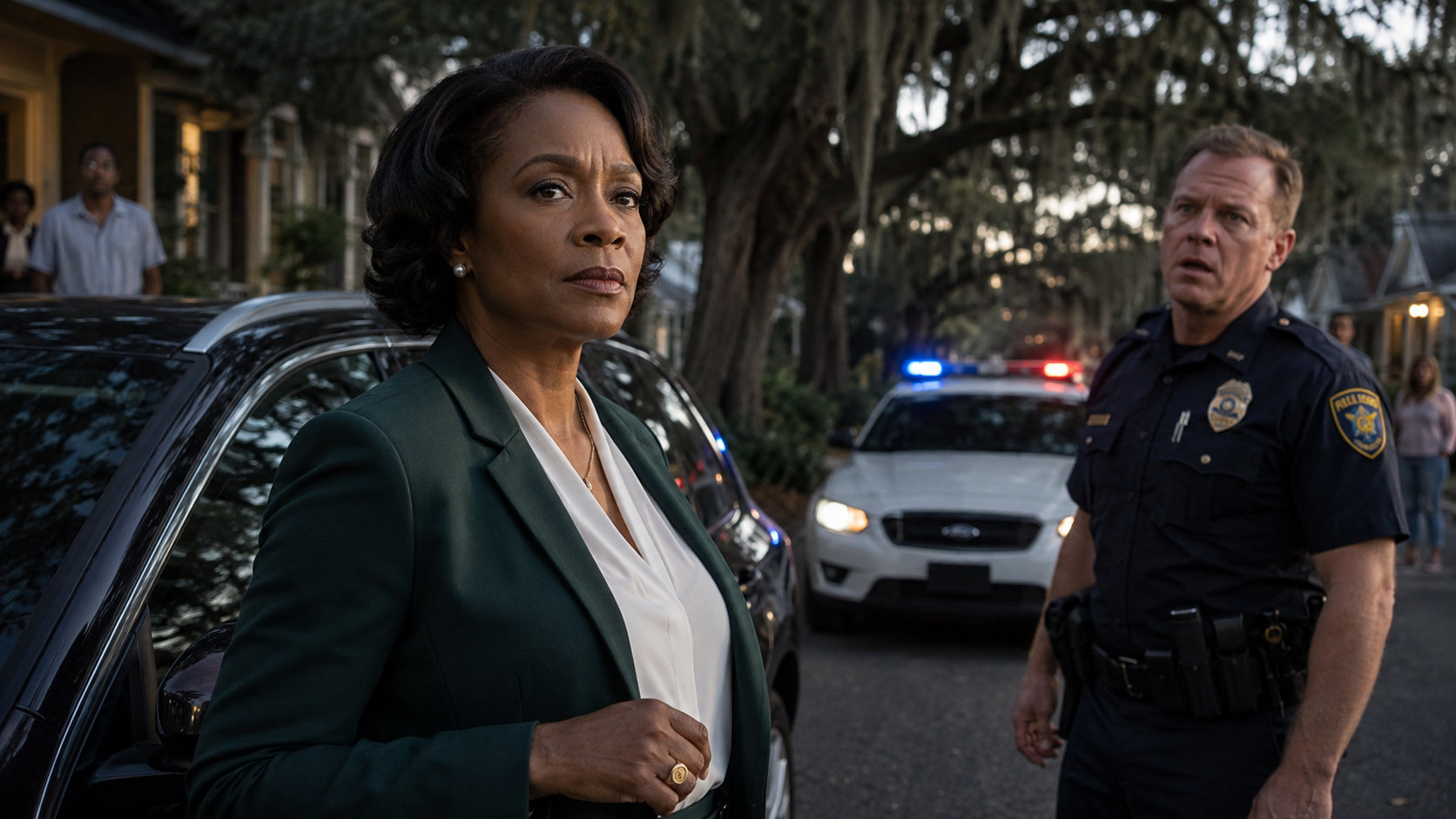
The first thing Officer Mason Rourke noticed about the woman behind the wheel was the car.

A black luxury SUV, spotless despite the summer dust, moving slowly through one of the oldest neighborhoods in Savannah.

The second thing he noticed was the woman herself.

Black. Mid-fifties, perhaps. Silver beginning to show at her temples. White shirt beneath a dark green jacket. Both hands on the wheel. Calm posture.

Rourke watched the SUV pass his parked patrol car.

Then he pulled into traffic behind it.

Dr. Evelyn Carter saw the police cruiser in her mirror but gave it little thought.

She had spent the previous twelve hours at St. Catherine Medical Center, where an emergency surgery had turned a routine Friday into something exhausting and unpredictable. She had canceled dinner twice, ignored seven personal messages, and survived mostly on coffee.

All she wanted now was to reach her sister’s house, take off her shoes, and sit somewhere nobody needed anything from her.

The blue lights began flashing.

Evelyn frowned.

She checked the speedometer.

Twenty-eight miles per hour.

The limit was thirty.

She signaled, turned onto a wider side street, and stopped beneath an enormous live oak.

Before the officer reached her window, Evelyn lowered it and placed both hands where they could be clearly seen.

Rourke approached slowly.

“License.”

Evelyn looked at him.

“Good evening. Is there a problem?”

“I said license.”

His tone immediately changed the atmosphere.

Evelyn had spent decades listening to frightened people, arrogant people, injured people, grieving people, generals, interns, nurses, politicians, and soldiers who thought shouting could make an impossible situation easier.

She recognized hostility when she heard it.

“My license is in my purse,” she said. “The purse is on the passenger seat. May I reach for it?”

Rourke glanced inside.

“Slowly.”

She retrieved the wallet and handed him her license.

He stared at it.

“Evelyn Carter.”

“Yes.”

“This your vehicle?”

“It is.”

“Registration.”

“In the glove compartment.”

He leaned slightly toward the open window.

“What are you doing around here?”

The question surprised her more than the traffic stop.

“My sister lives three blocks away.”

Rourke smiled without warmth.

“That wasn’t what I asked.”

Evelyn studied him.

“Then I’m not sure what you’re asking.”

His expression tightened.

“Registration.”

She opened the compartment and removed the document.

Rourke looked at the registration, then at the license, then at her again.

“You stay right here.”

He walked back to his cruiser.

Evelyn watched him in the mirror.

Something felt wrong.

Not dangerous yet.

But wrong.

She took out her phone and placed it upright in the center console.

She did not begin recording dramatically. She did not announce what she was doing.

She simply pressed the button.

Three minutes passed.

Then five.

The neighborhood remained quiet.

A man watering flowers across the street glanced toward the SUV.

Two young women walking a dog slowed down.

Rourke finally returned.

“Step out of the vehicle.”

Evelyn did not move.

“Why?”

“Because I told you to.”

“That is an instruction. It is not an explanation.”

His eyes narrowed.

“Are you refusing?”

“No. I’m asking why I’m being ordered out of my vehicle.”

Rourke placed one hand on the door.

“I received information about a vehicle matching this description.”

“What information?”

“Get out.”

Evelyn looked at him for another second.

Then she unfastened her seat belt.

“Understood.”

She opened the door carefully and stepped onto the pavement.

Rourke immediately pointed toward the rear of the SUV.

“Back there.”

She walked where he indicated.

“Hands on the vehicle.”

Evelyn stopped.

“Officer, my identification and registration confirm that the SUV belongs to me.”

“I’m not discussing it.”

“Then what exactly are you investigating?”

His voice rose.

“Hands on the vehicle.”

Several people were watching now.

Evelyn could feel their attention.

She also noticed the body camera mounted on Rourke’s uniform.

Its small light was on.

Good.

She placed her hands against the back of the SUV.

“Feet apart.”

She complied.

Rourke searched the outside pockets of her jacket.

“You carrying anything?”

“A phone, hospital identification, keys and a pen.”

“No weapon?”

“No.”

He removed the hospital badge clipped inside her jacket.

He examined the photograph.

DR. EVELYN CARTER
CHIEF OF TRAUMA SERVICES

He gave a short laugh.

“Doctor?”

“Yes.”

“You expect me to believe that?”

For the first time, irritation crossed Evelyn’s face.

“You are holding hospital identification with my photograph on it.”

“People fake things.”

“They do.”

Rourke looked almost disappointed that she had not argued.

“Turn around.”

Evelyn turned.

His gaze dropped to her left hand.

A heavy gold ring caught the fading sunlight.

The design was old-fashioned: a dark stone, an eagle worked into one side, a year engraved beneath it.

Rourke stared.

“What’s that?”

Evelyn followed his gaze.

“A ring.”

“I can see that.”

“Then I’m unclear about the question.”

One of the people across the street laughed quietly.

Rourke heard it.

His face hardened.

“You think this is funny?”

“No.”

“You’re acting pretty confident.”

“I am standing where you told me to stand.”

“That doesn’t answer me.”

Evelyn straightened.

“Confidence is not a crime, Officer.”

The laughter stopped.

Rourke stepped closer.

“What kind of ring is it?”

For a moment Evelyn said nothing.

Then she raised her hand slightly.

“United States Air Force Academy.”

His expression shifted.

Not enough to call it fear.

But enough to show calculation.

“You military?”

“I was.”

“What did you do?”

“I practiced medicine.”

“That all?”

“No.”

There was a silence.

Evelyn looked directly at him.

“I commanded a medical evacuation unit for four years.”

Rourke glanced toward the growing group of neighbors.

Someone had a phone raised.

Another person had walked onto a porch to watch.

His voice became lower.

“So now you’re some kind of colonel?”

“Retired brigadier general.”

The change in him was immediate.

His shoulders moved.

His jaw loosened.

His eyes flicked toward the body camera.

Evelyn saw all of it.

And suddenly she understood something that bothered her far more than the stop itself.

His behavior was changing because he had discovered who she was.

Not because he had realized how he was behaving.

Rourke stepped backward.

“Well, General, if you’d told me—”

“No.”

The single word stopped him.

Evelyn lowered her hand.

“Do not do that.”

“Do what?”

“Make my résumé responsible for your manners.”

Rourke glanced at the witnesses.

“I’m conducting an investigation.”

“Then conduct it.”

His face reddened.

“There was a report of a stolen black SUV.”

“Then check the plate.”

“I did.”

“And?”

He did not answer.

Evelyn watched him carefully.

“That registration is valid.”

Another silence.

“You know that vehicle belongs to me.”

Rourke reached toward his radio.

Before he could speak, another voice came through it.

“Unit twelve, confirm status.”

Rourke pressed the button.

“Possible stolen vehicle investigation. One detained.”

The dispatcher answered almost immediately.

“Unit twelve, what call are you attached to?”

Rourke hesitated.

Evelyn noticed.

So did several people nearby.

“Repeat?”

“There is no stolen-vehicle call assigned to your unit.”

Rourke looked toward Evelyn.

The radio continued.

“The reported stolen vehicle from the east district is a black Ford Explorer, Georgia plate ending seven-one-four. Your current location is outside the search area.”

Evelyn slowly turned her head toward her SUV.

A Lincoln.

Different manufacturer.

Different body shape.

Different plate.

Different part of the city.

The man with the garden hose across the street muttered something under his breath.

Rourke spoke into the radio.

“Possible visual match.”

The dispatcher replied.

“Negative. Vehicle description does not match.”

Evelyn’s expression became very still.

“You knew that before you ordered me out.”

“I had reasonable suspicion.”

“Based on what?”

“Ma’am—”

“You called me General thirty seconds ago.”

Rourke said nothing.

Evelyn continued.

“And before you saw this ring, you questioned whether I could possibly be a doctor.”

Rourke looked toward the witnesses again.

“This conversation is over.”

“No,” said someone from the sidewalk. “It isn’t.”

Rourke spun around.

The speaker was a woman in her sixties standing beside a bicycle.

She held her phone horizontally.

“I recorded the whole thing.”

“Back away,” Rourke ordered.

“I’m on a public sidewalk.”

“I said back away.”

Evelyn spoke before the confrontation could escalate.

“Officer Rourke.”

He turned toward her.

She had read his name from the badge.

“I suggest you request a supervisor.”

“I don’t need your suggestion.”

“You do if you intend to continue detaining me without explaining the legal basis.”

Rourke took another step toward her.

“You lawyers always think you know everything.”

“I’m a surgeon.”

That drew another quiet laugh from the crowd.

Rourke’s embarrassment transformed into anger.

“Turn around and put your hands behind your back.”

The street went silent.

Evelyn did not move.

“Am I under arrest?”

“Hands behind your back.”

“Am I under arrest?”

“You’re being detained.”

“For what offense?”

“You’re obstructing.”

“How?”

“You keep arguing.”

Evelyn’s eyes sharpened.

“Questions are not obstruction.”

Rourke reached for her arm.

The moment his fingers touched her sleeve, a car horn sounded behind them.

A dark sedan had stopped several yards away.

A tall man climbed out.

He wore jeans and a pale blue shirt.

Nothing about him suggested authority until he spoke.

“Mason.”

Rourke froze.

The newcomer crossed the street.

“Take your hand off her.”

“Lieutenant—”

“Now.”

Rourke released Evelyn.

Lieutenant Daniel Mercer approached, looked at Evelyn, then at the hospital identification still in Rourke’s hand.

“What happened?”

Rourke began speaking quickly.

“Vehicle matched a stolen-car description. Driver became uncooperative. I was trying to verify identity and—”

Mercer looked at the Lincoln.

“Stolen vehicle was a Ford.”

“It was dark.”

The sun had not yet set.

Everyone on the street looked at the sky.

Mercer looked back at him.

“It’s not dark.”

Rourke said nothing.

The dispatcher’s voice came over the radio again.

“Lieutenant Mercer, communications has located the original vehicle. East district has one in custody.”

Mercer closed his eyes briefly.

Then he looked at Rourke.

“So the stolen vehicle was found across town.”

“Yes, sir.”

“And it isn’t this vehicle.”

“Correct.”

Mercer faced Evelyn.

“Ma’am, are you injured?”

“No.”

“Were you searched?”

“My clothing was searched.”

“Were you handcuffed?”

“No.”

“Did he tell you why he stopped you?”

“He said there was a vehicle matching my description.”

Mercer turned back.

“What was the original reason for the stop?”

Rourke’s mouth opened.

Nothing came out.

Mercer waited.

“Traffic violation?”

“No.”

“Plate alert?”

“No.”

“Dispatch request?”

“No.”

“Then why did you activate your emergency lights?”

Rourke looked toward the street.

Toward the houses.

Toward the cameras.

Finally he said, “It looked suspicious.”

Evelyn’s voice came quietly.

“What looked suspicious?”

Nobody moved.

Rourke stared at her.

“The vehicle.”

“What about it?”

“You were driving slowly.”

“The speed limit is thirty. I was driving twenty-eight.”

“You kept looking in your mirror.”

“There was a police cruiser following me.”

Mercer’s expression darkened.

“Mason.”

“I made a judgment call.”

Evelyn looked at the lieutenant.

“No. He made a judgment. The call came afterward.”

For several seconds the only sound was water from the abandoned garden hose running into the gutter.

Then the woman with the bicycle spoke.

“I saw him before she came through.”

Mercer looked at her.

“What do you mean?”

“He was parked there for maybe fifteen minutes.”

“Did you see what happened?”

“Yes.”

She pointed down the street.

“The SUV passed him. He stared at the driver, pulled out, followed her and lit her up almost immediately.”

Rourke shook his head.

“That’s not accurate.”

“I have video.”

The man across the street raised his hand.

“So do I.”

Another neighbor spoke.

“My doorbell camera faces the intersection.”

Mercer looked slowly around the street.

Five phones were visible.

Maybe more.

Then he looked at Rourke’s body camera.

“Is that recording?”

Rourke answered reluctantly.

“Yes.”

“Good.”

Mercer reached for his own radio.

“Request a patrol supervisor and internal affairs investigator to my location.”

Rourke stared at him.

“Lieutenant, come on.”

Mercer ignored him.

“Also request another unit to transport Officer Rourke back to headquarters.”

“Transport?”

“You’re done for tonight.”

“You’re suspending me over this?”

“I’m removing you from field duty pending review.”

“This is ridiculous.”

Mercer’s eyes went cold.

“No. What would be ridiculous is pretending none of these cameras exist.”

Rourke looked at Evelyn.

His anger was gone now.

In its place was something more complicated.

Fear.

Calculation.

And, perhaps, the desperate hope that status might save him.

“General Carter,” he said, “I think this got out of hand.”

Evelyn stared at him.

“You still don’t understand.”

“I’m trying to apologize.”

“No. You’re trying to apologize to a general.”

Rourke blinked.

She lifted her hand and looked at the Academy ring.

For years it had reminded her of the people with whom she had served.

Young officers learning responsibility.

Pilots who trusted medical crews with their lives.

Doctors working thirty-hour shifts.

Patients who never asked the rank of the person stopping their bleeding.

She slowly removed it.

Everyone watched.

Evelyn placed the ring inside her jacket pocket.

Then she looked back at Rourke.

“Now apologize to the woman you stopped.”

Rourke’s face changed.

“That’s not what I meant.”

“It is exactly what you meant.”

She took one step closer.

“Five minutes ago you didn’t know what that ring represented. You didn’t know my rank. You didn’t know where I worked. You didn’t know what I had done with my life.”

Her voice remained controlled.

“And none of those things should have mattered.”

Nobody interrupted.

“You should not need a prestigious title before deciding to treat someone with dignity.”

Rourke looked away.

Evelyn continued.

“If I had been unemployed, would your behavior have been acceptable?”

No answer.

“If this SUV had been twenty years old?”

Silence.

“If nobody had been recording?”

Rourke swallowed.

Evelyn nodded once.

“That is the question you should be worried about.”

Two additional police vehicles arrived without sirens.

A captain stepped out and immediately began speaking with Mercer.

Rourke was instructed to surrender his keys and move away from Evelyn.

This time he followed the order without argument.

Evelyn returned to her SUV.

The woman with the bicycle approached carefully.

“Dr. Carter?”

Evelyn turned.

“I’m sorry that happened.”

“Thank you.”

“I have the recording. If you need it, I’ll give it to the department.”

Evelyn nodded.

“Please keep the original copy.”

The woman smiled slightly.

“You sound like you’ve done this before.”

“No.”

Evelyn looked toward Rourke.

“But I have spent most of my life preparing for situations where panic makes everything worse.”

The gardener crossed the street carrying the hose nozzle he had finally remembered to shut off.

“General?”

Evelyn smiled tiredly.

“Evelyn is fine.”

He nodded toward her pocket.

“My father had one of those rings. Naval Academy.”

“That explains why you recognized it.”

“I recognized the design. Your officer over there apparently didn’t.”

“He didn’t need to.”

The man considered that.

Then nodded.

“No. I guess he didn’t.”

When Evelyn finally reached her sister’s house, dinner had gone cold.

Her sister opened the door, looked at the police vehicles still visible down the street, and stared at her.

“What happened?”

Evelyn stepped inside.

“It’s a long story.”

“Are you okay?”

“Yes.”

That answer was technically true.

But she didn’t sleep much that night.

Not because she had been afraid.

That bothered her less than something else.

She kept returning to the moment Rourke noticed the ring.

The instant change in his voice.

The sudden politeness.

The hesitation.

He had not become respectful because he understood that his behavior was wrong.

He had become respectful because he realized she had power.

And Evelyn understood that power protected only the people who possessed it.

That thought stayed with her.

The investigation began Monday.

Body-camera footage was preserved.

The neighbors submitted their recordings.

Dispatch records were reviewed.

The initial report showed no traffic offense preceding the stop.

Additional complaints involving Officer Rourke were reopened after investigators discovered similarities in previous encounters.

Evelyn refused nearly every interview request from television stations.

She declined to become the center of a spectacle.

But several weeks later, she agreed to speak at a public city meeting reviewing policing procedures.

The room was packed.

Reporters waited at the back.

Residents filled every chair.

Evelyn stood at the microphone wearing a simple dark suit.

No uniform.

No medals.

And no Academy ring.

She had deliberately left it at home.

A council member introduced her with every title he could find.

Doctor.

Hospital executive.

Former military commander.

Retired brigadier general.

Decorated surgeon.

Evelyn waited patiently.

Then she leaned toward the microphone.

“I appreciate the introduction,” she said. “But tonight I would like you to forget all of it.”

The room became quiet.

“Imagine I had no title.”

She looked around the chamber.

“No distinguished career. No expensive vehicle. No military record. No influential colleagues. Imagine I was simply a woman driving to see her family.”

Several people lowered their phones.

“If your opinion of what happened changes when you remove my accomplishments, then we have identified the problem.”

Nobody applauded immediately.

That pleased her.

She had not come for applause.

She had come to make them think.

Evelyn continued.

“Authority is tested most honestly when it encounters someone who appears to have none.”

Now the room was completely silent.

“And dignity is meaningful only when it is given before you discover who a person knows, what uniform they once wore, how much money they earn, or what ring is on their hand.”

At the rear of the chamber, the woman with the bicycle watched from beside the door.

The gardener sat in the third row.

Lieutenant Mercer stood against the wall.

Evelyn looked at all of them.

Then she stepped away from the microphone.

This time, when the applause began, she did not smile.

She simply picked up her coat and walked toward the exit.

Because the ring had never been the important part of the story.

The important part was who Officer Rourke believed she was before he saw it.

And who he believed he was allowed to become because of that assumption.