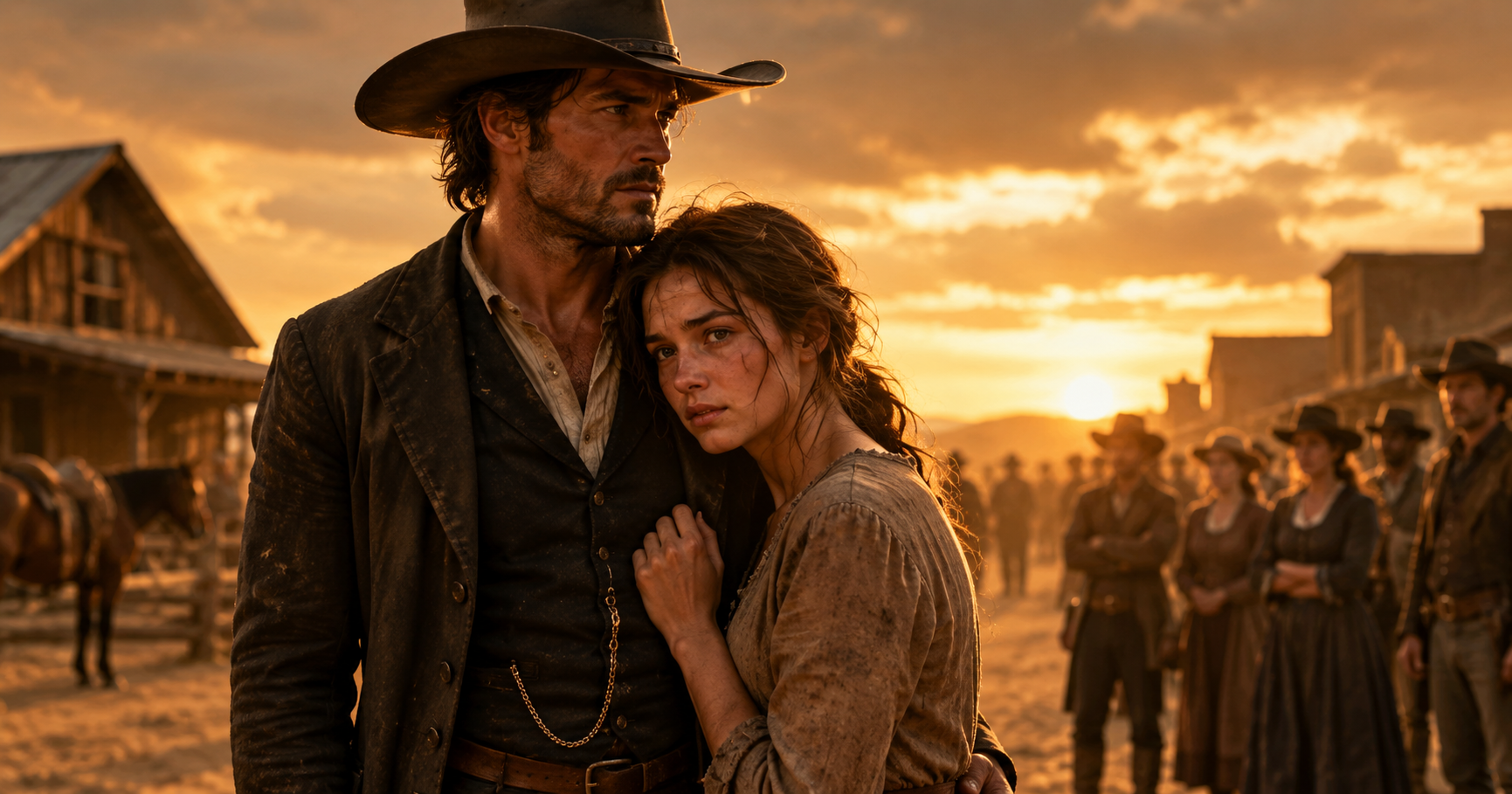
When a calf broke its leg, she held the lantern while Harlan did what had to be done.
When Tommy—Rowan’s youngest hand, sent along to earn extra pay—caught fever, she sat beside him for two nights, forcing water between his teeth until he cursed her with enough strength to prove he might live.
On the thirty-first day, Harlan handed her a cup of coffee she had not poured herself.
“You’re still here,” he said.
“So are you.”
“I expected you to quit.”
“I expected you to be smarter.”
His old face cracked into a grin.
That was the first time the trail accepted her.
Not kindly.
The trail was not kind.
But honestly.
Back at Stone Circle, Rowan was learning that silence did not save a man from needing people.
The bank pressed harder.
The mercantile cut him off completely.
The church ladies stopped hiring Stone Circle hands for odd jobs.
Then lightning struck the south ridge.
Fire came down the grassland faster than horses could run.
Rowan saw the smoke at midafternoon. By dusk, the sky was red and the wind had teeth. He and Abel dug firebreaks until their palms tore open. Men soaked blankets and beat sparks from fence posts. The cattle bawled in panic.
By midnight, Rowan knew they were losing.
“Get the horses out,” he told Abel.
“And you?”
“I’ll stay with the barn.”
Abel stared. “That barn ain’t worth your life.”
“It’s worth more than my fear.”
“That’s a stupid sentence.”
“Probably.”
He was dragging water from the well when riders came through the smoke.
At first he thought the town had come to watch him burn.
Then he saw Mrs. Voss.
Behind her came three wagons, six ranchers, four women with wet blankets, and a dozen boys carrying shovels.
Rowan stood frozen.
Mrs. Voss climbed down from the wagon, soot already streaking her face.
“Don’t stand there looking tragic,” she snapped. “Tell us where to dig.”
Rowan stared at her. “You came?”
She looked embarrassed enough to be angry about it.
“Yes, Mr. Flint. Apparently some of us remembered the Bible has more pages than scandal.”
They fought the fire until dawn.
When the wind shifted, the flames bent east and ran toward empty range. Stone Circle survived with black scars across the hills, a burned fence line, and a barn roof that smoked for two days.
Rowan stood in the ash, exhausted beyond pride.
Mrs. Voss handed him a canteen.
“I was wrong about the girl,” she said.
He looked at her.
She did not meet his eyes.
“I was wrong about you too.”
Rowan drank.
Then he said, “That must have hurt.”
She snorted. “Like childbirth.”
A week later, letters began arriving for Maribel.
One from Tommy, telling her the ranch still stood.
One from Abel, badly spelled but sincere.
One from Rowan, short enough to fit inside a matchbox and heavy enough to keep in her pocket.
Stone Circle is still here.
So am I.
Come back when you can.
She read that last line until the paper softened at the fold.
The drive ended in Abilene after fifty-seven days of dust, blood, weather, and men pretending they were not grateful for the woman who had kept them fed.
Harlan paid her in full.
Then he added another envelope.
“What’s this?” she asked.
“Bonus.”
“I didn’t ask for one.”
“That’s why you’re getting it.”
She tried to hand it back.
He refused.
“You earned more than money, girl. Take both.”
When Maribel returned to Briar Creek, she did not go to Stone Circle first.
She went to the bank.
She walked through the front door with sun-darkened skin, cracked hands, a trail knife at her belt, and the calm of a woman who had stopped asking permission to exist.
Silas Creed looked up from his desk.
His smile died.
“Miss Ashe.”
“Mr. Creed.”
“I assume Mr. Flint sent you.”
“No. That’s why this will go better.”
His eyes narrowed. “I do not discuss a man’s business with hired help.”
Maribel placed the first envelope on his desk.
“Payment.”
Creed glanced at it. “Partial.”
She placed a second envelope beside it.
“More payment.”
His mouth tightened.
Then she placed a stack of signed notes on the desk.
Statements from Mrs. Voss.
From Abel.
From Harlan Saye.
From two ranchers who had helped fight the fire.
From a newspaper man in Abilene who had been very interested in the idea of a bank using moral gossip to force foreclosure on a profitable ranch.
Creed went pale.
Maribel sat down without being invited.
“You called that loan because Reverend Keene and half the town wanted Rowan punished for hiring me. You dressed spite as risk. You dressed cruelty as policy. I have no education, Mr. Creed, but I know costumes when I see them.”
Creed’s hand twitched toward the papers.
She placed her knife on top of them.
Not pointed at him.
Just visible.
“You will accept payment. You will extend the remaining balance thirty days. And you will never again use a bank note like a whip.”