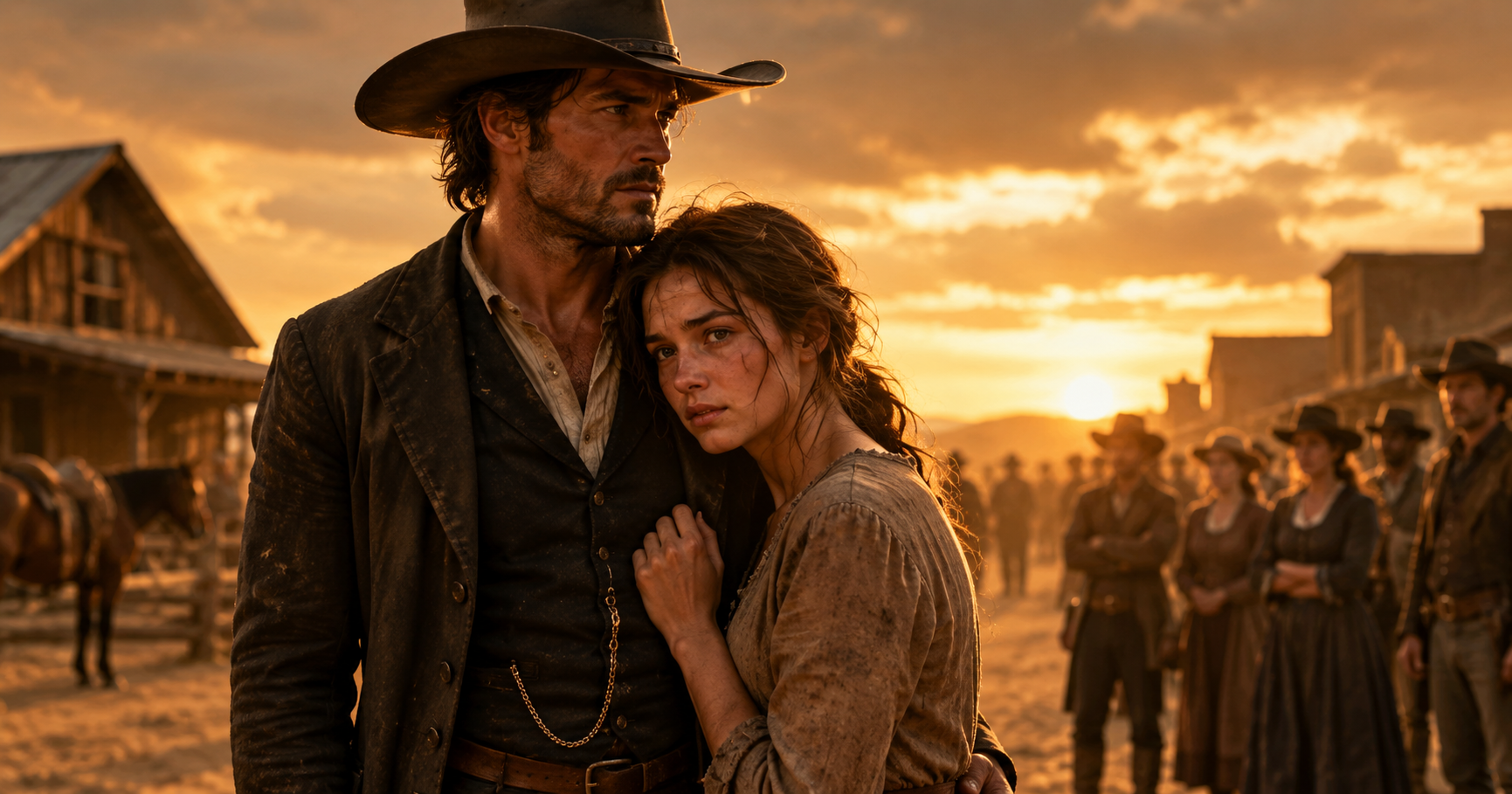
The Rancher Hired “Nobody” — Then the Giant Cowboy Fell for the Girl the Town Threw Away

Rowan Flint did not go into town looking for trouble.

He only needed flour, salt pork, coffee, lamp oil, and—if the Lord had decided to show mercy that week—a cook who could keep twelve hungry ranch hands from turning his kitchen into a battlefield.

By noon, he found the supplies.

By sunset, he found the cook.

And before winter, every respectable person in Briar Creek would swear that hiring that girl was the first foolish thing Rowan Flint had ever done.

They were wrong.

It was the first brave thing.

Rowan was known across the county for three facts. He was too tall for most doorways, too quiet for most conversations, and too stubborn for most men to threaten twice. He owned Stone Circle Ranch, a hard strip of land pressed between red hills and silver grass, where the wind came down at night like a living animal and the cattle learned early not to panic.

He had inherited the place from his father, along with old debts, tired fences, two hundred head of longhorns, and a reputation he had never asked for.

People called him the giant of Stone Circle.

Not because he was cruel.

Because he made them feel small.

Rowan did not smile often. He did not attend church socials. He did not gossip at the mercantile. He did not drink with the other ranchers after market days. He paid his bills, kept his fences mended, buried his dead animals without complaint, and lived as if needing people was a weakness best avoided.

Then his cook, old Mrs. Bellamy, slipped on a patch of mud, broke her hip, and was taken to her daughter’s house three counties away.

For three days, Rowan’s ranch hands lived on burnt beans, undercooked biscuits, and coffee strong enough to strip paint from a door.

On the fourth morning, his foreman, Abel Pike, set a blackened skillet on the table and said, “Boss, I’ll ride into town and confess to murder if it gets us a real meal.”

Rowan looked at the skillet.

“What did you murder?”

“Breakfast.”

So Rowan hitched the wagon and rode into Briar Creek.

He found no cook at the hotel.

No cook at the boardinghouse.

No cook at the widow’s kitchen, where Mrs. Voss looked him up and down and said, “A decent woman will not live under a bachelor’s roof, Mr. Flint. Surely you understand that.”

“I need someone to cook,” Rowan said.

“That is not the point.”

“It is the only point I came with.”

Mrs. Voss pursed her lips. “There are appearances to consider.”

Rowan had spent thirty-four years being disappointed by that word.

Appearances.

They had hanged more people in Briar Creek than ropes ever had.

He left before he said so.

The last place he stopped was the back of the laundry, where steam leaked from broken windows and women worked until their fingers cracked. He had only gone there because the mercantile clerk, eager to be rid of him, had muttered, “You could ask Maribel Ashe, I suppose. If you don’t care what people say.”

That was how Rowan first saw her.

Maribel Ashe stood over a boiling tub, sleeves rolled to her elbows, dark hair pinned badly at the back of her neck, a purple bruise fading along one cheekbone. She was not delicate. She was not polished. She had the kind of face that looked as if it had learned too early not to beg.

A woman beside her whispered something.

Maribel did not look up.

Rowan cleared his throat.

“I’m looking for a cook.”

The room went quiet in the way rooms do when people hope to witness harm without being blamed for it.

Maribel lifted her eyes.

They were gray.

Not soft gray.

Storm gray.

“I can cook,” she said.

The laundry mistress laughed sharply. “She can boil rags. Don’t make her sound grand.”

Maribel’s jaw tightened, but she said nothing.

Rowan looked at the laundry mistress. “I wasn’t speaking to you.”

That quieted the room more than shouting would have.

Maribel studied him for a moment, measuring danger against opportunity. “How many men?”

“Twelve. Sometimes sixteen.”

“Breakfast, supper, bread, coffee?”

“And whatever keeps them from mutiny.”

A flicker moved at the corner of her mouth. Not a smile. The memory of one.

“What does it pay?”

Rowan named a wage.

The laundry mistress snapped, “You cannot be serious.”

“I usually am.”

“She has no references.”

“I didn’t ask for any.”

“She has a history.”

Rowan looked back at Maribel. “Can you cook?”

“Yes.”

“Can you work hard?”

“I’ve done little else.”

“Can you ride in a wagon?”

“I can walk if I have to.”

“Then get your things.”

For the first time, the storm in her eyes broke.

Only for a second.

Then she untied her apron.

The laundry mistress stepped forward. “Mr. Flint, you do not know what you’re inviting into your home.”

Maribel stopped moving.

Rowan saw it then—the old wound beneath her silence. Not guilt. Not shame. Something placed on her by other hands and carried too long.

He took his hat from the peg.

“I’m inviting a cook.”

By evening, Briar Creek knew.

By the next morning, Briar Creek had improved the story.

By Sunday, respectable women were lowering their voices in church and men were pretending not to listen while listening very carefully.

Rowan Flint had taken Maribel Ashe to Stone Circle Ranch.

The unwanted girl.

The laundry girl.

The girl no one hired unless they wanted questions.

Some said she had ruined a man.

Some said she had been ruined by one.

Some said worse things because worse things are easy to say when the person being judged is not in the room.

At Stone Circle Ranch, Maribel said nothing about it.

She arrived with one canvas bag, one blue dress, one pair of boots nearly split at the sole, and a knife wrapped in cloth. Rowan gave her the small room beside the pantry and told Abel to inform the men that anyone who troubled her would be looking for work by noon.

Abel raised an eyebrow. “You expecting trouble?”

“I’m expecting men.”

“That’s not much faith.”

“It’s experience.”

The first supper she cooked was beef stew, corn cakes, fried onions, and coffee that did not taste like a punishment.

The men ate in stunned silence.

Then one of them, a young hand named Tommy, whispered, “I think I saw heaven.”

Maribel kept her face down, but Rowan saw her shoulders loosen.

A little.

Over the next week, the ranch changed.

Not loudly.

Not all at once.

Bread appeared under clean cloths. Coffee stayed hot. Supplies were counted, stretched, and saved. The kitchen smelled of pepper and yeast instead of smoke and panic. Men who had been growling at one another began showing up early to wash before meals. Even the dogs took to sleeping by the back door, waiting for scraps that came with suspicious regularity.

Maribel worked like she expected the floor to vanish beneath her.

She rose before dawn. She cooked. She scrubbed. She patched shirts when she thought no one noticed. She repaired the pantry latch with a bent nail and a piece of wire. She took inventory better than Rowan’s own ledger.

And she flinched whenever someone raised a hand too quickly.

Rowan noticed.

He noticed everything about her, which irritated him.

He noticed the way she never sat with her back to the door. The way she saved the smallest biscuit for herself. The way she went silent when men laughed too loudly. The way she spoke kindly to the old milk cow as if kindness was safer when given to animals.

One night, he found her outside the kitchen, staring across the dark pasture.

“You cold?” he asked.

“No.”

“Then why are you standing out here?”

“Because inside is quiet.”

“That’s usually why people go inside.”

She glanced at him. “Not the kind I mean.”

He understood more than he wanted to.

He stood beside her without asking questions.

After a while, she said, “They’ll come for you.”

“Who?”

“The town.”

Rowan looked toward the distant lights of Briar Creek. “Let them ride slow. It’s a long road.”

“You think stubbornness is armor.”

“It has worked so far.”

“No,” she said quietly. “It has only kept people from seeing where you bleed.”

He turned toward her.

Maribel seemed startled by her own words. She stepped back as if she had crossed a line.

“I’m sorry.”

“Don’t be.”

“I should go in.”

“Maribel.”

She stopped.

He wanted to ask who had taught her to apologize for truth. He wanted to ask about the bruise that had not yet faded from her face. He wanted to ask why the town looked at her as if mercy would be wasted.

Instead he said, “You’re doing good work here.”

Her face changed.

Not much.

But enough.

“Good work doesn’t make a person good,” she said.

“No,” Rowan replied. “But cruel people rarely worry about it.”

She looked at him for a long time.

Then she went inside.

The first warning came from the mercantile.

Rowan rode into town for sugar and nails and found Mr. Harrow waiting behind the counter with the face of a man who had already rehearsed his courage.

“Cash only now, Mr. Flint.”

Rowan set his list down. “Since when?”

“Since today.”

“I’ve had credit here for nine years.”

“Times change.”

“Do they?”

Harrow glanced toward the window, where two women pretended not to watch. “There are concerns.”

“About sugar?”

“About judgment.”

Rowan leaned one hand on the counter. The wood creaked.

Harrow swallowed.

“You refusing my credit because I hired Maribel Ashe?”

“I am protecting my business.”

“From biscuits?”

“From scandal.”

Rowan placed money on the counter one bill at a time.

“Give me the sugar,” he said.

On his way out, Mrs. Voss stood near the door and said, “A man who keeps the wrong company will find doors closing.”

Rowan paused.

“That sounds like a threat.”

“It is advice.”

“Then it’s poorly dressed.”

He walked out with his supplies and the knowledge that Briar Creek had decided to test him.

The church came next.

Reverend Amos Keene arrived at Stone Circle Ranch on a bright afternoon, wearing black wool too fine for dust and a smile too thin for charity.

Rowan met him at the porch.

“Reverend.”

“Mr. Flint. I come with concern.”

“People seem to travel far with that.”

The reverend’s smile stiffened. “A young woman of uncertain reputation living in your house creates a moral burden.”

“She works here.”

“Work does not erase impropriety.”

“Neither does a collar.”

The reverend’s eyes cooled. “You are making this difficult.”

“No. You rode seven miles to make it difficult.”

Maribel appeared in the kitchen doorway behind him. Rowan felt rather than saw her stop.

Reverend Keene lowered his voice. “That girl needs guidance.”

Rowan stepped off the porch.

The reverend looked up.

Rowan was not merely tall. He was built like a man carved from fence posts and storm weather. Most people forgot that until he stood close.

“She needs wages,” Rowan said. “She needs safety. She needs people to stop speaking about her like she’s a cracked dish.”

“You do not know what she has done.”

“I know what you are doing.”

The reverend’s face reddened. “You will regret setting yourself against this town.”

Rowan smiled then.

It was not comforting.

“I never belonged to it.”

The reverend left without blessing anyone.

Maribel did not thank Rowan.

Instead, she waited until supper was over, until the men had gone, until the kitchen lamp burned low. Then she said, “You should not have done that.”

Rowan was washing his hands at the basin. “He should not have come.”

“They won’t punish you in ways you can fight.”

“I can fight most things.”

“You can’t fight whispers with fists.”

“No.”

“You can’t punch a bank note.”

He looked at her.

She looked away.

“What do you know about bank notes?”

“Enough to know men with clean cuffs can ruin people faster than men with guns.”

He dried his hands slowly. “Who ruined you, Maribel?”

The question hung between them.

For a moment, he thought she would leave.

Instead she placed both hands on the table and stared at the wood.

“My father died owing money. My mother took in sewing until her eyes failed. When she died, the church put me with a family who needed help and called it charity. Their son decided I belonged to him because I slept under their roof.”

Rowan went very still.

“I ran before he could do worse than he already had. He told everyone I tempted him. The town believed him because his family owned land and I owned one dress.”

Her voice did not break.

That made it worse.

“I came to Briar Creek because nobody knew me. Then a woman from my old town passed through and told the story better. By the time it reached here, I was already guilty.”

Rowan’s hands curled around the towel.

Maribel noticed.

“Don’t look like that.”

“Like what?”

“Like you want to kill a dead past.”

“I was thinking about it.”

“It won’t help.”

“No,” he said. “But it would be honest.”

She almost smiled.

Almost.

Then she whispered, “I am tired of being a story other people tell.”

Rowan’s anger shifted into something deeper.

Something steadier.

“Then write a better one.”

Her eyes lifted to his.

“With what?”

He looked around the kitchen. At the clean shelves. The warm stove. The bread she had made. The ranch that felt less empty because she was in it.

“With whatever you have left.”

Three days later, the bank called Rowan’s loan.

Mr. Silas Creed sent a letter folded neatly enough to look innocent.

Rowan read it once in the barn.

Then again by the corral.

Then a third time in the kitchen while Maribel watched his face go hard.

“What is it?” she asked.

“Nothing.”

“Men only say nothing when something has teeth.”

He handed her the letter.

She read it.

The bank demanded full payment within sixty days.

If payment was not made, Stone Circle Ranch would be seized.

Maribel lowered the paper.

“This is because of me.”

“No.”

“Don’t lie kindly. It insults both of us.”

Rowan pushed away from the table. “It’s because Creed is a coward who found permission to act like one.”

“That does not change the amount.”

“No.”

“How short are you?”

“Too short.”

“Number.”

He hesitated.

She stared.

He told her.

For the first time since he had met her, Maribel looked afraid in a way she could not hide.

Then she stood.

“I’ll leave.”

“No.”

“If I leave, they may stop.”

“They won’t.”

“You don’t know that.”

“Yes, I do.”

She slammed her palm on the table. “You are going to lose your ranch because you hired me to make biscuits.”

Rowan stood too.

The chair scraped across the floor.

“I am not losing my ranch because you cooked supper. I am losing it because small men hate seeing someone stand upright.”

“That sounds noble until they take your land.”

“Then I’ll be noble and homeless.”

“That is not funny.”

“I wasn’t joking.”

She stared at him, furious and terrified.

Then Abel appeared in the doorway and cleared his throat.

“There’s a cattle drive leaving north in six days,” he said. “Big outfit. Hard country. They lost their cook to fever.”

Rowan turned. “No.”

Maribel looked at Abel. “What does it pay?”

“No.”

Abel rubbed his jaw. “More than fair. Hazard pay too. Trail boss is desperate.”

“No,” Rowan repeated.

Maribel’s eyes flashed. “You don’t get to no me.”

“You’ve never cooked on a drive.”

“I had never cooked for twelve ranch hands until last week.”

“A cattle drive is not a kitchen.”

“Neither is a laundry, but I survived that.”

“It is dangerous.”

“So is staying where people can starve you politely.”

Rowan had no answer for that.

The trail boss was named Harlan Saye. He had a beard like winter brush and eyes that looked through people before deciding whether they were useful. He met Maribel outside the stockyard and laughed before she said a word.

“I asked for a cook,” he said.

“I am one.”

“I asked for someone trail-tested.”

“I’m life-tested. It’s harder.”

Harlan’s grin faded a little.

“You ever slept under a wagon in a storm?”

“No.”

“Ever fed thirty men with wet flour and half a fire?”

“No.”

“Ever had a drunk hand decide you’re entertainment?”

Maribel looked at him coldly.

“Yes.”

The old trail boss stopped smiling altogether.

Rowan stood beside her, silent, trying not to interfere and failing at it in his bones.

Harlan spat into the dust. “Men on the trail can be ugly.”

“So can men in town.”

“One mistake and I send you back.”

“One mistake and I’ll pack myself.”

“You got a knife?”

“Yes.”

“You know how to use it?”

“I know where men bleed.”

Harlan stared.

Then he barked a laugh. “Dawn. Monday. Chuck wagon. Don’t slow me down.”

On the ride home, Rowan said nothing for nearly a mile.

Finally Maribel asked, “Are you angry?”

“Yes.”

“With me?”

“With the world. You’re just closest.”

“That’s not fair.”

“No.”

The wagon wheels creaked over the rutted road.

Then he said, quieter, “Come back.”

She looked at him.

It was the closest he had ever come to asking for anything.

“I intend to.”

“Intentions don’t hold against rivers, fever, and fools.”

“Then I’ll be more stubborn than all three.”

He looked at her then, and something passed across his face so naked that she had to look away.

On Monday before dawn, she climbed onto the chuck wagon with a bedroll, two dresses, a skillet, and the knife wrapped in cloth.

Rowan stood by the corral, his hat low.

The sky was pale.

The world smelled of dust and horses.

Maribel looked down at him.

“You’ll keep the ranch standing?”

“I’ll try.”

“That is not an answer.”

“It is the only honest one.”

She nodded.

Then the wagons rolled out.

For the first week, the men tested her.

They complained about the coffee.

They complained about the biscuits.

They complained that she was too quiet, then that she spoke too sharply, then that she looked at them like she was sharpening nails behind her eyes.

A rider named Clete Morrow made himself her enemy by supper on the second night.

“Cook’s too pretty for the trail,” he said, loud enough for the others.

Maribel stirred beans and did not look up.

On the fourth night, he kicked over a water bucket.

She refilled it.

On the seventh, he left a dead snake in her flour sack.

She removed the snake, sifted the flour, and served him the hardest biscuit.

He bit into it and cursed.

She said, “Careful. That one has bones.”

The men laughed.

Clete did not.

The trouble came two nights later.

Rain had been threatening all day. The herd was nervous. Lightning crawled across the hills like white veins. Maribel was tying down supplies when Clete came up behind the wagon.

“You think the boss likes your sharp tongue,” he said.

“I don’t think about you enough to answer.”

He grabbed her wrist.

The entire camp seemed to pause.

Maribel looked at his hand.

Then at his face.

“Let go.”

“Or what?”

She drove her knee into him hard enough that he folded. Before he could breathe, she had her knife out and pressed flat—not cutting, just promising—against his throat.

The rain began.

One drop.

Then another.

Harlan Saye appeared from the dark.

“Problem?” he asked.

Maribel did not move the knife.

“He forgot his manners.”

Harlan looked at Clete, wheezing in the mud.

“Find them fast,” he said. “Or ride out before breakfast.”

By morning, Clete was gone.

After that, the men still complained.

But they did it at a safer distance.

Then the trail turned cruel.

A hailstorm split the sky and tore the canvas cover from the chuck wagon. Maribel drove the team half-blind through mud while a wheel threatened to break. A flash flood swallowed their low camp and took two crates of beans, three sacks of flour, and a man’s boot. She spent the night drying coffee over coals while the men shivered and cursed.

When a calf broke its leg, she held the lantern while Harlan did what had to be done.

When Tommy—Rowan’s youngest hand, sent along to earn extra pay—caught fever, she sat beside him for two nights, forcing water between his teeth until he cursed her with enough strength to prove he might live.

On the thirty-first day, Harlan handed her a cup of coffee she had not poured herself.

“You’re still here,” he said.

“So are you.”

“I expected you to quit.”

“I expected you to be smarter.”

His old face cracked into a grin.

That was the first time the trail accepted her.

Not kindly.

The trail was not kind.

But honestly.

Back at Stone Circle, Rowan was learning that silence did not save a man from needing people.

The bank pressed harder.

The mercantile cut him off completely.

The church ladies stopped hiring Stone Circle hands for odd jobs.

Then lightning struck the south ridge.

Fire came down the grassland faster than horses could run.

Rowan saw the smoke at midafternoon. By dusk, the sky was red and the wind had teeth. He and Abel dug firebreaks until their palms tore open. Men soaked blankets and beat sparks from fence posts. The cattle bawled in panic.

By midnight, Rowan knew they were losing.

“Get the horses out,” he told Abel.

“And you?”

“I’ll stay with the barn.”

Abel stared. “That barn ain’t worth your life.”

“It’s worth more than my fear.”

“That’s a stupid sentence.”

“Probably.”

He was dragging water from the well when riders came through the smoke.

At first he thought the town had come to watch him burn.

Then he saw Mrs. Voss.

Behind her came three wagons, six ranchers, four women with wet blankets, and a dozen boys carrying shovels.

Rowan stood frozen.

Mrs. Voss climbed down from the wagon, soot already streaking her face.

“Don’t stand there looking tragic,” she snapped. “Tell us where to dig.”

Rowan stared at her. “You came?”

She looked embarrassed enough to be angry about it.

“Yes, Mr. Flint. Apparently some of us remembered the Bible has more pages than scandal.”

They fought the fire until dawn.

When the wind shifted, the flames bent east and ran toward empty range. Stone Circle survived with black scars across the hills, a burned fence line, and a barn roof that smoked for two days.

Rowan stood in the ash, exhausted beyond pride.

Mrs. Voss handed him a canteen.

“I was wrong about the girl,” she said.

He looked at her.

She did not meet his eyes.

“I was wrong about you too.”

Rowan drank.

Then he said, “That must have hurt.”

She snorted. “Like childbirth.”

A week later, letters began arriving for Maribel.

One from Tommy, telling her the ranch still stood.

One from Abel, badly spelled but sincere.

One from Rowan, short enough to fit inside a matchbox and heavy enough to keep in her pocket.

Stone Circle is still here.

So am I.

Come back when you can.

She read that last line until the paper softened at the fold.

The drive ended in Abilene after fifty-seven days of dust, blood, weather, and men pretending they were not grateful for the woman who had kept them fed.

Harlan paid her in full.

Then he added another envelope.

“What’s this?” she asked.

“Bonus.”

“I didn’t ask for one.”

“That’s why you’re getting it.”

She tried to hand it back.

He refused.

“You earned more than money, girl. Take both.”

When Maribel returned to Briar Creek, she did not go to Stone Circle first.

She went to the bank.

She walked through the front door with sun-darkened skin, cracked hands, a trail knife at her belt, and the calm of a woman who had stopped asking permission to exist.

Silas Creed looked up from his desk.

His smile died.

“Miss Ashe.”

“Mr. Creed.”

“I assume Mr. Flint sent you.”

“No. That’s why this will go better.”

His eyes narrowed. “I do not discuss a man’s business with hired help.”

Maribel placed the first envelope on his desk.

“Payment.”

Creed glanced at it. “Partial.”

She placed a second envelope beside it.

“More payment.”

His mouth tightened.

Then she placed a stack of signed notes on the desk.

Statements from Mrs. Voss.

From Abel.

From Harlan Saye.

From two ranchers who had helped fight the fire.

From a newspaper man in Abilene who had been very interested in the idea of a bank using moral gossip to force foreclosure on a profitable ranch.

Creed went pale.

Maribel sat down without being invited.

“You called that loan because Reverend Keene and half the town wanted Rowan punished for hiring me. You dressed spite as risk. You dressed cruelty as policy. I have no education, Mr. Creed, but I know costumes when I see them.”

Creed’s hand twitched toward the papers.

She placed her knife on top of them.

Not pointed at him.

Just visible.

“You will accept payment. You will extend the remaining balance thirty days. And you will never again use a bank note like a whip.”

His voice went thin. “You cannot threaten me.”

“I’m not threatening you. I’m giving you a chance to look merciful before everyone finds out you were afraid of a cook.”

The door opened behind her.

Mrs. Voss walked in.

Then Abel.

Then two ranchers.

Then the newspaper man from Abilene, smiling like breakfast had arrived.

Creed stared at them.

Maribel leaned back.

“It appears,” she said, “you have witnesses.”

By the end of the hour, the payment was accepted.

The extension was signed.

And Silas Creed looked as if he had swallowed his own reputation.

When Maribel reached Stone Circle, Rowan was repairing a fence post near the lower pasture.

He saw her wagon coming and stopped moving.

For a moment, neither of them did anything.

Then he walked toward her.

Not fast.

Rowan Flint did not run.

But he crossed that pasture like a man whose whole life had narrowed to the distance between himself and one wagon.

Maribel climbed down.

He looked at her face, her hands, the dust on her skirt, the exhaustion in her shoulders.

“You came back,” he said.

“I said I would.”

He swallowed once.

Then she handed him the bank receipt.

He read it.

His eyes lifted.

“How?”

“I cooked. I fought. I embarrassed a banker.”

“That sounds like you.”

“It is becoming me.”

He looked at the receipt again, then at her.

For once, words failed him completely.

Maribel waited.

“You could say thank you,” she suggested.

“Thank you.”

“You could say you’re glad I’m alive.”

“I am very glad you’re alive.”

“You could say you missed me.”

His jaw tightened.

The wind moved through the grass.

Finally he said, “Every meal tasted worse without you.”

She stared at him.

Then laughed.

It surprised both of them.

Rowan looked wounded. “That was not the right answer?”

“It was the most you answer.”

He stepped closer.

“Maribel.”

Her laughter faded.

“Yes?”

“I missed you.”

There it was.

Plain.

Rough.

Honest enough to hurt.

She looked down because looking at him suddenly felt dangerous.

“I missed this place,” she said.

He nodded, though disappointment flickered across his face before he could hide it.

She took mercy on him.

“And you.”

The giant of Stone Circle Ranch stood very still.

Then, with great care, as if touching something breakable and not wanting to be the kind of man who broke it, Rowan reached for her hand.

She let him take it.

That night, after supper, after Abel made three terrible jokes and Tommy asked if trail cooking had made her meaner, after the men left and the kitchen quieted, Maribel found Rowan on the porch.

The stars were out.

The land smelled of ash and summer grass.

“I need to tell you something,” she said.

He turned.

“I am not staying because I owe you.”

“I know.”

“I am not staying because the town changed its mind.”

“I don’t care if it did.”

“I am not staying because I have nowhere else.”

He looked at her then.

“Why are you staying?”

Maribel folded her arms, as if holding herself together.

“Because when I came here, you did not ask me to prove I was innocent before you let me work. Because you gave me wages before you gave me questions. Because you made this house feel like a place where I could put something down.”

Her voice shook once.

Only once.

“And because somewhere between the bread and the fire and the bank, I stopped feeling unwanted.”

Rowan’s face changed.

Slowly.

Painfully.

Like a locked door opening from the inside.

“You were never unwanted here.”

“I know that now.”

He stepped closer.

“I am not good with pretty words.”

“No one expected miracles.”

“That may be a problem.”

“Why?”

“Because I need one.”

She looked up at him.

Rowan reached into his vest pocket and took out a ring. It was plain gold, old, scratched thin with years. No jewel. No flourish. Just a circle that had survived being worn.

“My mother’s,” he said. “I kept it because it was the only thing in this house that still knew how love looked.”

Maribel could not breathe.

“Rowan.”

“I can offer you a hard life. Weather. Cattle. Bad coffee when you’re away. A town that may need years to learn decency. A man who says the wrong thing before the right one.” He paused. “But I can also offer you my name without ownership, my home without condition, and my hand without shame.”

Her eyes filled.

He dropped to one knee on the porch boards.

The giant cowboy kneeling before the girl the town had thrown away.

“Maribel Ashe,” he said, voice rough, “will you build a life with me?”

For a second, all she could hear was the wind.

Then she laughed through tears.

“You make it sound like fence work.”

“It might be.”

She wiped her cheek.

“Yes,” she whispered. “I’ll build it.”

He slid the ring onto her finger.

It fit badly.

They both laughed.

The wedding took place in the lower pasture three weeks later.

Not in Reverend Keene’s church.

No one asked him.

Mrs. Voss baked three pies and threatened anyone who mentioned it. Abel stood beside Rowan and cried openly, then claimed dust had attacked his eyes. Harlan Saye rode in from the trail with a gift of cast iron pans and told Maribel she was still the meanest cook he had ever hired, which from him was a blessing.

The newspaper man came too.

Not for scandal.

For cake.

Briar Creek attended because towns attend weddings whether they approve or not. Some came curious. Some came ashamed. Some came because they had fought the fire and learned that helping a man made it harder to hate him.

Maribel walked down no church aisle.

She crossed the grass by herself.

Head high.

No veil over her face.

No father giving her away.

She had already been given away by too many people.

This time, she arrived.

Rowan watched her come with the look of a man seeing rain after drought.

Their vows were simple.

No obedience.

No possession.

No promises to become smaller for each other.

Only this:

To stand.

To stay.

To tell the truth.

To make room.

When Rowan kissed her, the ranch hands cheered loud enough to scare the horses.

Years later, people would tell the story differently.

They would say Rowan Flint saved Maribel Ashe.

They would say the giant cowboy rescued the unwanted girl.

They would say love softened him and respect restored her.

Maribel never liked that version.

It was too neat.

Too easy.

The truth was harder and better.

Rowan had hired a cook because his men were starving.

Maribel had taken the job because survival was not prideful enough to refuse wages.

The town had tried to break them both because people often mistake cruelty for order.

And somewhere in the middle of debt, fire, hunger, shame, and stubborn hope, two lonely people had stopped disappearing.

The ranch grew after that.

Stone Circle became the place women came when they needed work and no questions. Men came when they needed second chances and were willing to earn them. Boys learned that strength without kindness was just noise. Girls learned that a reputation built by liars could be outlived.

The bank changed hands.

The church changed preachers.

Mrs. Voss changed slower than both, but she changed.

On quiet evenings, Maribel would stand on the porch with Rowan beside her and look over the land that had nearly been taken from them.

Sometimes she still felt the old fear.

Fear did not vanish just because love arrived.

But now it had less room.

One autumn night, with the sky turning copper and the cattle moving like shadows beyond the fence, Rowan asked, “Do you ever wish you had gone somewhere else?”

Maribel leaned against him.

“No.”

“Never?”

She thought about the laundry steam. The whispering women. The first wagon ride to Stone Circle. The bruise on her cheek. The bank receipt in her hand. The ring that still fit badly and meant everything.

“I used to think being unwanted was something people could make true by saying it often enough.”

Rowan’s arm tightened around her waist.

“And now?”

She smiled into the wind.

“Now I think people are wrong about nearly everything until someone proves otherwise.”

He looked down at her. “You proved otherwise.”

“So did you.”

The house glowed behind them.

The ranch breathed around them.

And far beyond the fence line, Briar Creek kept telling stories.

But this time, Maribel did not care who told them.

She had written her own.

And it was no longer about the girl nobody wanted.

It was about the woman who stayed.

The woman who fought.

The woman who built a home out of the very place meant to ruin her.

And the giant cowboy who hired “nobody”—

only to discover she was the one person strong enough to help him become the man the town could not break.

The Rancher Hired “Nobody” — Then the Giant Cowboy Fell for the Girl the Town Threw Away
‘Baywatch’ alum Donna D’Errico slammed for seductive snaps