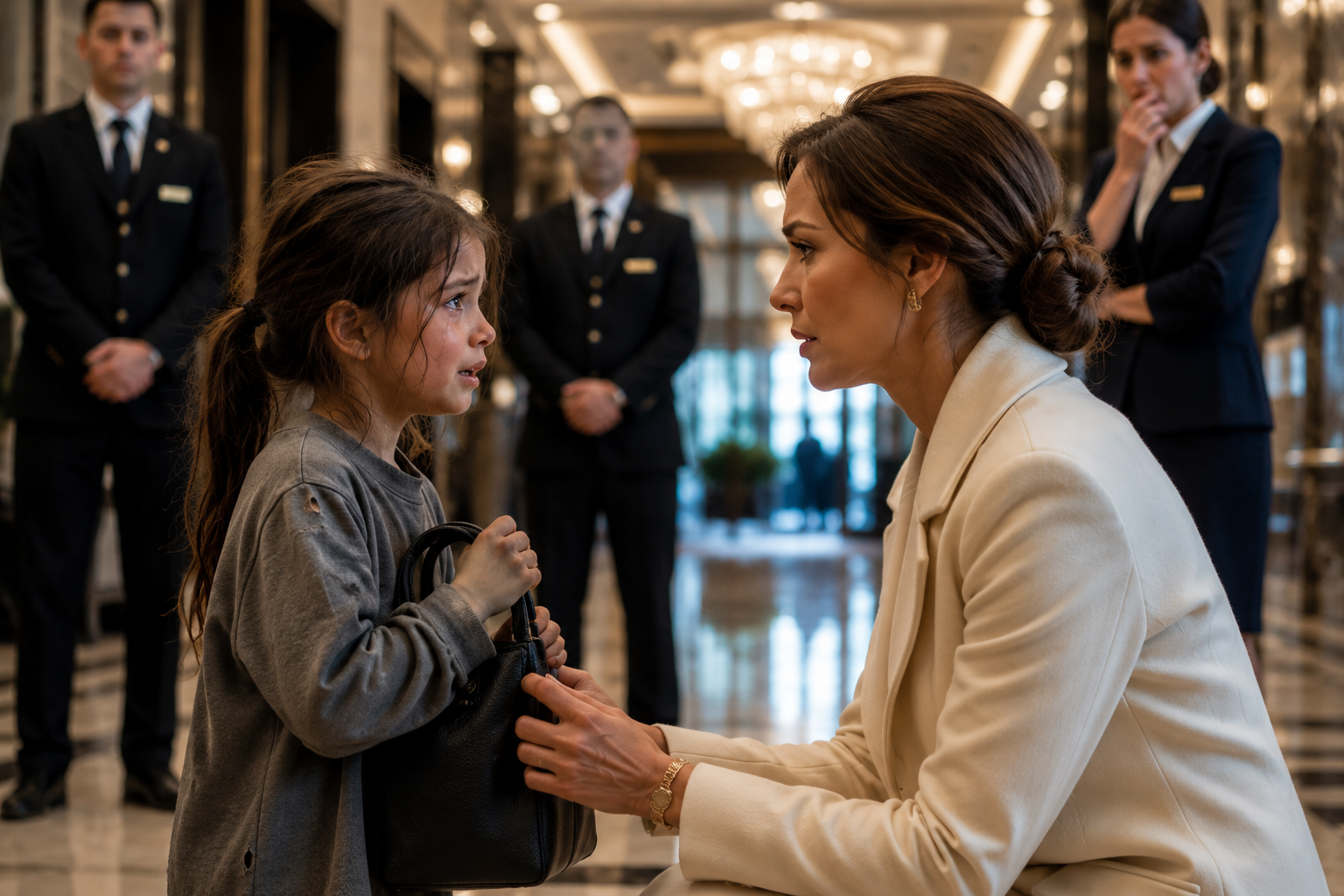
“How did you get here?” Evelyn asked.
“I took two buses. Then I walked.”
“Were you alone?”
Lily nodded.
“Grandma gave me the hotel name before she went to the hospital. She told me the date and said you would be here for an important meeting.”
Evelyn looked down at the conference folder still tucked beneath her arm.
She had come to the hotel to negotiate a major development contract.
An hour earlier, she had believed it was the most important meeting of her year.
Now she could not remember the name of the company involved.
She reached carefully toward Lily.
The girl stiffened but did not step away.
“I am sorry,” Evelyn whispered. “I’m sorry I called you a thief.”
Lily looked down.
“I only grabbed the bag because you were walking away. I called your name, but you didn’t hear me.”
“I should have listened.”
“Grandma said sometimes important people forget how.”
The words were not spoken cruelly.
That made them hurt more.
Evelyn nodded.
“Your grandmother was right about many things.”
She remained on her knees, unable to find words large enough for what had happened.
Then Lily reached out and placed her small, dirty hand against Evelyn’s tear-soaked cheek.
“Don’t cry,” she said. “Grandma cried when she talked about you too. But she said tears wash away the things people are afraid to say.”
Evelyn covered Lily’s hand with both of hers.
This time, she did not release it.
The Room Upstairs
Grace arranged a private hotel room where Evelyn and Lily could speak without strangers watching them.
She contacted a child welfare officer and, at Evelyn’s request, called the attorney who had handled the firm’s most confidential legal matters.
Everything had to be done correctly.
Lily was a child who had recently lost the only family she knew. A revelation, no matter how powerful, could not erase legal responsibilities or emotional consequences.
While they waited, Grace brought food.
Lily stared at the neatly arranged sandwiches and fruit as though she was afraid to touch them.
“You can eat whatever you like,” Evelyn said.
“Do I have to pay?”
“No.”
“Are you sure?”
“I’m completely sure.”
Lily chose half a sandwich and ate slowly, saving the other half in a napkin.
Evelyn noticed.
“You can have more later.”
“It’s for tomorrow.”
“There will be food tomorrow.”
Lily looked at her cautiously.
“How do you know?”
The question struck Evelyn harder than any accusation could have.
“Because I will make sure of it,” she said.
Lily did not answer, but she unfolded the napkin and finished the sandwich.
After eating, she took a shower in the hotel bathroom. Evelyn ordered clean clothing from a nearby shop.
When Lily emerged wearing a soft blue sweater and dark trousers, her hair damp and combed, Evelyn had to sit down.
Without the dirt and oversized clothing, the resemblance was undeniable.
It was in the eyebrows, the eyes, the shape of the face, and even the way Lily pressed her lips together when she felt uncertain.
For several seconds, Evelyn could only stare.
Lily shifted uncomfortably.
“Do I look wrong?”
“No,” Evelyn said quickly. “You look like someone I thought I would never meet.”
They talked for hours.
Lily told her about the small house where she had lived with Rebecca and Margaret. The floors were made of concrete, the roof leaked during heavy rain, and two hens wandered through the narrow garden.
She loved books.
She wanted to become a teacher.
She knew the capitals of almost every country in the Western Hemisphere and could recite them in alphabetical order.
Rebecca had worked long hours sewing uniforms. Margaret had grown herbs near the kitchen window and told stories at night when the electricity failed.
Evelyn listened without checking her telephone.
It was the first time in years she had given another person her complete attention.
When it was her turn to speak, she told Lily the truth.
She explained how young she had been, how frightened she was, and how completely she had believed her parents.
“Would you have looked for me?” Lily asked.
Children rarely soften the questions adults spend their lives avoiding.
Evelyn could have lied.
She could have said yes immediately and presented herself as another victim of the deception.
Instead, she chose honesty.
“I don’t know,” she admitted. “At nineteen, I was afraid of everyone. I allowed other people to make decisions for me. I wish I could tell you I would have been brave, but I’m not certain that I would have been.”
Lily studied her.
“But now?”
“Now I will not abandon you.”
“You don’t know me.”
“Then I’ll learn.”
“What if you don’t like me?”
“I already know you took two buses and walked across the city because you were brave enough to bring me the truth. I know you save food for tomorrow. I know you love books and want to teach. I think that is a very good beginning.”