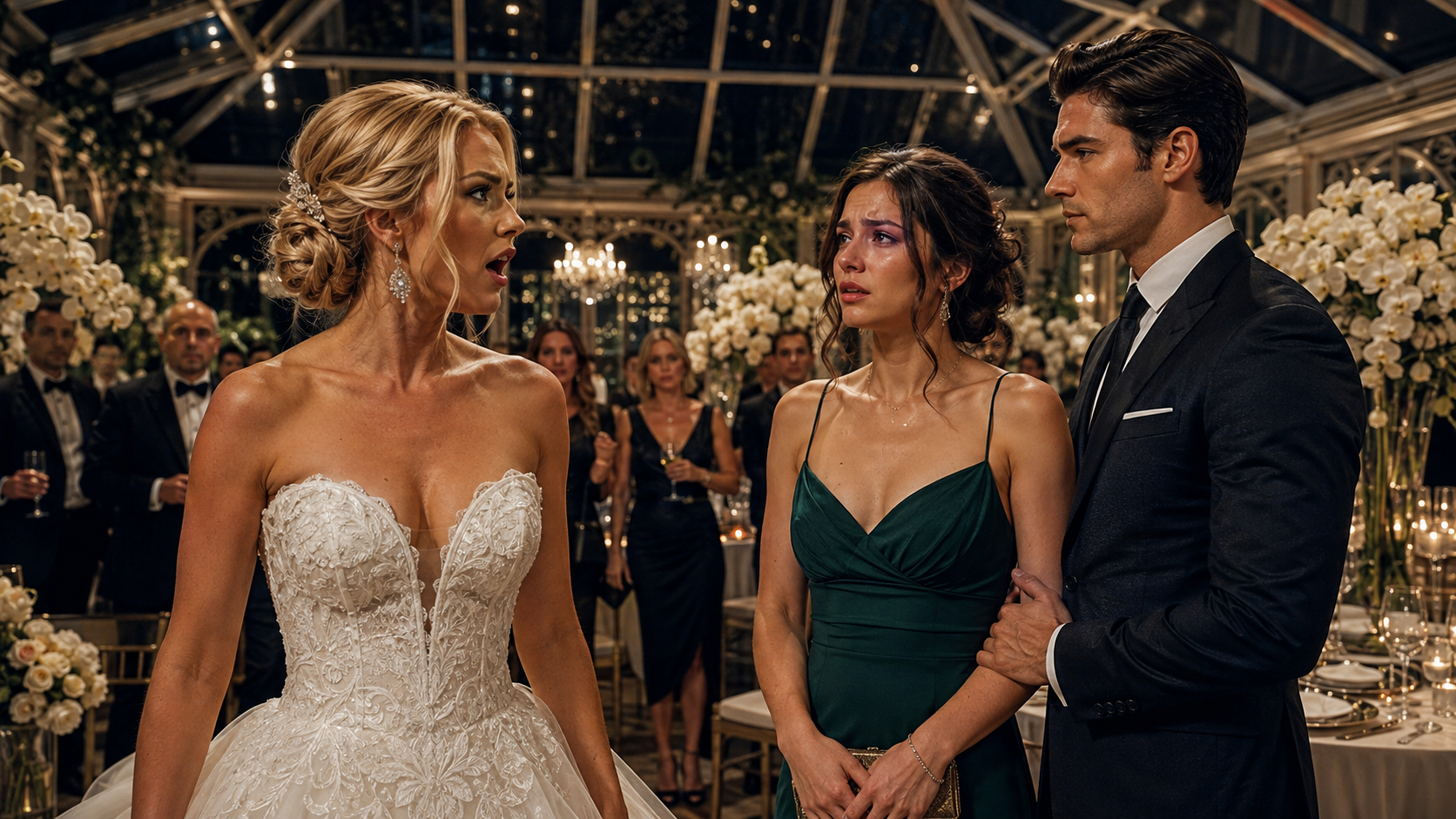
No one could see Adrienne standing alone near the microphone.
From a distance, perfection was incredibly convincing.
Lena turned away.
“I think I will be.”
Noah opened the passenger door of his very ordinary sedan.
Before getting in, Lena looked at him.
“You really weren’t going to reject their financing because of tonight?”
“No.”
“Even after what she said?”
“No.”
She studied him.
“You are a better person than I am.”
Noah shook his head.
“No. I just don’t want to become the kind of man who thinks power exists to settle personal scores.”
Lena smiled.
“That’s annoyingly reasonable.”
“I’ve been told.”
They drove away.
The Halden situation did not disappear after the wedding.
Three days later, the company’s board announced an independent review.
Two senior managers were suspended.
A month later, investigators confirmed that contractors connected to several Halden properties had submitted falsified maintenance documents and that employee overtime complaints had been improperly suppressed.
Hawthorne Stewardship did not approve the original refinancing agreement.
But Noah did not destroy the company either.
A new proposal was eventually accepted after the board replaced several executives, strengthened worker protections, appointed outside compliance officers, and agreed to sell two failing properties.
Marcus lost his executive position.
His father stepped down from the board.
The Halden family remained wealthy.
Just not untouchable.
For Adrienne, the months after the wedding were quieter.
The photographs appeared in magazines and society pages.
They looked beautiful.
Nobody viewing them could know that twenty minutes after the cake was cut, the bride had cried alone in a dressing room.
Nobody could know that her honeymoon had been shortened because Marcus spent most of it on calls with lawyers.
Nobody could know that for nearly four months, Lena did not answer Adrienne’s messages.
At first the messages were defensive.
I was embarrassed.
You didn’t have to do that in front of everyone.
You know I didn’t mean it like that.
Then came explanations.
Then excuses.
Then silence.
Finally, one evening in November, Lena received a letter.
Not a text.
Not an expensive gift.
Not flowers.
A letter.
Adrienne had written it by hand.
She did not mention Noah’s position.
She did not mention Marcus.
She did not mention the wedding guests.
She listed memories.
The thrift-store dress.
The apartment.
The job.
The comments about money.
The jokes.
One by one.
At the end she wrote:
I kept thinking an apology was supposed to make you forgive me. I understand now that an apology is supposed to acknowledge what I did whether you forgive me or not.
Lena read the letter twice.
Then she placed it in a drawer.
She didn’t call immediately.
Two weeks later, she sent her sister a message.
Coffee next Thursday?
Adrienne responded less than a minute later.
Yes.
When they met, there were no cameras.
No champagne.
No designer dresses.
Just two sisters sitting near the window of a small neighborhood café.
Adrienne arrived first.
For once, she didn’t comment on the furniture.
She didn’t complain about the menu.
She didn’t mention how much anything cost.
When Lena sat down, Adrienne looked nervous.
“I’m glad you came.”
Lena nodded.
“So am I.”
Adrienne swallowed.
“Do you forgive me?”
Lena thought about the question.
“Partly.”
Adrienne looked surprised.
Lena smiled gently.
“Forgiveness isn’t the same as pretending nothing happened.”
Adrienne lowered her eyes.
“I know.”
“And being family doesn’t give us unlimited permission to hurt each other.”
“I know that too.”
Lena reached for her coffee.
“Good.”
For a while they simply sat there.
It was awkward.
Imperfect.
Real.
And perhaps that was why it mattered.
Adrienne had spent most of her life thinking dignity could be measured by what a person displayed.
A house.
A name.
A watch.
A wedding.
She had needed one terrible evening to understand something Lena had known for years:
The loudest person in a room is not necessarily the strongest.
The richest person is not necessarily the most powerful.
And the person who appears to have the least may be the only one who has nothing to prove.
But there was one lesson even more important.
Noah Quinn’s wealth had never been the reason Adrienne was wrong.
His position had never been the reason Lena deserved respect.
Even if Noah had been exactly what Adrienne assumed — an ordinary man with an ordinary salary driving an aging car — the cruelty would have been just as cruel.
That was the truth Adrienne finally had to face.
Respect that appears only after discovering someone’s status isn’t respect.
It’s fear wearing good manners.
And kindness offered only to people who can reward you isn’t kindness at all.