THE PRICE OF APPEARANCES

By the time the first string quartet began playing beneath the glass ceiling of the Halcyon Conservatory, Adrienne Vale was already certain that her wedding would be remembered for years.

She had planned it that way.

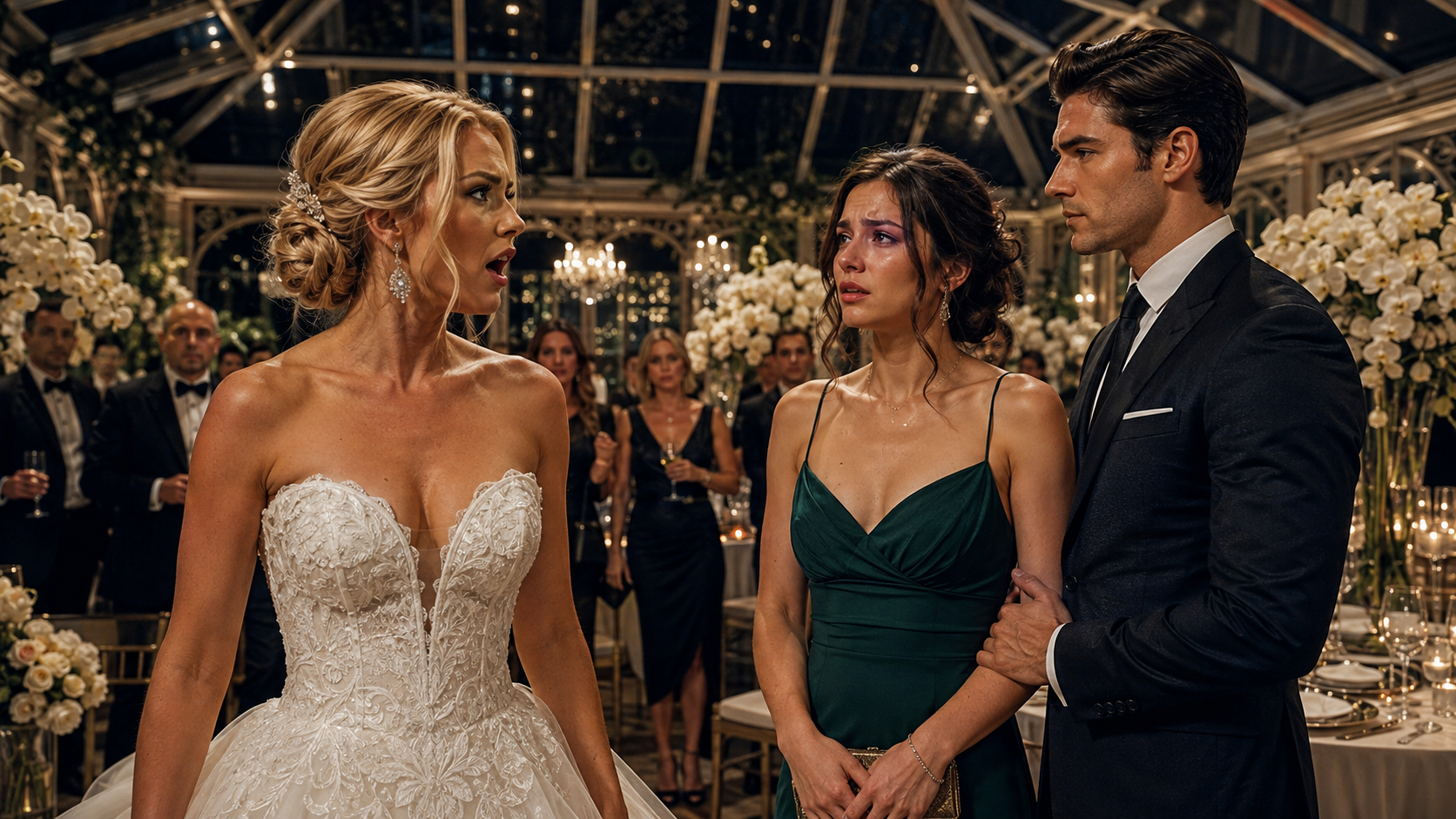
The old botanical hall had been closed to the public for three days while florists, lighting designers, caterers, musicians, and decorators transformed it into something that looked less like a wedding venue and more like a palace built inside a garden.

Thousands of white orchids climbed the iron columns.

Tiny lights floated above the tables like trapped stars.

Every place setting carried the guest’s name written by hand on thick ivory cards edged with gold.

Even the champagne had been chosen because the vineyard produced fewer than two thousand bottles a year.

Adrienne knew that because she had told people at least six times.

At the center of the room, beneath an arch of pale roses, she stood beside her new husband, Marcus Halden.

Marcus was thirty-four, handsome in the polished, carefully maintained way of a man who had spent his entire life being photographed at charity events.

His family controlled Halden Urban Resorts, a real-estate and hospitality company whose name appeared on luxury hotels, private clubs, apartment towers, and waterfront developments across several cities.

People knew the Halden name.

That mattered enormously to Adrienne.

She had always believed that success should be visible.

A successful man drove the right car.

A successful woman wore the right dress.

A successful marriage should make other people slightly jealous.

And tonight, judging by the admiring faces surrounding her, Adrienne believed she had achieved all three.

There was only one person in the room who seemed entirely unimpressed.

Her younger half-sister, Lena.

Lena sat near the end of the family table wearing a dark green dress that had probably cost less than Adrienne’s shoes.

Her hair was pinned loosely behind her head.

She wore no necklace.

No glittering earrings.

No designer handbag carefully positioned where photographers might notice it.

She looked comfortable.

Adrienne had never understood how anyone could look comfortable at an event where there were people worth impressing.

Beside Lena’s empty chair sat another place card.

NOAH QUINN.

Lena’s husband.

Late, apparently.

Adrienne had expected nothing else.

She had met Noah only a handful of times since he and Lena married eighteen months earlier.

He was quiet.

Painfully quiet, in Adrienne’s opinion.

He drove an ordinary gray sedan.

He wore the same watch nearly every time she saw him.

He didn’t talk about vacations, investments, restaurants, or property.

When Adrienne had once asked him what he did for a living, Noah had answered, “I work in investment governance.”

Adrienne had smiled sympathetically.

She assumed that meant paperwork.

Later, she told Marcus that Lena had married “some sort of financial administrator.”

Marcus had been distracted by a phone call and barely responded.

Adrienne had never asked again.

Why would she?

Noah Quinn clearly wasn’t important.

And in Adrienne’s world, unimportant people required very little investigation.

The first dinner course had been cleared when Adrienne rose from her chair and tapped a spoon against her glass.

Conversation softened.

The quartet stopped.

Two hundred guests turned toward her.

Adrienne smiled.

She loved rooms that became quiet when she stood up.

“I know the bride isn’t traditionally supposed to give another speech,” she began, and laughter moved politely through the hall, “but nobody has ever accused me of being traditional.”

More laughter.

Marcus grinned.

Adrienne thanked his parents.

She thanked her mother.

She praised the planners, the musicians, the chefs, and the friends who had flown across the country.

Then her eyes landed on Lena.

“And, of course,” Adrienne said, “I have to thank my little sister.”

Lena looked up.

Something in Adrienne’s expression made her shoulders tighten.

“Lena and I have always been very different.”

A few relatives exchanged glances.

They knew where this was going.

Adrienne continued anyway.

“I was always the ambitious one.”

She gestured toward the room.

“As you can probably tell.”

Guests laughed.

“Lena was the romantic.”

Adrienne smiled toward her sister.

“She never cared about status. Or labels. Or money.”

Lena lowered her glass.

“Adrienne,” she said quietly.

But Adrienne pretended not to hear.

“Actually, I admire that about her.”

The words sounded kind.

The smile did not.

“She could walk past a luxury boutique without even looking through the window.”

Another ripple of laughter.

“She once told me the best coffee she’d ever had came from a gas station.”

This time the laughter was louder.

Lena stared down at the table.

Adrienne felt the room responding and continued.

“And then she met Noah.”

Several guests looked toward the empty seat.

Adrienne sighed theatrically.

“I suppose everyone should experience true love at least once. Even if true love apparently drives a ten-year-old sedan.”

A few people laughed openly.

Marcus’s smile weakened.

“Adrienne,” he murmured.

She waved him off.

“Lena has always said money doesn’t matter.”

Her gaze returned to her sister.

“Fortunately for Noah.”

The laughter came quickly.

It lasted only three seconds.

To Lena, it felt much longer.

She had spent most of her life learning how to survive Adrienne’s jokes.

When they were children, Adrienne mocked her freckles.

In high school, she mocked her secondhand clothes.

In college, she mocked Lena for choosing urban planning instead of finance.

When Lena worked for a nonprofit neighborhood redevelopment organization, Adrienne called it “volunteering with a salary.”

Every insult arrived disguised as humor.

And whenever Lena objected, Adrienne used the same defense.

You are too sensitive.

So Lena learned to smile.

She learned to let things pass.

She learned that protecting the peace usually meant sacrificing a small piece of herself.

But tonight felt different.

Maybe because she was thirty-one now.

Maybe because she was married to a man who had never once required her to make herself smaller.

Or maybe she was simply tired.

“That’s enough,” Lena said.

Adrienne blinked.

The microphone remained close to her mouth.

“What?”

“I said that’s enough.”

There was no anger in Lena’s voice.

That somehow made the words stronger.

Adrienne gave a nervous little laugh.

“Oh, come on. I’m joking.”

“You’re enjoying it.”

The room went still.

Adrienne’s smile tightened.

Before she could answer, one of the glass doors at the rear of the conservatory opened.

A man stepped inside.

He paused beside the entrance, scanning the tables.

Noah Quinn had arrived.

His dark suit was simple and perfectly fitted, though nothing about it demanded attention.

Rain had darkened one shoulder of his jacket.

He carried no briefcase.

No entourage followed him.

He apologized quietly to an attendant and headed toward Lena.

Adrienne noticed him and raised her eyebrows.

“Perfect timing.”

Lena closed her eyes.

“Please don’t.”

But Adrienne had already turned toward the room.

“And here is the mysterious husband himself.”

Noah heard the words.

So did Marcus.

The moment Marcus saw Noah clearly, something changed in his face.

It happened so quickly that Adrienne almost missed it.

His smile disappeared.

His jaw tightened.

Then he stared.

Not with curiosity.

With recognition.

Marcus leaned forward.

“No.”

Adrienne glanced at him.

“What?”

Marcus didn’t answer.

Noah continued walking.

A few guests turned to look at him, mostly because the bride was still holding the microphone.

Marcus pushed his chair back.

The sound of its legs scraping the floor seemed strangely loud.

“Adrienne.”

She looked at him.

His face had lost its color.

“What is wrong with you?”

Marcus didn’t take his eyes off Noah.

“Tell me you haven’t been talking about him.”

Adrienne laughed.

“Of course I’ve been talking about him. He’s Lena’s husband.”

“I know who he is.”

The certainty in his voice finally unsettled her.

Adrienne lowered the microphone.

“You’ve met?”

Marcus looked at her as if she had just announced that the building was on fire.

“That’s Noah Quinn.”

“Yes.”

“Quinn.”

She frowned.

“Marcus, what are you talking about?”

Noah reached the table.

He ignored the attention surrounding him and went directly to Lena.

“Hey,” he said softly.

Her eyes were wet.

His expression changed immediately.

“What happened?”

“Nothing.”

Noah looked at her for a moment.

“You only say ‘nothing’ when it’s something.”

Despite herself, Lena almost smiled.

Adrienne was watching them.

So was everyone else.

Marcus stepped around the table.

“Mr. Quinn.”

Noah looked up.

Recognition appeared in his eyes, but it carried none of Marcus’s fear.

“Marcus.”

Adrienne looked between them.

“You two do know each other.”

Marcus gave a strange, breathless laugh.

“Know each other?”

His voice dropped.

“My father has been trying to get a meeting with him for six weeks.”

Adrienne stared.

Noah’s expression remained neutral.

Marcus continued.

“Hawthorne Stewardship.”

Two men near the front table looked sharply toward Noah.

A woman sitting beside them whispered something to her husband.

Adrienne still didn’t understand.

“What about it?”

Marcus turned toward her.

“Noah chairs the investment council.”

Adrienne’s expression remained blank.

Marcus swallowed.

“The council that controls Hawthorne’s restructuring fund.”

Still nothing.

He lowered his voice.

“The fund backing our refinancing.”

For the first time, Adrienne stopped looking confident.

Halden Urban Resorts had expanded too aggressively during the previous three years.

Two hotel renovations had gone over budget.

A waterfront development had stalled.

Interest expenses had climbed.

Publicly, the company remained glamorous.

Privately, it needed new financing.

Hawthorne Stewardship had been expected to provide it.

Adrienne knew that much.

Marcus had talked about the deal constantly.

She just hadn’t known the names of the people behind it.

“He’s that Noah Quinn?” she whispered.

Marcus stared at her.

“There is only one Noah Quinn at Hawthorne.”

Adrienne looked at Lena.

Then at Noah.

Then back at Marcus.

“But she said he worked in investment governance.”

Noah heard her.

“I do.”

The answer was so simple that a few guests looked away to hide their expressions.

Adrienne’s cheeks burned.

Marcus stepped closer to Noah.

“I didn’t realize you were coming tonight.”

“I was invited.”

“Of course. I meant—”

Marcus stopped himself.

For the first time that evening, someone else seemed to control the room.

Noah didn’t appear interested in doing so.

He pulled out the empty chair beside Lena.

Then he looked at her again.

“What happened?”

Lena shook her head.

“Not here.”

Adrienne suddenly moved toward them.

“Noah.”

He turned.

Her entire manner had changed.

The playful cruelty had vanished.

Her voice was gentle now.

Almost warm.

“I hope you know I was just teasing Lena.”

Noah said nothing.

“You know how sisters are.”

Still nothing.

Adrienne forced a laugh.

“Families joke.”

Lena looked at her in disbelief.

Ten minutes earlier, Adrienne had wanted the entire room to hear her.

Now she seemed desperate to make the room forget.

Adrienne continued.

“I certainly didn’t mean any disrespect.”

Noah finally spoke.

“You weren’t talking to me.”

“I’m sorry?”

“You weren’t humiliating me.”

His gaze moved toward Lena.

“You were humiliating your sister.”

Adrienne’s face stiffened.

“So why are you apologizing to me?”

Nobody moved.

Adrienne opened her mouth.

Nothing came out.

Noah’s voice remained calm.

“If Marcus hadn’t recognized me, would you be apologizing right now?”

Adrienne looked at Marcus for help.

He offered none.

“That’s not fair.”

“It was a question.”

“I said I was joking.”

Lena stood.

“No.”

Adrienne turned toward her.

Lena’s voice shook slightly, but she continued.

“You always call it a joke afterward.”

“Lena—”

“When I was sixteen and you told everyone at dinner that my dress came from a thrift store, it was a joke.”

Adrienne looked around the room.

“This isn’t the place.”

Lena almost laughed.

“You chose the place.”

Adrienne went silent.

“When I got my first job and you asked whether I needed you to lend me ‘real adult money,’ that was a joke.”

“Lena, please.”

“When I bought my apartment, you told people it was adorable that I was proud of something so small.”

Their mother stared at the table.

Several relatives looked uncomfortable.

Not because the accusations were surprising.

Because they remembered them.

“You’ve spent years making me the cheapest thing in every room,” Lena said. “And whenever I objected, you told me I couldn’t take a joke.”

Adrienne’s eyes filled with tears.

“I didn’t know you felt like that.”

Lena nodded slowly.

“That might be the worst part.”

Marcus’s father, Richard Halden, appeared beside the table.

He was a broad man in his sixties who rarely looked uncertain.

Tonight he did.

“Mr. Quinn,” he said, “perhaps we could speak privately.”

Noah glanced at him.

“About what?”

Richard hesitated.

“The Hawthorne financing.”

Noah’s expression cooled.

“My wife is talking to her sister.”

“I understand. But considering the circumstances—”

“The circumstances are unrelated.”

Richard frowned.

“I’m not sure I follow.”

Noah looked directly at him.

“My marriage is not part of Hawthorne’s due diligence.”

A murmur moved through the room.

Marcus’s father lowered his voice.

“We’ve been told the investment committee delayed its vote.”

“Correct.”

“Can I ask why?”

Noah was silent for a moment.

Then he pulled out his chair but remained standing.

“You can ask.”

Richard waited.

“The answer is employee claims, safety records, and accounting discrepancies.”

Marcus stiffened.

His father stared at Noah.

“What accounting discrepancies?”

“That would be a question for your finance team.”

Marcus stepped forward.

“There’s been a misunderstanding.”

Noah looked at him.

“Three maintenance contractors submitted identical inspection reports for properties in different states.”

Marcus said nothing.

“Several dates on those reports correspond to days when the contractors were not operating.”

Richard’s face hardened.

“That’s impossible.”

“The committee would be delighted if you prove that.”

The entire atmosphere changed again.

This was no longer a wedding embarrassment.

It was business.

Serious business.

Adrienne stared at her husband.

“You told me the financing was practically finished.”

Marcus didn’t answer.

“You said the delay was paperwork.”

“Not now.”

“What does he mean, accounting discrepancies?”

“Adrienne.”

She stepped back.

For perhaps the first time since she had met Marcus, the Halden name looked less like armor and more like a costume.

Noah turned to Richard.

“To be absolutely clear, tonight changes nothing about the review.”

Richard seemed surprised.

Noah continued.

“I will not approve your financing because you are polite to my wife, and I will not reject it because someone insulted her.”

Adrienne looked up.

Noah’s eyes met hers.

“Business decisions shouldn’t depend on whether powerful people are personally offended.”

The sentence landed harder than a threat.

“If your company meets the standards, the committee will evaluate it accordingly. If it doesn’t, being my relative won’t save it.”

Richard slowly nodded.

Noah sat beside Lena.

The conversation should have ended there.

Adrienne could have put down the microphone.

She could have apologized.

She could have allowed the musicians to start again and let the evening recover.

Instead, embarrassment turned into anger.

“You could have told me,” she said to Lena.

Lena looked confused.

“Told you what?”

“Who he was.”

Noah’s expression changed.

Lena stared at her sister.

“Why?”

Adrienne spread her hands.

“This entire situation could have been avoided.”

For a second Lena simply looked at her.

Then she understood.

“You mean you wouldn’t have mocked him if you knew he was important.”

Adrienne realized too late what she had admitted.

“That’s not what I meant.”

“It is exactly what you meant.”

“No.”

“You aren’t sorry you judged him. You’re sorry you judged someone who turned out to have more power than you.”

Adrienne’s face crumpled.

“Why are you making me sound horrible?”

Lena’s voice became softer.

“I’m not making you anything.”

That silenced her.

Lena glanced around the extraordinary room.

The orchids.

The crystal.

The gold-edged menus.

The flowers that would be thrown away tomorrow.

For years, Adrienne had treated expensive things as evidence of value.

Maybe that was why she had never learned to recognize value when it arrived without a price tag.

“I’ve spent my whole life trying to convince you I was doing okay,” Lena said.

Adrienne wiped a tear from her cheek.

“You are my sister.”

“I know.”

“I love you.”

“I think you do.”

Adrienne looked wounded.

Lena continued.

“But sometimes you love people and still hurt them because you need to feel above them.”

Noah reached for Lena’s hand.

She squeezed his fingers.

“I don’t want to compete with you anymore,” Lena said.

“We weren’t competing.”

“You were.”

A long silence followed.

“And I kept participating because I wanted your approval.”

Lena exhaled.

“I don’t anymore.”

Adrienne stared at her.

Those four words frightened her more than Noah’s job title had.

Because money could be regained.

Status could be rebuilt.

A damaged deal could perhaps be renegotiated.

But affection that had stopped asking for permission was harder to control.

Lena picked up her small handbag.

Noah stood with her.

“You’re leaving?” their mother asked.

Lena nodded.

“I think so.”

Adrienne looked toward Noah.

“You’re taking her away?”

Lena answered before he could.

“No.”

She placed one hand against her chest.

“I’m leaving.”

The distinction mattered.

Noah simply walked beside her.

They reached the edge of the dance floor when Marcus called after them.

“Mr. Quinn.”

Noah stopped.

Marcus looked exhausted.

“Tomorrow. Could we talk tomorrow?”

Noah considered him.

“Call Hawthorne’s office.”

Marcus flinched at the formality.

Noah added, “And bring the documents your auditors requested.”

Then he and Lena walked out beneath the glass ceiling and into the cool night.

Outside, the rain had stopped.

The city smelled clean.

For several seconds neither of them spoke.

Then Noah looked at Lena.

“I really do drive an old car.”

She laughed.

It came out through tears.

“A tragically old car.”

“I like that car.”

“That’s because you’re emotionally attached to depreciation.”

He smiled.

“You okay?”

Lena looked back through the illuminated glass walls.

From outside, the conservatory still looked magnificent.

No one could see the tension inside.

No one could see Marcus arguing with his father.

No one could see Adrienne standing alone near the microphone.

From a distance, perfection was incredibly convincing.

Lena turned away.

“I think I will be.”

Noah opened the passenger door of his very ordinary sedan.

Before getting in, Lena looked at him.

“You really weren’t going to reject their financing because of tonight?”

“No.”

“Even after what she said?”

“No.”

She studied him.

“You are a better person than I am.”

Noah shook his head.

“No. I just don’t want to become the kind of man who thinks power exists to settle personal scores.”

Lena smiled.

“That’s annoyingly reasonable.”

“I’ve been told.”

They drove away.

The Halden situation did not disappear after the wedding.

Three days later, the company’s board announced an independent review.

Two senior managers were suspended.

A month later, investigators confirmed that contractors connected to several Halden properties had submitted falsified maintenance documents and that employee overtime complaints had been improperly suppressed.

Hawthorne Stewardship did not approve the original refinancing agreement.

But Noah did not destroy the company either.

A new proposal was eventually accepted after the board replaced several executives, strengthened worker protections, appointed outside compliance officers, and agreed to sell two failing properties.

Marcus lost his executive position.

His father stepped down from the board.

The Halden family remained wealthy.

Just not untouchable.

For Adrienne, the months after the wedding were quieter.

The photographs appeared in magazines and society pages.

They looked beautiful.

Nobody viewing them could know that twenty minutes after the cake was cut, the bride had cried alone in a dressing room.

Nobody could know that her honeymoon had been shortened because Marcus spent most of it on calls with lawyers.

Nobody could know that for nearly four months, Lena did not answer Adrienne’s messages.

At first the messages were defensive.

I was embarrassed.

You didn’t have to do that in front of everyone.

You know I didn’t mean it like that.

Then came explanations.

Then excuses.

Then silence.

Finally, one evening in November, Lena received a letter.

Not a text.

Not an expensive gift.

Not flowers.

A letter.

Adrienne had written it by hand.

She did not mention Noah’s position.

She did not mention Marcus.

She did not mention the wedding guests.

She listed memories.

The thrift-store dress.

The apartment.

The job.

The comments about money.

The jokes.

One by one.

At the end she wrote:

I kept thinking an apology was supposed to make you forgive me. I understand now that an apology is supposed to acknowledge what I did whether you forgive me or not.

Lena read the letter twice.

Then she placed it in a drawer.

She didn’t call immediately.

Two weeks later, she sent her sister a message.

Coffee next Thursday?

Adrienne responded less than a minute later.

Yes.

When they met, there were no cameras.

No champagne.

No designer dresses.

Just two sisters sitting near the window of a small neighborhood café.

Adrienne arrived first.

For once, she didn’t comment on the furniture.

She didn’t complain about the menu.

She didn’t mention how much anything cost.

When Lena sat down, Adrienne looked nervous.

“I’m glad you came.”

Lena nodded.

“So am I.”

Adrienne swallowed.

“Do you forgive me?”

Lena thought about the question.

“Partly.”

Adrienne looked surprised.

Lena smiled gently.

“Forgiveness isn’t the same as pretending nothing happened.”

Adrienne lowered her eyes.

“I know.”

“And being family doesn’t give us unlimited permission to hurt each other.”

“I know that too.”

Lena reached for her coffee.

“Good.”

For a while they simply sat there.

It was awkward.

Imperfect.

Real.

And perhaps that was why it mattered.

Adrienne had spent most of her life thinking dignity could be measured by what a person displayed.

A house.

A name.

A watch.

A wedding.

She had needed one terrible evening to understand something Lena had known for years:

The loudest person in a room is not necessarily the strongest.

The richest person is not necessarily the most powerful.

And the person who appears to have the least may be the only one who has nothing to prove.

But there was one lesson even more important.

Noah Quinn’s wealth had never been the reason Adrienne was wrong.

His position had never been the reason Lena deserved respect.

Even if Noah had been exactly what Adrienne assumed — an ordinary man with an ordinary salary driving an aging car — the cruelty would have been just as cruel.

That was the truth Adrienne finally had to face.

Respect that appears only after discovering someone’s status isn’t respect.

It’s fear wearing good manners.

And kindness offered only to people who can reward you isn’t kindness at all.