THE PHOTOGRAPH IN THE RAIN

The Little Girl Who Told a Widower His Dead Wife Was Still Alive

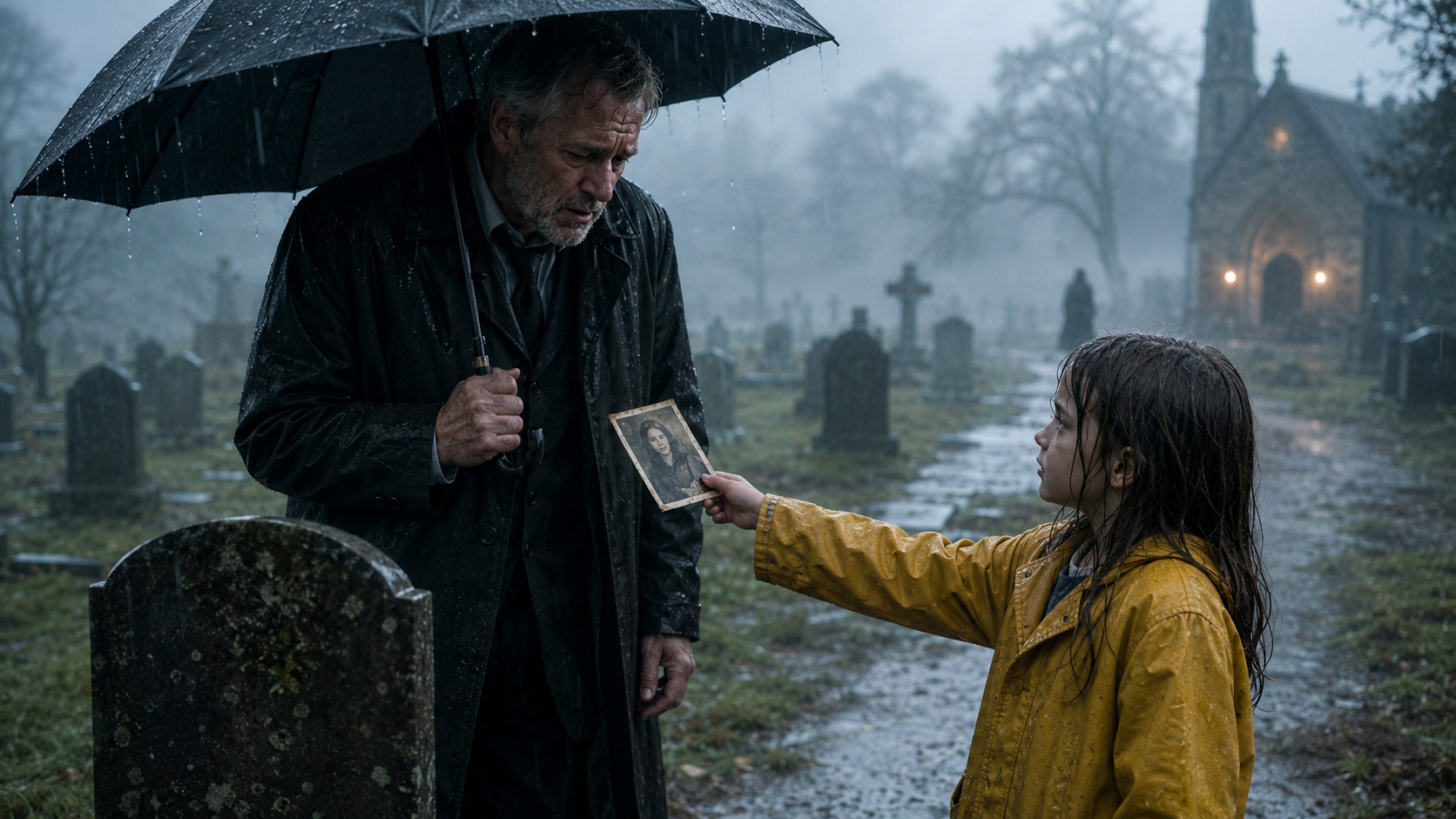
The rain had polished every gravestone in Saint Margaret’s Cemetery until the names shone like words written beneath glass.

Thomas Alder stood beside the grave he had visited on the first Sunday of every month for nearly nine years. In one hand, he held a black umbrella. In the other, he carried a small bundle of lavender tied with white thread.

Lavender had been Rebecca’s favorite.

She used to place it inside drawers, between the pages of books, and beneath her pillow. Even years after she was gone, Thomas sometimes imagined he could smell it in their old house.

He bent down and placed the flowers against the stone.

REBECCA ALDER
BELOVED WIFE
1978–2017

“I repaired the porch,” Thomas said quietly.

Talking to a grave had once felt strange. Now it was as ordinary as making morning coffee.

“The third step was rotten, just like you always said. You were right about that.”

Rain tapped against the umbrella.

“And Mrs. Whitmore’s cat had kittens in my shed. Four of them. One is completely black and keeps climbing into my toolbox.”

He paused.

“You would have kept all four.”

A soft voice came from behind him.

“Is that your wife?”

Thomas turned.

A little girl stood several feet away between two rows of graves. She looked no older than seven. Her yellow raincoat was too large for her, and water dripped from the ends of her dark curls.

She was alone.

Thomas glanced toward the cemetery entrance, expecting to see a parent hurrying after her. The iron gates stood open, but the path beyond them was empty.

“Yes,” he answered. “She was my wife.”

The girl stepped closer.

She studied Rebecca’s name, then looked at Thomas with an expression far too serious for a child.

“My mother has a picture of you.”

Thomas tightened his grip on the umbrella.

“You must be mistaken.”

The girl reached into the pocket of her raincoat.

“I took it from her bedroom.”

She produced a photograph protected inside a clear plastic sleeve.

Thomas accepted it carefully.

For a moment, he did not understand what he was seeing.

The picture showed a younger version of himself standing on a wooden pier. His hair was darker, his shoulders straighter. One arm was wrapped around Rebecca’s waist.

She wore a red scarf and was laughing at something beyond the camera.

Thomas remembered the exact afternoon.

They had been celebrating their fifteenth wedding anniversary at Lake Briar. A stranger had offered to take their photograph before the two of them boarded a sightseeing boat.

Only one copy had ever been printed.

Thomas had kept it inside Rebecca’s jewelry box until the week of her funeral, when he placed it in her coffin.

His fingers began to shake.

“Where did you get this?”

“In my mother’s room.”

“What is your mother’s name?”

The girl hesitated.

“She calls herself Anna.”

“Calls herself?”

“Sometimes she wakes up and says another name.”

Thomas could hear the rain falling around them, but it seemed very far away.

“What name does she say?”

The girl looked directly into his eyes.

“Rebecca.”

The umbrella slipped from Thomas’s hand.

It struck the wet grass and rolled against the base of the grave.

For nine years, Thomas had lived with the certainty that Rebecca was dead.

Her train had derailed during a winter storm. Several carriages had overturned and caught fire near the Graymoor tunnel. Rebecca’s handbag, coat, wedding ring, and identification had been recovered from the wreckage.

The authorities had told him that some of the bodies could not be visually identified.

A sealed coffin had been delivered three weeks later.

Thomas had touched the polished wood while a priest spoke of eternal rest. He had watched the coffin descend into the earth. He had stood beside the grave until everyone else had gone home.

Now a child was telling him that Rebecca was alive.

Thomas stared at the photograph again.

“This isn’t possible.”

The girl’s lower lip trembled.

“I didn’t come here to upset you.”

“What is your name?”

“Lily.”

“Lily, where is your mother?”

“At home.”

“Does she know you came here?”

The girl shook her head.

“She doesn’t like cemeteries. She cries whenever she sees one.”

Thomas slowly retrieved his umbrella.

His knees felt weak, and his heart beat with such force that it hurt.

“Why did you bring the photograph?”

“Because yesterday she remembered this place.”

Lily pointed toward the old stone chapel beyond the trees.

“She drew the window and the angel above the door. Then she wrote your name on the table with her finger.”

Thomas looked toward the chapel.

Rebecca and Thomas had been married there thirty-two years earlier.

A coldness spread through him that had nothing to do with the rain.

“Can you take me to her?”

Lily did not answer immediately.

She looked at the grave, then at the photograph in his hand.

Finally, she nodded.

“But you must promise not to shout.”


Lily’s home stood at the edge of town, where the road narrowed and the houses became scattered among pine trees.

They walked for nearly twenty minutes.

Thomas asked questions along the way, but Lily knew little about her mother’s past.

Anna had lived in the house for as long as Lily could remember. She repaired antique clocks for a shop in town and rarely traveled farther than the market.

She had no relatives.

She had no old friends.

She avoided hospitals, train stations, and police officers.

Most nights she slept peacefully, but sometimes she woke screaming about smoke, broken windows, and a man wearing gray gloves.

“Who is your father?” Thomas asked.

Lily kicked a stone along the roadside.

“I don’t have one.”

“Everyone has a father.”

“Mother says mine died before I was born.”

Thomas calculated the years.

Lily looked seven. Rebecca had supposedly died nine years ago.

The realization struck him with a fresh wave of confusion.

If the woman truly was Rebecca, the child might belong to someone else.

Jealousy rose in him before he could stop it. He hated himself for feeling it. Rebecca might be alive, and yet his first thoughts were already tangled with questions of loyalty, betrayal, and the years someone else might have shared with her.

The house appeared beyond a line of wet pine trees.

It was a modest cottage with pale blue walls and a crooked chimney. Wind chimes hung beneath the porch roof, turning silently in the damp air.

Lily stopped at the gate.

“She may be frightened.”

“So am I,” Thomas admitted.

The girl opened the gate.

They crossed the garden and climbed the porch steps.

Before Lily could reach for the handle, the front door opened.

A woman stood inside.

She wore a gray sweater and held a kitchen towel in one hand. Her hair was cut to her shoulders and streaked with silver. A thin scar ran from her left temple to the edge of her eyebrow.

She looked older.

She looked exhausted.

But she had Rebecca’s green eyes.

Thomas forgot how to breathe.

The woman’s face lost all color.

The towel fell from her hand.

For several seconds, neither of them moved.

Then she whispered his name.

“Thomas.”

It was not the uncertain voice of a stranger reading a name from a letter.

It was Rebecca’s voice.

It carried the same gentle roughness it had possessed in the mornings, before coffee. It shaped the first syllable the way only she had ever done.

Thomas gripped the porch railing.

“You’re alive.”

The woman pressed one hand against her mouth.

Lily stood between them, watching silently.

“Please come inside,” the woman said.

Thomas did not move.

“I buried you.”

“I know.”

“I stood over your coffin.”

“I know.”

“I mourned you for nine years.”

Tears filled her eyes.

“I know.”

Thomas’s shock hardened into anger.

“How could you know?”

She looked toward the neighboring houses.

“Please. Not outside.”

Thomas wanted to demand answers immediately. He wanted the whole street to hear. He wanted the sky itself to open and accuse her.

But Lily was still there.

He entered the house.


The living room smelled of tea, old wood, and machine oil.

Dozens of clocks covered the walls. Some were elegant, some cracked, some no larger than a man’s palm. Their ticking overlapped until the room seemed to contain hundreds of tiny footsteps.

Rebecca—or Anna—sat on one end of a faded sofa.

Thomas remained standing.

Lily climbed into an armchair and hugged her knees.

“Start at the beginning,” Thomas said.

The woman folded her hands.

“My name is Rebecca Alder.”

Hearing her say it made the room tilt.

“I remembered that name three years ago,” she continued. “Before then, I only knew pieces. A lake. A red scarf. Lavender. The sound of someone playing the piano badly.”

Thomas stared at her.

“I played badly.”

A faint, wounded smile appeared and disappeared.

“Yes. You did.”

“What happened on the train?”

Rebecca looked at Lily.

“Go to your room, sweetheart.”

“I brought him here.”

“I know, and you did the right thing. But I need to speak with him alone.”

Lily reluctantly left the chair. Before walking upstairs, she handed Thomas the photograph.

“I’m sorry I took it,” she said.

“You have nothing to apologize for.”

When the bedroom door closed above them, Rebecca began.

“The last thing I clearly remember before the crash was a man entering my compartment. He wore a dark coat and gray leather gloves.”

Thomas’s anger faltered.

“A man?”

“He asked whether I was Rebecca Alder. I thought he worked for the railway. Then he locked the compartment door.”

Her fingers tightened around each other.

“He wanted a folder I was carrying.”

Thomas remembered the weeks before the crash. Rebecca had worked as an accountant for Vale Maritime, one of the largest shipping companies in the region. She had seemed distracted, often staying late at the office and checking the locks twice before bed.

She had told him it was because of an audit.

“What was in the folder?”

“Evidence. False cargo records, payments to shell companies, names of officials who had accepted bribes. I found them by accident. When I realized what they were, I copied everything.”

“Why didn’t you tell me?”

“I was afraid you would try to protect me.”

“I was your husband.”

“That was exactly why I couldn’t tell you.”

Thomas turned away.

Every clock in the room seemed suddenly louder.

Rebecca continued.

“The man searched my bag. The train entered the storm before he found the folder. There was a violent jolt. The lights went out. I remember glass breaking, then fire.”

She touched the scar near her temple.

“I woke beside a river two days later.”

“That makes no sense.”

“I had been pulled from the wreck by a volunteer rescue worker named Nathan Cole. At least, that was what he told me.”

Lily’s father, Thomas thought.

Rebecca nodded as if she could see the conclusion forming in his mind.

“I had no identification. I didn’t remember my name. I barely remembered how to speak. Nathan told the hospital that I was his wife because he was afraid they would separate us while I was confused.”

“Why would a rescue worker do that?”

“He wasn’t a rescue worker.”

Thomas slowly faced her again.

Rebecca’s expression darkened.

“Nathan had been hired to retrieve the folder. He was working with the man who attacked me.”

Thomas felt the skin on his arms tighten.

“He kidnapped you.”

“At first, yes. But I didn’t know it. He told me my name was Anna Cole. He said we had been traveling together when the train crashed. He showed me photographs he had taken after the accident and claimed they were proof of our life.”

“How long did you believe him?”

“Almost two years.”

Thomas sank into a chair.

Rebecca stared down at her hands.

“He moved us constantly. Whenever a doctor suggested specialist treatment, Nathan said we couldn’t afford it. Whenever I remembered something that contradicted his story, he told me the injury had confused me.”

“And Lily?”

Rebecca’s eyes softened.

“Nathan brought her home one night when she was four months old. He said she was the daughter of his younger sister, who had died.”

“She isn’t your biological child?”

“No. But she is my daughter in every way that matters.”

“What happened to Nathan?”

Rebecca glanced toward the staircase.

“When Lily was two, I found a locked case beneath the floorboards. It contained passports, cash, newspaper clippings about the train, and a list of passengers.”

“My name was on the list.”

Thomas felt sick.

“There were photographs of you,” Rebecca said. “Your house. Your workshop. The cemetery.”

“He watched me?”

“Yes.”

“Why?”

“To make sure I never reached you.”

Thomas rose so quickly that the chair struck the wall.

“You knew I was alive after that.”

“I knew a man named Thomas Alder existed. I didn’t yet understand who he was to me.”

“But you saw the photographs.”

“I saw a stranger standing outside a grave.”

Rebecca’s voice broke.

“My grave.”

The clocks continued ticking.

“The memories returned slowly,” she said. “Not like a door opening. More like light entering through cracks. I remembered your hands. The kitchen window. The blue cup you always used. I remembered dancing with you when the radio stopped working.”

Thomas remembered that night.

They had continued dancing in silence, Rebecca laughing against his shoulder.

He looked away before she could see his face.

“I confronted Nathan,” she said. “He told me that contacting you would get you killed. He claimed the people behind the records still believed I had hidden copies of the evidence. He said they had been watching you for years.”

“Was that true?”

“I don’t know. But I believed him.”

“What happened next?”

“Nathan disappeared three days later. He took the money and the passports. He left Lily behind.”

Thomas looked toward the ceiling.

“How long ago?”

“Five years.”

“You had five years to come home.”

Rebecca closed her eyes.

“Yes.”

The word landed harder than any excuse.

“You remembered me.”

“Not everything.”

“You remembered enough to keep our photograph.”

“Yes.”

“You knew I had buried you.”

“Yes.”

“And you stayed here.”

Tears moved silently down her cheeks.

“I was terrified. I had spent years being told that finding you would destroy your life. By the time I understood how much Nathan had lied, I no longer knew whether the danger was real.”

“You could have sent a message.”

“I wrote dozens.”

“But you sent none.”

“No.”

Thomas walked to the window.

Rain streamed across the glass, blurring the garden.

He had imagined this impossible reunion many times during the first months after Rebecca’s death. In those fantasies, she returned through the front door, and he embraced her without asking how or why.

But fantasies did not contain nine years of silence.

They did not contain another name, another house, or a little girl sleeping upstairs.

“Did you love him?” Thomas asked.

Rebecca was silent for a long time.

“I depended on him before I understood who he was. I mistook dependence for love.”

“Did he love you?”

“In the way a jailer might love the prisoner who makes the cell feel like a home.”

Thomas closed his eyes.

“Why did you never come to the cemetery?”

“I tried once. I reached the gate and saw you beside the grave. You looked so much older. You were talking to the stone.”

She covered her face.

“I couldn’t breathe. I ran.”

“When?”

“Last winter.”

Thomas remembered that day. He had felt watched and had turned toward the entrance, but there had been no one there.

“Lily saw the photograph afterward,” Rebecca said. “She began asking questions. I told her only that you had once been important to me.”

“Important?”

“I didn’t know what word I had the right to use.”

The anger inside Thomas remained, but something beneath it had changed. He no longer saw a woman who had simply abandoned him. He saw someone whose mind had been broken, rebuilt around lies, and then trapped by fear.

That understanding did not erase what she had done.

It only made the pain more complicated.

“Why today?” he asked. “Why did Lily come today?”

Rebecca looked toward the staircase.

“Last night, I told her the truth.”

“All of it?”

“Enough. I said there was a man who deserved to know I was alive. I planned to visit you tomorrow.”

“But she didn’t wait.”

“No.”

For the first time, Rebecca gave a real smile.

“She has never been patient.”

Thomas almost smiled in return.

Almost.


He left before sunset.

Rebecca did not ask him to forgive her. She did not ask him to return.

At the garden gate, Lily ran after him.

“Are you angry with my mother?”

Thomas looked back at the cottage.

“Yes.”

The child lowered her head.

“But I’m also grateful she is alive,” he added.

“Will you come back?”

“I don’t know.”

Lily considered this answer.

“Mother says ‘I don’t know’ can mean there is still hope.”

“Your mother has always been good at finding hope where it causes trouble.”

Lily smiled uncertainly.

Thomas handed her the photograph.

“You can keep this.”

“But it belongs to you.”

“It belongs to the moment. Neither of us can go back there.”

He walked away through the rain.


For the next three weeks, Thomas told no one.

He continued repairing furniture in his workshop. He bought groceries on Thursdays. He fed the black kitten that had decided to live beneath his porch.

At night, he opened Rebecca’s old boxes.

He found letters, dried lavender, receipts from forgotten holidays, and a list of possible names for children they had never been able to have.

He had once believed grief was a locked room.

Now he understood that grief could change shape. It could become anger, hope, guilt, or even relief without asking permission.

On the twenty-third day, a letter appeared beneath his front door.

It was from Rebecca.

She wrote that the authorities had reopened the investigation into the train disaster. Nathan Cole had been arrested in another country while traveling under a false identity. The records Rebecca once copied had been recovered from a railway locker registered in her name.

At the end, she wrote:

I do not expect our old life back. That life ended, even if neither of us did. But Lily asks about you every morning. I think she believes she found you for a reason.

Thomas read the letter twice.

Then he placed it on the kitchen table.

He made tea.

He waited until the tea was cold.

Finally, he put on his coat and walked to the blue cottage.


Rebecca opened the door before he knocked.

She wore the red scarf from the photograph.

It had faded with time, and one end had been repaired with uneven stitches.

“I thought you might never come,” she said.

“So did I.”

Lily appeared behind her carrying a chessboard.

“Do you know how to play?”

“Very badly.”

“Good. Mother plays badly too.”

Rebecca laughed.

The sound struck Thomas with both joy and pain.

He stepped inside.

They did not embrace.

Not that day.

Instead, they sat at the kitchen table while Lily arranged the chess pieces incorrectly. Rebecca made tea, and Thomas told them about the black kitten beneath his porch.

It was not a reunion.

It was a beginning.


The grave at Saint Margaret’s Cemetery remained for another year.

Legal proceedings took time. Records had to be corrected. The unidentified woman inside the coffin had to be given her real name.

When the stone was finally removed, Thomas stood beside Rebecca and Lily beneath a clear autumn sky.

Workers lifted the marker from the ground.

Rebecca stared at the place where her name had been carved.

“I’m sorry,” she said.

Thomas nodded.

He had heard those words many times during the past year.

They had attended counseling. They had argued. They had gone months without speaking and then spent entire nights discussing memories that belonged to one of them but not the other.

Forgiveness had not arrived as a single dramatic moment.

It came in small decisions.

A returned telephone call.

A shared meal.

A door opened after an argument.

A second cup placed on a table.

Thomas looked at the empty space where the grave marker had stood.

“For years, I thought this was where our story ended,” he said.

Rebecca slipped her hand into his.

“Where does it end now?”

Thomas looked at Lily, who was gathering fallen leaves and arranging them into a crown.

“I don’t think we get to know that in advance.”

Lily ran toward them and placed the crown on Thomas’s head.

“You look like a forest king.”

“I look ridiculous.”

“That too.”

Rebecca laughed again.

This time, the sound did not break him.

Thomas took one last look at the empty grave.

The woman he had mourned no longer existed. Neither did the husband who had stood there speaking to a stone in the rain.

The people walking away from the cemetery were different.

Scarred.

Older.

Uncertain.

Alive.

And sometimes, Thomas realized, being alive did not mean recovering what had been lost.

Sometimes it meant finding the courage to build something new from what remained.


SEEDANCE VIDEO TRAILER PROMPTS

1

Create a cinematic 15-second emotional mystery trailer set in a rain-soaked old cemetery. Photorealistic characters, realistic facial expressions, natural cinematic lighting, shallow depth of field, dramatic sound design, spoken English dialogue.

0–4 seconds: Wide shot of 61-year-old Thomas Alder standing alone beside his wife’s grave beneath a black umbrella. Rain falls heavily. A seven-year-old girl in an oversized yellow raincoat approaches through the mist.

Girl, softly: “Is that your wife?”

Thomas turns toward her.

4–9 seconds: Close-up as the girl hands Thomas an old photograph showing him beside his supposedly dead wife. His hand begins to shake.

Girl: “My mother keeps this in her bedroom.”

Thomas, frightened: “Where is your mother?”

9–15 seconds: Extreme close-up of the girl’s serious eyes, then a rapid cut to Thomas staring at the grave.

Girl: “At home. She says her name is Rebecca.”

End with a sharp thunderclap and Thomas dropping his umbrella.

No subtitles, no captions, no titles, no written words, no logos, no watermarks, and no visible text anywhere in the video.

2

Create a tense photorealistic 15-second cinematic drama trailer. A widower follows a mysterious child to a small blue cottage during a rainstorm. Moody thriller atmosphere, handheld camera movement, realistic spoken English dialogue, emotional acting.

0–5 seconds: Thomas and the little girl hurry through a wet garden. She opens the cottage gate.

Girl: “Please don’t shout. She gets scared.”

5–10 seconds: The front door slowly opens. A silver-haired woman with a scar above her eyebrow appears. Thomas freezes as he recognizes his dead wife.

Woman, whispering in shock: “Thomas?”

Thomas: “I buried you.”

10–15 seconds: Tight alternating close-ups of their tearful faces. The woman grips the doorframe.

Woman: “Then they buried the wrong woman.”

A clock begins ticking loudly as the screen cuts to darkness.

No subtitles, no captions, no opening title, no ending title, no signs, no letters, no logos, no watermarks, and no text on screen.

3

Create a fast-paced 15-second psychological mystery trailer with photorealistic visuals, fragmented memories, dramatic cinematic editing and natural spoken English dialogue.

0–3 seconds: Inside a room filled with ticking antique clocks, Rebecca sits opposite Thomas.

Rebecca: “I woke beside the river with no name.”

3–7 seconds: Rapid flashbacks—a burning train carriage, shattered glass, a man wearing gray leather gloves, Rebecca crawling through smoke.

Mysterious man, off-screen: “Your name is Anna. You have no other life.”

7–11 seconds: Thomas strikes the table with his hand.

Thomas: “You remembered me and still stayed away?”

Rebecca, crying: “I thought finding you would get you killed.”

11–15 seconds: The little girl listens from the staircase as the clocks abruptly stop. Close-up of Thomas looking toward her.

Thomas, quietly: “Who is that child?”

Cut to black on Rebecca’s frightened expression.

No subtitles, no captions, no written dialogue, no titles, no interface elements, no logos, no watermarks, and no visible text.

4

Create a deeply emotional 15-second cinematic trailer about forgiveness and a family beginning again. Photorealistic, warm autumn lighting, expressive acting, gentle orchestral music, natural spoken English dialogue.

0–5 seconds: Cemetery workers remove a gravestone while Thomas, Rebecca, and seven-year-old Lily watch beneath golden autumn trees.

Rebecca, tearfully: “Can you ever forgive me?”

Thomas: “I can’t bring back who we were.”

5–10 seconds: Rebecca lowers her head. Thomas slowly takes her hand.

Thomas: “But maybe we can meet who we’ve become.”

10–15 seconds: Lily places a crown of autumn leaves on Thomas’s head.

Lily, laughing: “You look like a forest king.”

Thomas smiles for the first time.

Thomas: “I look ridiculous.”

Rebecca and Lily laugh as the three walk away from the empty grave together.

No subtitles, no captions, no titles, no credits, no written words, no logos, no watermarks, and no text visible anywhere in the scene.