Ethan Caldwell had spent most of his adult life polishing the parts of himself that could be seen.
His shoes were always clean. His watch was never cheap. His apartment on the thirty-first floor of a glass tower in Charlotte had white counters, a wide balcony, and a view he liked to show people at night, when the city lights made him feel as if he had outrun everything behind him. At thirty-four, he was a senior project director for a real estate development firm, the kind of man people called “self-made” because they never saw the hands that had lifted him.
He wore that word proudly.
Self-made.
It sounded strong. It sounded clean. It sounded like no one could claim a piece of his success.
But the truth lived four hours away, down a two-lane road outside a forgotten North Carolina town, in a small wooden house with a leaning porch, a patched roof, and a garden that had kept him fed through years when money was more prayer than paper.
His mother, Ruth Caldwell, still lived there.
She was sixty-four, though the years had pressed themselves into her shoulders until strangers sometimes guessed older. She had worked in laundries, kitchens, tobacco fields, school cafeterias, and church bake sales. She had taken every tired dollar life handed her and stretched it until Ethan could study, dress decently, and stand in rooms where no one smelled wood smoke in his clothes.
Ethan sent her money now. He paid bills when she let him. He called on Sundays when he remembered. He told himself that was enough.
Then came Clara Bennett.
Clara was not impressed by glass towers.
She worked as a speech therapist at a children’s clinic and drove a small blue car with a dent on the back door. She forgot to care about luxury brands. She cried during old movies. She remembered what people liked in their coffee. She talked to waiters as if they were old friends. When Ethan took her to expensive restaurants, she complimented the soup and then asked whether he had called his mother that week.
They had been together for two years when he proposed.
He did it properly: rooftop dinner, candles, a violinist paid too much money to appear casual, a ring he had chosen after three separate consultations. Clara cried before he finished the question. She said yes with both hands over her mouth, then laughed because the violinist started crying too.
For a while, Ethan felt safe.
Then the wedding got closer.
At work, his colleagues spoke about marriage as if it were a business merger that could turn hostile at any moment. They told stories over coffee: women who changed after the wedding, women who looked down on a man’s family, women who loved the apartment but not the old neighborhood, women who smiled at the ring but frowned at the relatives.
One afternoon, in the conference room, Ethan’s coworker Blake slapped him on the shoulder and said, “You ever taken Clara to that little town you came from?”
Ethan stiffened. “Not yet.”
Blake grinned. “You should. Before the wedding. Let her see the real package.”
Another man laughed. “Exactly. Everybody loves success. Let her meet the leaking roof and the country roads. That’ll tell you what kind of woman she is.”
Ethan laughed with them because pride often disguises fear as humor.
But later, sitting alone in his office, he thought about Clara walking into his mother’s house. He pictured her noticing the cracked porch boards, the faded curtains, the old stove, the plastic tubs Ruth used to catch rain when the wind pushed water through the back window. He imagined Clara’s polite smile tightening. He imagined disappointment hiding behind her eyes.
He hated himself for imagining it.
Then he imagined it again.
That was how suspicion entered him. Not like a storm. Like a drop of dirty water falling into a clean glass.
Three weeks before the wedding, Ethan called his mother.
“Ma,” he said, keeping his voice light, “I’m bringing Clara home this Saturday.”
On the other end, Ruth went quiet for half a breath too long.
“Home?” she asked.
“Yes. She should meet you before the wedding.”
“She should have met me a long time ago.”
Ethan looked at the city through his office window. “I know.”
Ruth did not scold him. That almost made it worse.
“What time should I expect you?”
“Afternoon,” he said. “And Ma…”
“Yes?”
He rubbed the bridge of his nose. “Don’t fix the place up too much.”
Another silence.
“What does that mean?”
“It means just leave it how it is.”
“My house is usually how it is.”
“I know. I just…” Ethan lowered his voice though no one was nearby. “I need to know how Clara reacts.”
Ruth understood him immediately. Mothers often hear the shame behind words before the words finish dressing themselves.
“You are testing that girl,” she said.
“I’m not testing her. I’m being careful.”
“Careful people tell the truth. Cowards set traps.”
The sentence landed hard, but Ethan pushed it away.
“Ma, please. Just… if your knee hurts, say it hurts. If the roof leaks, don’t hide it. Don’t pretend everything is better than it is.”
Ruth breathed out slowly. “You want me to make my life look pitiful so you can see whether the woman you love has a heart.”
“That is not what I said.”
“That is exactly what you said, only wearing a nicer coat.”
Ethan closed his eyes. “I have to know.”
“No,” Ruth said softly. “You want to know without trusting. That is different.”
He almost changed his mind then.
Almost.
But pride has a stubborn voice, and it spoke louder than his conscience.
“Saturday,” he said.
Ruth’s voice grew tired. “Come then.”
On Saturday morning, Ethan told Clara his car needed servicing.
It was a lie. His black SUV sat perfect and shining in the underground garage.
“We’ll take the bus part of the way,” he said, watching her face carefully.
Clara, who was packing a tote bag with banana bread wrapped in foil, only nodded. “That’s fine. I like looking out the window when I’m not driving.”
“You don’t mind?”
“Why would I mind?”
“It’s not exactly comfortable.”
She smiled. “Ethan, I work with toddlers who sneeze directly into my face. A bus is not going to defeat me.”
He smiled back, but the smile felt fake on his own mouth.
The trip took longer than driving would have. The first bus was crowded. The second was late. By the time they reached the small town nearest his mother’s house, the afternoon sun had turned heavy and gold. They hired a local man with a dusty van to take them the last twelve miles down a narrow road lined with pine trees, red clay ditches, and mailboxes leaning like tired old men.
Clara watched everything with quiet attention.
“This is where you grew up?” she asked.
“Near here.”
“It’s beautiful.”
Ethan almost laughed. “Beautiful?”
“Yes. It feels honest.”
He turned away because that word made him uncomfortable.
When the van stopped in front of Ruth’s house, Ethan felt his stomach tighten.
The place looked smaller than memory and larger than guilt. The porch sagged at one corner. The white paint had faded into a tired gray. A rusted bicycle leaned against the side wall though no one had ridden it in years. There were buckets near the steps, a clothesline behind the house, collard greens growing in uneven rows, and a faded yellow chair where Ruth sat waiting.
She wore her old green dress.
Ethan noticed that first.
He had bought her a new one last Christmas, soft blue with pearl buttons. She had refused to wear it. Instead, she sat in the dress she wore for gardening, her gray hair pinned badly, her left hand resting on her knee.
For one cruel second, Ethan was glad.
This was the test. This was the truth. This was the doorway where Clara would reveal whether she belonged in his future or only in the shiny version of it.
Clara stepped out of the van.
She did not freeze.
She did not look embarrassed.
She did not glance at Ethan with a silent question of why he had brought her there.
Instead, she walked straight to Ruth, placed both hands around the older woman’s hand, bent slightly, and said, “Mrs. Caldwell, I’m Clara. I have been waiting so long to meet you.”
Ruth stared at her.
Then Clara added, “And I brought banana bread, but I’m nervous because Ethan told me nobody bakes better than you.”
Ruth’s mouth trembled before it became a smile. “That boy said that?”
“He did.”
Ethan had said it once, months ago, half distracted while answering emails.
Clara had remembered.
Ruth looked past Clara at her son. There was no triumph in her eyes, only sadness.
“Come inside, child,” Ruth said. “It’s too hot standing out here.”
Clara took the tote bag from Ethan before he could carry it. “Let me help.”
“You’re a guest,” Ruth said.
“Not for long,” Clara replied gently. “Soon I’ll be family. Family helps.”
Ethan stood in the yard with his hands empty.
Inside, the house smelled of onions, cornmeal, old wood, and lavender soap. Clara looked around without pretending not to look. Her eyes moved over the worn sofa, the framed school photos, the crocheted blanket, the Bible on the side table, the small fan turning slowly in the corner.
On the wall near the kitchen hung a photo of Ethan at seventeen, thin and serious in a graduation gown too large for his shoulders.
Clara stopped in front of it.
“You looked terrified,” she said.
“I was not terrified,” Ethan answered too quickly.
Ruth chuckled. “He was terrified. Walked across that stage like the principal had a gun pointed at him.”
Clara laughed, and the sound warmed the little room.
Ethan should have been happy.
Instead, he felt exposed.
Ruth moved toward the kitchen, limping more than usual. Ethan knew at once that she was obeying him, playing the part he had asked her to play. He wished she would stop. He wished she had refused him. He wished Clara would not notice.
Clara noticed.
“Is it your left knee?” she asked.
Ruth turned. “Sometimes.”
“May I?” Clara said, already reaching for a chair. “Please sit for a minute.”
Ethan frowned. “Clara, she’s fine.”
Clara looked at him, not sharply, but firmly. “Let her answer.”
Ruth sat.
Clara knelt in front of her and gently touched near the swollen joint. “Does it get worse in the morning or at night?”
Ruth looked confused. “Morning mostly.”
“Does it lock up when you stand?”
“Sometimes.”
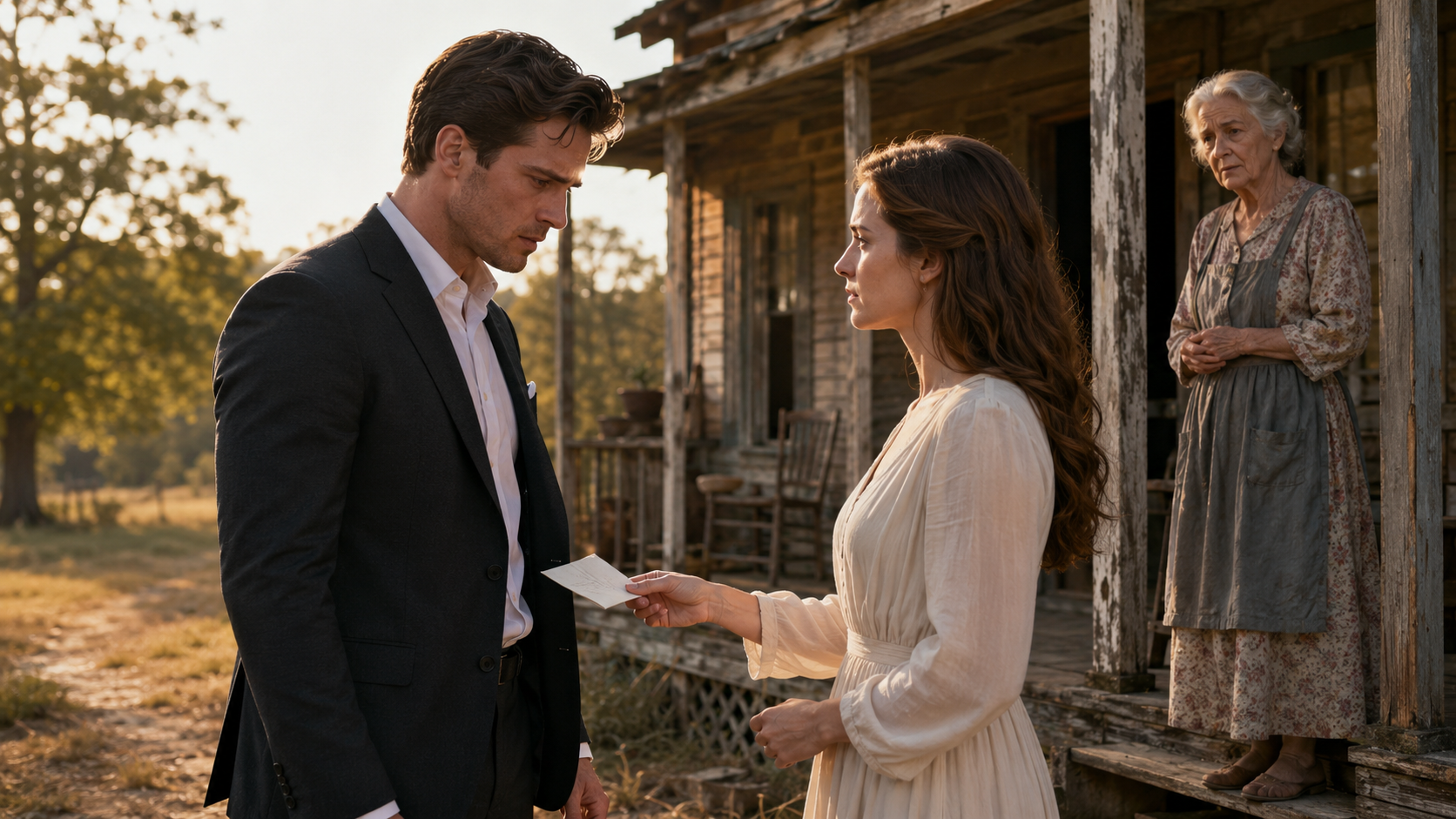
Clara nodded as if she had expected this. Then she opened her tote bag, moved aside the banana bread, and took out a folded envelope.
She stood and handed it to Ethan.
“Before we talk about anything else,” she said, “you should read this.”
Ethan looked at the envelope.
His name was written on it.
Not in a dramatic way. Not like a love letter. Just his name in Clara’s careful handwriting.
“What is it?” he asked.
“Read it.”
The room became very quiet.
Ethan opened the envelope and pulled out three pages, folded neatly. At the top of the first page was a title:
For After the Wedding: Things We Should Not Forget
He looked up.
Clara said nothing.
Ruth lowered her eyes.
Ethan began reading.
The first section was called: For Ruth.
Under it, Clara had written a list.
Arrange a full medical appointment for her knee, not just pain medicine.
Ask whether she wants a second handrail by the porch steps.
Research roof repair before hurricane season.
Set aside monthly money for groceries without making her feel dependent.
Visit at least twice a month, even when work is busy.
Call every Wednesday evening, not only when convenient.
Ask Ruth what she wants before making decisions about her house.
Do not pressure her to move unless she wants to.
Make sure she has transportation to church, doctor visits, and the market.
Learn her recipes before they disappear with her hands.
Ethan swallowed.
The paper blurred slightly, but he forced himself to keep reading.
The second section was called: For Ethan.
He almost stopped there.
Clara had written:
Remember that pride can sometimes be grief wearing expensive clothes.
Remember that your mother’s house is not proof that you failed to escape. It is proof that someone held the door open long enough for you to leave.
Do not confuse giving money with giving time.
Do not make your past compete with your future. A man who is ashamed of his roots will eventually become ashamed of anyone who loves him deeply enough to see them.
At the bottom of the page, one sentence had been underlined.
If Ruth is poor, that is not a stain on you. It is a record of what she survived so you could stand tall.
Ethan’s face grew hot.
The pages shook slightly in his hands.
He looked at Clara then, really looked at her. She was standing beside his mother in the little kitchen with dust on her shoes, sweat near her hairline, and tenderness in her eyes. She was not angry in the way he would have preferred. Anger would have allowed him to defend himself. Her sadness gave him nowhere to hide.
“When did you write this?” he asked.
“Last month.”
His throat tightened. “Before I told you we were coming here.”
“Yes.”
“How did you know what she needed?”
Clara glanced at Ruth.
Ruth pressed her lips together like a schoolgirl caught passing notes.
Ethan stared. “You two know each other?”
Clara nodded. “We’ve been speaking for a while.”
“How long is a while?”
“Since January.”
It was June.
Ethan turned to his mother. “You never told me.”
Ruth lifted one shoulder. “You never asked what I do on Wednesday evenings.”
A small silence filled the kitchen.
Clara said softly, “I called her because I wanted to know what kind of flowers she liked for the wedding. Then we started talking. She told me about her garden. About your father. About how you used to sleep with one shoe on because you were afraid of missing the school bus.”
Ruth smiled faintly. “He did.”
Ethan could not speak.
Clara continued, “She also told me you were nervous about bringing me here.”
His hand tightened around the paper.
Ruth looked away.
Clara’s voice grew quieter. “And yesterday she told me what you asked her to do.”
Ethan’s stomach dropped.
“What did she say?” he asked, though he already knew.
Clara held his gaze. “That you wanted to see whether I would still love you if your mother looked poor enough.”
The words struck him harder because they were simple.
He wanted to deny them. He wanted to explain that his coworkers had filled his mind with doubt, that he had been afraid, that men had to protect themselves too, that marriage was serious, that people changed. He wanted to wrap his ugliness in reasonable language.
But Clara was still standing beside Ruth.
And Ruth was still sitting in the old green dress he had asked her to wear.
Every excuse died before it reached his mouth.
“I was scared,” he said at last.
Clara nodded once. “I know.”
“I needed to be sure.”
“No,” she said. “You needed control.”
He flinched.
Her voice did not rise. “If I had looked disappointed, what would you have done?”
Ethan said nothing.
“That’s the problem,” Clara said. “You built a courtroom without telling me I was on trial. You made yourself the judge, your mother the evidence, and me the accused.”
Ruth covered her mouth with one hand.
Ethan lowered his eyes to the paper.
Clara stepped closer, and for one second he thought she might touch his arm. She did not.
“I am not afraid of where you came from,” she said. “I am afraid that you were willing to humiliate your mother to test me.”
Those words did what shame had failed to do for years.
They broke something open.
Ethan looked at Ruth.
His mother’s face was calm, but her eyes were wet.
“Ma,” he whispered.
She stood slowly. “Not now.”
“I’m sorry.”
“I said not now.”
Her voice was not loud, but it ended the conversation.
She turned to Clara. “Come help me with supper, child. If he wants to stand there holding paper, let him.”
Clara hesitated.
Then she followed Ruth into the kitchen.
Ethan remained in the doorway, holding three pages that weighed more than anything he owned.
That evening, supper was fried chicken, beans, stewed greens, cornbread, and sliced tomatoes from the garden. Ruth cooked with Clara beside her, explaining small things in a voice that was warmer than the one she used with Ethan. Clara listened seriously, as if Ruth were teaching sacred knowledge.
“Don’t stir greens like that,” Ruth said. “You bruise them.”
“I didn’t know greens had feelings,” Clara replied.
“They do in this house.”
Clara laughed.
Ethan sat at the table and watched two women create family without his permission.
He had imagined Clara discovering poverty.
Instead, she had discovered love.
He had imagined himself testing her.
Instead, he had exposed himself.
After supper, Ruth went outside to take clothes from the line. Clara stayed in the kitchen, washing plates in a chipped sink. Ethan stood beside her with a towel.
“I’ll dry,” he said.
She handed him a plate without looking at him.
For a while, only the water spoke.
Then Ethan said, “I don’t know how to fix what I did.”
Clara turned off the faucet.
“That is the first honest thing you’ve said about it.”
He nodded, accepting the cut.
“I was wrong,” he said. “Not confused. Not cautious. Wrong.”
She leaned against the sink. The kitchen light made her look tired.
“You hurt me,” she said.
“I know.”
“You hurt your mother more.”
His jaw tightened. “I know that too.”
“Do you?” Clara asked. “Because I don’t think you understand yet. You didn’t just hide this place from me. You treated it like something shameful. But this house raised you. She raised you. Every floorboard here knows something about you that your apartment never will.”
Ethan looked toward the hallway where childhood photos lined the wall.
“I thought success meant getting far away,” he admitted.
“Maybe success is being able to return without disgust.”
He closed his eyes.
Clara picked up the folded paper from the table and pressed it flat with her palm.
“I wrote that because I wanted us to begin marriage with gratitude,” she said. “I thought we could build a life that included your mother, not one that kept her hidden like an old bill you didn’t want to pay.”
“I don’t want to hide her.”
Clara’s eyes softened, but only a little. “You already did.”
The sentence settled between them.
Outside, Ruth shook a sheet in the evening air. The fabric snapped once, white against the darkening yard.
Ethan looked through the window and saw his mother as if for the first time in years. Not as a problem to manage. Not as an origin story he could edit. Not as an old woman living too far away in a house he had outgrown.
He saw the hands that had packed his lunches.
The back that had bent over work.
The face that had smiled when she had less than nothing left to give.
“I postponed the wedding in my head about ten times today,” Clara said quietly.
Ethan turned to her.
His voice came out thin. “Are you leaving?”
“I don’t know.”
The answer hurt, but he knew he deserved uncertainty.
“I love you,” he said.
“I believe you,” she replied. “But love without humility can still damage people.”
“What do you need from me?”
Clara looked toward the window, where Ruth was folding the sheet slowly.
“I need you to stop performing goodness and start practicing it.”
That night, Ruth put Clara in Ethan’s old room and Ethan on the narrow sofa in the front room. No one discussed it. No one needed to.
Ethan lay awake under a crocheted blanket, listening to the sounds of the house: insects outside, the refrigerator humming, the porch boards creaking as the temperature dropped. Every sound carried a memory.
At eight, he had sat on that sofa with a fever while Ruth placed cool cloths on his forehead.
At eleven, he had hidden report cards under the cushion because he had gotten a B in math and thought the world had ended.
At sixteen, he had promised himself he would never live in a house like this again.
He had kept the promise too well.
Near dawn, Ethan rose and found Ruth in the kitchen making biscuits.
She did not look surprised.
“Couldn’t sleep?” she asked.
“No.”
“Good.”
He almost smiled. “Good?”
“Some things should cost a man rest.”
He stood in the doorway, feeling again like a boy.
“Ma, I’m sorry.”
Ruth pressed dough with the heel of her hand. “You said that.”
“I’m saying it when you’re ready to hear it.”
She stopped kneading.
“That is better.”
He stepped into the kitchen. “I was ashamed of the house.”
“I know.”
“I told myself I wasn’t ashamed of you, only the way things looked.”
Ruth looked at him then.
“And now?”
“Now I think that was a lie I used because it sounded less ugly.”
She studied his face for a long moment.
Then she nodded toward the counter. “Wash your hands.”
He blinked. “What?”
“Wash your hands. You’re helping.”
“Ma, I don’t know how to make biscuits.”
“That has been clear for thirty-four years.”
Despite everything, he laughed.
It came out broken.
She gave him a lump of dough and showed him how to fold it, press it, turn it, and press again. His first biscuit looked like a stone. His second looked worse. Ruth inspected it with the seriousness of a judge.
“I have seen prettier accidents,” she said.
Ethan laughed again, and this time it hurt less.
From the hallway, Clara appeared quietly. Her hair was loose over her shoulders, and she wore one of Ruth’s old sweaters against the morning chill. She watched mother and son standing side by side at the counter.
Ethan met her eyes.
There was no forgiveness there yet.
But there was attention.
That was something.
Later that morning, Ethan walked outside with his phone and called Blake.
“Man,” Blake answered, “how’s the country trial going? She pass?”
Ethan looked at the porch steps, at the weak handrail, at the place where rain had eaten a line through the wood.
“No,” he said.
Blake laughed. “That bad?”
“She didn’t fail. I did.”
Silence.
“What are you talking about?”
“I tested her. It was wrong.”
Blake scoffed. “Don’t get dramatic. Better to know before marriage.”
Ethan looked through the kitchen window. Clara was helping Ruth pack biscuits into a basket for a neighbor recovering from surgery.
“Better to be the kind of man who doesn’t need tricks,” Ethan said.
Blake made a dismissive sound. “You’ve changed.”
“I hope so.”
He ended the call.
For the first time, he did not care whether the men at work found him foolish.
By noon, Ethan had called the church and the venue. He asked what it would mean to postpone the wedding. There would be fees. There would be questions. There would be relatives whispering and friends making jokes.
He accepted all of it.
In the afternoon, he found Clara sitting under the pecan tree behind the house. Ruth had gone inside to rest, though Ethan suspected she was near a window, listening with all the subtlety she did not possess.
Clara held a glass of sweet tea in both hands.
Ethan sat a careful distance away.
“I called the church,” he said.
Clara looked at him.
“I told them we might need to postpone.”
Her expression changed, but he could not read it.
“I’m not saying that to pressure you,” he continued quickly. “I’m saying the opposite. I don’t want you walking down an aisle in three weeks because invitations are printed and people bought clothes. After what I did, you deserve time to decide whether I am still someone you want to marry.”
Clara looked down at the grass.
“That sounds like the man I thought I knew,” she said.
The words gave him hope and pain at the same time.
“I want to be that man,” he said.
“Wanting is easy.”
“I know.”
“Do you?”
He nodded. “I’m beginning to.”
She watched him for a long moment. “What happens after you feel guilty for a week? You go back to Charlotte, work gets busy, the apartment feels normal, and this place becomes uncomfortable again. What then?”
Ethan had no polished answer ready.
So he told the truth.
“Then I come back anyway.”
Clara waited.
“I come back when it’s inconvenient,” he said. “I fix the porch because it needs fixing, not because guilt is loud. I call my mother on Wednesdays because you were right and because she deserves more than leftover minutes. I stop pretending money is the same thing as presence. And I stop letting embarrassed men teach me how to love.”
Clara’s eyes filled with tears.
She blinked them back. “Do not say beautiful things to escape doing hard ones.”
“I won’t.”
“Don’t promise me loudly.”
He understood then.
“Watch me quietly,” he said.
For the first time since she had handed him the envelope, Clara smiled.
It was small.
But it was real.
The wedding was postponed.
Some people complained. Clara’s aunt said it was bad luck. Ethan’s colleagues joked that he had been “domesticated.” Blake stopped inviting him to lunch as often. Ethan found he did not miss him.
Every Wednesday evening, Ethan called Ruth and did not multitask. At first, she answered with suspicion.
“You driving?” she asked the first week.
“No.”
“Emailing?”
“No.”
“Watching television?”
“No, Ma.”
“Good. Then tell me something true.”
So he did.
He told her work made him tired. He told her he was afraid Clara might still leave. He told her he had spent years acting as if ambition had no cost. Ruth listened, sometimes gently, sometimes with the mercy of a hammer.
On Saturdays, he drove to her house.
The first time he came alone with lumber, tools, groceries, and a contractor, Ruth stood on the porch with both hands on her hips.
“What is all this?”
“Repairs.”
“I didn’t ask for repairs.”
“I know.”
“I don’t want guilt money.”
“It isn’t guilt money.”
She narrowed her eyes.
He corrected himself. “Some of it started that way. But I’m trying to do better than starting.”
Ruth looked at the lumber, then at him. “Do not turn my house into something cold.”
“I won’t.”
“And don’t touch my kitchen curtains.”
“I wouldn’t dare.”
The porch was repaired first. Then the roof. Then the window. Ethan learned the names of neighbors he had forgotten, people who remembered him as “Ruth’s boy” before they remembered him as any kind of director. Clara came most weekends, not always with him, sometimes on her own. She brought Ruth knee braces, appointment notes, recipes she wanted corrected, and stories from the clinic.
Slowly, the house changed.
Not into a showroom.
Into a safer version of itself.
The old yellow chair stayed. The garden stayed crooked. The stove stayed because Ruth said a stove that had survived that much deserved respect. The walls were painted a warm cream, but the family photos went back exactly where Ruth wanted them.
Three months later, Ethan and Clara stood again under the pecan tree.
The wedding was two weeks away.
This time, smaller.
No rooftop rehearsal dinner. No extravagant performance. The ceremony would be held at Ruth’s church, with a reception in the fellowship hall and food cooked by women who had known Ethan when his knees were always scraped.
Clara had chosen it.
Ethan had agreed before she finished asking.
“Are you sure?” he said now.
Clara looked at the house. Ruth was on the porch, pretending not to watch them.
“No,” Clara said.
His heart dropped.
Then she turned to him. “I’m not sure in the way people are sure when nothing bad has happened. I’m sure in the way people become sure after seeing someone fall and then watching whether they get up differently.”
He exhaled slowly.
“I am still sorry,” he said.
“I know.”
“I will probably spend a long time being sorry.”
“Good,” she said. “Not because I want you punished. Because some kinds of sorrow keep people careful.”
He nodded.
She reached into her bag and pulled out the same envelope.
His name still written across it.
The paper was softer now from being handled.
“I kept this,” she said.
“I thought you might have thrown it away.”
“I almost did.”
“Why didn’t you?”
She opened it and showed him the last page. Beneath her original list, new lines had been added in different ink.
Ethan recognized his own handwriting.
Call Wednesday.
Repair porch.
Ask before deciding.
Come back without being asked.
Learn biscuits.
Tell the truth before fear turns it into a test.
He looked at her.
Clara’s eyes shone. “You added to it.”
“I needed instructions.”
“You still do.”
“I know.”
She folded the paper and placed it in his hand.
“Then keep it,” she said. “Not as proof that I forgave you. As proof that love should make us remember who paid the price for us to become ourselves.”
Two weeks later, Ethan stood at the front of a small church with wooden pews and uneven floors. He wore a navy suit, but no expensive watch. Ruth sat in the first row in the blue dress with pearl buttons, the one she had refused to wear before. Clara had insisted on helping her choose it.
When Clara entered, the whole room seemed to inhale.
She did not look like a woman entering a perfect life.
She looked like a woman choosing a real one.
Ethan cried before she reached him.
Ruth cried harder.
During the vows, Ethan did not promise Clara a life without fear, pride, mistakes, or painful lessons. He promised her honesty before fear, humility before pride, repair after mistakes, and gratitude before ambition.
Clara held his hands.
Her voice was steady when she said, “I promise to love the man you are, challenge the man you pretend to be, and honor the people who made you possible.”
At the reception, Ruth danced once, badly, with her son. Her knee hurt afterward, but she said it was worth it. Clara saved the folded envelope in a small wooden box with their marriage certificate, a pressed flower from Ruth’s garden, and a biscuit recipe written in Ruth’s slanted handwriting.
Years later, when people asked Ethan how he knew Clara was the right woman, he never told the polished version.
He told the true one.
“I took her home to test her,” he would say. “And she handed me a paper that showed me I was the one who needed examining.”
Then he would look toward Clara, who always raised an eyebrow as if to warn him not to make himself sound too noble.
And he would add, “The best thing she ever did was not pass my test. It was refusing to let love become one.”

