Richard had no answer.
Mara did.
“Then we make sure people listen before the orchestra starts next time.”
Eight months later, the unused rehearsal wing of the Marlowe Hotel reopened.
It was no longer called the Ellison Rehearsal Hall.
Mara had rejected that name before Richard finished proposing it.
Instead, the brass letters outside the entrance read:
THE OPEN SKY ARTS ROOMS
Theo chose the name.
He argued that the word center sounded like somewhere people were expected to sit quietly while adults explained things to them.
The renovation included wide entrances, adjustable lighting, acoustic wall panels, low mirrors and a floor designed for wheels, feet, canes, crutches and bodies that moved in ways architects rarely anticipated.
The first planning meeting lasted three hours.
Mara attended with six disabled artists, two access consultants, three musicians, a theater director, Theo, Elena and Richard.
Richard began the meeting by presenting a detailed construction proposal.
Mara stopped him after the second page.
“Did you ask anyone here what they need?”
He looked at the folder.
Then at the people around the table.
“No.”
He closed it.
“What do you need?”
The answers changed the entire plan.
A dancer requested temperature controls because cold made her muscles tighten.
A photographer asked for worktables that could be raised or lowered.
A blind pianist asked for consistent furniture placement and tactile markings.
An actor with chronic fatigue requested a quiet room that would not be treated as an emergency medical space.
Theo requested a cupboard for paper.
Nobody understood why until opening day.
He arrived carrying hundreds of folded comets.
Some were made from gold paper. Others came from old menus, discarded sheet music, grocery bags and unsuccessful drafts of Richard’s speeches.
They were suspended from the ceiling at different heights.
When the ventilation system started, their tails moved gently above the room.
“Stars stay where people put them,” Theo reminded Mara.
“And comets go where they want,” she replied.
By then, Mara had returned to regular rehearsals.
The first months had not been triumphant.
They had been difficult.
Her shoulders ached after long sessions. Some venues advertised accessible entrances that turned out to be locked. One orchestra manager spoke to Samuel instead of her during an entire meeting.
Mara interrupted him each time.
“Ask me.”
By the fourth interruption, he finally did.
Her first public concert as assistant conductor was not flawless. She missed a cue. A trumpet entered early. A critic wrote that her personal story risked overshadowing the music.
Mara printed the review and used it to protect her desk while painting a model stage.
The next review discussed only her interpretation of the score.
She framed that one.
Richard attended every performance he was invited to.
He no longer waited behind her chair.
Sometimes he still moved too quickly to help.
Sometimes Mara snapped at him even when he had asked.
Learning did not turn either of them into perfect people.
It simply made correction possible.
On the first anniversary of the Winter Restoration Ball, the hotel held another gala.
This time the dance floor was open before the donors arrived.
There was no dramatic reveal.
No special announcement.
No moment designed to make the guests feel generous.
Musicians from the Open Sky program performed alongside members of Samuel’s orchestra. Some played from chairs. One used a customized bow attached to his wrist. A percussionist followed visual light cues. A singer rested between songs without apologizing.
Theo, now wearing a jacket that actually fit him, stood near the stage distributing paper comets.
Elena had left catering work six months earlier and now managed the Open Sky workshop schedule.
Richard entered the ballroom beside Mara.
His hair had become more silver over the year.
His hand hovered near the handle of her wheelchair.
He noticed and placed it in his pocket.
“Would you like me to accompany you to the orchestra?” he asked.
“Not yet.”
“All right.”
“You can walk with me.”
Richard smiled.
“That is what I meant.”
“No, it wasn’t.”
“No,” he admitted. “But I am improving.”
They crossed the ballroom together.
Nobody cleared a special path.
Nobody announced Mara’s arrival.
People simply moved because someone was passing.
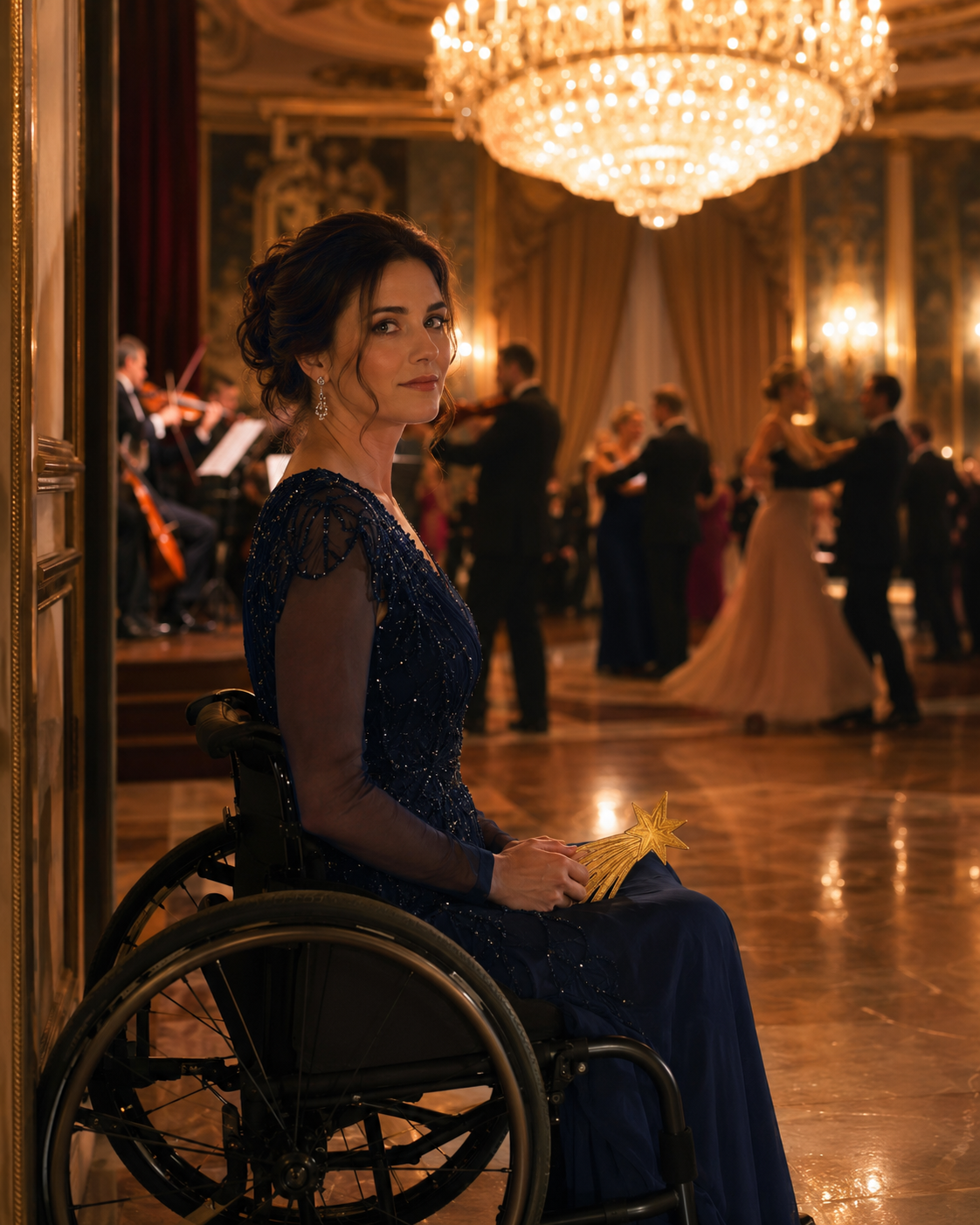
Theo met them beneath the chandelier.
He held a new paper comet made from deep-blue paper with a silver tail.
“For the conductor,” he said.
“I’m not conducting tonight.”
“Samuel says you are conducting the final piece.”
“Samuel enjoys surprises too much.”
“He said you would complain and then do it.”
Mara looked toward the orchestra.
Samuel Crowe lifted one shoulder innocently.
Richard leaned toward her.
“Would you like me to tell him you are not prepared?”
Mara considered it.
“No.”
“Would you like me to say anything?”
“Yes.”
“What?”
“Tell him the brass section rushed the ending last year.”
Richard smiled.
“I believe he already knows.”
Theo placed the comet on Mara’s lap.
The ballroom lights dimmed.
Mara moved toward the orchestra.
Samuel stepped aside and offered her the baton.
This time her hand did not tremble.
She turned toward the musicians.
Then she looked at Theo.
“Are you ready?”
He shook his head.
“No?”
“You didn’t ask the room.”
Mara smiled.
He was right.
She faced the dancers, musicians, guests, staff members and children gathered beneath the moving paper comets.
“Would you like to begin?” she asked.
A dozen voices answered at once.
“Yes.”
Mara raised the baton.
The orchestra breathed with her.
The music began.
Above them, hundreds of paper comets moved in the warm air.
None of them followed a perfectly straight path.
That was what made the sky beautiful.