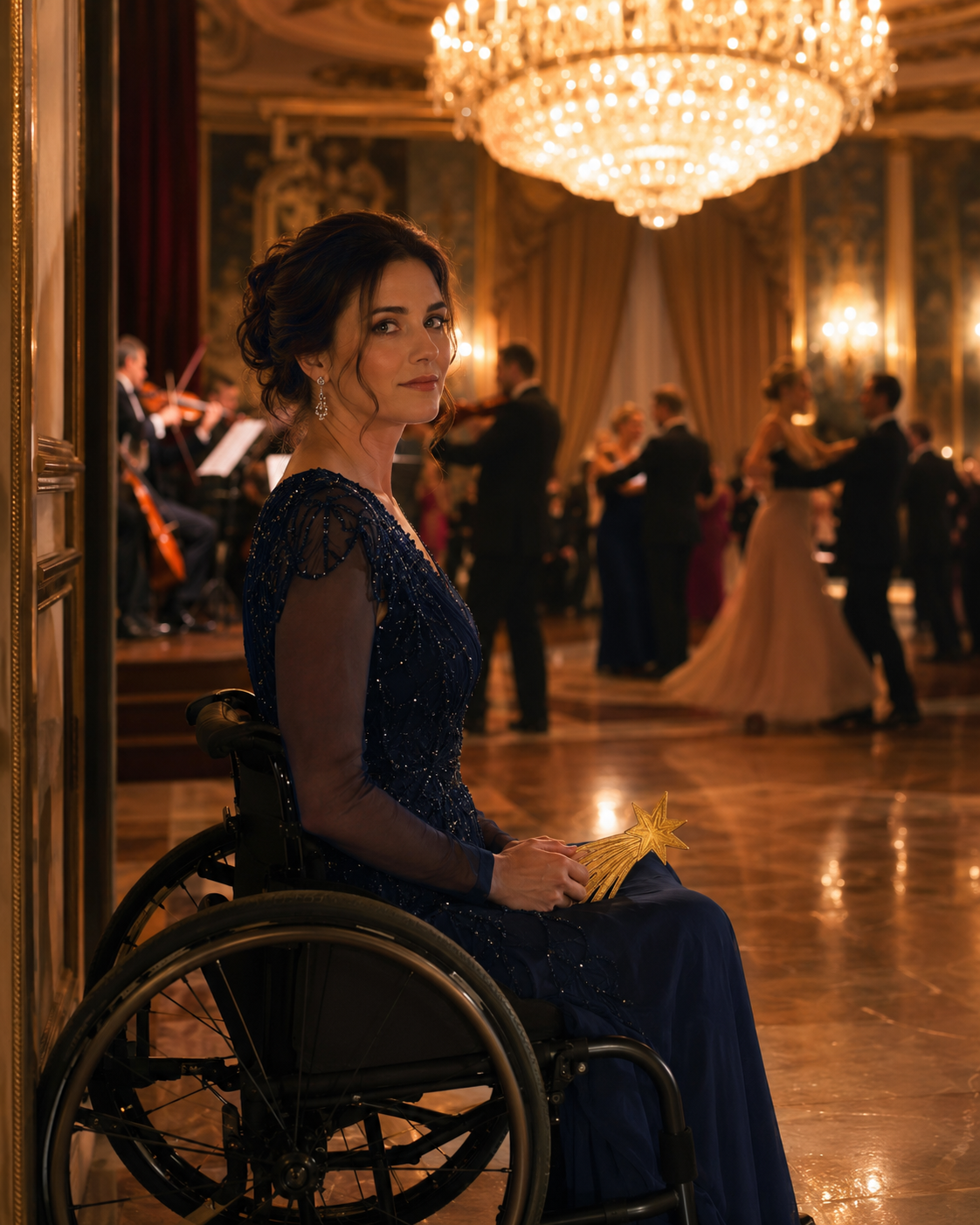
Mara Ellison kneanged its tempo before anyone else in the ballroom noticed.
The violins softened by half a breath. The cellos held a note longer than the conductor had intended. Even the harp seemed to hesitate, as though the musicians were listening for an instruction that had not yet been given.
Mara heard it because she had spent most of her life inside music.
Not beside it.
Not admiring it from velvet seats.
Inside it.
Her right hand moved almost imperceptibly above the armrest of her wheelchair. Two fingers rose. Her wrist turned. The melody lifted with them.
Then she realized what she was doing and quickly lowered her hand.
Nobody had seen.
At least, that was what she believed.
The Winter Restoration Ball glittered around her beneath the enormous chandelier of the old Marlowe Hotel. Hundreds of glass drops caught the light and scattered it across polished marble, silver trays and carefully arranged white orchids. Men in tailored dinner jackets discussed construction projects and charitable foundations. Women in jeweled gowns smiled for photographers near the staircase.
At the center of the ballroom, couples moved through a slow waltz.
Mara sat near the edge of the room at a table chosen by her father.
It had an excellent view.
It was also safely separated from the dance floor, the musicians, the crowded bar and anything else that might have made him nervous.
Richard Ellison called the arrangement convenient.
Mara called it exile with expensive flowers.
“You’re doing it again,” said a voice beside her.
She turned.
A boy stood near the curtain separating the ballroom from the service corridor. He looked about twelve. His dark jacket was too large across the shoulders, and one sleeve had been folded inward to stop it covering his hand. He wore black trousers that had clearly belonged to someone taller.
A pale stain marked one of his shoes.
He was holding something made from gold-colored paper.
“Doing what?” Mara asked.
“Moving the orchestra.”
She glanced toward the nearest guests. Nobody seemed to have heard him.
“I’m not moving anything.”
The boy studied her with the patient suspicion of someone who expected adults to deny obvious facts.
“You lifted your fingers,” he said. “The violins got quieter.”
“That was a coincidence.”
“You turned your wrist.”
“The conductor turned his wrist.”
“After you.”
Mara almost smiled.
The boy stepped closer, although he remained far enough away not to crowd her.
“Are you a conductor?”
“No.”
“Were you one before?”
“Before what?”
His eyes dropped briefly toward the wheelchair.
Mara waited for the familiar change in his expression.
People usually became embarrassed when they realized they had referred to her life as having a before and an after. They apologized too quickly. They looked at the floor. Sometimes they began explaining that they had not intended to be insensitive.
The boy did none of those things.
“Before you started sitting here pretending you don’t hear everything,” he said.
Mara stared at him.
Then she laughed.
It was not the restrained laugh she used during her father’s business dinners. It escaped before she could make it elegant.
Several guests looked in her direction.
The boy appeared pleased with himself.
“What’s your name?” Mara asked.
“Theo.”
“Theo what?”
“Theo Vale.”
“Are you invited to this ball, Theo Vale?”
“No.”
He answered without shame, but his fingers tightened around the folded paper object.
“How did you get inside?”
“My mother is working with the catering staff. I’m supposed to wait in the linen room until she finishes.”
“And instead you came into the ballroom.”
“I heard the orchestra.”
“That explanation may not satisfy hotel security.”
“It didn’t last time.”
Mara raised an eyebrow.
Theo looked toward the musicians.
“The conductor is rushing the second movement,” he whispered.
This time Mara did smile.
“He is.”
“I knew it.”
“How?”
“My grandmother used to play that piece whenever the neighbors became too loud. She said good music could defeat any argument if you turned it up high enough.”
“Your grandmother sounds dangerous.”
“She was.”
Theo lifted the object in his hands.
It was a small paper comet with an uneven tail. One side had been folded sharply, while the other curved outward. The gold paper had probably come from one of the gala menus or table decorations.
“Did you make that?” Mara asked.
“Yes.”
“Why a comet?”
“Because stars stay where people put them. Comets go where they want.”
“That is scientifically questionable.”
“It is emotionally correct.”
Mara laughed again.
Theo placed the paper comet on the empty chair beside her.
“For you.”
“Why?”
“You look like someone placed you here.”
The laughter disappeared from Mara’s face.
Across the ballroom, Richard Ellison was speaking with three members of the hotel’s board. He looked distinguished in his black tuxedo, silver beginning to show at his temples. He was sixty-one, though magazines regularly described him as ageless, disciplined and impossible to surprise.
He was also watching Mara.
Even while speaking to other people, part of his attention remained fixed on her.
It always did.
Mara touched the folded comet.
“My father chose the table because there is more space here.”
“There is more space everywhere,” Theo said. “The ballroom is enormous.”
“He wanted me to be comfortable.”
“Are you?”
The question came without pity.
That made it harder to answer.
Before Mara could speak, a woman in a fitted black gown approached the table. Vivian Harrow managed public relations for the Ellison Foundation and treated every room as if it were already appearing in tomorrow’s newspapers.
“There you are,” Vivian said to Mara. “Your father has been wondering whether you’d like to move closer to the family table.”
“He put me here.”
“Yes, but several photographers have arrived. The foundation’s family portrait will be taken after the next dance.”
Theo began stepping toward the curtain.
Vivian noticed him.
Her smile did not disappear, but it became thinner.
“And who are you?”
“Theo Vale.”
“Are your parents among the guests?”
“My mother is working in the kitchen.”
Vivian looked toward the service corridor.
“You need to return to the staff area immediately. Guests are not permitted behind the curtains, and staff families are certainly not permitted in the ballroom.”
“He’s speaking with me,” Mara said.
Vivian’s smile tightened further.
“Of course. But the hotel has procedures.”
“My family owns the hotel.”
“That is precisely why procedures matter.”
Mara looked at Theo.
“Would you like to stay for the end of the piece?”
“Yes.”
“Then stay.”
Vivian lowered her voice.
“Mara, there are cameras throughout the room.”
“I had noticed.”
“We need to avoid misunderstandings.”
“What misunderstanding?”
“A child wearing a borrowed jacket is standing beside the daughter of the foundation’s chairman during an event attended by the national press.”
Mara’s expression cooled.
“That sounds less like a misunderstanding and more like a photograph.”
“You know what I mean.”
“I do. That is the problem.”
Vivian glanced at Theo, who was pretending not to listen.
“I’ll speak to your father.”
“You usually do.”
Vivian walked away.
Theo watched her cross the ballroom.
“She doesn’t like my jacket.”
“She doesn’t like anything she cannot arrange in advance.”
“Do you like her?”
“Occasionally.”
“When?”
“I’m still collecting evidence.”
The orchestra completed the waltz. Applause rolled politely through the ballroom.
Theo studied Mara’s face.
“You stopped moving your hand.”
“You distracted me.”
“Do it during the next song.”
“I told you, I wasn’t conducting.”
“You were.”
“Theo.”
“Try.”
Mara looked at the orchestra.
The musicians adjusted their pages. The conductor, Samuel Crowe, raised his baton. He had known Mara since she was a teenager. Years ago, when she was still studying composition, Samuel had allowed her to sit in on rehearsals. Once, when the regular assistant conductor had become ill, he had given Mara the baton for twenty minutes.
She remembered the terror of that moment.
Then the power.
Not power over the musicians, but responsibility for them. Every breath, pause and entrance passed through her hands. She had not controlled the music. She had opened a door and asked it to come through.
She had planned to study conducting in Vienna.
Then, five years earlier, a delivery truck had crossed a red light on a rainy morning.
There had been surgery.
Rehabilitation.
Months of unfamiliar ceilings.
Pain that arrived without warning.
Doctors who spoke carefully.
Friends who visited frequently at first and less frequently later.
Her mother had died when Mara was seventeen, so Richard had faced the accident alone. He reorganized his company, canceled meetings, hired specialists and converted an entire floor of the family home.
He had fought for Mara with the ferocity of a man who believed love meant defeating every possible danger before it reached her.
At first, she had been grateful.
Later, she had begun to feel as though the danger he fought most desperately was her own life.
The orchestra started a livelier composition.
Mara recognized the piece immediately.
“The Northern Sky,” she whispered.
Theo’s eyes widened.
“You know it?”
“I wrote part of it.”
He turned toward her so quickly that his oversized sleeve fell over his hand.
“What?”
“I was a student. Samuel Crowe was preparing a concert and let several of us submit variations. He kept mine.”
“Which part?”
“The middle section.”
“The part with the cellos?”
“Yes.”
“That is the best part.”
“You don’t need to flatter me.”
“I don’t. The beginning is too polite.”
Mara looked toward the orchestra again.
The cellos began the transition she had written at twenty-two. The notes moved downward before rising unexpectedly, like a flock of birds turning against the wind.
Her fingers responded before she could stop them.
One.
Two.
Hold.
Release.
Theo watched her hand.
This time he said nothing.
Mara allowed herself to continue.
Her movements remained small, almost hidden against the dark fabric of her dress. She knew Samuel could not see her from the orchestra platform.
But one of the violinists could.
A young woman in the second row glanced toward Mara. Her bow changed direction exactly as Mara’s fingers opened.
A cellist noticed.
Then the first violin.
The section became softer.
Mara froze.
The musicians continued playing, but several were now watching her instead of Samuel.
Samuel noticed the shift.
His baton remained in motion, yet his eyes followed theirs across the ballroom.
He saw Mara.
For a moment, neither of them moved.
Then Samuel smiled.
It was barely visible, but she recognized it.
He altered his tempo and gave the musicians more room. Not enough to expose what was happening. Just enough to invite her.
Mara shook her head.
Samuel continued smiling.
Theo leaned toward her.
“He sees you.”
“I know.”
“What are you going to do?”
“Nothing.”
“Why?”
“Because this is not my concert.”
“Did you write the music?”
“Part of it.”
“Do they know?”
“Some of them.”
“Does everyone here know?”
“No.”
“Why not?”
Mara looked around the ballroom.
Most guests were still dancing. Her father had moved closer and was now speaking with Vivian. Their expressions were controlled, but Mara knew them well enough to recognize concern.
“Because tonight is about the hotel restoration,” she said.
“The hotel has enough people looking at it.”
“Theo.”
“You don’t.”
Mara turned back to him.
He did not look away.
“You should go before my father reaches us,” she said.
“Are you afraid of him?”
“No.”
“Is he afraid of you?”
The question was so unexpected that Mara nearly answered honestly.
Instead, she said, “My father is afraid of almost everything that might happen to me.”
“That sounds exhausting.”
“It is.”
“For him or for you?”
“Both.”
Richard and Vivian were already crossing the ballroom.
Theo picked up the paper comet from the chair.
“I should return to the linen room.”
Mara felt a sharp disappointment.
“You gave that to me.”
“I’m borrowing it back.”
“Why?”
Theo looked toward Samuel Crowe.
“Because stars stay where people put them.”
Before Mara could stop him, he walked away from the table.
He did not head toward the service curtain.
He headed toward the orchestra.
“Theo,” Mara called.
The music covered her voice.
The boy passed between two tables, avoiding a waiter carrying champagne. Several guests noticed him now. His poorly fitted jacket and determined expression made him impossible to mistake for one of the invited children.
Richard reached Mara’s table.
“Who is that boy?”
“His name is Theo.”
“Why is he walking toward the orchestra?”
“I don’t know.”
Vivian touched the wireless earpiece hidden beneath her hair.
“I’ll have security intercept him.”
“No,” Mara said.
Both of them looked at her.
“He hasn’t done anything.”
“He is crossing the ballroom during a formal performance,” Vivian replied.
“He’s twelve.”
“Which means he may not understand how dangerous this room can be.”
Mara stared at her.
“Dangerous?”
“With trays, cables, equipment and a crowded dance floor.”
“He crossed it more easily than half the donors.”
Richard rested a hand on the back of Mara’s wheelchair.
The gesture was habitual.
Mara hated it.
“What was he doing beside you?” he asked.
“Talking.”
“About what?”
“Music.”
Richard watched Theo approach the orchestra platform.
“Vivian, ask security to bring him to the service corridor. Quietly.”
“Dad.”
“We don’t know who he is.”
“I just told you who he is.”
“We don’t know why he approached you.”
“He heard music.”
“Mara, please don’t make this difficult.”
The old anger rose inside her.
It was rarely dramatic. It did not explode.
It accumulated.
Every moved chair.
Every canceled invitation.
Every event where the word accessible meant someone had measured a doorway but forgotten to ask whether she wanted to attend.
Every time Richard answered a question addressed to her.
Every time he placed a hand on her chair as if her body and his fear were connected by the same handle.
“Take your hand away,” she said.
Richard looked down as though he had not realized it was there.
Then he removed it.
Near the orchestra, Theo had reached Samuel Crowe.
The conductor lowered his baton slightly while the musicians continued the repeating passage.
Theo held up the paper comet.
Samuel bent to hear him.
Vivian spoke into her earpiece.
Two security employees began moving from opposite sides of the room.
Mara saw them.
“Theo!” she called.
This time he turned.
Everyone nearest the orchestra turned with him.
Samuel raised one hand.
The musicians completed the passage and stopped.
The silence spread outward through the ballroom.
Dancers slowed in confusion. Conversations ended. Hundreds of faces turned toward the small boy standing beneath the orchestra platform with a folded paper comet in his hand.
Samuel addressed him quietly.
“What exactly are you asking me to do?”
Theo pointed toward Mara.
“Let her finish it.”
Murmurs moved through the room.
Richard’s face lost color.
Vivian whispered, “This is precisely what I was trying to prevent.”
Samuel looked at Mara.
She wanted to disappear.
She also wanted to cross the ballroom, take the baton and demand the music that had been waiting inside her for five years.
Those two desires collided so violently that she could barely breathe.
Samuel stepped down from the platform.
The guests watched him walk toward Mara.
Nobody understood what was happening.
Mara did.
That frightened her more.
Samuel stopped several feet away.
“I believe this belongs to you,” he said.
He held out the conductor’s baton.
Mara did not take it.
“No.”
“You wrote the transition.”
“That was years ago.”
“The notes have not expired.”
“I’m not prepared.”
Samuel glanced around the ballroom.
“Neither are they.”
A few guests laughed uncertainly.
Richard stepped forward.
“Samuel, this is not appropriate.”
Samuel turned to him.
“I’m asking Mara whether she would like to conduct the final section.”
“She hasn’t rehearsed.”
“She knows the score.”
“This is a public event, not an experiment.”
Mara watched Samuel’s expression harden.
Before he could reply, she spoke.
“Ask me.”
Richard turned.
“What?”
“You’re speaking about whether I should do it. Samuel is standing here with the baton. Ask me what I want.”
“I’m trying to protect you from being placed in an impossible position.”
“You’re placing me in one now.”
Richard lowered his voice.
“Mara, if this goes wrong, the entire room will watch.”
“They are already watching.”
“That is exactly my concern.”
“No. Your concern is that they might see me fail.”
“I don’t want you humiliated.”
“Then stop treating every decision I make as a possible humiliation.”
The silence around them deepened.
Richard’s face tightened.
Mara knew she had hurt him.
She also knew that avoiding his pain had become another cage.
Samuel still held the baton.
Theo stood beside the platform, the paper comet pressed against his chest.
Mara looked at him.
“Did you plan this?”
“No.”
“That is not reassuring.”
“I thought he would bring you to the orchestra.”
“Why didn’t you ask me first?”
Theo’s confidence disappeared.
He looked down.
“I should have.”
The simple admission changed something inside her.
He had made a mistake.
He had also listened when she named it.
Adults rarely did that so quickly.
Mara turned to Samuel.
“I don’t want to go onto the platform.”
“You don’t need to.”
“I’ll conduct from here.”
Samuel handed her the baton.
Richard’s lips parted, but no words came.
Mara positioned her chair so she faced the orchestra directly. Guests moved away, creating an open space between her and the musicians.
The dance floor became still.
Mara placed the baton across her lap.
Her hand was trembling.
Theo noticed.
“Are you scared?” he asked.
“Yes.”
“Do you want to stop?”
The question was quiet enough for only Mara to hear.
She looked at him.
“No.”
“Then what do you need?”
Mara inhaled slowly.
“Four beats of silence.”
Theo nodded with complete seriousness.
He turned toward the crowd and lifted his hand.
The murmurs faded.
Mara closed her eyes.
For five years, people had told her what courage looked like.
Courage was surviving.
Courage was smiling.
Courage was attending public events.
Courage was accepting help graciously.
Nobody had told her that courage could also look like wanting something again.
She opened her eyes.
The orchestra waited.
Samuel stood to one side.
Not in front of her.
Not behind her.
To one side.
Mara lifted the baton.
One beat.
Two.
Three.
Four.
The cellos entered.
The sound rolled through the ballroom, low and warm. Mara’s left hand rose, guiding the violas above them. The violins followed. The melody gathered itself, no longer cautious, no longer polite.
Her hands remembered.
Not perfectly.
Her first cue came too early, and the second violin corrected half a second late. A horn entered more loudly than she wanted. For one terrifying moment, the tempo threatened to escape.
Mara did not stop.
She brought the baton down, tightened the rhythm and opened her left hand.
The musicians responded.
The music expanded.
It did not matter that she was sitting below the platform.
It did not matter that she could not feel the floor beneath her feet.
The orchestra did not require her to stand.
It required her to listen.
Mara heard each section clearly. She shaped the cellos, restrained the brass and allowed the woodwinds to rise above the melody.
The ballroom disappeared.
There was only sound.
Movement.
Choice.
Conversation without words.
When the final section began, Samuel quietly gestured to the couples on the floor.
A woman in a red dress took her husband’s hand.
Another couple followed.
Then another.
Soon the dance floor began moving again, but the guests were no longer watching themselves.
They were watching Mara.
At first, that awareness frightened her.
Then she saw Theo.
He stood beside the orchestra, moving the paper comet through the air in time with the music.
He was not looking at her wheelchair.
He was watching her hands.
Mara raised the baton higher.
The orchestra reached the final chord.
She held it.
The sound remained suspended beneath the chandelier.
Then she closed her fingers.
Silence.
For several seconds, nobody applauded.
Mara’s heart pounded.
She wondered whether she had misunderstood the room.
Then Samuel Crowe struck his baton gently against the music stand.
One musician began applauding.
Another joined.
The orchestra stood.
The sound spread through the ballroom until every guest was on their feet.
Mara remained seated in the center of it.
Not below them.
Not apart from them.
At the center.
Theo hurried toward her and placed the paper comet on her lap.
“You dropped this,” he said.
“It was never mine.”
“It is now.”
Richard stood several feet away.
He was not applauding.
His eyes were wet.
Mara could not tell whether he was proud, afraid or grieving for all the years that had led them there.
Perhaps he was all three.
Vivian approached him.
“The press will want a statement,” she whispered.
“No,” Richard said.
“We need to control the story.”
He looked at his daughter.
“That is what I have been doing for too long.”
Vivian stared at him.
Richard walked toward Mara.
Theo immediately stepped back.
Richard noticed.
“You don’t have to leave,” he told the boy.
Theo remained where he was, uncertain.
Richard looked at the paper comet.
“Did you make that?”
“Yes, sir.”
“From one of our menus?”
“Yes, sir.”
Richard almost smiled.
“Vivian spent six weeks approving those.”
Theo looked worried.
“Should I unfold it?”
“No. I think it has finally become useful.”
Mara studied her father’s face.
“You told Samuel it was inappropriate.”
“I did.”
“You tried to stop him.”
“Yes.”
“Why?”
Richard looked around the room.
Many guests were still watching, though they pretended to resume their conversations.
“Could we discuss this somewhere private?”
Mara’s first instinct was to refuse. She had spent years allowing private conversations to replace public truths.
But Richard was not ordering her.
He was asking.
“All right,” she said.
They moved toward the hotel’s winter garden, a glass-walled room overlooking the river. Theo followed at a distance until his mother appeared through the service curtain.
Elena Vale was still wearing a catering apron. Her face was pale with alarm.
“Theo!”
He stopped.
She rushed toward him but slowed when she noticed Richard and Mara.
“Mr. Ellison, I am so sorry. He was told to remain downstairs. I had no idea he had entered the ballroom.”
“He didn’t break anything,” Mara said.
Elena looked at the orchestra, the guests and the paper comet on Mara’s lap.
“What happened?”
“Theo interrupted the concert,” Richard said.
Elena closed her eyes.
“I’ll take him home immediately.”
Richard continued, “Then he persuaded Samuel Crowe to give my daughter the orchestra.”
Elena opened her eyes again.
Theo lifted one shoulder.
“They gave it back afterward.”
Mara laughed.
Elena stared at her son.
“Have you completely lost your mind?”
“Not completely.”
“Theo.”
“I heard the music.”
“That is not an explanation.”
“It usually is,” Mara said.
Elena looked embarrassed.
“I’m sorry. He has always believed curiosity excuses everything.”
“It doesn’t,” Mara replied. “But tonight it helped.”
Theo glanced toward Mara.
“I should have asked you first.”
“Yes.”
“I’m sorry.”
“I accept.”
Richard watched this exchange carefully.
Mara turned toward him.
“We still need to talk.”
The winter garden was cooler than the ballroom. Condensation covered the lower edges of the glass walls, and the river beyond reflected the lights of the city in broken lines.
Richard closed the doors behind them.
Mara placed the paper comet on a small table.
For a moment, neither spoke.
Then Richard said, “You were extraordinary.”
Mara looked away.
“That is not the conversation we came here to have.”
“I know.”
“Do you?”
He took a slow breath.
“I was afraid.”
“You are always afraid.”
“Yes.”
“You think admitting it excuses everything.”
“No.”
“Sometimes it sounds as though it does.”
Richard moved toward the window.
“When the hospital called me after the accident, they said you might not survive the night.”
Mara had heard this before.
Richard had never described the call without using the same words. She realized that he was still living inside that moment, answering a telephone five years ago and learning that the world could take his daughter without asking permission.
“You survived,” he continued. “Then the doctors told me what might never return. Every day brought another uncertainty. Pain. Infection. Surgery. I could not fix any of it.”
“So you decided to control everything else.”
“Yes.”
The answer came so plainly that Mara was unprepared for it.
Richard turned from the window.
“I controlled the house. Your appointments. Your transportation. Your visitors. I told myself I was creating stability.”
“You created a smaller life.”
“I know that now.”
“No, you know it tonight. Knowing something for ten minutes is not the same as changing.”
“You’re right.”
Mara studied him.
He usually defended himself through explanations, solutions and carefully structured apologies. This time he seemed to have none.
“I wanted to return to music two years ago,” she said.
Richard lowered his eyes.
“I remember.”
“You told me the rehearsal hall had steps.”
“It did.”
“I told you there was another entrance.”
“The alley was poorly lit.”
“I told you I could manage it with assistance.”
“The weather was terrible.”
“There was always something.”
“I thought there would be another opportunity.”
“There was. You found a reason to fear that one too.”
Richard sat on the bench opposite her.
“I saw the way people looked at you after the accident.”
“So did I.”
“They spoke to you differently.”
“Yes.”
“They invited you places because they wanted to feel generous.”
“Some did.”
“They treated you as fragile.”
“And you answered by treating me as fragile more efficiently than any of them.”
The words landed hard.
Richard looked down at his hands.
“I did not realize that was what I was doing.”
“I told you.”
“You did.”
“You thought I was angry because I hadn’t accepted my new life.”
“I thought you were pushing yourself because you wanted your old life back.”
“Of course I wanted parts of it back. They were mine.”
Richard nodded.
“You were afraid I would fail,” Mara said.
“Yes.”
“I was afraid too.”
He looked at her.
“I’m still afraid. I’m afraid of being stared at. I’m afraid of a lift breaking. I’m afraid someone will grab my chair without asking. I’m afraid of falling during a transfer. I’m afraid of being invited somewhere and discovering the accessible entrance is beside the garbage containers.”
Richard’s jaw tightened.
Mara continued before he could interrupt.
“But I am more afraid of waking up one day and realizing I allowed your fear to make every decision for me.”
“I never wanted that.”
“Intentions do not give me back the things I missed.”
“No.”
“I don’t need you to stop caring.”
Richard’s voice became quiet.
“Then what do you need?”
The question remained between them.
Mara had waited years to hear it.
Not what was safest.
Not what was practical.
Not what the doctors recommended.
What do you need?
“I need you to ask before helping me,” she said. “I need you to believe me when I tell you what I can manage. I need you to stop speaking for me in rooms where I am present.”
Richard nodded slowly.
“And if you believe I’m making a mistake?”
“Tell me once.”
“Once?”
“Then let it be my mistake.”
“That may be the most difficult thing you have ever asked me to do.”
“It is not as difficult as living inside decisions someone else makes for you.”
He closed his eyes.
“No,” he said. “It isn’t.”
Mara looked toward the ballroom doors.
Through the glass, she could see Theo and Elena waiting near the curtain. Theo had probably been ordered not to move.
He was moving his hands anyway, silently replaying the rhythm of the concert.
“There is something else,” Mara said.
Richard followed her gaze.
“The boy?”
“Not only him.”
“What, then?”
“The foundation.”
Richard’s expression changed.
The Ellison Foundation funded rehabilitation equipment, medical transport and accessibility renovations. Its annual reports were filled with photographs of smiling recipients and sentences about overcoming limitations.
“What about it?” he asked.
“We decide what people need before we ask them.”
“We rely on medical advisers.”
“Medical advisers know what treatment people need. They don’t automatically know what kind of life people want.”
“What are you suggesting?”
“I’m suggesting we listen.”
“Mara—”
“You asked what I need.”
He stopped.
She continued.
“I want to return to music. Not as the chairman’s daughter who appears at galas. I want to work.”
“As a conductor?”
“As whatever I become when I have the chance to try.”
Richard looked toward the ballroom where Samuel Crowe was speaking with several musicians.
“Samuel would support you.”
“I know.”
“Have you already discussed it with him?”
“He wrote to me three times.”
Richard’s face changed.
“When?”
“Over the last eighteen months.”
“You never told me.”
“I knew what you would say.”
He accepted that without protest.
Mara touched the paper comet.
“I also want the foundation to create a program run by disabled artists, not merely designed for them. Music, theater, dance, visual art. Accessible spaces. Paid instructors. Real performances.”
Richard considered her words.
“That would require a new facility.”
“The hotel has an unused rehearsal wing.”
“It needs extensive renovation.”
“You just spent sixteen million restoring decorative balconies nobody can stand on.”
Despite everything, Richard laughed.
“That is an unfair comparison.”
“It is an accurate comparison.”
“What would you call the program?”
Mara looked through the glass at Theo.
“I don’t know yet.”
“You’re serious.”
“I was conducting an orchestra in the middle of your gala. How much more serious do I need to look?”
Richard smiled, but the smile faded quickly.
“I can fund it.”
“No.”
He frowned.
“You just said the foundation should create it.”
“The foundation can support it. You cannot announce it tonight, name it after me and turn one unexpected performance into a campaign.”
“I was not going to—”
“You were thinking about it.”
Richard looked toward the floor.
“I was.”
“I don’t want tonight turned into a story about a father giving his daughter a dream.”
“What should it be a story about?”
“A musician returning to music.”
Richard absorbed this.
“And a boy with a paper comet?” he asked.
“That part can stay.”
When they returned to the ballroom, the formal schedule had collapsed completely.
Guests stood in groups discussing the performance. The photographers had been instructed to lower their cameras until Mara gave permission. Vivian looked as though this decision had reduced her life expectancy.
Samuel Crowe approached Mara.
“Tomorrow,” he said.
“What about tomorrow?”
“Rehearsal. Ten in the morning.”
Mara felt Richard tense beside her.
She looked at him.
His mouth opened.
Then closed.
The effort it cost him was visible.
Samuel waited.
“Ten is early,” Mara said.
“You used to arrive at eight.”
“I used to be irritating.”
“You remain gifted.”
“I’ll come at ten.”
Samuel smiled.
Richard remained silent.
Mara looked at him.
“You can say something.”
He exhaled.
“Do you want me to arrange transportation?”
The question was cautious.
Imperfect.
Beautiful.
“Yes,” Mara said. “But I’ll choose who drives.”
“Agreed.”
Theo and Elena joined them.
Elena had removed her apron and folded it over one arm.
“We should leave,” she said.
Richard looked at Theo.
“Before you go, may I ask you something?”
Theo nodded.
“Why did you make the comet?”
The boy thought for a moment.
“My grandmother taught me. She made them from old concert programs.”
“Was she a musician?”
“She repaired instruments. She said broken things should not be hidden because people needed to see that repair was possible.”
Richard looked at Mara.
She raised one eyebrow.
“Do not turn that into a foundation slogan.”
“I wasn’t going to.”
“You were.”
“A little.”
Theo looked confused.
Mara picked up the comet.
“Your grandmother was right about repair,” she said. “But people are not instruments.”
“She said that too.”
“I think I would have liked her.”
“She would have corrected your tempo.”
“She would have been right.”
Elena touched Theo’s shoulder.
“Come. We have caused enough disruption.”
“The evening needed disruption,” Samuel said.
Elena glanced around at the wealthy guests.
“People like us are rarely thanked for disrupting rooms like this.”
Richard’s face tightened with embarrassment.
“You should not have been made to feel that way.”
Elena met his eyes.
“It is easy to say that after your daughter makes the entire orchestra listen.”
Richard had no answer.
Mara did.
“Then we make sure people listen before the orchestra starts next time.”
Eight months later, the unused rehearsal wing of the Marlowe Hotel reopened.
It was no longer called the Ellison Rehearsal Hall.
Mara had rejected that name before Richard finished proposing it.
Instead, the brass letters outside the entrance read:
THE OPEN SKY ARTS ROOMS
Theo chose the name.
He argued that the word center sounded like somewhere people were expected to sit quietly while adults explained things to them.
The renovation included wide entrances, adjustable lighting, acoustic wall panels, low mirrors and a floor designed for wheels, feet, canes, crutches and bodies that moved in ways architects rarely anticipated.
The first planning meeting lasted three hours.
Mara attended with six disabled artists, two access consultants, three musicians, a theater director, Theo, Elena and Richard.
Richard began the meeting by presenting a detailed construction proposal.
Mara stopped him after the second page.
“Did you ask anyone here what they need?”
He looked at the folder.
Then at the people around the table.
“No.”
He closed it.
“What do you need?”
The answers changed the entire plan.
A dancer requested temperature controls because cold made her muscles tighten.
A photographer asked for worktables that could be raised or lowered.
A blind pianist asked for consistent furniture placement and tactile markings.
An actor with chronic fatigue requested a quiet room that would not be treated as an emergency medical space.
Theo requested a cupboard for paper.
Nobody understood why until opening day.
He arrived carrying hundreds of folded comets.
Some were made from gold paper. Others came from old menus, discarded sheet music, grocery bags and unsuccessful drafts of Richard’s speeches.
They were suspended from the ceiling at different heights.
When the ventilation system started, their tails moved gently above the room.
“Stars stay where people put them,” Theo reminded Mara.
“And comets go where they want,” she replied.
By then, Mara had returned to regular rehearsals.
The first months had not been triumphant.
They had been difficult.
Her shoulders ached after long sessions. Some venues advertised accessible entrances that turned out to be locked. One orchestra manager spoke to Samuel instead of her during an entire meeting.
Mara interrupted him each time.
“Ask me.”
By the fourth interruption, he finally did.
Her first public concert as assistant conductor was not flawless. She missed a cue. A trumpet entered early. A critic wrote that her personal story risked overshadowing the music.
Mara printed the review and used it to protect her desk while painting a model stage.
The next review discussed only her interpretation of the score.
She framed that one.
Richard attended every performance he was invited to.
He no longer waited behind her chair.
Sometimes he still moved too quickly to help.
Sometimes Mara snapped at him even when he had asked.
Learning did not turn either of them into perfect people.
It simply made correction possible.
On the first anniversary of the Winter Restoration Ball, the hotel held another gala.
This time the dance floor was open before the donors arrived.
There was no dramatic reveal.
No special announcement.
No moment designed to make the guests feel generous.
Musicians from the Open Sky program performed alongside members of Samuel’s orchestra. Some played from chairs. One used a customized bow attached to his wrist. A percussionist followed visual light cues. A singer rested between songs without apologizing.
Theo, now wearing a jacket that actually fit him, stood near the stage distributing paper comets.
Elena had left catering work six months earlier and now managed the Open Sky workshop schedule.
Richard entered the ballroom beside Mara.
His hair had become more silver over the year.
His hand hovered near the handle of her wheelchair.
He noticed and placed it in his pocket.
“Would you like me to accompany you to the orchestra?” he asked.
“Not yet.”
“All right.”
“You can walk with me.”
Richard smiled.
“That is what I meant.”
“No, it wasn’t.”
“No,” he admitted. “But I am improving.”
They crossed the ballroom together.
Nobody cleared a special path.
Nobody announced Mara’s arrival.
People simply moved because someone was passing.
Theo met them beneath the chandelier.
He held a new paper comet made from deep-blue paper with a silver tail.
“For the conductor,” he said.
“I’m not conducting tonight.”
“Samuel says you are conducting the final piece.”
“Samuel enjoys surprises too much.”
“He said you would complain and then do it.”
Mara looked toward the orchestra.
Samuel Crowe lifted one shoulder innocently.
Richard leaned toward her.
“Would you like me to tell him you are not prepared?”
Mara considered it.
“No.”
“Would you like me to say anything?”
“Yes.”
“What?”
“Tell him the brass section rushed the ending last year.”
Richard smiled.
“I believe he already knows.”
Theo placed the comet on Mara’s lap.
The ballroom lights dimmed.
Mara moved toward the orchestra.
Samuel stepped aside and offered her the baton.
This time her hand did not tremble.
She turned toward the musicians.
Then she looked at Theo.
“Are you ready?”
He shook his head.
“No?”
“You didn’t ask the room.”
Mara smiled.
He was right.
She faced the dancers, musicians, guests, staff members and children gathered beneath the moving paper comets.
“Would you like to begin?” she asked.
A dozen voices answered at once.
“Yes.”
Mara raised the baton.
The orchestra breathed with her.
The music began.
Above them, hundreds of paper comets moved in the warm air.
None of them followed a perfectly straight path.
That was what made the sky beautiful.

