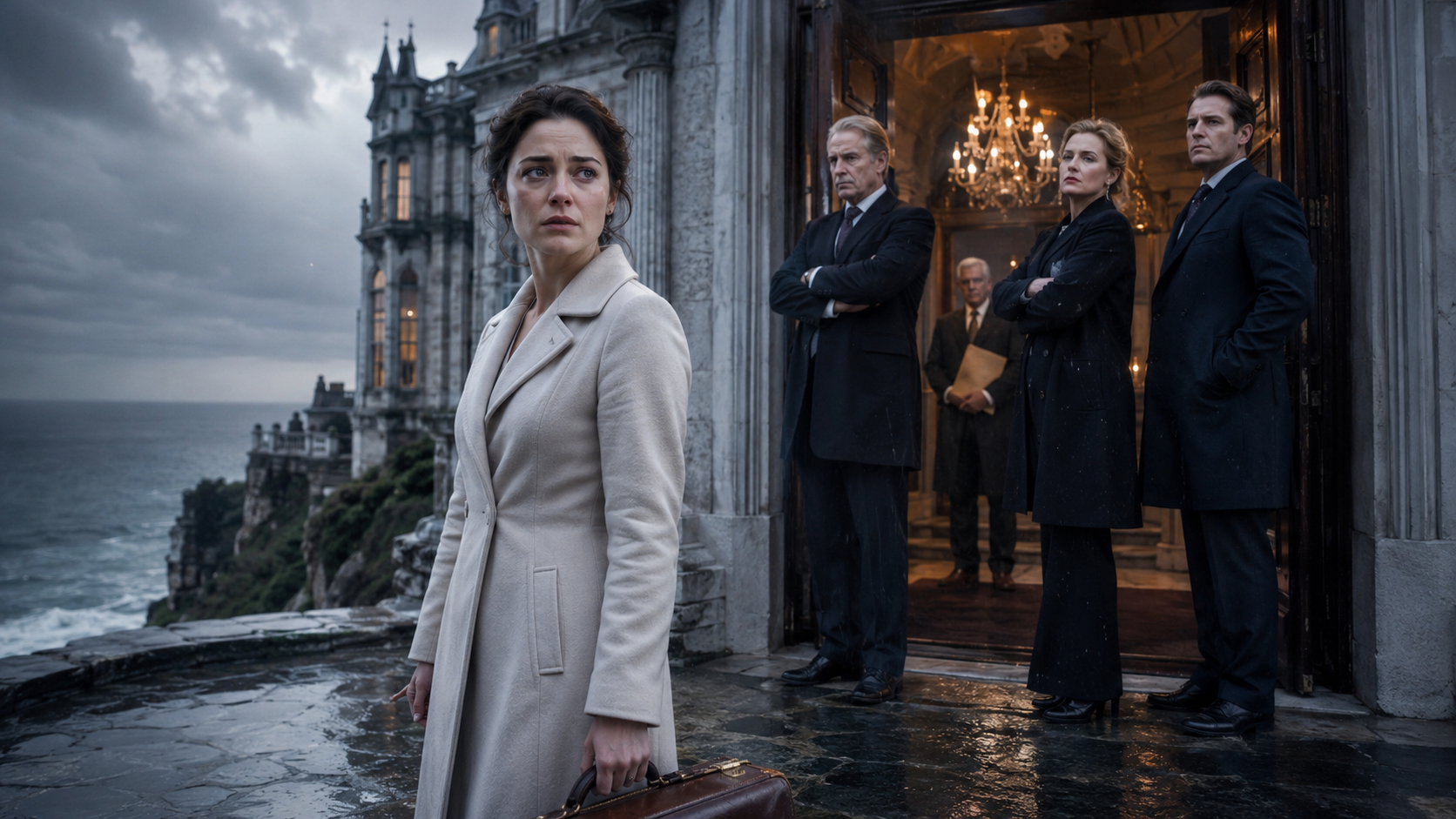
Nathaniel removed a thick file from his case.
Inside the compartment, Evelyn had found letters, financial records, original company contracts, and a photograph of two young women standing beside the first Ashbourne cargo vessel.
One woman was Lenora.
The other was Evelyn’s grandmother, Margaret Reed.
Nathaniel placed the photograph before the family.
“In 1974, Lenora Ashbourne and Margaret Reed founded a small coastal freight company together. Margaret provided half of the initial capital and designed the logistics system that later became the foundation of Ashbourne Maritime.”
Charles looked at the photograph.
“I have never heard of her.”
“That was intentional,” Nathaniel said.
He opened one of the original contracts.
“Margaret owned forty percent of the company. After she died in a suspicious boating accident, Lenora’s husband concealed the partnership agreement and transferred Margaret’s ownership into the Ashbourne family trust.”
Evelyn struggled to speak.
“My grandmother was Lenora’s business partner?”
“She was also her closest friend.”
“Why didn’t my family know?”
“Your mother was still a child when Margaret died. She was told that her mother had worked as a secretary for the Ashbournes. Lenora attempted to expose what had happened, but her husband threatened to have your mother placed in institutional care and to destroy the Reed family financially.”
Evelyn looked toward Lenora’s portrait.
“She stayed silent.”
“For fifty-two years,” Nathaniel said. “And she regretted it every day.”
The memory of Lenora whispering Margaret’s name suddenly made sense.
Vivian folded her arms.
“This has nothing to do with the will.”
“It has everything to do with it.”
Nathaniel began reading.
Lenora had ordered the restoration of Margaret Reed’s stolen ownership, adjusted for decades of growth, dividends, and reinvestment.
The amount was staggering.
Through a newly established trust, Evelyn would receive thirty-eight percent of Ashbourne Maritime.
The remaining shares previously controlled by Lenora would be transferred to an employee ownership foundation.
Charles would lose his expected position as chairman.
Adrian would receive nothing.
Vivian would be permitted to keep one private residence, but Ashbourne House itself would become the headquarters of the Margaret Reed Foundation, an organization providing legal and medical assistance to caregivers, domestic employees, and workers exploited by wealthy families.
Evelyn would serve as the foundation’s first director.
Nathaniel paused before reading Lenora’s final personal statement.
“My children believed inheritance was a reward for sharing my name. They were wrong. Wealth is not proof of character, and blood is not a license to behave without consequence.
“Evelyn Reed entered my home as a nurse. She gave me dignity when my own family treated my death as a business transaction. She did not flatter me, fear me, or ask me for money.
“I could not return the years stolen from Margaret. I could not give her daughter the truth while she was still alive. But I can return what was taken from her family.
“To Evelyn, I leave not charity, but restitution.
“To my children, I leave the consequences of their choices.
“And to anyone who asks why a nurse inherited what an Ashbourne expected to receive, tell them this: she was the only person in the house who understood that caring for someone is more valuable than waiting for them to die.”
No one spoke.
The sea thundered against the cliffs outside.
Charles finally turned to Evelyn.
“This company belongs to us.”
Evelyn looked at the original partnership agreement.
“It belonged to my grandmother too.”
“You know nothing about shipping.”
“No,” she replied. “But I know what it means when powerful people assume someone without money cannot defend themselves.”
Vivian approached her more carefully.
“Evelyn, we were all emotional this morning. Mistakes were made.”
“You accused me of stealing.”
“We acted on information Adrian gave us.”
“You did not even ask whether it was true.”
“We can resolve this privately.”
Evelyn looked around the library—the polished shelves, the portraits, the enormous windows facing the ocean.
For generations, the room had been used to make decisions about people who were never permitted to enter it.
“No,” she said. “This family has resolved too many things privately.”
The police arrested Adrian for planting evidence and attempting to frame her. Charles was questioned about his role in concealing the act and later became the subject of a wider investigation into company funds he had moved through foreign accounts.
Vivian challenged the will.
She lost.
Nine months later, Ashbourne House reopened.