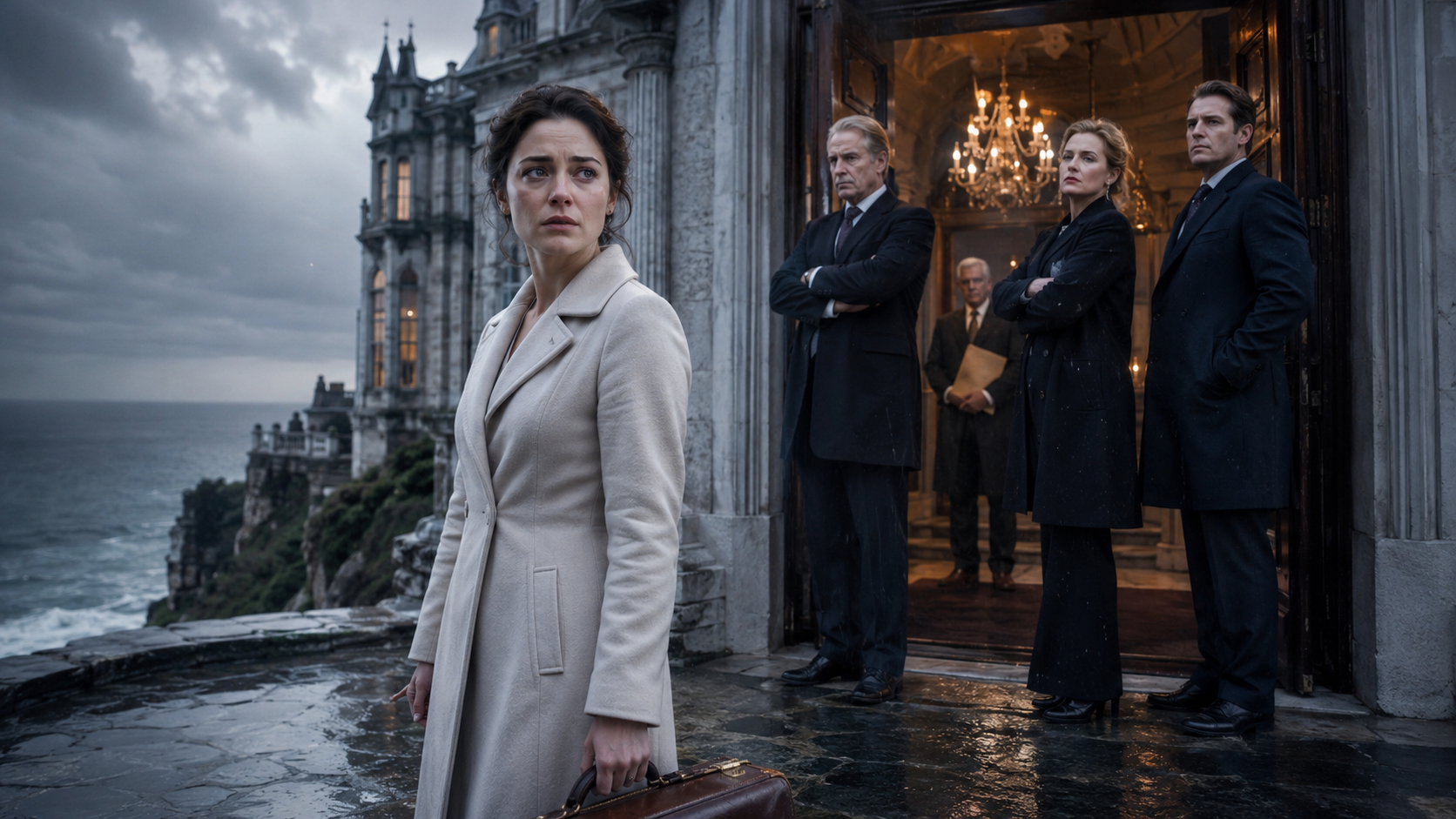
The Nurse They Cast Out of Ashbourne House

On the night Lenora Ashbourne died, the clocks inside Ashbourne House stopped at exactly 2:17 in the morning.

There was no power failure. No storm had damaged the electrical lines. Yet every clock in the mansion—from the brass carriage clock in the library to the enormous pendulum clock overlooking the main staircase—fell silent at the same moment.

Only one person heard Lenora’s final breath.

Her name was Evelyn Reed.

For eleven months, Evelyn had lived in a modest room at the far end of the servants’ corridor. She was thirty-one years old, a private nurse with calm gray eyes and a voice that rarely rose above a gentle murmur. She had been hired after three other nurses resigned, each complaining that Lenora was demanding, suspicious, and impossible to please.

Evelyn had never considered her impossible.

She had simply considered her lonely.

Ashbourne House stood on a cliff above the cold Atlantic, surrounded by windswept gardens and iron gates blackened by age. The estate had belonged to the Ashbourne family for more than a century. Its stone halls were filled with paintings of solemn men, jeweled women, hunting dogs, military officers, and children who had grown into adults incapable of loving one another.

Lenora had built the family fortune into an empire.

Ashbourne Maritime owned ports, warehouses, cargo vessels, and shipping contracts across three continents. Her children had spent years waiting for her to die so they could divide everything she had created.

Her eldest daughter, Vivian, wanted the estate.

Her son, Charles, wanted control of the company.

Her grandson, Adrian, wanted the money without the inconvenience of responsibility.

None of them wanted Lenora herself.

They visited when the lawyers called. They smiled when photographers were present. They sent flowers chosen by assistants and cards signed by secretaries.

Evelyn was the one who washed Lenora’s hair, read her the morning newspaper, warmed her hands during painful treatments, and listened when the old woman woke from nightmares calling the name of someone named Margaret.

During Lenora’s final hour, the mansion was silent except for the sea striking the cliffs below.

Lenora lay beneath a pale blue blanket, her face thin and almost translucent. Evelyn sat beside her, holding her hand.

“Open the curtains,” Lenora whispered.

“It’s still dark.”

“I know. Open them anyway.”

Evelyn crossed the room and pulled the heavy curtains apart. Beyond the glass, the horizon was beginning to turn silver.

Lenora watched the first weak light appear over the water.

“They think this house belongs to them,” she said.

“You should rest.”

“I have rested for too many years.”

Her fingers tightened around Evelyn’s hand with unexpected strength.

“Promise me something.”

“Anything.”

“When they tell you to leave, do not believe that you have lost.”

Evelyn frowned.

“Why would they tell me to leave?”

Lenora’s lips curved into the faintest smile.

“Because cruel people become careless when they think they have already won.”

Her eyes moved toward the carved wooden cabinet beside the fireplace.

“The truth is not in the jewelry box,” she whispered. “It is in the music.”

Evelyn leaned closer.

“What music?”

But Lenora was looking past her now, toward the distant light beyond the window.

“Margaret,” she breathed.

Then her hand became still.

Evelyn remained beside the bed for several minutes. She did not call the family immediately. She adjusted the blanket, closed Lenora’s eyes, and placed the old woman’s hands gently over her heart.

Only then did she telephone the doctor.

By sunrise, the mansion was no longer quiet.

Cars swept through the gates. Attorneys were called. Employees were ordered from room to room. Florists arrived with white lilies. The kitchen was instructed to prepare breakfast for twelve, although no one seemed hungry.

Vivian Ashbourne entered her mother’s bedroom wearing a black wool coat and pearl earrings. Her eyes were dry.

Behind her came Charles, still speaking into his telephone, and Adrian, who appeared irritated that death had required him to wake before noon.

Vivian glanced at the bed and then at Evelyn.

“What are you still doing here?”

Evelyn stood.

“I was organizing Mrs. Ashbourne’s medical records for the doctor.”

“The doctor has what he needs.”

“There are also instructions from Mr. Bennett. He said everyone mentioned in the estate documents should remain until the reading this afternoon.”

Vivian’s expression hardened.

“You were employed to care for my mother. My mother is dead. Your employment has ended.”

Evelyn lowered her voice.

“She asked me to stay.”

Charles ended his telephone call.

“Our mother was heavily medicated.”

“She was fully aware of what she was saying.”

Adrian wandered toward the cabinet near the fireplace.

“How touching,” he said. “The devoted nurse receiving mysterious final instructions.”

Evelyn ignored him.

Vivian stepped closer.

“My mother had become emotionally dependent on you. That does not make you part of this family.”

“I never claimed it did.”

“Then collect your belongings.”

Evelyn looked toward the window. Lenora’s warning returned to her.

When they tell you to leave, do not believe that you have lost.

“I would prefer to wait for Mr. Bennett.”

“You do not have a preference here,” Vivian replied.

Adrian opened the cabinet.

Inside were several shelves of music boxes collected from different countries. Some were made of silver, others of painted porcelain or dark polished wood.

He lifted a small walnut box decorated with a brass nightingale.

“What is this doing open?”

Evelyn turned.

“It wasn’t open.”

Adrian reached inside and removed a folded document.

Vivian’s face changed.

“What is that?”

Adrian unfolded it dramatically.

“It appears to be a transfer authorization for shares in Ashbourne Maritime.”

Charles snatched it from his hand.

At the bottom of the document was Lenora’s signature.

The beneficiary line contained Evelyn Reed’s name.

For several seconds, no one spoke.

Evelyn stared at the paper.

“I have never seen that before.”

Charles examined the signature.

“This gives you two percent of the company.”

“I didn’t ask her for anything.”

“Two percent is worth several million dollars,” Vivian said.

“I know nothing about it.”

Adrian continued searching the cabinet.

A moment later, he produced Lenora’s emerald brooch.

Vivian gave a quiet gasp.

“That was kept in the bedroom safe.”

Evelyn felt the blood leave her face.

Adrian held the brooch between two fingers.

“And now it is hidden beside a document giving the nurse a fortune.”

“That cabinet was locked yesterday,” Evelyn said.

“Who had access to the room?” Charles asked.

“Your mother, the housekeeper, the doctor, and me.”

Vivian looked at the security guard standing near the door.

“Search her room.”

Evelyn stepped forward.

“No.”

Vivian turned to her.

“No?”

“You may dismiss me, but you will not search my personal belongings without permission.”

“You have apparently been stealing from a dying woman.”

“I did not take that brooch.”

Adrian smiled.

“Of course you didn’t. It simply walked out of the safe and hid itself beside a forged share transfer.”

“The document is forged?” Evelyn asked.

Charles held it toward the window.

“My mother would never give company shares to an employee.”

Evelyn looked from one face to another.

Their outrage seemed rehearsed. Their accusations had arrived too quickly, as though they had been waiting for a reason to remove her.

“You knew something was in that cabinet,” she said.

Adrian’s smile vanished.

Vivian pointed toward the hallway.

“Leave this house immediately.”

“I am waiting for Mr. Bennett.”

“You are leaving before I call the police.”

Charles stepped between them.

“Perhaps we should call them. Fraud, theft, manipulation of a vulnerable patient—”

“No,” Vivian said sharply.

Charles glanced at his sister.

Vivian regained her composure.

“A public scandal would be disrespectful to Mother. We will allow Miss Reed to leave quietly.”

Evelyn finally understood.

They did not want an investigation.

They wanted her gone.

She returned to her small room and packed her belongings into a single leather suitcase. Two guards waited outside the door as though she were a criminal.

The housekeeper, Mrs. Doyle, stood at the end of the corridor. Her eyes were wet, but she was too frightened to speak.

As Evelyn passed, the older woman secretly pressed something into her hand.

It was a tiny brass key.

Evelyn looked at her.

Mrs. Doyle whispered, “She told me to give you this only if they forced you out.”

“What does it open?”

“I don’t know.”

Before Evelyn could ask another question, one of the guards ordered her to continue walking.

Rain had begun to fall when the front doors opened.

Vivian stood beneath the portico, protected from the weather.

“You will not contact the newspapers,” she said.

“I have nothing to tell them.”

“You will not speak publicly about my mother’s condition.”

“I have always respected her privacy.”

“And you will not return to this property.”

Evelyn turned to face her.

“You should spend less time protecting this house from me and more time asking why your nephew knew exactly where to search.”

Adrian emerged behind Vivian.

“Be careful, nurse.”

“Of what?”

“People who accuse this family usually discover that no one believes them.”

Evelyn looked back through the open doors.

For almost a year, Ashbourne House had been her entire world. Now it seemed colder than ever, a beautiful monument built to protect generations of lies.

“You are right,” she said. “People may not believe me.”

Her fingers closed around the brass key.

“But Lenora believed someone would eventually discover the truth.”

Vivian’s face tightened.

The doors closed.

Evelyn walked through the rain toward the gates.

At four o’clock that afternoon, the Ashbourne family gathered in the library.

Vivian sat in Lenora’s chair. Charles poured himself a drink. Adrian stood near the fireplace, checking his phone every few seconds.

Several executives from Ashbourne Maritime were present, along with the director of Lenora’s charitable foundation.

At precisely four, Nathaniel Bennett entered carrying a leather case.

He had served as Lenora’s attorney for thirty-seven years. He was tall, silver-haired, and known for speaking with the patience of a man who had never needed to repeat himself.

He surveyed the room.

“Where is Miss Reed?”

Vivian crossed her legs.

“She was dismissed.”

“By whom?”

“By the family.”

Nathaniel placed his case on the table.

“On what grounds?”

“She was discovered with stolen property and a fraudulent transfer document.”

“Was she arrested?”

“We chose not to involve the police.”

“How generous.”

Charles leaned forward.

“Is there a problem?”

Nathaniel opened his case but did not remove the will.

“There may be several.”

Adrian spoke impatiently.

“Can we begin?”

“No.”

Nathaniel looked toward the library doors.

“Lenora’s instructions require Evelyn Reed to be present.”

Vivian rose.

“An employee cannot delay the legal affairs of this family.”

Nathaniel met her gaze.

“Miss Reed was not invited as an employee.”

The room became silent.

Charles set down his glass.

“What exactly does that mean?”

“It means your mother expected this situation.”

Nathaniel removed a sealed envelope.

“Three weeks ago, Lenora gave me written instructions. She believed someone would plant the emerald brooch and a forged share document in the music cabinet. She further predicted that Miss Reed would be accused and expelled before the reading of the will.”

Adrian stopped moving.

Vivian stared at him.

Nathaniel continued.

“Lenora also instructed me to contact the police if the family refused to report the alleged theft.”

Charles stood.

“This is absurd.”

“Is it?”

Nathaniel took a small remote control from his pocket.

The television screen above the fireplace came to life.

The recording showed Lenora’s bedroom at 1:26 that morning.

Adrian entered quietly.

He unlocked the cabinet with a key, placed the folded document inside, and removed the emerald brooch from his jacket.

He arranged both objects where they would be easily discovered.

Then he looked directly toward the bed, unaware that a camera had been concealed inside the carved frame of Lenora’s mirror.

Vivian slowly turned toward him.

“You told me the nurse had already hidden them.”

Adrian’s mouth opened.

“I thought she had.”

“The recording says otherwise,” Nathaniel replied.

Charles moved toward the television.

“Turn that off.”

Nathaniel did not.

The recording continued.

It showed Charles entering the room twenty minutes later.

He opened the cabinet, examined the objects, and then closed it again.

Charles said nothing.

The screen went dark.

Vivian looked at her brother.

“You knew.”

Charles’s face had lost its color.

“I knew Adrian suspected her.”

“You saw him plant everything.”

“I was trying to protect the family.”

“From a nurse?”

“From whatever Mother intended to give her.”

Nathaniel returned the remote to his pocket.

“Lenora understood each of you better than you understood yourselves.”

He opened a second envelope.

“The forged document was a test. The actual estate plan contains a misconduct clause. Any beneficiary who knowingly participated in the false accusation, unlawful expulsion, concealment of evidence, or intimidation of Evelyn Reed forfeits all personal inheritance.”

Vivian gripped the back of the chair.

“I did not know Adrian planted the evidence.”

“You ordered Miss Reed from the property without allowing her to defend herself.”

“I believed my son.”

“You believed what was financially convenient.”

Charles slammed his hand against the table.

“My mother cannot control us from the grave.”

Nathaniel finally removed the will.

“She appears to be doing exactly that.”

The library doors opened.

Evelyn entered with Mrs. Doyle and two uniformed police officers.

Her damp hair had been pulled back, and she was still wearing the same simple coat in which she had left the estate.

Vivian stared at her.

“How did you get back inside?”

Nathaniel answered.

“I sent a car for her.”

Adrian pointed toward the officers.

“Why are they here?”

Evelyn placed the brass key on the table.

“Because the key Mrs. Doyle gave me opened a private compartment at Lenora’s bank.”

Nathaniel removed a thick file from his case.

Inside the compartment, Evelyn had found letters, financial records, original company contracts, and a photograph of two young women standing beside the first Ashbourne cargo vessel.

One woman was Lenora.

The other was Evelyn’s grandmother, Margaret Reed.

Nathaniel placed the photograph before the family.

“In 1974, Lenora Ashbourne and Margaret Reed founded a small coastal freight company together. Margaret provided half of the initial capital and designed the logistics system that later became the foundation of Ashbourne Maritime.”

Charles looked at the photograph.

“I have never heard of her.”

“That was intentional,” Nathaniel said.

He opened one of the original contracts.

“Margaret owned forty percent of the company. After she died in a suspicious boating accident, Lenora’s husband concealed the partnership agreement and transferred Margaret’s ownership into the Ashbourne family trust.”

Evelyn struggled to speak.

“My grandmother was Lenora’s business partner?”

“She was also her closest friend.”

“Why didn’t my family know?”

“Your mother was still a child when Margaret died. She was told that her mother had worked as a secretary for the Ashbournes. Lenora attempted to expose what had happened, but her husband threatened to have your mother placed in institutional care and to destroy the Reed family financially.”

Evelyn looked toward Lenora’s portrait.

“She stayed silent.”

“For fifty-two years,” Nathaniel said. “And she regretted it every day.”

The memory of Lenora whispering Margaret’s name suddenly made sense.

Vivian folded her arms.

“This has nothing to do with the will.”

“It has everything to do with it.”

Nathaniel began reading.

Lenora had ordered the restoration of Margaret Reed’s stolen ownership, adjusted for decades of growth, dividends, and reinvestment.

The amount was staggering.

Through a newly established trust, Evelyn would receive thirty-eight percent of Ashbourne Maritime.

The remaining shares previously controlled by Lenora would be transferred to an employee ownership foundation.

Charles would lose his expected position as chairman.

Adrian would receive nothing.

Vivian would be permitted to keep one private residence, but Ashbourne House itself would become the headquarters of the Margaret Reed Foundation, an organization providing legal and medical assistance to caregivers, domestic employees, and workers exploited by wealthy families.

Evelyn would serve as the foundation’s first director.

Nathaniel paused before reading Lenora’s final personal statement.

“My children believed inheritance was a reward for sharing my name. They were wrong. Wealth is not proof of character, and blood is not a license to behave without consequence.

“Evelyn Reed entered my home as a nurse. She gave me dignity when my own family treated my death as a business transaction. She did not flatter me, fear me, or ask me for money.

“I could not return the years stolen from Margaret. I could not give her daughter the truth while she was still alive. But I can return what was taken from her family.

“To Evelyn, I leave not charity, but restitution.

“To my children, I leave the consequences of their choices.

“And to anyone who asks why a nurse inherited what an Ashbourne expected to receive, tell them this: she was the only person in the house who understood that caring for someone is more valuable than waiting for them to die.”

No one spoke.

The sea thundered against the cliffs outside.

Charles finally turned to Evelyn.

“This company belongs to us.”

Evelyn looked at the original partnership agreement.

“It belonged to my grandmother too.”

“You know nothing about shipping.”

“No,” she replied. “But I know what it means when powerful people assume someone without money cannot defend themselves.”

Vivian approached her more carefully.

“Evelyn, we were all emotional this morning. Mistakes were made.”

“You accused me of stealing.”

“We acted on information Adrian gave us.”

“You did not even ask whether it was true.”

“We can resolve this privately.”

Evelyn looked around the library—the polished shelves, the portraits, the enormous windows facing the ocean.

For generations, the room had been used to make decisions about people who were never permitted to enter it.

“No,” she said. “This family has resolved too many things privately.”

The police arrested Adrian for planting evidence and attempting to frame her. Charles was questioned about his role in concealing the act and later became the subject of a wider investigation into company funds he had moved through foreign accounts.

Vivian challenged the will.

She lost.

Nine months later, Ashbourne House reopened.

The locked gates were removed. The servants’ rooms were renovated into offices and temporary accommodation for caregivers escaping abusive employers. The library became a legal assistance center. The ballroom, once reserved for private galas, was converted into a training hall for nurses and home-care workers.

Evelyn kept Lenora’s bedroom exactly as it had been.

She did not preserve it as a monument to a perfect woman. Lenora had not been perfect. She had been powerful, frightened, guilty, and silent for far too long.

But in the final months of her life, she had chosen to tell the truth.

One evening, Evelyn returned to the music cabinet.

Inside stood the small walnut box with the brass nightingale.

She inserted the key Mrs. Doyle had given her.

The box opened with a soft click.

A melody began to play.

Evelyn recognized it immediately.

It was the lullaby her mother had sung to her when she was a child—the same melody Margaret Reed had once taught Lenora during long nights aboard their first cargo vessel.

Beneath the mechanism was one final note written in Lenora’s hand.

Evelyn read it beside the window as the sun disappeared into the Atlantic.

“Dear Evelyn,

“A house is only stone until someone decides what it will protect.

“My family used these walls to protect its reputation.

“I hope you will use them to protect people.

“Do not remember me only for the truth I finally told. Remember Margaret, who deserved to hear it while she was alive.

“And when someone enters this house wearing a uniform, carrying a cleaning bag, delivering food, repairing a pipe, or caring for the sick, look at their face.

“Never make the mistake my children made.

“Never believe that wealth makes one person important and another invisible.”

Evelyn folded the note.

Downstairs, voices filled the mansion—not the cold voices of heirs arguing over property, but nurses attending a training program, lawyers advising workers, children visiting parents, and volunteers preparing the evening meal.

For the first time in its history, Ashbourne House no longer felt like a fortress.

Evelyn placed Margaret’s photograph beside Lenora’s portrait.

Then she restarted every clock in the mansion.

One by one, the silent mechanisms returned to life.

And at 2:17 the following morning, the great clock above the staircase continued ticking—past the minute of Lenora’s death and into a future the Ashbourne family had never expected.