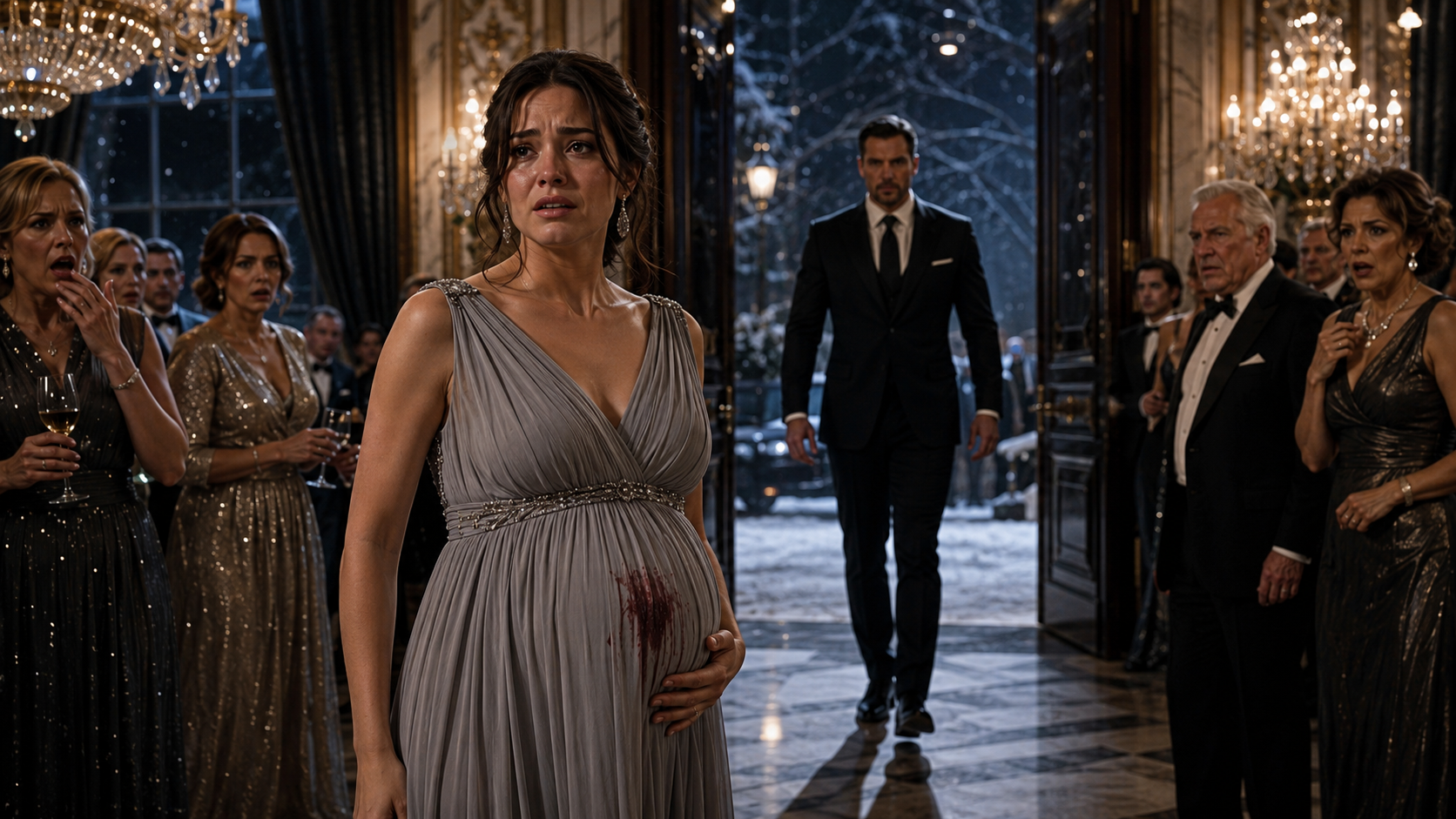
By the time Elena Ward reached the top of the marble staircase, she already knew she had made a mistake.
Not because of the dress.
The dress was simple, yes. A soft pearl-gray gown with long sleeves, a modest neckline, and a satin ribbon that rested gently above the curve of her six-month pregnancy. It was not a designer piece shipped from Milan. It had not been chosen by a stylist or guarded in a velvet garment bag. She had found it herself in a quiet boutique near the river, and when she tried it on, she had smiled at her reflection for the first time in weeks.
She had liked the woman in the mirror.
She looked calm.
She looked strong.
She looked like someone who belonged beside Adrian Blackwell.
But the moment Elena entered the grand ballroom of the St. Aurelia Hotel, she felt every eye decide otherwise.
Crystal chandeliers burned above her like frozen fire. A string quartet played near the stage, their music polished and expensive. Men in black tuxedos moved through the room with the practiced confidence of people who had never wondered whether they were welcome. Women glittered in diamonds, silk, emerald velvet, and judgment.
The Winter Mercy Gala was the most exclusive charity event in Manhattan. It raised money for children needing critical surgeries, and the guest list was almost impossible to enter unless your name opened doors before you touched them.
Elena’s name opened nothing.
Adrian’s opened everything.
That was why she had come alone.
He had called an hour earlier, his voice quiet and tight with apology. A board emergency. A last-minute legal meeting. A delay he could not avoid.
“Stay in the car until I arrive,” he had told her.
“I’ll be fine,” Elena had answered.
There had been a pause.
“Elena.”
She had laughed softly then, trying to make him less worried. “I am not made of glass.”
“No,” Adrian had said. “But people in rooms like that like to pretend they are made of gold.”
She should have listened.
Now she stood at the edge of a ballroom filled with people who had known Adrian Blackwell for years but had never bothered to know the woman he married. Some looked away as soon as she caught them staring. Others looked longer, as if she were a stain on a white tablecloth.
Elena placed one hand over her stomach.
Her baby shifted beneath her palm.
“It’s all right,” she whispered.
A waiter passed with champagne. Elena took a glass of sparkling water instead and moved toward the window, hoping to become invisible until Adrian arrived. Snow drifted outside, softening the city beyond the glass. The view was beautiful enough to hide in.
For almost five minutes, it worked.
Then Celeste Harrington saw her.
Celeste was the kind of woman whose smile could open society doors and close careers. She was tall, sharp, dressed in white silk, with a diamond collar at her throat and a voice trained to sound gentle while cutting skin.
She approached Elena with three women beside her.
One of them, Bianca Rowe, was already laughing.
“Elena, isn’t it?” Celeste asked.
Elena turned politely. “Yes.”
“Celeste Harrington,” the woman said, as if the name itself were a gift.
“I know,” Elena replied. “It’s nice to meet you.”
That made Bianca laugh harder.
Celeste’s gaze traveled slowly over Elena’s dress, her shoes, her hands, and finally her stomach.
“How brave of you to come alone,” Celeste said. “Most women in your position would wait for their husbands.”
Elena tried to keep her voice warm. “Adrian was delayed. He’ll be here soon.”
“Of course he will.” Celeste lifted her champagne glass. “Men like Adrian are always delayed by important things.”
Bianca tilted her head. “I heard he married someone outside our circle. I didn’t realize how far outside.”
The third woman, Lillian Cross, covered her mouth in a little gesture of fake shock. “Bianca.”
“What?” Bianca said. “I’m only admiring the romance of it. A billionaire marries a bakery girl. It sounds like one of those movies people cry over on airplanes.”
Elena felt heat rise behind her eyes.
“I worked in a bakery,” she said. “Before that, I worked in a clinic. And before that, I worked wherever I needed to work.”
Celeste smiled.
“How practical.”
The word practical sounded, in her mouth, like dirty.
Elena turned slightly toward the window again. She could have walked away. She should have walked away. But her feet remained still, and something inside her refused to give these women the satisfaction of seeing her retreat.
Bianca stepped closer.
“Is it true Adrian bought your mother’s house?”
Elena’s fingers tightened around her glass.
Celeste gave Bianca a warning glance, but it was not a warning to stop. It was a warning to enjoy the cruelty more elegantly.
Elena answered slowly. “My mother’s house was facing foreclosure. Adrian helped us keep it.”
“How generous,” Celeste said. “He does enjoy rescue projects.”