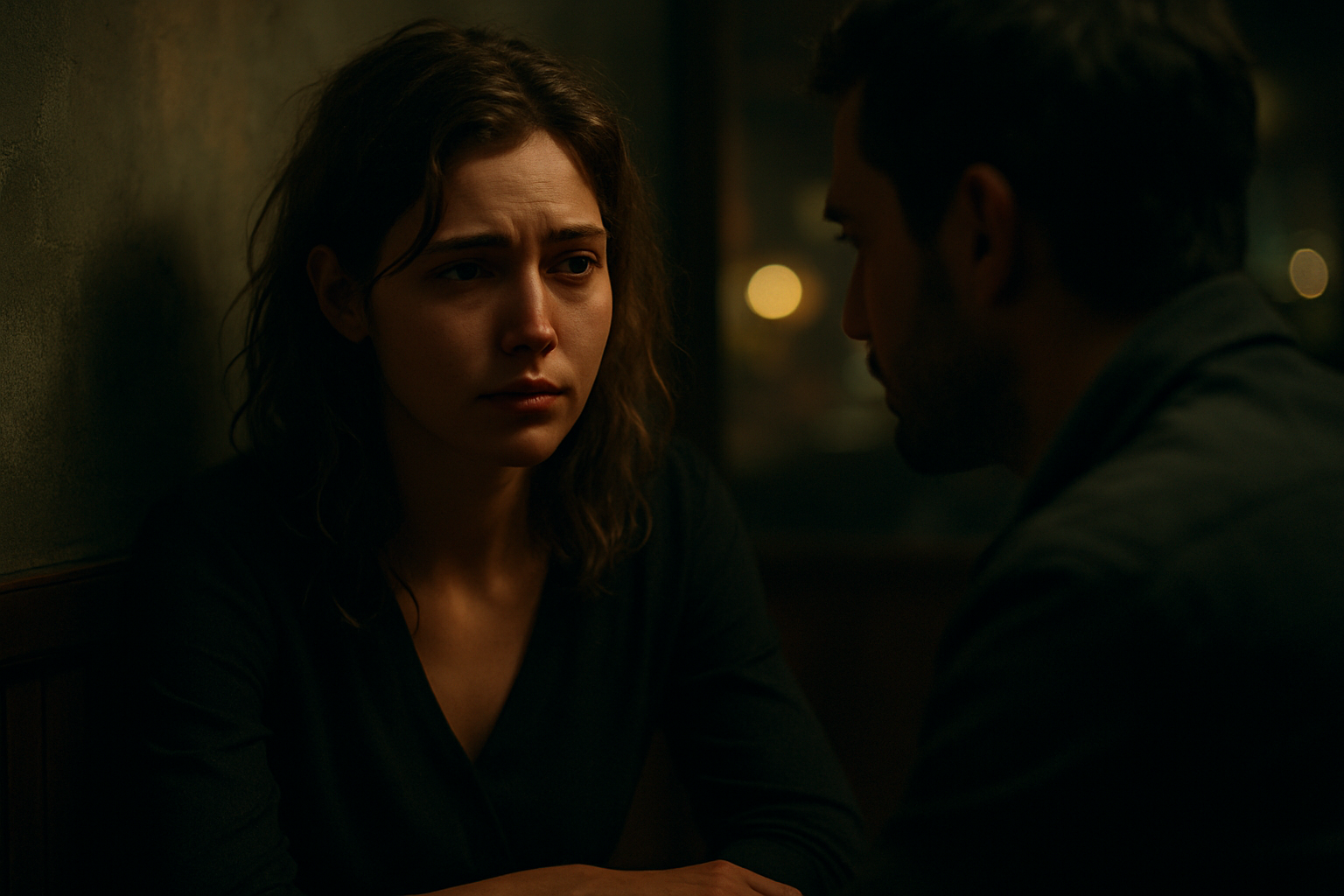
Cassian reached inside his jacket and placed a card on the table.
It was matte black, thick as a secret. Only a number appeared on it, pressed in silver. No name. No crest. No company.
“When you are finished vanishing inside someone else’s life,” he said, “call this.”
“I don’t know you.”
“No.”
“You could be worse than him.”
“Yes.”
The honesty startled her more than any reassurance could have.
“But I will not lie to you about what I am,” Cassian said. “And I will not call pain love merely because a husband is the one causing it.”
Seraphine stared at the card.
“Why?” she asked. “Why help me?”
For the first time, something broke the surface of Cassian Draevon’s controlled face. Not much. A shadow behind the eyes. Old grief, sealed badly.
“Because once,” he said, “a woman I loved needed someone to stand beside her while everyone around her told her to be sensible. I arrived late. I have never developed a taste for repeating mistakes.”
He stood before she could ask who the woman had been.
“Liora can call you a car. Or you can sit in this room until the last candle burns out. No one will touch you.”
Seraphine did not stay until closing.
Pride dragged her first. Then fear. Then habit, the old obedient animal inside her that still believed returning to the penthouse might restore the world to its former shape.
It did not.
The roses Corvin’s assistant had ordered for their anniversary were already bending their heads in the silver vase. The champagne had sweated through its ice. Her wedding ring, which she had pulled off in the restaurant bathroom without remembering doing it, sat on the bedroom vanity like evidence tagged for trial.
Corvin had not come home.
At 12:31, her phone lit again.
Staying elsewhere. We will discuss our future tomorrow.
Our future.
Seraphine read the message in the bathroom mirror, wet hair hanging in ropes around her face, mascara washed into gray shadows beneath her eyes.
For four years, Corvin had spoken of their future as if it were an acquisition under negotiation. Their address. Their holiday schedule. Their public statements. Their children, if and when such children improved the Halewick legacy.
But a child already existed now.
Not in a boardroom projection. Not on a timeline Corvin had approved.
Inside her.
And suddenly Seraphine understood with terrible clarity that if she stayed, he would turn even motherhood into a contract clause.
She reached into her coat pocket and took out Cassian’s black card.
Her thumb hovered over the silver number for almost a full minute. The old Seraphine whispered that respectable wives did not run in the middle of the night to dangerous strangers. The new Seraphine, small and shaking but alive, whispered back that good mothers did not raise children in mausoleums merely because the marble was expensive.
She called.
Cassian answered on the second ring.
“Seraphine.”
“You knew I would call?”
“I hoped you would.”
“I’m carrying a child my husband will not want,” she said. The sentence held until the last word, then broke. “I have nowhere to go that he cannot reach.”
There was a pause. Not uncertainty. Calculation.
“Pack identification,” Cassian said. “Medical records if you have them. Bank information. Anything irreplaceable. Leave the rest.”
“You sound as if you have said this before.”
“I have.”
“That should frighten me.”
“It should make you listen.”
Seraphine closed her eyes.
“Are you rescuing me,” she asked, “or collecting me?”
“Neither. I am opening a door. Whether you step through it belongs to you.”
It mattered.
She did not yet know why, but it mattered.
“Send the car,” she whispered.
“Fifteen minutes.”
She packed one suitcase.
Passport. Birth certificate. Laptop. A folder of medical papers. A photograph of herself at twenty-three, before Corvin had polished away every unruly edge. The pregnancy test, wrapped now in tissue.
She left the ring.
She left the roses.
She left the sapphire dress in a wet heap on the bathroom floor because it belonged to a woman who had been trained to look beautiful while feeling nothing.
The car waiting at the curb was black, silent, and sleek, driven by a man who did not glance at her in the rearview mirror. As they pulled away, Seraphine looked up at the penthouse windows shining high above the rain-black street.
Her phone began ringing before they reached Harborline Drive.
Corvin.
Then Corvin again.
Then his assistant.
Then her mother.
Seraphine turned the phone off and placed both palms over her abdomen.
“We are leaving,” she whispered to the life inside her. “That is the first gift I know how to give you.”
Cassian’s estate stood outside the city behind iron gates and old trees, in a district where money did not shout from glass balconies but hid behind stone walls, private roads, and cameras disguised by ivy.
Seraphine expected a mansion meant to intimidate.