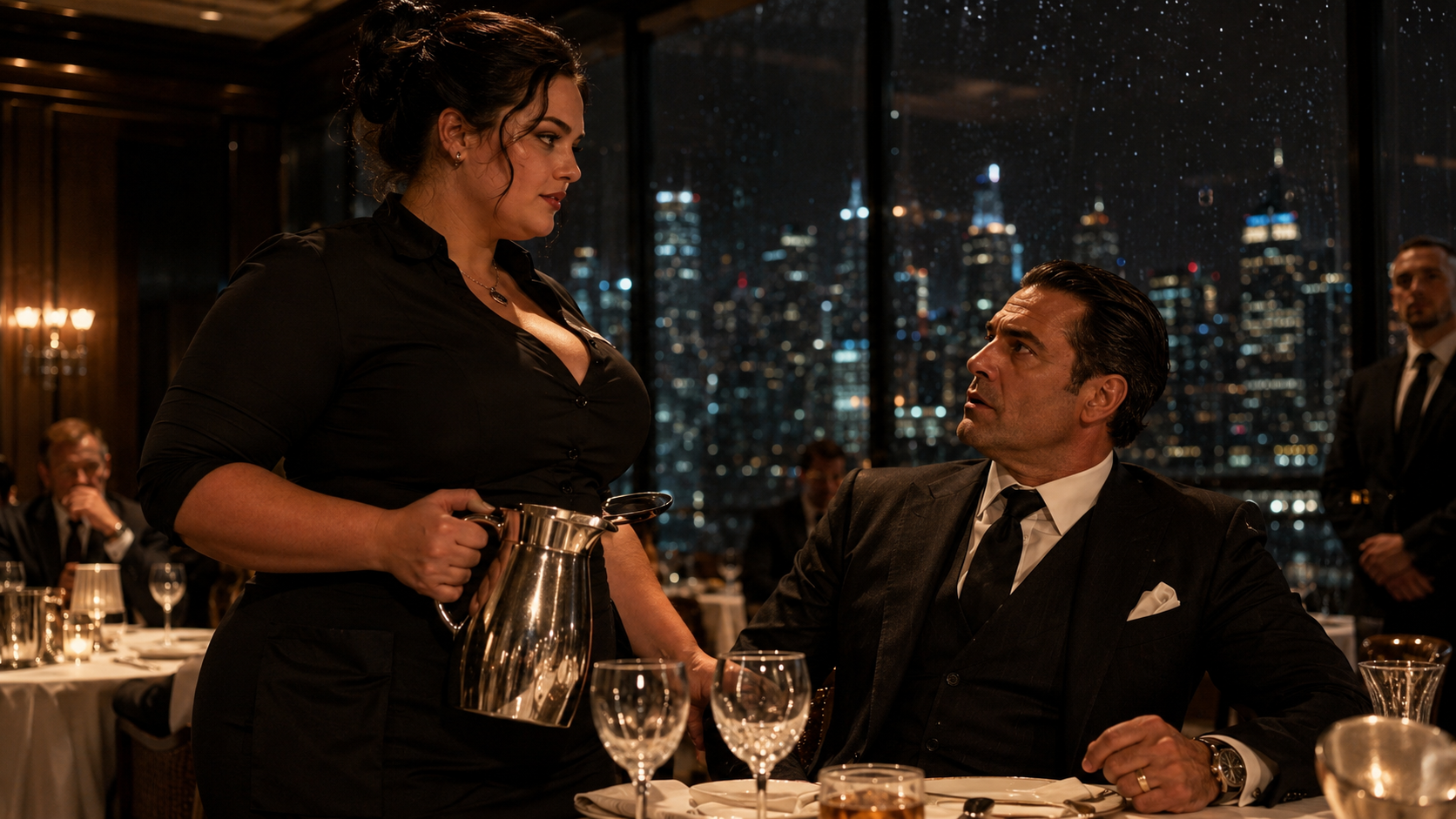
By the third day, everyone understood the truth.
Dante had not merely helped destroy Kareem.
He had exposed half his own empire to do it.
That was the secret.
Not that Dante Marrow was powerful.
Everyone knew that.
The secret was that his power had always depended on men worse than him staying hidden. Once their names were dragged into daylight, his throne cracked under him.
Some called him a traitor.
Some called him strategic.
Lena called him what he was.
Late.
Two weeks after the ferry terminal, Dante came to the community language clinic where Lena volunteered on Monday mornings. He arrived without guards inside the building, though she spotted two across the street pretending to read newspapers in the rain.
Children chased each other between plastic chairs. An old Yemeni man argued cheerfully with a receptionist about paperwork. A mother from Aleppo bounced a baby on her hip while Lena helped fill out housing forms.
Dante stood near the doorway, uncomfortable among ordinary need.
Good, Lena thought.
Let him feel small somewhere.
When her shift ended, she found him waiting in the hallway beside a bulletin board covered in flyers.
“No suit?” she asked.
He looked down at his dark sweater. “I was told I frighten people less this way.”
“Who told you that?”
“Imani.”
“She’s right.”
He almost smiled.
Lena crossed her arms. “Why are you here?”
He handed her a folder.
She did not take it.
“If that is money, leave.”
“It is the deed to this building.”
Her expression hardened. “Absolutely not.”
“Not to you. To the clinic. Through a foundation. Fully legal. No conditions.”
“There are always conditions with men like you.”
“Yes,” Dante said. “That is why I had lawyers remove mine.”
Lena stared at him.
He looked tired. The wound in his arm had healed enough that he no longer favored it, but something else in him seemed newly broken open.
“My organization is changing,” he said.
“Into what?”
“I don’t know yet.”
“That is not comforting.”
“No.”
“Are you asking me to forgive you?”
“No.”
“Good.”
“I am asking whether a man can become different before the world finishes punishing him for what he was.”
Lena looked through the glass door at the clinic. At the people waiting with folders, fears, children, accents, hope. At the kind of world men like Dante had always used without seeing.
“Becoming different is not a speech,” she said. “It is rent paid with clean money. It is names given to prosecutors. It is men protected from your men. It is women believed the first time they speak. It is choosing the harder door every day until people stop applauding you for finding it.”
Dante listened.
No interruption.
No argument.
No performance.
At last he nodded. “Then I will start there.”
Months passed.
Kareem Sayegh’s trial became the kind of public spectacle the city pretended to hate and secretly devoured. Lena testified in a navy dress and flat shoes. She spoke in English. She translated Arabic recordings without shaking. When Kareem’s lawyer tried to make her look emotional, confused, unreliable, she looked at the jury and said, “Understanding cruelty in more than one language does not make me confused. It makes him exposed.”
The quote ran across newspapers the next morning.
Lena hated the attention.
Nora framed the article anyway.
Dante’s name surfaced slowly. Not as a defendant. Not as a hero. As a shadow behind evidence nobody could explain. His empire shrank. Men left him. Some tried to kill him. A few succeeded in killing each other first.
Imani took over the legal businesses.
The illegal ones became smaller, then quieter, then gone in ways Lena did not ask about because she knew change did not arrive pure. Not in Dante’s world. Not in any world built on fear.
But change arrived.
The Sapphire Room offered Lena her job back with a raise after firing the manager who had once told her she should “move more delicately around premium guests.”
Lena declined.
She opened her own translation office on the second floor of the clinic building. Ward Language Services. Legal interpretation. Medical forms. Immigration hearings. Emergency calls. No one turned away for inability to pay.
On opening day, a white envelope arrived.
No lilies.
Just a note.
Your father would have understood the power of this room.
No signature.
Lena knew.
She kept the note in a drawer and told herself it meant nothing.
A year after the night at The Sapphire Room, the clinic hosted a fundraiser in the building Dante had given away and Lena had refused to let him control. There was music, food, crowded tables, children running underfoot, old women laughing, young lawyers networking too loudly, translators switching languages mid-sentence without noticing.
Lena wore a deep green dress that fit her body without apology.
Dante arrived late.
No entourage.