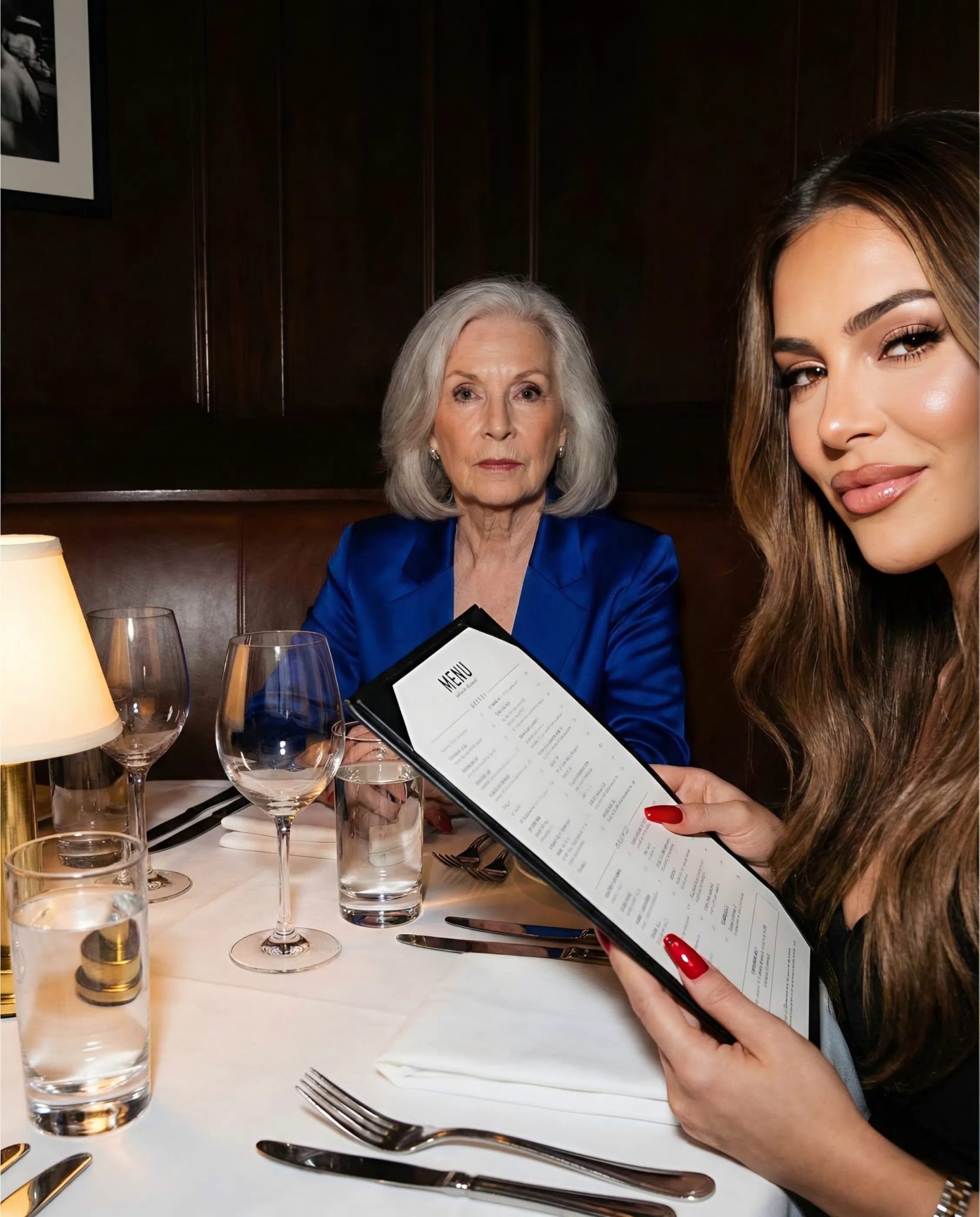
My daughter-in-law launched her little coup under the soft golden glow of The Sovereign—Atlanta’s most self-congratulatory steakhouse, where the chandeliers cost more than starter homes and every plate looks like it’s auditioning for the cover of a fine-dining magazine. It was Jamal’s 38th birthday, a night meant for him. Instead, it became the night Tia crowned herself queen.
I sat at the far end of the long mahogany table, watching Jamal laugh louder than he ever needed to, surrounded by people who liked the image of him more than the man. Tia sparkled beside him in a red sequined dress, soaking up every glint of light in the room. Everything about her broadcast ambition disguised as confidence. Dinner had been a spectacle—towering seafood platters, wine bottles so precious the servers cradled them like newborns. And the moment dessert plates were cleared, the air shifted.

Thomas, the waiter who’d served me for fifteen years, approached with the check. He didn’t even look at anyone else; he knew the routine. But before he could hand it to me, a red-tipped hand darted out.
“I’ll take that,” Tia declared, plucking the bill folder with theatrical flair.
The table went silent. Even nearby diners looked over. She tapped her spoon against her wineglass, summoning attention she hadn’t earned.
“Everyone,” she announced, rising like she was delivering a national address, “I have something to share. As of today, Evelyn can finally relax.”
I folded my hands in my lap as that cold, steady calm washed over me—the kind you feel right before an irreversible shift.
“Put your wallet away, Evelyn,” she said sweetly, with an edge like glass. “I cancelled your platinum card this morning.”
Jamal stared at the tablecloth. He wouldn’t look at me. He wouldn’t look at her. But he also didn’t deny it.
“We have Power of Attorney now,” she added. “We’ve decided you shouldn’t be handling the finances anymore. You’re getting older. So from now on—” her chin lifted “—I run this family.”
There it was. Her coup. Served with tiramisu and arrogance.
“Tia,” I said evenly, “give me the bill.”
She laughed, waving my own card in my face. “This? Cancelled. You don’t make decisions anymore. Right, baby?”

Jamal nodded, jaw tight, still refusing to meet my eyes. That hurt more than her performance ever could.
But I simply smiled—the kind of smile that had ended careers in boardrooms.
“If that’s how you want to play it,” I said, rising, “then who am I to argue?”
She expected a scene. Tears. Rage. Instead, I picked up my purse, smoothed my jacket, and left with flawless composure. She thought I was retreating.
I wasn’t.
Outside, the Atlanta night wrapped around me like velvet. I slid into the backseat of my sedan and gave myself ten seconds to feel the wound. Ten seconds to acknowledge what my son had just done.
Then the grief evaporated. The CEO returned.
I pulled out my phone and tapped the contact labeled simply: Sterling.
“Good evening, Ms. Ross,” he answered. “Problem?”
“Yes,” I said. “Activate Protocol Zero.”
He inhaled sharply. “That freezes everything. All accounts. All access.”
“Exactly.”
Within minutes, he walked me through the sequence. Every joint account Jamal had signed? Frozen. The house card Tia used? Flagged as stolen. Jamal’s personal checking? Transfer limit: zero. Every financial artery they depended on was shut down.

“You understand, ma’am,” Sterling said carefully, “this will decline everything they try. Even small purchases.”
“She wanted control,” I replied. “Let her experience what that actually means.”
Ten minutes later, right on schedule, my phone rang.
Jamal.
I let it ring twice. Then answered.
“Mom!” he shouted. “What did you do? The card declined—the waiter says it’s stolen—the police are here—”
“Oh dear,” I said mildly. “That sounds inconvenient.”
Tia grabbed the phone. “You evil old woman! You humiliated us!”
“You said the card was cancelled,” I replied. “I simply agreed with you.”
“We can’t pay!” Jamal cried.
“Then use your money.”
Silence.
Officer Green came on the line next—polite and embarrassed. I paid the restaurant directly to avoid them spending the night in holding.
But the lesson had already landed.

The next morning, Niha sent over the audit. Eighteen months of siphoned funds. Fake consulting LLCs. Luxury purchases. Quiet vacations. Nearly $840,000 gone.
And Jamal had signed every transfer.
The board meeting was swift and merciless. Niha laid out the evidence. Tia tried to call it “branding work.” Jamal looked like a man crumbling from the inside.
I removed him from the Board. Offered him a job in the mailroom. Minimum wage. No shortcuts. No pity.
Tia stormed out, threatening lawsuits she couldn’t afford. Her name was erased from every company record. And when the IRS took interest in her “consulting,” I did nothing to intervene.
Six months passed.
Jamal texted me after every shift. Small strides. Small repayments. Accountability built one humble step at a time.
Mom, the sorting machine jammed again but I fixed it. Sending $200 today. Dinner Sunday?
He was rebuilding himself from the ground up—finally.
From my office window, I watched the Atlanta skyline shimmer—my kingdom restored, my son slowly returning to himself.
People say you can’t choose your family.

They’re wrong.
You choose who you protect.
Who you let close.
Who earns a place in your life again.
I turned off the lights, my heels echoing across the polished floor—steady, assured, unshaken.
The queen was still on her throne.
And at long last, the kingdom was quiet.