That was the cruel part.
The sky was clear. The moon was white. The mountain air was sharp enough to cut through the thin black coat she had been allowed to keep. Behind her, the gates of the Vale estate closed with a soft electric hum, as if the house itself had decided she no longer belonged among its heated marble floors, polished silver frames, and rooms where grief was treated like a social inconvenience.
Vivienne Vale stood on the other side of the gate in a long ivory coat, diamonds at her ears, one hand resting lightly on the arm of her husband, Conrad. Her face was calm. Not sad. Not angry. Calm, as if she were removing a wilted flower from a centerpiece.
“You should be grateful we let you leave with anything,” Vivienne said.
Mara gripped the handle of her suitcase. “I was married to your son.”
Vivienne’s mouth tightened at the word married.
“You were attached to our son,” she corrected. “Julian was emotional. Generous. Easily influenced. He made decisions from the heart, and look where that got him.”
The sentence struck harder than the cold.
Julian had been dead for eleven days.
Eleven days since the mountain road swallowed his car in a storm. Eleven days since the police came to the estate with careful voices. Eleven days since Mara’s world split open while the Vale family quietly moved lawyers, bankers, and public relations people around her like walls being built in the dark.
“You can’t erase me,” Mara said.
Vivienne gave a small laugh. “Dear, we already have.”
Conrad, who had said almost nothing since the funeral, looked away toward the dark trees. He was a billionaire twice over, a man who could buy ski resorts, shipping ports, vineyards, and senators’ attention. Yet he could not meet the eyes of the woman his son had loved.
A security guard placed a cardboard box beside Mara’s suitcase. Inside were two sweaters, a pair of boots, a framed wedding photograph with the glass cracked, and a paper envelope.
Mara reached for it.
Vivienne noticed and smiled.
“Oh, that. Julian’s little sentimental joke. We found it in his desk. I thought you might want it.”
Inside the envelope was a five-dollar bill. Old, folded, softened by time. Julian had written on it in blue ink years ago, the first summer they met, when they had driven through the mountains and stopped beside a collapsed cabin by a creek. Mara had said it looked like a ghost had given up living there. Julian had laughed and said, “One day we’ll buy something impossible and make it ours.”
On the bill, he had written: For our impossible home.
Mara closed her fingers around it.
Vivienne leaned closer to the gate.
“Keep it,” she said. “Perhaps you can buy yourself a shack.”
The guard shifted uncomfortably.
Mara lifted her chin. “One day you may regret saying that.”
Vivienne looked genuinely amused.
“My dear, people like you survive on dramatic sentences. People like us survive on ownership.”
Then she turned and walked back toward the mansion, her white coat glowing beneath the security lights.
The gate clicked shut.
Mara stood alone with a suitcase, a cardboard box, a dead husband’s five-dollar bill, and nowhere to go.
By midnight, clouds had begun sliding over the moon.
By morning, the first snow came down.
She walked into the town of Briarfall with her hands numb and her face raw from the wind. Briarfall was the kind of mountain town that looked charming on postcards and unforgiving in real life. There were boutique hotels and coffee shops with copper signs on Main Street, but behind them were rental cabins with bad plumbing, workers living two families to a house, and people who knew exactly how much a winter could cost.
Mara went first to the bank. Her card was frozen.
Then to a hotel. Her name was declined.
Then to a lawyer’s office. The assistant at the front desk recognized the Vale name, went pale, disappeared into the back, and returned with an apology that sounded rehearsed.
By late afternoon, Mara found herself outside the county records building, not because she had a plan, but because the wind had become too painful and the entrance had a roof.
A corkboard beside the door held notices about snow routes, unpaid taxes, permit disputes, and property auctions. Mara read them without focus until one line caught her eye.
ABANDONED WATCHMAN’S CABIN — NORTH HOLLOW ROAD — TAX DEFAULT SALE — MINIMUM BID: $5.
She stepped closer.
The photograph showed a ruin.
A one-room cabin leaning under pine trees. Half the roof was caved in. The porch looked broken. The chimney was cracked. The description was worse: no electricity, no maintained winter road, no water service, no guarantee of safe occupancy, buyer accepts all risk.
Mara stared at the words.
North Hollow.
She knew that name.
Julian had mentioned it once, quietly, near the end. He had been tired, distracted, spending hours in his study with old maps spread across the floor.
“If anything happens,” he had told her, “remember North Hollow.”
She had thought he meant a memory. A place. A strange romantic clue from a man who loved old roads and forgotten things.
Now she looked down at the five-dollar bill in her hand.
For our impossible home.
The clerk inside was a broad-shouldered woman named Agnes Pike with silver hair, a red cardigan, and the expression of someone who had spent thirty years watching desperate people make dangerous choices.
“The auction closed at four,” Agnes said.
Mara looked at the clock. “It’s four-ten.”
“And that cabin should have been burned down ten years ago.”
“I have five dollars.”
Agnes took off her glasses. “Honey, that place is not a bargain. It’s a coffin with a door.”
“I still want it.”
“There’s no heat.”
“I understand.”
“No road service.”
“I understand.”
“The roof may not hold snow.”
“I understand.”
Agnes studied her for a long moment. Then her eyes dropped to the bill in Mara’s hand. She saw the writing. Something in her face softened, though not enough to become pity.
“You got a name for the deed?”
Mara almost said Vale.
The name sat on her tongue like a cold stone.
Then she remembered the gate closing.
“Mara Ellison,” she said. “My name is Mara Ellison.”
Agnes nodded and pulled out the paperwork.
Twenty minutes later, Mara stepped back into the snow owning the least wanted piece of land in the county.
The cabin was six miles uphill.
She dragged the suitcase until one wheel broke, then carried what she could. She left the cardboard box hidden beneath a fallen fir and promised herself she would come back for it, though she was not sure promises meant anything anymore.
By the time she reached North Hollow, night had fallen hard.
The cabin appeared between the trees like a dare.
It was worse than the photograph.
The front steps sagged. Snow had blown through the broken window. One side of the roof dipped under the weight of old damage. The door was swollen and stubborn. When Mara shoved it open, something small and alive skittered across the floor.
The air inside smelled of rot, dust, cold ash, and old pine.
Mara laughed once, without humor.
“So this is what five dollars buys.”
Then she touched the deed in her coat pocket.
No gate code. No guard. No mother-in-law measuring her worth. No lawyer deciding whether she deserved to sleep indoors.
It was ugly.
It was dangerous.
It was hers.
That night, she wrapped herself in her coat and slept sitting upright against the wall with a tire iron in her lap. The wind moved through the cracks like fingers. Snow drifted across the floorboards. Somewhere in the darkness, a branch scraped the roof again and again.
Mara did not cry.
Crying required a kind of safety she did not yet have.
At dawn, someone knocked on the door with the end of a walking stick.
Mara jolted awake and grabbed the tire iron.
“Don’t swing that unless you’re good at it,” a voice called from outside.
Mara opened the door a few inches.
An older woman stood on the porch wearing a green parka, heavy boots, and a wool hat pulled low over white hair. Her face was narrow and weathered, her eyes bright as sparks.
“I’m Beatrice Crowe,” the woman said. “I live down the creek. Saw smoke where there shouldn’t be smoke. Thought I’d check whether you were a criminal, a fool, or a corpse.”
Mara stared at her.
“And?”
“Too early to tell.”
Despite everything, Mara almost smiled.
Beatrice pushed a thermos into her hands. “Coffee. Drink before you freeze standing up.”
“Why are you helping me?”
“Because I’ve been thrown away before.” Beatrice looked past her into the cabin. “And because this place has been waiting for someone too stubborn to die.”
Over the next three days, Beatrice came back with old gloves, two blankets, a sack of potatoes, and advice that sounded like insults but kept Mara alive.
“Seal the cracks before you decorate your tragedy.”
“Don’t burn wet wood unless you enjoy smoke in your lungs.”
“That chimney will kill you faster than loneliness.”
On the fourth day, a truck climbed the icy trail.
A man stepped out carrying tools and a coil of rope. He was tall, dark-haired, with sawdust on his jacket and tired eyes that had seen too many rich people treat workers like weather.
“I’m Rowan Hale,” he said. “Beatrice sent me.”
“I don’t have money,” Mara said immediately.
“I didn’t ask for money.”
“People always ask eventually.”
Rowan glanced at the roof. “Then let’s make sure you live long enough for them to disappoint you.”
He repaired the chimney first. Then the door. Then he showed Mara how to brace the broken roof beams with salvaged lumber from a collapsed shed behind the cabin. He did not do the work for her. He taught her. He handed her the hammer. He corrected her grip. He made her redo every crooked nail.
At night, Mara’s hands throbbed.
By morning, she picked up the hammer again.
People in town began to talk.
Some said Julian Vale’s widow had lost her mind. Some said the Vale family had been crueler than anyone knew. Some came quietly and left things at the trailhead: canned soup, candles, nails, a kettle, a bag of salt, a faded quilt.
Mara accepted what she needed and remembered every name.
On the ninth day, Vivienne Vale came.
Her black SUV crawled up the road like it resented the mud. She stepped out in boots too clean for the mountain and stared at the cabin.
It no longer looked dead.
Smoke rose from the chimney. The door stood straight. The broken window was covered. Freshly cut wood was stacked beneath a tarp. The gaps between the logs had been packed and sealed. A lantern glowed inside.
Vivienne’s shock lasted only a second, but Mara saw it.
“How charming,” Vivienne said. “You’ve made a little museum of poverty.”
Mara stood on the porch with a hammer in one hand. “Did you come to insult the architecture?”
“I came for Julian’s notebooks.”
“They were in his study. You locked me out before I could take anything.”
Vivienne’s eyes cooled. “You have always had a talent for making yourself the victim.”
Mara stepped down from the porch. “And you have always had a talent for confusing cruelty with class.”
Vivienne looked toward the trees, then back at the cabin.
“You cannot live here forever.”
“I don’t need forever. I need the truth.”
For the first time, something moved behind Vivienne’s polished face.
“What truth?”
Mara watched her carefully.
The fear was small.
But it was there.
That night, while pulling up a rotted floorboard near the back wall, Mara found the metal ring.
It was set into a square outline beneath years of dust and mouse droppings. Rowan helped her pry it open the next morning. Beneath the floor was a shallow stone-lined space, cold and dry.
Inside sat a black waterproof case.
Mara’s pulse hammered so hard she could hear it.
The case contained survey maps, old deeds, photographs, a flash drive, and an envelope with her name written in Julian’s hand.
Not Mara Vale.
Mara Ellison.
She opened it with shaking fingers.
My Mara,
If you are reading this, then I failed to bring the truth home myself.
I am sorry.
I thought I was protecting you by keeping you away from this. I was wrong. You always deserved the whole truth, not the gentle version I thought you could survive.
North Hollow is not worthless.
The cabin sits on the oldest access claim to the upper ridge. More importantly, the spring beneath the property feeds the lower valley and carries historic water rights that my father needs for the Alder Crown Resort expansion. Without those rights, the project collapses. The investors were promised land and water my family does not legally control.
I found evidence that safety reports were buried. The road where I died had been marked unstable. Someone approved travel anyway. Someone needed me quiet.
Do not trust my parents.
Do not trust Vale attorneys.
Trust the documents. Trust Beatrice. Trust Rowan if he is still willing to help.
And trust yourself most of all.
You see homes where others see ruins.
That is why I loved you.
J.
Mara pressed the letter to her chest.
For days, grief had been a heavy, shapeless thing. Now it sharpened into purpose.
Julian had not simply died in bad weather.
He had died in the shadow of his family’s ambition.
And the shack Vivienne had mocked was the piece they needed most.
Mara called the number attached to the legal packet. A lawyer named Helena Ortiz answered on the second ring and went silent when Mara gave her name.
“I have been trying to find you,” Helena said.
“My in-laws made that difficult.”
“I suspected they might.”
“No,” Mara said, looking around the cabin Julian had led her to. “You suspected. Now we’re going to prove.”
The storm arrived four days later.
Weather reports called it a historic blizzard.
Briarfall called it trouble.
Mara prepared like a woman who had learned that survival was not a feeling. It was a list.
Wood stacked inside. Water stored. Blankets near the hearth. Tools by the door. Battery lanterns charged. Gaps checked. Roof cleared. Food counted. Firewood split. The old spring pipe behind the cabin thawed and protected. Rowan helped secure the last roof brace before the wind became dangerous.
By evening, the mountain vanished.
By midnight, the town lost power.
Mara stood at the window and watched the valley go dark in sections: the hotels first, then the shops, then the estate on Alder Ridge.
The Vale mansion disappeared into blackness.
The cabin held.
The wind slammed against it. Snow screamed over the roof. The repaired chimney drew clean and strong. The walls trembled but did not open. The fire burned steady.
At 3:17 in the morning, someone pounded on the door.
Mara grabbed a lantern.
When she opened it, Rowan stood outside with ice in his hair and a child wrapped in his coat.
Behind him were more people.
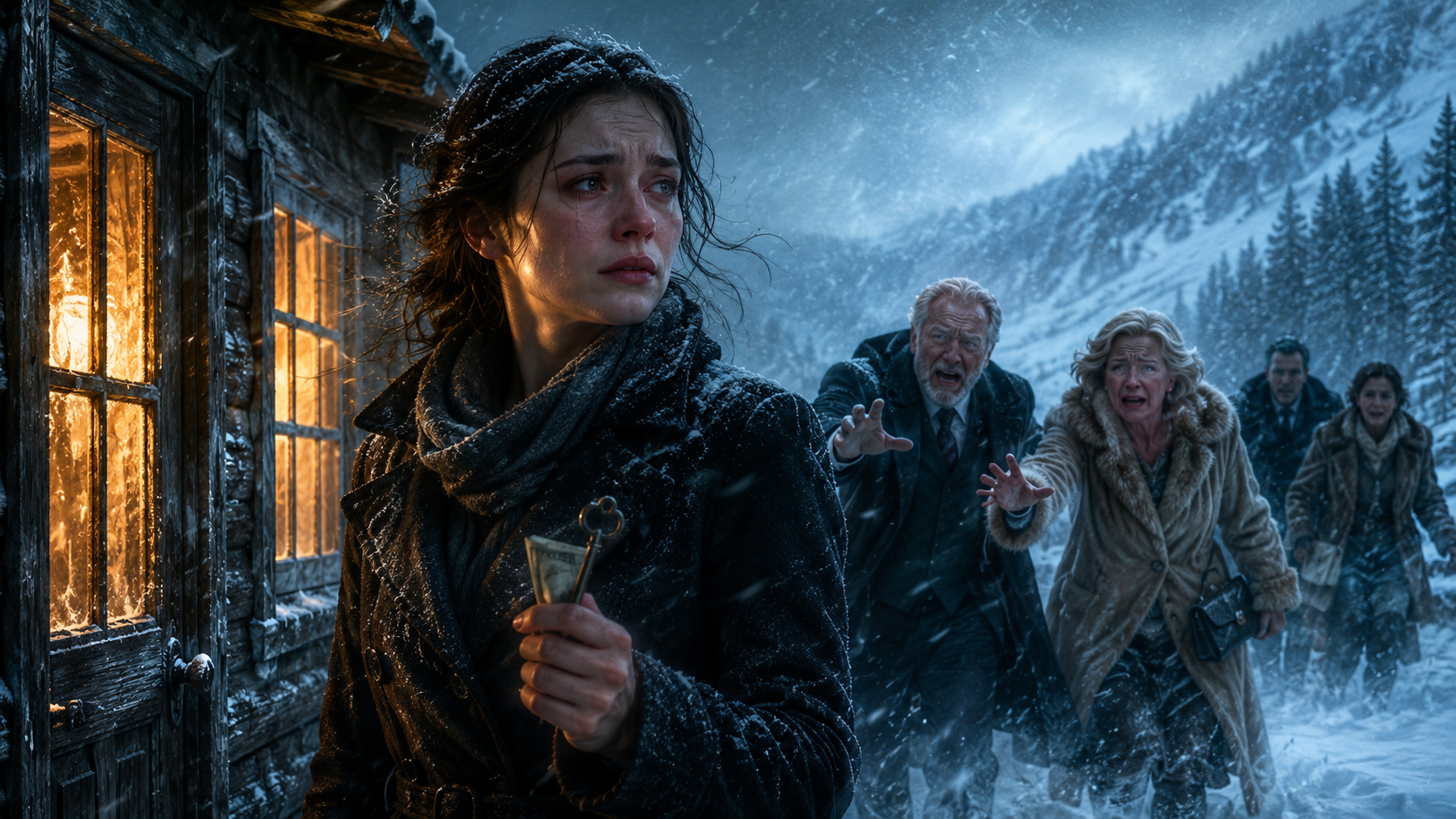
Beatrice, leaning on her stick but refusing help. A diner waitress with a bleeding cut on her forehead. Two hotel workers. An elderly couple. Sheriff Dane Cross carrying a medical bag. A teenage boy shaking with cold.
And behind them, stumbling through the storm in a ruined cashmere coat, came Vivienne Vale.
Conrad was with her, pale and breathing hard.
For one second, no one spoke.
The people who had thrown Mara into winter now stood at her door because winter had found them too.
Sheriff Cross shouted over the wind. “Community shelter roof failed. Main road’s blocked. The Vale estate lost heat and the pipes burst. We need shelter until rescue gets through.”
Vivienne’s lips were blue. Her perfect hair hung wet against her face.
“Mara,” she said, and for the first time her voice contained no command. “Please.”
Mara looked at her.
She thought of the gate.
The suitcase.
The five-dollar bill.
The words: Perhaps you can buy yourself a shack.
Then she looked past Vivienne at the child in Rowan’s arms.
Mara stepped back.
“Bring the child in first.”
People crowded into the cabin. Beatrice took charge of blankets. Rowan fed the fire. The sheriff checked injuries. Mara gave water to the elderly couple and wrapped the shaking boy in the quilt someone had left at the trailhead.
Vivienne stood near the door, dripping melted snow onto the floor.
Conrad stared around the room as if seeing the cabin for the first time.
“This place,” he said quietly. “You repaired it.”
“No,” Mara said. “I rebuilt what you thought was worthless.”
Vivienne’s eyes moved to the locked black case on the table.
She knew.
Mara saw the exact moment she knew.
By morning, rescue crews reached North Hollow.
By noon, Helena Ortiz arrived with county officials and investigators.
By evening, the story had spread farther than Briarfall.
The billionaire family who mocked a five-dollar cabin had survived the storm only because the woman they cast out opened its door.
But Mara did not let the town turn her into a saint.
She had not opened the door for Vivienne.
She had opened it because freezing people were still people.
That did not mean she forgave.
Three weeks later, the Alder Crown Resort expansion was suspended pending investigation. Old safety reports surfaced. Shell companies were traced. Water rights were confirmed under Mara’s deed. The access claim belonged to North Hollow, and North Hollow belonged to Mara Ellison.
Vivienne came one last time in early spring.
This time, she arrived without a driver.
The snow had begun to melt. Water ran silver down the rocks. The cabin stood in morning light, no longer beautiful by accident, but strong by choice.
Mara was planting herbs in a wooden box beneath the window.
Vivienne stopped at the edge of the yard.
“I came to apologize,” she said.
Mara did not look up. “For which part?”
Vivienne swallowed. “All of it.”
“That’s a large word when you’ve lived a small conscience.”
The older woman flinched.
“I lost my son,” Vivienne whispered.
Mara finally looked at her.
“So did I.”
For a moment, there was only the sound of melting snow dropping from the pines.
Vivienne looked at the cabin. “He loved this place?”
Mara shook her head. “No. He loved what it could become.”
“And what will it become?”
Mara turned toward the ridge, where the old trail curved down toward town. Rowan was there, repairing a fence post. Beatrice sat on a stump giving orders no one had asked for. Smoke lifted from the chimney. The spring ran clear.
“A shelter,” Mara said. “A legal office twice a month for people who can’t afford one. A winter emergency stop. Maybe someday, a real home.”
Vivienne’s eyes filled, but Mara did not soften.
“You can’t buy your way through this door,” Mara said. “You can only be invited.”
Vivienne nodded slowly.
“Am I invited?”
Mara picked up the small hand shovel and returned to the planter.
“Not today.”
Vivienne accepted that.
It was the first decent thing Mara had ever seen her do.
Months later, when summer came to North Hollow, wildflowers grew around the cabin in yellow and blue waves. The roof was straight. The porch was rebuilt. The springhouse had been restored. A sign hung beside the door, carved by Rowan and painted by the diner girl who used to bring chili.
It did not say Vale.
It did not mention money.
It did not tell the world what had happened there.
It simply read:
HOLLOW HOUSE
Inside, above the fireplace, Mara framed the old deed.
Beside it, she placed an empty frame.
Not for a photograph.
For a five-dollar bill that was no longer there.
The original had bought the cabin.
It had done what Julian always believed impossible things could do.
It had become a beginning.
And whenever storms rolled over the mountain, people in Briarfall looked up toward North Hollow and knew one light would still be burning.
Not because wealth had built it.
Not because power had allowed it.
But because a woman who had been thrown away refused to stay broken.
And because sometimes the door everyone laughs at becomes the only door left standing.

