We were renovating my grandparents’ house when we found it — hidden behind a loose panel in the hallway, sealed in a yellowed envelope.
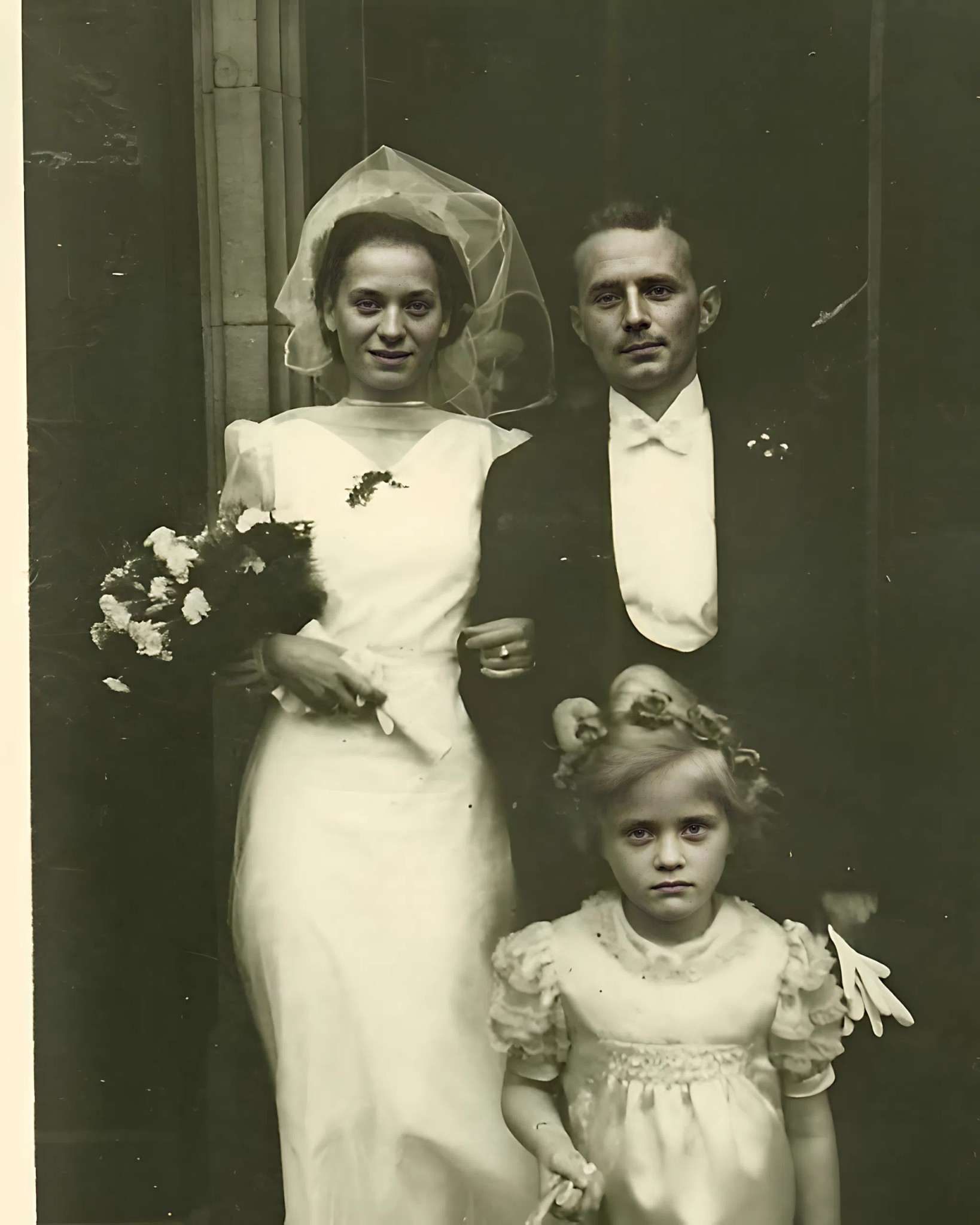
At first glance, it was an ordinary old wedding photograph. The bride was wearing satin, the groom a formal suit, both with impassive faces, as was customary at the time. But my attention was drawn to the little girl standing in front of them.

She wasn’t smiling. Not even close.
While the couple looked proud — perhaps even relieved — she stared straight at the camera, as if she knew something the others did not. It was a strange look for a girl with flowers. It was as if she didn’t belong there.
I asked my father if he recognised them. He swore he had never seen the photograph before.
‘Looks like it was taken right here,’ he said, pointing to the doorway behind them. And he was right. The details matched — the stone arch, the door frame, even the tiny crack in the left panel that remains to this day.
We turned the photograph over. There was only one sentence written in faded ink:
‘She came alone.’
That was our only clue. My mind raced as I stared at those words. ‘She came alone.’ It didn’t make sense. Was she a foster child? A relative we didn’t know about? Maybe a child they were taking care of temporarily? There were endless possibilities, but none of them seemed to fit. The longer I looked at the photo, the more I felt that the little girl was trying to tell me something.
‘Who do you think she is?’ I asked my father again, this time more insistently, hoping for some kind of recognition.
He shook his head. ‘I don’t know, dear. No one in the family has ever mentioned anything like this. We have lots of photographs, but none like this.’
I could see that he wasn’t evading the question, but was genuinely puzzled. As we stood in the dimly lit hallway, the house seemed to hold its breath, and the old wooden floors creaked beneath us, as if the house itself was waiting for us to solve this mystery.
We took the photograph to my grandmother, who was sitting in her favourite armchair by the window. Her hands, once so firm, now trembled slightly as she took it from me, and her eyes narrowed as she studied the faces in the photo.
‘I’ve never seen this photograph,’ she said slowly, with a hint of uncertainty in her voice. But then her expression changed, as if something had clicked in her mind. ‘Wait… wait a minute.’
Her eyes filled with tears. I wasn’t sure if it was from nostalgia or fear, but I could see the weight of memories pressing down on her. I took a step closer, my heart pounding.
‘Grandma, do you recognise the girl?’ I asked, almost in a whisper.
She didn’t answer for a long moment. She just sat there, clutching the edges of the photograph tightly in her hands. Then, finally, she looked up at me, and I saw it — the same knowing, pained look in her eyes that I had seen on the girl’s face.
‘She… she looks like someone I once knew,’ Grandma said, her voice breaking. ‘But that was a long time ago. Too long ago.’
I felt the room closing in around me as my father and I waited for her to continue. Grandmother took a shaky breath and put the photograph down, her fingers sliding along the edges as if she were trying to put her memories in order.
‘The girl in this photograph was called Clara. I knew her… before she disappeared.’
My heart broke at those words. ‘Disappeared? What do you mean?’
Grandmother looked at both of us, and for the first time in a long time, her voice was clear and strong. ‘Klara was my sister’s daughter. My niece. She lived with us when she was very young, but one day she just disappeared. No one ever saw her again. Not even her parents. We searched for her for years, but she was gone.’
The room grew colder, the air thick with loss and regret. I stared at the photograph, my mind racing. It couldn’t be the same Clara, could it? The girl in the picture couldn’t be the niece my grandmother lost so many years ago. But then again, who else could she be?
‘We looked everywhere for her,’ my grandmother continued. ‘There were rumours that she had run away, maybe even joined a group of travellers, but nothing was ever confirmed. We just never understood what happened to her. And the whole family… well, we never talked about it again. It was too painful.’
My father’s face paled, and I could see that he was having as much trouble coping with this discovery as I was. The thought that there was a missing piece in our family history — a person we had never talked about — was too difficult to comprehend.
‘Do you think Clara went back to that wedding?’ I asked, almost in a whisper.
Grandmother didn’t answer right away. She closed her eyes for a moment, as if memories were flooding back to her. Then, with a long, slow exhale, she nodded.