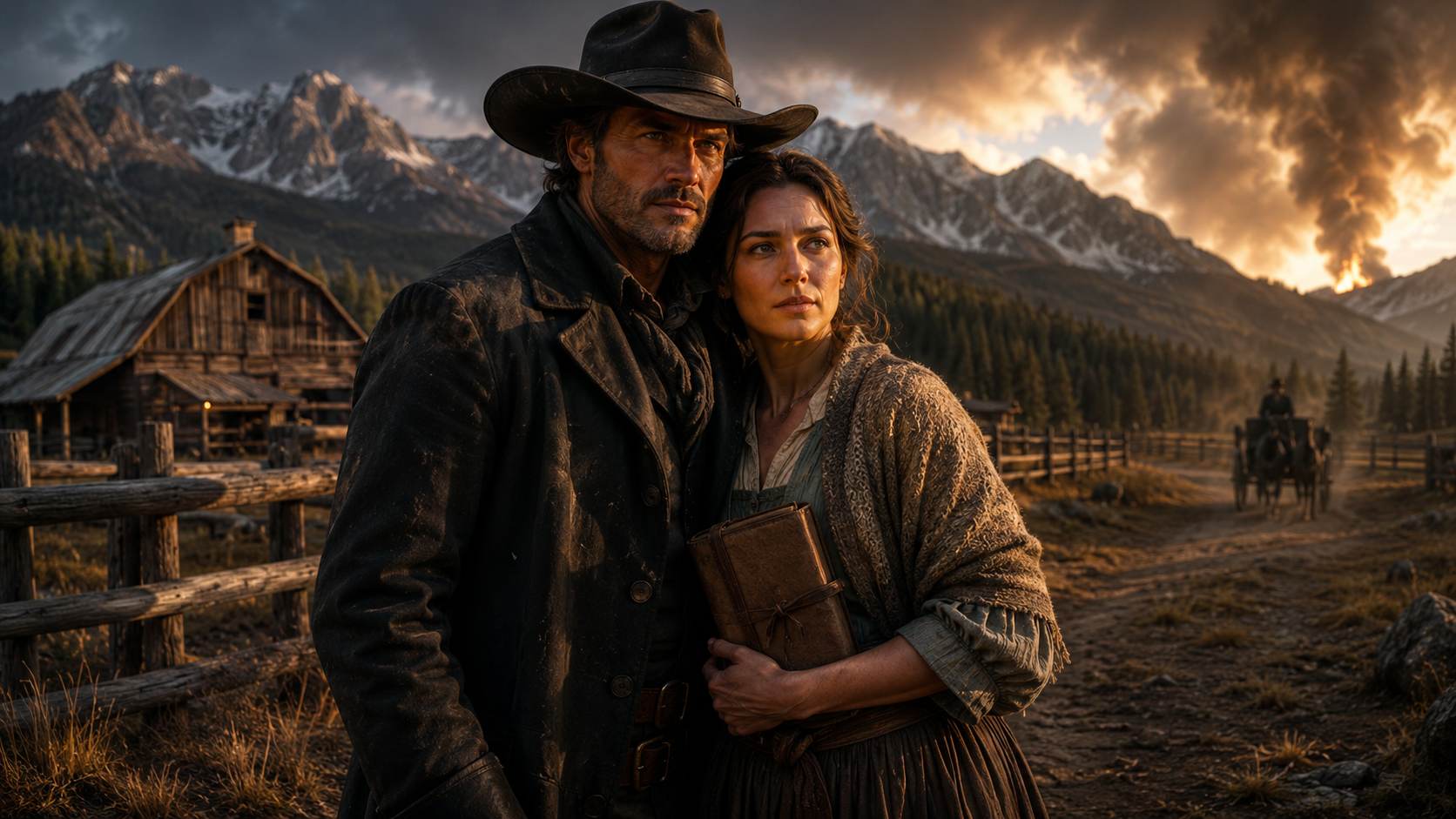
They came to the kitchen after work because warmth lived there. Will kept the ledgers. Tomas recovered enough to ride again. Amos guarded everyone’s dignity by insulting them all equally.
And Lila’s garden, against every sensible prediction, produced one crooked green tomato.
She held it up like proof in court.
Rowan studied it. “That is the ugliest tomato I’ve ever seen.”
“It survived.”
“Then it belongs here.”
In August, the federal correction arrived.
Stonefall’s foreclosure was declared fraudulent. The false liens were voided. Meridian Rail’s claim was dismissed. The corrected title returned to Rowan Pike, clear of invented debt.
He read the document once.
Then again.
Then he walked out past the barn, past the corral, past the fence his father had built and Thorne had tried to steal, until he reached the garden where Lila was tying bean vines to stakes.
She looked up. “Well?”
“It’s ours,” he said.
Her hands went still.
“The title?”
“Clean.”
For a moment, neither moved.
Then Lila crossed the dirt rows and wrapped her arms around him without hesitation. Rowan held her there, legal paper in one hand, garden soil on her sleeve, the hard blue sky above them.
He thought of his father, who had died believing land was the only thing that stayed.
Rowan wished he could tell him he had been wrong.
No.
Not wrong.
Incomplete.
Land could stay. So could fear. So could shame, if a man fed it long enough.
But so could loyalty.
So could stubborn hope.
So could a woman who walked into a dying kitchen and decided broken things were not allowed to remain broken.
That evening, Rowan asked Lila to walk with him to the ridge above Stonefall.
From there, the ranch spread below them: the rebuilt barn, the repaired fences, the kitchen window glowing gold, Amos standing on the porch pretending not to watch.
Rowan took off his hat.
Lila’s mouth curved. “You look serious.”
“I am.”
“You usually are.”
“More than usual.”
She turned toward him fully, and he saw that she already knew. Lila noticed truth before it found words.
He went down on one knee in the prairie grass.
“I won’t promise easy,” he said. “This land is hard. I am harder than I should be. There will be bad winters, low prices, stubborn cattle, and days when I say the wrong thing because silence raised me better than speech.”
Her eyes shone, but her voice stayed steady. “That is the least romantic beginning to a proposal I’ve ever heard.”
“I’m improving.”
“Continue.”
He took her hand.
“I can promise you this. No locked door you don’t choose. No running alone. No table where you have to earn your place by being useful. Stay because you want to. Stay because this is home. Stay because I love you, Lila Mercer, Celeste Harrow, and every name you carried to survive.”
For a moment, the whole ridge seemed to hold its breath.
Then Lila knelt in front of him, bringing them eye to eye.
“I was tired of running before I met you,” she said. “I just didn’t know stopping could feel like this.”
“Is that a yes?”
She smiled through tears.
“Get up, Rowan. It’s a yes.”
He kissed her there above Stonefall, with the wind moving through the grass and the kitchen light waiting below.
Months later, Lila testified in Denver.
Her voice did not shake.
Rowan sat behind her every day.
Thorne’s lawyers tried to paint her as confused, vengeful, unstable, dishonest. They failed because Lila had built her survival out of details, and details did not abandon her.
Other women testified too.
Not all who had been lost were found.
But enough voices rose together that even Thorne’s newspapers could not silence them.
Victor Thorne was convicted the following spring.
Lucian Graves turned evidence and spent the rest of his life proving that cowardice, when squeezed hard enough, could sometimes serve justice.
Stonefall kept running.
The garden improved.
The kitchen grew louder.
And Rowan Pike, once known across the mountains as the coldest, loneliest rancher in the county, became a man who came in before supper because he wanted to hear his wife laugh.
He never forgot the hard years.
Neither did Lila.
But memory changed when carried by two people instead of one. It became less like a chain and more like a map—proof of where they had been and how far they had come.
Stonefall Ranch had almost been stolen by greed, silence, forged paper, and fear.
It was saved by evidence, stubborn hands, strong coffee, loyal men, one crooked tomato, and a quiet woman who refused to let broken things stay broken.
When people later asked Rowan when he knew he loved her, he never mentioned the kiss first.
He said it began the day she stood in his yard with one satchel, looked past his rifle into the starving heart of his ranch, and said she had come to work.
Because that was what love had done.
It had come to work.
And it had stayed.