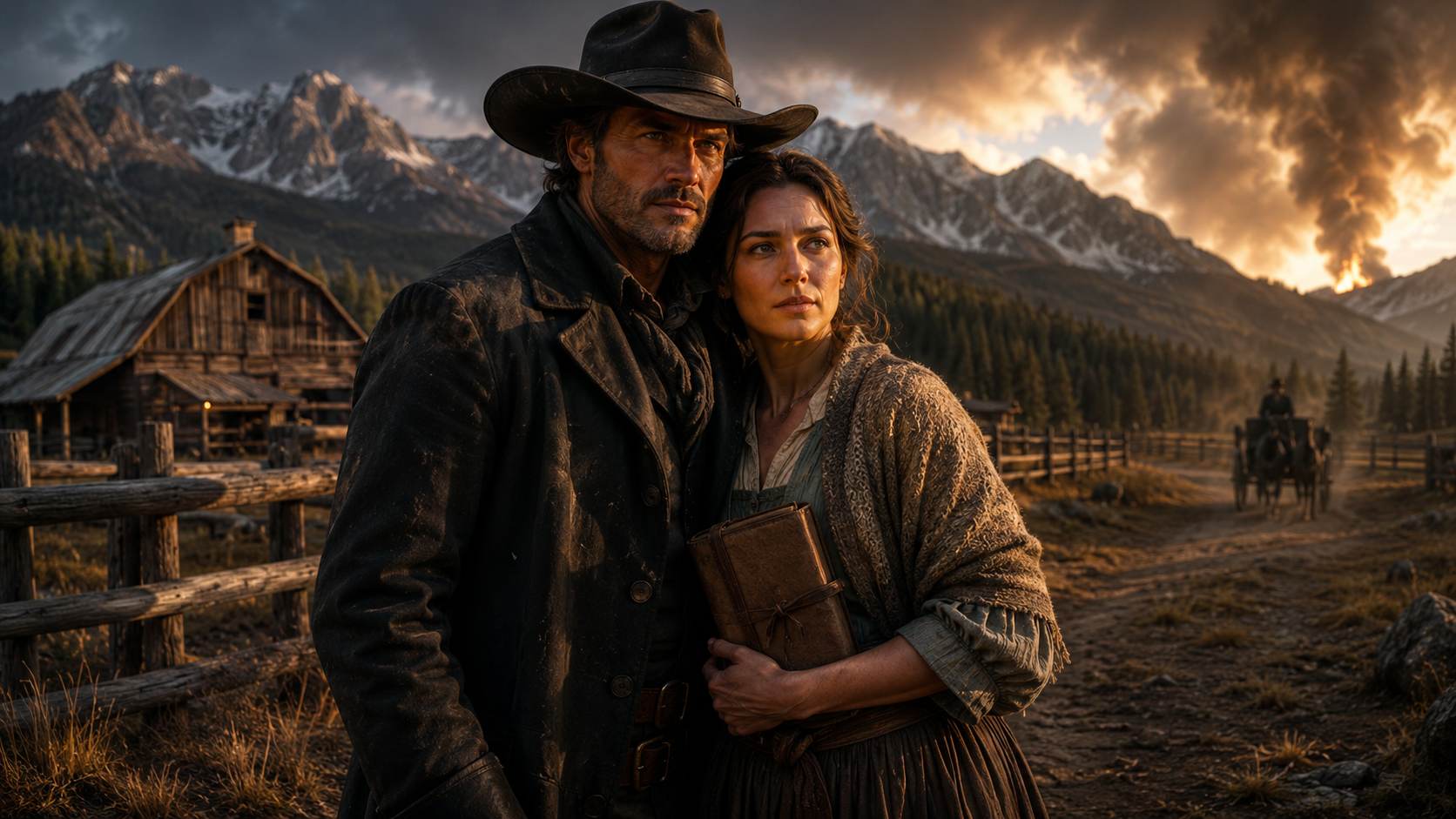
“You’re charging me twice for flour I never received.”
The supplier across the counter stopped smiling.
Rowan Pike did not raise his voice. He never had to. Men in Elk Crossing knew the owner of Stonefall Ranch could speak softly and still make a room feel smaller.
The supplier, Mr. Harlan, looked down at the invoice, then back at Rowan. “Mistakes happen, Mr. Pike.”
“Not six months in a row.”
Harlan’s throat moved. Behind him, sacks of feed leaned against the wall like witnesses. Outside, a cold spring wind dragged dust along the street, rattling the windows of the mercantile and lifting the edges of handbills nailed to posts.
Rowan laid three invoices on the counter. “Same weight missing. Same charge added. Same handwriting correcting the total after my men signed delivery.”
Harlan’s face changed then—not much, but enough.
For nearly two years, Rowan had blamed drought, bad cattle prices, and his father’s old debts for the slow bleeding of Stonefall Ranch. He had blamed his own failure too, though he never said that part aloud. A man could endure hunger, weather, broken fence, and bank notices. Shame was quieter. It stayed in the bones.
But the numbers had not come from him.
They had come from a woman who had worked in his kitchen for twelve days and noticed what every tired man on the ranch had missed.
Lila Mercer.
Quiet, sharp-eyed Lila, who had arrived at Stonefall with one brown satchel, a plain gray dress, and a manner so still it made people talk around her as if she were furniture. She had answered Rowan’s notice for a ranch cook without asking about comfort, wages in advance, or whether the bunkhouse men were polite.
“I can cook,” she had said.
“Most people say that before they burn beans.”
“I can also count.”
That had been the sentence that made him hire her.
Now, standing in Harlan’s store, Rowan understood the sentence had saved him more than burned coffee ever could.
Harlan folded before Rowan finished questioning him. He blamed his clerk first, then bad recordkeeping, then confusion with another ranch. By the time Rowan left with restitution money and a written statement, the man’s hands were shaking.
It was not enough to rescue Stonefall.
But it was enough to prove Lila had been right.
When Rowan rode back at dusk, he found the kitchen lamps glowing through the windows. That sight used to mean food and little else. Since Lila had come, it meant order. Shelves cleaned. Bread wrapped in linen. Coffee strong enough to shame a dead man awake. Men speaking at the table instead of swallowing silence with their supper.
He dismounted near the barn and paused.
Inside the kitchen, Lila sat beside young Will Mercer—no relation, despite the shared surname—and guided his finger down a column in the ranch ledger.
Will was nineteen, broad-shouldered, and ashamed of every number he did not understand.
“That mark means the payment cleared,” Lila said. “This one means it was entered but not confirmed.”
Will frowned. “Looks like chicken scratches.”
“All numbers look like chicken scratches until someone teaches them to behave.”
A reluctant grin crossed his face.
Rowan stood in the doorway, hat in his hand, and felt something inside him tighten.
His father would have mocked the boy. Not out of pure cruelty, perhaps, but because Silas Pike had believed kindness made men weak. Rowan had learned that lesson young. At Stonefall, pain was corrected with work. Fear was corrected with more work. Grief was not corrected at all. It was buried under winter chores and never spoken of again.
His mother had left when Rowan was eight.
His father removed her name from the house as if silence could erase a woman better than death.
By forty-two, Rowan owned twelve hundred acres of mountain pasture, eighty-three cattle, a debt he could not trust, and a house where no one laughed unless they were drunk, injured, or both.
Then Lila Mercer came with a satchel and started fixing things no one had asked her to see.
Including him.
That was the part Rowan disliked most.
Her room was behind the kitchen, a narrow old storage space that had once held tack, cracked lanterns, and salt blocks. On her second night, Rowan noticed she had moved a chair under the door latch. By the fourth night, she had added a bolt.
On the sixth, he found her standing barefoot beside the back window after midnight, holding a carving knife low against her skirt.
She was not admiring the moon.
She was listening.
Rowan had wanted to ask what she feared. He did not. A woman did not owe a man her story because he paid her wages. A frightened woman owed him even less.
But trouble had a way of finding the one door a person tried hardest to lock.
It came on a pale morning with three riders and a black carriage.
Rowan was repairing a gate hinge when the carriage rolled through the lower road and stopped just beyond the yard. It was the kind of carriage that did not belong near mud, cattle, or honest work. A tall man stepped down wearing a dark wool coat, polished boots, and gloves too clean for the country.
Lila came out of the kitchen carrying a basket of laundry.
The man smiled.
“Miss Celeste Harrow,” he called. “You have made yourself inconveniently difficult to locate.”
The basket slipped from her hands.
Rowan moved before he thought.
He stepped between Lila and the stranger.
“You’ve crossed onto private land,” Rowan said.
The man’s eyes flicked over him with polished contempt. “And you are?”
“The man telling you to leave.”
“Lucian Graves.” The stranger gave a shallow bow. “I represent Meridian Rail and Land. I have business with Miss Harrow.”
“Her name is Lila Mercer.”
“For the moment, perhaps.”
Behind Rowan, Lila’s breathing had changed. He could hear it because he had spent years listening to storms before they broke.
Graves looked past him. “Mr. Thorne remains willing to settle this matter quietly. That generosity has limits.”
Lila said nothing.
Rowan took one step forward. “Whatever matter you think you have with her is finished.”
Graves’ smile thinned. “You own a failing ranch, Mr. Pike. I suggest you do not add another man’s war to your unpaid debts.”
Rowan did not blink.
Graves looked at him a moment longer, measuring whether arrogance would survive contact with bone. Then he put his gloves back on.
“Miss Harrow,” he said, “running does not change ownership.”
Lila flinched.
That was all Rowan needed to see.
He lifted the gate latch and swung it open toward the road. “Get out.”
The riders shifted in their saddles. For one sharp second, the yard seemed to hold its breath.
Then Graves climbed back into the carriage.
Dust swallowed them as they left.
Rowan waited until the wheels disappeared beyond the cottonwoods before he turned.
Lila stood very still, but stillness was not calm. It was discipline. It was a woman holding the pieces of herself together by force.
“I should leave,” she said.
“No.”
Her eyes lifted to his. “You don’t know what you just stepped into.”
“I know enough.”
“You know nothing.”
“Then tell me.”
She looked toward the house, then the bunkhouse, then the long road where Graves had vanished.
Rowan understood.
“Not inside,” he said. “Walk with me.”
They went to the old stone wall above the lower pasture. Open sky stretched over them. The wind came cold off the mountain, smelling of pine sap and distant snow.
Lila wrapped her shawl tighter.
“My name was Celeste Harrow before it was Lila Mercer,” she said. “Before that, it was probably something else in my mother’s mouth, but I don’t remember her well enough to know.”
Rowan leaned one boot on the lower rail and waited.
“I worked at the Arden House in Denver,” she continued. “It belonged to Victor Thorne. Hotels, rail contracts, land offices, newspapers—he had his hands in everything that could make a man rich and invisible. I started in the laundry. Then the kitchen. Then the accounts room because I could read figures better than the men he hired to pretend they understood them.”
She looked down at her hands.
“Women came through that hotel. Young ones. Widows. Immigrants who thought they had been promised work. Some stayed a week. Some only a night. They were moved under freight codes. Service transfers. Domestic placements. False employment contracts.”
Rowan’s jaw tightened.
“I found the second ledger by accident,” she said. “A book no guest was meant to see. Names, routes, payments, land parcels, bribes. I copied what I could. Then I stole the original when I realized the sheriff was already bought.”
“You went to the law?”
“I went to a man wearing a badge.” Her mouth hardened. “That was not the same thing.”
“How long have you been running?”
“Nearly three years.”
The wind pulled a strand of hair loose from her braid. She tucked it back with fingers that did not shake.
“I cooked in mining camps, boarding houses, rail crews, and one widow’s inn where I slept in the pantry because the owner’s son watched doors too closely. I used different names. I stayed nowhere long enough to be remembered. I thought Stonefall was far enough from Denver.”
“Graves found you.”
“Yes.”
“What does he want?”
“The ledger.”
“Where is it?”
Her silence stretched.
Rowan did not push. Trust given too quickly was often fear in disguise.
At last she said, “In my satchel.”
He almost laughed, but nothing about her face allowed it.
“You carried evidence against a rail baron into my kitchen?”
“I carried it everywhere. Wrapped in butcher paper, tucked inside a flour sack, under dried bay leaves. Men rarely search a woman’s kitchen things unless they understand women, and most dangerous men don’t.”
Rowan looked toward the road.
Then toward Stonefall.
A bank notice sat on his desk. Thirty days until foreclosure. The debt had grown in strange increments. Fees added twice. Interest recalculated. Records missing, then found with new signatures. His father had died believing he had mismanaged everything. Rowan had inherited the same shame and worked himself half-dead under it.
Now a thought colder than mountain water entered him.
“What land parcels?” he asked.
Lila studied him. “What?”
“You said the ledger included land parcels.”
“Yes.”
“Stonefall?”
She turned fully toward him.
“I don’t know,” she said. “I never decoded all of it.”
Rowan stared down at the pasture, at the fence his father had built, at the cattle moving like dark stones across the grass.
“You’re not leaving,” he said.
“Mr. Pike—”
“Rowan.”
Her expression changed at the name. Not soft. Careful.
“Rowan,” she said, “men like Thorne do not send polite visitors twice. Graves came here to learn what stood between me and that ledger.”
“Then he learned.”
“That should frighten you.”
“It does.”
She blinked.
He looked at her directly. “I’m not fearless, Lila. I’m tired of being robbed and told it’s weather.”
For the first time since the carriage arrived, something broke through her guarded face.
Not hope.
Not yet.
But the shape of it.
The next morning, Rowan rode to Silver Creek to see Deputy Marshal Miriam Hale.
Miriam had once dragged two horse thieves out of a canyon with a broken wrist and no patience for male foolishness. Rowan trusted her because she disliked charm and collected facts the way other women collected china.
She read the pages Lila had copied first.
Then she read four entries from the original ledger.
By the time she finished, her office felt colder.
“This is larger than trafficking,” Miriam said. “There are land acquisitions tied to false debt instruments. Tax pressure. Forged liens. Forced foreclosure.”
Rowan leaned forward. “Stonefall?”
Miriam ran one finger down a column.
Her face gave the answer before her mouth did.
“Say it,” Rowan said.
“Stonefall appears twice. Once under projected purchase. Once under secured route.”
“Route for what?”
“Rail spur through the lower pass.” She tapped the page. “Water, high ground, access to timber. If Thorne controls your land, he doesn’t have to negotiate with four smaller owners.”
Rowan stood.
For years, he had believed Stonefall was dying because his father had failed and because he himself had not been enough to repair it. Every bank letter had carried his father’s ghost. Every unpaid bill had sounded like judgment.
But the ranch had not simply been failing.
It had been hunted.
“What can you do?” he asked.
“I can wire Denver and Kansas City. I can request federal warrants. I can put the county clerk under quiet review. But Thorne has lawyers, judges, newspapers, and men who make witnesses vanish.”
“Lila won’t vanish.”
Miriam folded the ledger pages. “That woman is evidence. So are you. Evidence has to survive long enough to speak.”
Rowan returned to Stonefall after sundown.
Lila had supper ready. The men were quieter than usual. Old Amos Finch watched Rowan’s face from the far end of the table, and Will stopped pretending he was not worried.
Rowan waited until the plates were filled.
Then he told them enough.
Not everything. Enough.
He told them the ranch debt was likely false. He told them Meridian Rail had been pushing Stonefall toward foreclosure. He told them Lila’s evidence might stop it.
Then he offered every man a choice.
“If you want to leave, you’ll get what wages I can pay and a written reference. No shame. No argument.”
Amos snorted. “I’m too old to run from a city vulture in shiny boots.”
Will swallowed. “Miss Lila taught me numbers without laughing. I’m staying.”
Tomas, who rarely spoke unless a horse was bleeding, lifted his coffee. “I never liked rail men.”
One by one, they stayed.
Lila stood in the kitchen doorway, holding a towel in both hands.
Rowan did not look at her too long. If he did, every man at the table would see what he had not yet admitted to himself.
That decision cost them before dawn two nights later.
Graves’ men cut the north fence and drove cattle toward Deadman’s Wash. They did not take many. Theft was not the purpose. Ruin was. By sunrise, three steers were dead, one horse had torn a tendon, and the men came back with mud to their knees and fury in their throats.
Lila had breakfast waiting.
No one spoke for several minutes. Forks scraped plates. Coffee steamed. The kitchen smelled of biscuits and wet wool.
At last Will asked, “What now?”
Lila set a fresh pot on the table.
“Now we mend the fence,” she said. “We count what remains. We bury what we lost. Men like Graves want fear to make us stupid. So we refuse to be stupid.”
Amos looked at Rowan. “She gives orders better than you.”
Rowan nodded. “Most people do.”
A tired laugh moved around the table.
It mattered more than any speech could have.
The second attack came at the barn.
A torch landed in the hayloft just after midnight. The bell clanged. Men ran half-dressed into smoke and orange light. Rowan saw shadows near the tack room and fired above them. Someone fired back.
Tomas went down with a bullet through the upper arm.
Lila reached him before Rowan did.
She pressed both hands to the wound, looked directly into Tomas’s panicked face, and said, “You are not dying before you admit my coffee is better than Amos’s.”
Tomas gasped. “It ain’t.”
“Then stay alive and be wrong.”
He did.
By dawn, the east wall of the barn was blackened, the hay was gone, and Tomas was in a wagon bound for the doctor. Lila rode beside him, holding pressure on the wound, talking with such steady command that panic seemed embarrassed to remain.
At the doctor’s office, Tomas was stitched and declared survivable.
Outside, Lila scrubbed blood from her hands until her skin reddened.
“It happened because of me,” she said.
“No.”
“Rowan—”
“No.” He faced her. “Thorne marked my land before you ever crossed my gate. Graves lit that barn because he is afraid of what you carried. Tomas got hurt because bad men chose violence. Not because you told the truth.”
Her composure trembled once.
Only once.
But Rowan saw what it cost her to keep standing.
He wanted to touch her. Her shoulder, her hand, her cheek—something simple and human.
He did not.
Wanting was not permission.
Instead, he said, “We take the ledger to Miriam today. The original. Your statement. My bank papers. We force the case open before Graves burns the rest of Stonefall down.”
“And if he waits on the road?”
“Then he learns Amos taught me to shoot before he taught me to curse.”
For the first time that day, she smiled.
Small.
Brief.
Enough to ruin his peace.
Before they left, Amos pulled Rowan aside near the saddle room.
“You know what this is, don’t you?”
“A federal case.”
Amos stared at him. “Try again, boy.”
Rowan tightened the cinch on his horse.
The old man lowered his voice. “That woman came here carrying hell in a flour sack, and somehow she made this place warm again. You were drying up faster than the creek. She noticed.”
Rowan looked toward Lila. She was tying her satchel to the saddle with careful, efficient knots.
“She may leave when this is finished,” Rowan said.
“Maybe.” Amos spat into the dust. “But if you never ask her to stay, don’t blame her for not hearing you.”
The road to Silver Creek ran between gray hills and early grass.
For the first hour, Rowan and Lila rode in silence. The ledger sat between them like a loaded gun.
At last Lila said, “I don’t know how to live after running.”
Rowan glanced at her.
“I know how to change names,” she continued. “I know how to sleep lightly, count exits, hide money in hems, and leave before breakfast. I know how to become useful so people ask fewer questions. But if Thorne falls? If I do not have to run anymore? I don’t know what remains.”
“What did you want before Denver?”
She was quiet a long time.
“A kitchen that belonged to me,” she said. “A garden. A table where people came because they wanted to, not because they were hungry and desperate.”
Rowan felt the answer before he dared speak it.
“Stonefall has a kitchen.”
Her eyes turned toward him.
“And poor soil,” he added. “But you’ve already started arguing with it.”
“Are you offering me permanent employment?”
“No.”
The word lay between them.
Her breath changed, soft enough that a less attentive man would have missed it.
“What are you offering?”
Rowan gripped the reins.
He could face fire, debt, armed men, and a rail baron’s hired wolves. He could ride toward a gun without thinking. But saying a plain truth to a woman beside him on a cold road felt like stepping beyond the edge of a cliff.
“A reason not to run,” he said.
Lila did not answer.
But she did not ride farther away.
Miriam Hale was waiting when they arrived.
So was a federal prosecutor named Beatrice Wynn, a woman with iron-gray hair, calm hands, and a voice that sounded like courtroom oak.
Lila gave her statement for four hours.
She did not make herself pitiful. She did not dramatize. She told them names, dates, rooms, freight markings, payment codes, and the exact color of the ink used on forged contracts. When she did not know something, she said so. When she remembered something, she placed it like a nail driven straight.
Beatrice checked the ledger against Lila’s statement.
Once.
Twice.
By the sixth match, she looked at Miriam.
“This will hold.”
Lila closed her eyes for one breath.
Rowan did not take her hand, though he wanted to.
Warrants went out before sunset.
The county clerk who had certified Stonefall’s false debt was arrested before breakfast. Two Meridian agents were taken at a freight office with payment drafts, forged land deeds, and a list of witnesses to be “discouraged.” Lucian Graves vanished for twelve hours before he was found in a private rail car trying to leave the territory.
Victor Thorne did not fall immediately.
Men that rich rarely did.
But his accounts were frozen. His freight routes were seized. His newspapers, suddenly nervous, began printing careful statements about misunderstandings and administrative errors.
The foreclosure on Stonefall was suspended.
The debt was placed under federal review.
For the first time in years, Rowan read a bank document without feeling his father’s shame climb onto his back.
The news reached Stonefall by telegraph three days later.
Amos read it aloud because he enjoyed official words when they harmed people he disliked.
“Foreclosure suspended pending federal correction. Clerk Alder in custody. Graves detained. Meridian Rail assets frozen under inquiry. Witness Lila Mercer, also known as Celeste Harrow, placed under federal protection.”
No one spoke.
Then Will asked, “Does that mean we won?”
Lila looked around the kitchen—at tired men, smoke-stained sleeves, bandaged hands, faces trying hard not to hope too loudly.
“No,” she said. “It means we get to fight standing up.”
Amos lifted his cup. “That’s better than fighting on our knees.”
The weeks that followed were not easy.
That made them honest.
The barn had to be rebuilt. Tomas complained so much while healing that Lila threatened to feed him only boiled turnips if he did not let the wound close. Will learned enough accounting to correct Rowan’s arithmetic, which Rowan considered an unfortunate side effect of education. Amos pretended to hate everyone and proved the opposite by checking doors at night.
Lila’s garden failed twice.
She tried anyway.
The federal inquiry widened. Women were found. Not all. Never all. But enough to turn whispers into testimony, and testimony into a case too large for Thorne’s money to bury.
Some evenings, Rowan found Lila behind the house, hands in the dirt, staring toward the mountains as if measuring how far grief could travel.
He learned not to demand words.
He stood nearby.
Sometimes she spoke.
Sometimes she did not.
Both became trust.
One evening in late May, after the new barn wall stood straight and raw against the older wood, Rowan came toward the kitchen and heard Lila laughing.
Not politely.
Not carefully.
Laughing fully because Will had dropped a pan of biscuit dough onto Amos’s boots and claimed he was improving the floor.
The sound stopped Rowan in the yard.
It moved through him like rain into cracked ground.
He understood then, with a force that almost made him angry, that he had been lonely so long he had mistaken loneliness for strength.
He had called it discipline.
Independence.
Endurance.
But it was fear wearing his father’s coat.
He stepped into the kitchen.
Will fled at once, carrying the dough pan like evidence. Amos followed with theatrical disgust, though he winked at Rowan before leaving.
Lila turned from the stove.
Her smile faded into something quieter when she saw his face.
“What happened?” she asked.
“Nothing.”
She waited, because she knew better.
Rowan crossed the room and stopped close enough to ask, not close enough to assume.
“When I said I wanted to give you a reason not to run,” he said, “did you find one?”
Her eyes held his.
“You know I did.”
“I need to hear it.”
She drew a slow breath.
“I found you,” she said.
That was all.
It was enough.
Rowan lifted his hand slowly, giving her time to turn away. She did not. His palm touched her cheek with a care that made her eyes close for one brief second.
Then he kissed her.
It was not desperate.
Not stolen.
Not a thing taken in fear.
It was steady, certain, and long overdue. Lila kissed him back like a woman who had survived too much to waste time pretending she did not know what she wanted.
When they parted, her eyes were bright.
“You took your time,” she said.
“I’m careful.”
“You faced gunmen faster.”
“I was less afraid of them.”
Her expression softened.
Then she laughed, and Rowan knew with painful clarity that no land deed, cattle count, bank correction, or inheritance had ever made Stonefall feel as much like home as that sound in his kitchen.
By summer, the ranch had changed.
Not magically.
Not completely.
The barn’s new wall looked too clean beside the old wood. Money remained tight. The case against Thorne stretched toward trial in Denver. Lila would have to testify, and Rowan had already arranged for Amos to run the ranch while they were gone.
But men stayed now.
They came to the kitchen after work because warmth lived there. Will kept the ledgers. Tomas recovered enough to ride again. Amos guarded everyone’s dignity by insulting them all equally.
And Lila’s garden, against every sensible prediction, produced one crooked green tomato.
She held it up like proof in court.
Rowan studied it. “That is the ugliest tomato I’ve ever seen.”
“It survived.”
“Then it belongs here.”
In August, the federal correction arrived.
Stonefall’s foreclosure was declared fraudulent. The false liens were voided. Meridian Rail’s claim was dismissed. The corrected title returned to Rowan Pike, clear of invented debt.
He read the document once.
Then again.
Then he walked out past the barn, past the corral, past the fence his father had built and Thorne had tried to steal, until he reached the garden where Lila was tying bean vines to stakes.
She looked up. “Well?”
“It’s ours,” he said.
Her hands went still.
“The title?”
“Clean.”
For a moment, neither moved.
Then Lila crossed the dirt rows and wrapped her arms around him without hesitation. Rowan held her there, legal paper in one hand, garden soil on her sleeve, the hard blue sky above them.
He thought of his father, who had died believing land was the only thing that stayed.
Rowan wished he could tell him he had been wrong.
No.
Not wrong.
Incomplete.
Land could stay. So could fear. So could shame, if a man fed it long enough.
But so could loyalty.
So could stubborn hope.
So could a woman who walked into a dying kitchen and decided broken things were not allowed to remain broken.
That evening, Rowan asked Lila to walk with him to the ridge above Stonefall.
From there, the ranch spread below them: the rebuilt barn, the repaired fences, the kitchen window glowing gold, Amos standing on the porch pretending not to watch.
Rowan took off his hat.
Lila’s mouth curved. “You look serious.”
“I am.”
“You usually are.”
“More than usual.”
She turned toward him fully, and he saw that she already knew. Lila noticed truth before it found words.
He went down on one knee in the prairie grass.
“I won’t promise easy,” he said. “This land is hard. I am harder than I should be. There will be bad winters, low prices, stubborn cattle, and days when I say the wrong thing because silence raised me better than speech.”
Her eyes shone, but her voice stayed steady. “That is the least romantic beginning to a proposal I’ve ever heard.”
“I’m improving.”
“Continue.”
He took her hand.
“I can promise you this. No locked door you don’t choose. No running alone. No table where you have to earn your place by being useful. Stay because you want to. Stay because this is home. Stay because I love you, Lila Mercer, Celeste Harrow, and every name you carried to survive.”
For a moment, the whole ridge seemed to hold its breath.
Then Lila knelt in front of him, bringing them eye to eye.
“I was tired of running before I met you,” she said. “I just didn’t know stopping could feel like this.”
“Is that a yes?”
She smiled through tears.
“Get up, Rowan. It’s a yes.”
He kissed her there above Stonefall, with the wind moving through the grass and the kitchen light waiting below.
Months later, Lila testified in Denver.
Her voice did not shake.
Rowan sat behind her every day.
Thorne’s lawyers tried to paint her as confused, vengeful, unstable, dishonest. They failed because Lila had built her survival out of details, and details did not abandon her.
Other women testified too.
Not all who had been lost were found.
But enough voices rose together that even Thorne’s newspapers could not silence them.
Victor Thorne was convicted the following spring.
Lucian Graves turned evidence and spent the rest of his life proving that cowardice, when squeezed hard enough, could sometimes serve justice.
Stonefall kept running.
The garden improved.
The kitchen grew louder.
And Rowan Pike, once known across the mountains as the coldest, loneliest rancher in the county, became a man who came in before supper because he wanted to hear his wife laugh.
He never forgot the hard years.
Neither did Lila.
But memory changed when carried by two people instead of one. It became less like a chain and more like a map—proof of where they had been and how far they had come.
Stonefall Ranch had almost been stolen by greed, silence, forged paper, and fear.
It was saved by evidence, stubborn hands, strong coffee, loyal men, one crooked tomato, and a quiet woman who refused to let broken things stay broken.
When people later asked Rowan when he knew he loved her, he never mentioned the kiss first.
He said it began the day she stood in his yard with one satchel, looked past his rifle into the starving heart of his ranch, and said she had come to work.
Because that was what love had done.
It had come to work.
And it had stayed.

