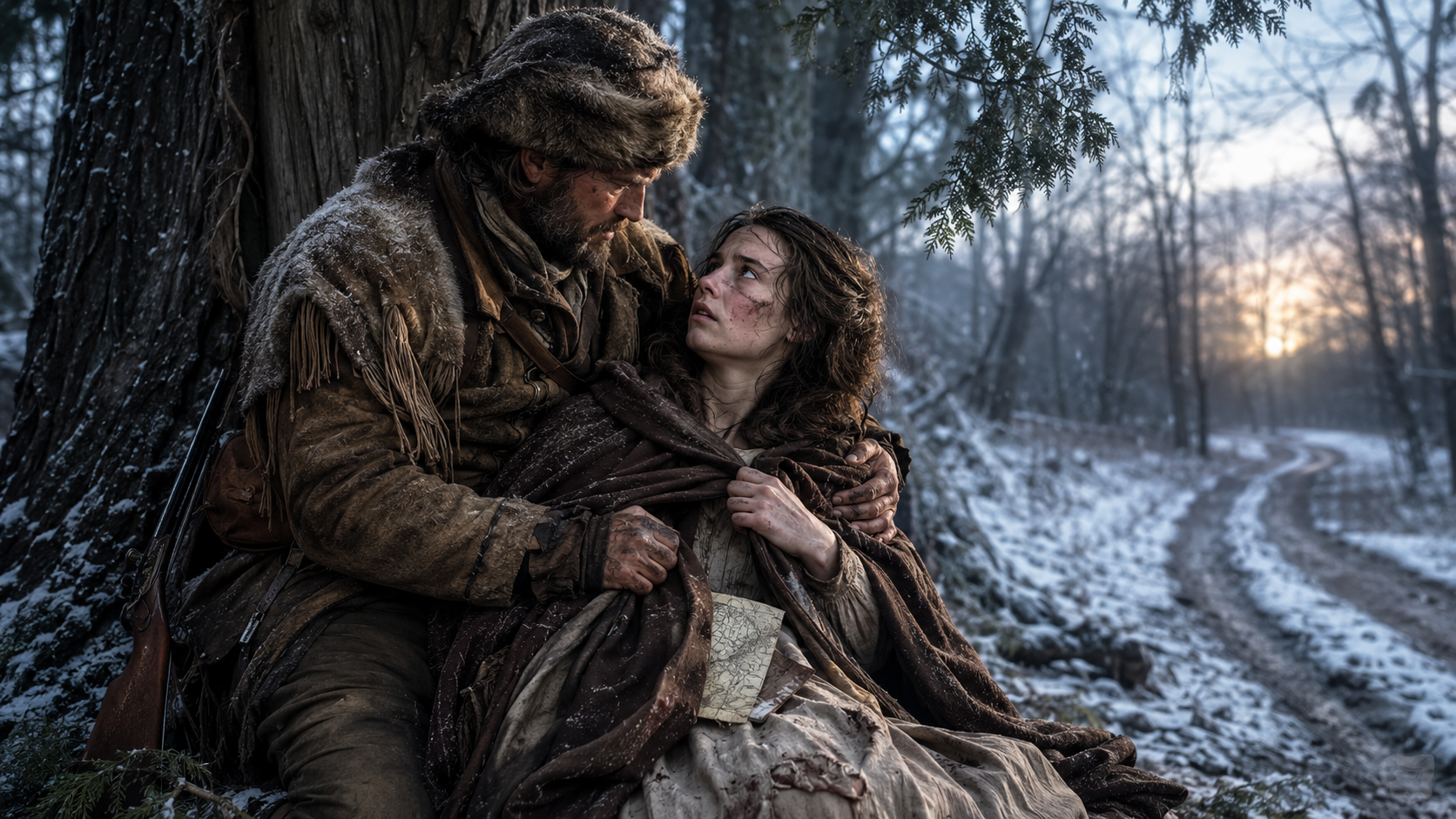
A planter’s daughter found freezing near the Trace.
Fraudulent ledgers.
Disputed freedom papers.
A woman declared mad by the men her documents exposed.
Northern editors loved that last part.
Southern neighbors did not love it, but they read it.
Lucius called Marian a liar. Then unwell. Then ungrateful. Then corrupted. But every accusation required him to say her name, and every time he said her name, someone remembered the papers.
By spring, Bellamy Oaks no longer shone.
Paint peeled from the columns. Creditors took the best horses. Rafe Cutter left for Louisiana after Silas found him near the stable one night and explained, without raising his voice, that the Natchez Trace was a poor place to be hunted by a man who knew every hollow of it.
No one saw Cutter in the county again.
Marian never returned to her father’s house.
For a time, she lived at Galloway Ridge, where Mercy taught her how to be useful without turning usefulness into vanity. Marian learned to copy letters in code. She learned which baskets carried medicine and which carried messages. She learned that guilt was not repair, and courage was not a feeling but a habit practiced when fear remained.
Months later, a letter came from Ohio.
It carried no names that would endanger anyone.
Only this:
The creek held. The children are well. N. laughs in her sleep now. J. asks whether the Amara record can still be found. Tell M. her map was wrong in three places, but useful in one.
Marian read the last sentence three times.
Then she laughed until she cried.
Silas found her on the porch with the letter in her lap.
“Good news?” he asked.
“The best insult I have ever received.”
He sat at the far end of the porch, leaving space between them as he always did.
Not coldness.
Respect.
For a while, they watched evening settle over the fields. Not cotton fields. Corn, beans, squash. Food for ordinary hunger. The difference mattered.
“Do you regret finding me?” Marian asked.
Silas looked at her as if the question had been built poorly.
“No.”
“You answered too quickly.”
“I had the winter to think on it.”
She smiled.
Her body had changed some with labor, grief, and healing, because all bodies change when life asks things of them. But it had not become the body her father once demanded. She no longer wished it would. It had carried evidence through ice. It had stood in a chapel. It had survived.
That was beauty enough.
“People still talk,” she said.
“People talk when the weather is dull.”
“They say you ruined yourself by helping me.”
Silas leaned back. “A man living alone with a mule and a dead wife’s shawl does not keep much for society to ruin.”
Marian looked toward the ridge.
“I do not want to be remembered as a romantic heroine.”
“Good.”
“I want to be useful.”
“Better.”
“I want my father to wake every morning and know I am still speaking.”
Silas’s mouth almost smiled.
“Best.”
She laughed softly, then grew quiet.
“Do you think Josiah will find what happened to Amara?”
Silas looked toward the darkening trees.
“I think he will try. I think Mercy will help him. And if that record still breathes somewhere, God pity the man who buried it.”
Marian folded the letter carefully.
The sunset threw gold across the porch boards. For a moment, she remembered Bellamy Oaks at dusk, how the windows had once shone like polished teeth. She had mistaken that shine for beauty when she was young.
Now she knew some houses glowed because they were burning quietly inside.
Her father had not lost everything.
Not yet.
But he had lost the thing men like him guarded most fiercely.
The right to define the story.
He could call Marian mad.
Others called her witness.
He could call Josiah property.
Somewhere north, Josiah was writing his own name.
He could call Nell saleable.
Somewhere free, Nell laughed in her sleep.
That was not justice complete. Marian knew better now than to confuse one rescue with redemption. The machinery of bondage still groaned across the South. Families were still divided. Men still profited. Women still vanished behind polite explanations. Children still learned fear before letters.
But nine people had reached the next station.
A ledger had become a weapon.
A woman left to freeze had lived long enough to speak.
And a mountain man who believed grief had finished him had carried her from the snow, not because she was helpless, and not because he was a savior, but because the work had placed her in his path and he still had two arms strong enough to lift.
Years later, when people asked Marian where her life truly began, they expected her to say it began in the chapel, when she named her father’s crimes before the county.
Sometimes, if the listener needed drama, she let them believe it.
But the truth was quieter.
Her life began beneath a cedar beside the Natchez Trace, half frozen, bleeding, ashamed of the body that had dragged her farther than fear wanted her to go.
It began when a stranger looked at that body and did not mock it, pity it, bargain for it, or try to own it.
He simply wrapped her in his coat and said, “Stay awake.”
So she did.
And once Marian Bellamy woke, the world that had tried to bury her never again knew peace.