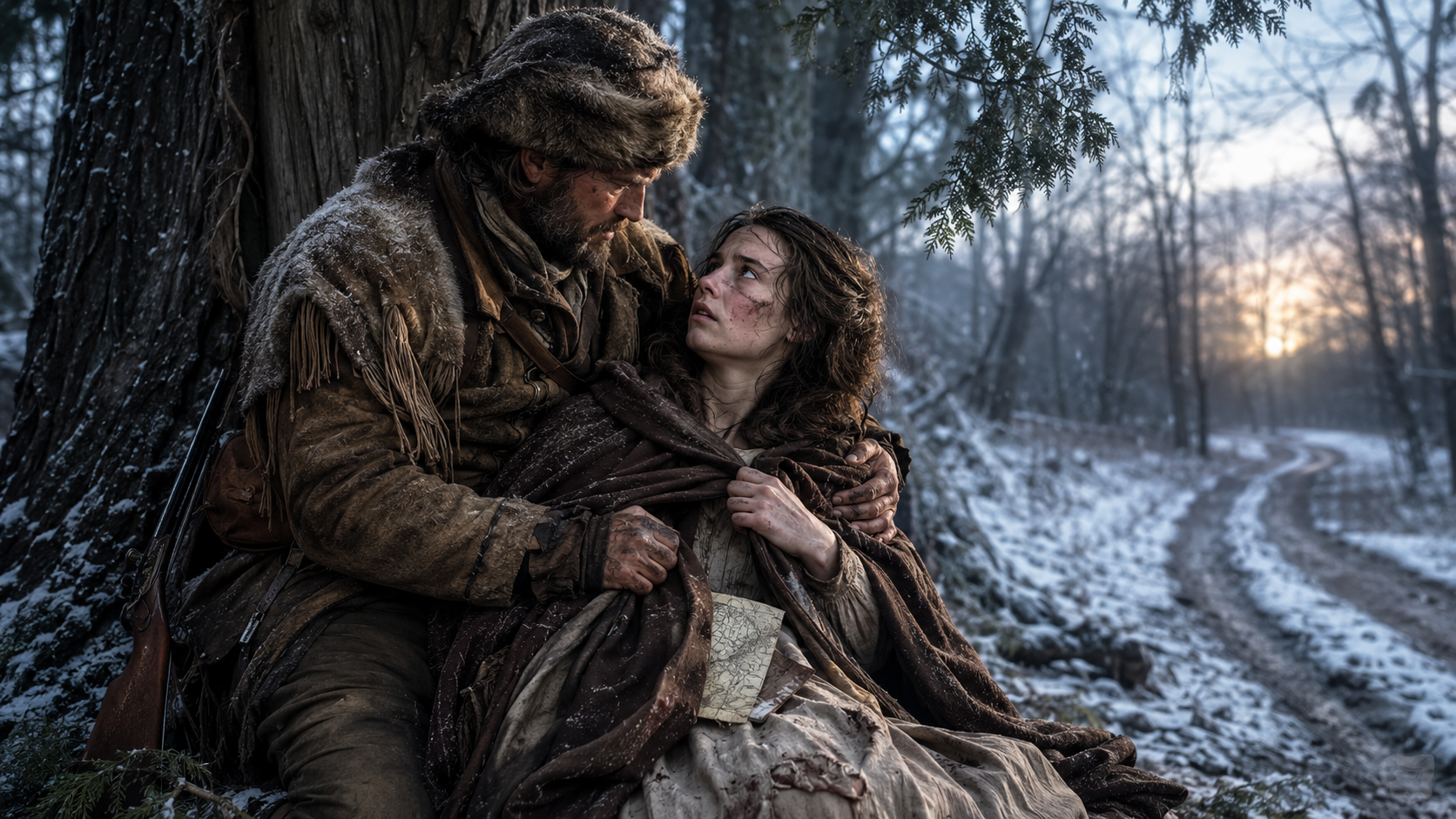
When her legs finally failed, she crawled beneath a cedar and curled around the papers sewn inside the lining.
That was where Silas Crowe found her.
People along the Trace called Silas a mountain man, though the hills there were not true mountains. He had earned the name because he had come down from the Cumberland country with a rifle, a mule, and a silence so complete that gossip had starved trying to feed on him.
Some said he had killed a man.
Some said he had once hunted runaways for money.
Some said he had lost a wife and buried the rest of himself with her.
Only one of those stories was true.
Silas had lost a wife.
Her name had been Anna Hale.
When Marian woke beneath his roof, the first thing she saw was a blue shawl hanging beside the hearth.
The second thing she saw was a Black woman sitting beside the bed with a shotgun across her lap.
Marian froze.
The woman was perhaps fifty, with silver at her temples and eyes that measured lies before they finished forming.
“Good,” the woman said. “You lived.”
Marian tried to sit up. Pain tore through her ankle.
“My cloak,” she whispered. “Where is it?”
“Safe.”
“Where?”
“Girl, safe is more than you had yesterday.”
Silas stood by the hearth, pouring coffee into a tin cup. He had a beard dark with rain, shoulders broad enough to block the firelight, and a face carved by weather rather than kindness. Yet when he brought the cup to Marian, he held it where she could take it without his fingers touching hers.
That small mercy nearly broke her.
“This is Mercy Galloway,” Silas said. “She decides whether you are worth believing.”
Marian looked at the shotgun. “And if she decides I am not?”
Mercy rested one hand on the barrel. “Then you will regret waking up.”
Silas said, “Tell it.”
So Marian told it.
Not beautifully. Not bravely. She stumbled, corrected herself, forgot the order of things, and began again. She confessed the map, the ledger, the route, Josiah, Nell, Amara Reed, Everett Kane, Rafe Cutter, the fire, the run through the sleet. She did not make herself noble. She did not ask them to admire her. When she reached the part where Josiah had been whipped because Cutter suspected something, her voice failed.
Mercy did not soften.
“Why should I believe a Bellamy?”
Marian closed her eyes.
“You should not,” she said. “You should believe the papers.”
Silas looked at Mercy.
Mercy looked at Silas.
Then Silas took the cloak from a peg, opened the lining with his knife, and laid the documents across the table.
Mercy read first.
Her face changed on the fourth page.
“Lord have mercy,” she whispered.
Silas leaned closer. “What?”
Mercy tapped one line. “Amara Reed.”
Marian’s breath caught. “Josiah’s mother.”
“You said they were told she was sold.”
“That is what my father said.”
Mercy’s mouth hardened. “This says there was a freedom claim.”
Silas read the line silently, then again aloud.
“Manumission irregularity unresolved. Keep buried.”
The cabin seemed to shrink around the fire.
“What does that mean?” Marian asked, though part of her already knew.
Mercy looked at her. “It means somebody tried to free that woman. Maybe a former owner. Maybe a will. Maybe a court paper. It means your father kept her anyway. It means her children may have a claim too, if dates and records hold.”
“That is proof,” Marian said.
Mercy’s eyes flashed. “No. It is paper. Proof is what powerful men agree not to ignore.”
The truth of that hurt worse than the cold.
Silas gathered the pages. “There is also Kane’s letter, payment terms, transport route.”
Mercy stood. “If Josiah moved them early, they will aim for the hollow church first. From there, west ridge. Then the farm.”
Marian looked from one to the other.
“You know the route.”
Silas’s jaw tightened.
Mercy answered instead.
“We are the route.”
The words moved through Marian like heat.
Silas looked toward the blue shawl by the hearth. “When your note says ask for Anna, it is asking for my dead wife.”
Marian went still.
“I did not know.”
“No,” Silas said. “You did not.”
“Then I failed.”
His eyes cut back to her. “Not yet.”
Mercy watched him carefully. “What are you thinking?”
Silas reached for his coat. “You ride to the hollow church. If Josiah’s group made it, move them before dark. If they did not, wait until moonrise. I will keep Bellamy busy.”
“How?”
Silas looked at Marian’s torn dress, swollen ankle, and fever-bright face.
“I am taking Miss Bellamy home.”
Marian recoiled. “No.”
Mercy lifted the shotgun a fraction. “Silas.”
“Not to surrender her,” he said. “To make them look at her.”
Marian shook her head. “I do not understand.”
“Your father thinks you ran with evidence. Cutter’s men are hunting the woods. If they hunt you, they are not hunting Josiah, Nell, or the children. But by noon they will remember the others. We need one more day.”