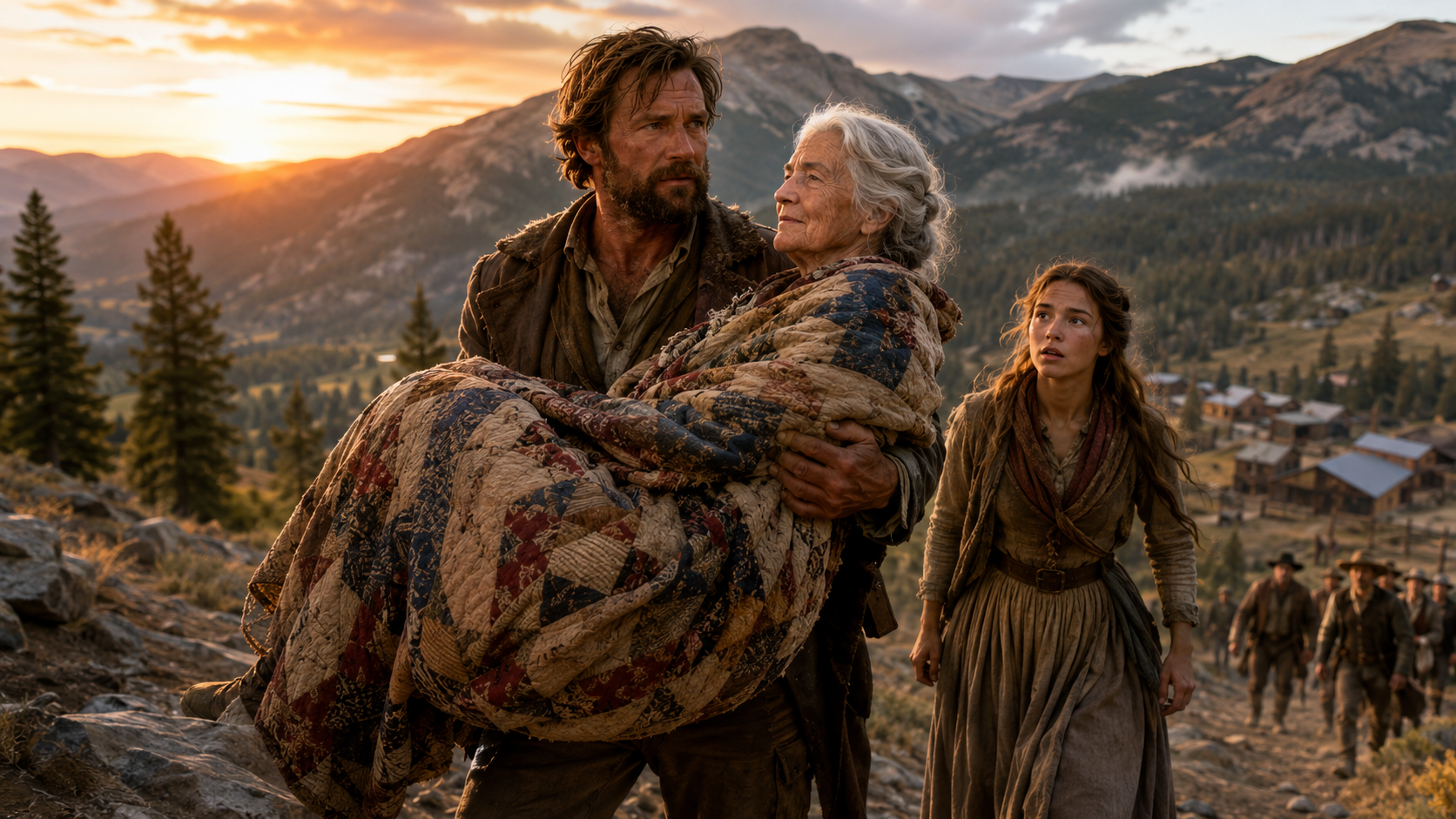
When my grandmother first saw the mountain, she smiled as if it had been waiting for her.
I thought the sight would frighten her. The peaks rose ahead of us like dark teeth against a bruised evening sky, their shoulders covered in pine, their summits still holding patches of old snow though spring had already softened the valleys. The wagon road narrowed as it climbed, twisting between boulders, black firs, and drops so steep I could not look over the edge without feeling my stomach turn.
But Grandmother Mae only lifted one trembling hand from her quilt and pointed.
“There,” she whispered. “That is where your grandfather said the world touched heaven.”
I tightened my grip on the reins. “Grandfather never came this far west.”
“No,” she said, her eyes still fixed on the ridge. “But he dreamed farther than he walked.”
That was Mae Holloway. Eighty-one years old, bones brittle as winter branches, lungs tired from years of smoke and sewing-room dust, yet still capable of speaking as if life were a hymn no hardship had managed to silence.
I was not like her.
I had spent the last six years keeping accounts, paying debts, burying my parents, stretching flour, hiding fear, and pretending that hope was a practical household item we simply could not afford. When the letter arrived saying Mae had inherited a mountain claim near the town of Briarfall, I had not believed in providence. I had believed in signatures, legal seals, and the chance that we might finally own a roof no creditor could take.
The letter said the place was modest.
The deed said it was ours.
The man at the last stage stop said we would be fools to go.
He had leaned against a hitching post with tobacco in his cheek and a warning in his eyes.
“You ladies headed toward Briarfall?”
“Yes,” I had said.
“With that old woman?”
“My grandmother has a name.”
He glanced at Mae, then back at me. “Names don’t help much in those mountains.”
I should have walked away. Instead, I asked, “What does?”
“A rifle. A fast horse. And staying clear of Jonah Blackwood.”
Mae had opened one eye beneath the brim of her bonnet. “Who is Jonah Blackwood?”
The man spat into the dust. “Mountain brute. Lives above Briarfall like a wolf. Killed his own brother seven years ago and dragged the body through town to scare anybody who might ask questions.”
Mae had stared at him for a long moment. “Did you see him do it?”
The man shifted. “Everybody knows.”
“That was not what I asked.”
He did not answer.
I remembered that silence later.
I remembered it when the road bent under the pines and three riders came out of the trees.
They did not announce themselves as thieves. Thieves, I imagine, would have demanded money first. These men looked straight past our small trunk, our sacks of flour, our battered coffee tin, and the quilt tucked around Mae’s knees.
The tallest one said, “Hand over the papers.”
My heart dropped.
I knew then that the inheritance was not modest. I knew before I understood anything else that the letter had pulled us toward danger, and danger had been waiting.
“I don’t know what you mean,” I said.
The man smiled. “Then we’ll search.”
One of the riders moved toward the wagon.
Mae’s hand closed over mine. Her fingers were cold.
I had my father’s pistol under the seat. I had loaded it badly that morning, praying I would not need to prove whether my hands could do more than shake. I reached for it now.
The tall rider saw.
He cursed.
A shot cracked through the trees.
For one awful second, I thought he had fired at Mae. Then the wagon lurched, the left wheel splintered, and the horses screamed.
Another shot rang out.
But this one did not come from the road.
It came from above.
A bullet struck the ground near the tall rider’s boot, spraying dirt against his trousers.
A voice rolled down from the slope.
“Next one takes fingers.”
The forest went silent.
A man stood between two pines high above the road, rifle lowered but ready. He was enormous in the way mountains make men look enormous when they belong to them. Broad shoulders beneath a weather-dark coat. Beard rough as black cedar. Hair tied back with a leather strip. His face was hard, wind-browned, and unreadable, but his eyes were clear.
The riders knew him.
I saw it before they spoke.
The tall one’s mouth twisted. “Blackwood.”
The man on the slope did not move. “Ride away.”
“There are three of us.”
“And you have two good hands each,” the mountain man said. “For now.”
The smallest rider made a nervous sound. The third pulled his horse around first. The tall one lingered, rage flickering across his face, but he must have heard something in Jonah Blackwood’s voice that I did not. He spat once, wheeled his horse, and followed the others into the trees.
Only when the hoofbeats faded did I realize I was still pointing the pistol at the air.
The mountain man came down the slope with quiet steps. Up close, he seemed less like a brute and more like a storm that had learned manners.
He looked first at my grandmother.
“Ma’am, are you hurt?”
Mae swallowed. “Only my pride. And perhaps my opinion of scenic travel.”
Something moved at the corner of his mouth.
Then his gaze turned to me.
“You can lower the pistol.”
Heat rushed to my face. I lowered it at once. “I’m sorry.”
“Don’t be,” he said. “A frightened woman with a pistol is still wiser than a confident fool with empty hands.”
He crouched beside the ruined wheel. I watched him examine the broken spokes, the cracked rim, the axle bent just enough to make my stomach sink.
“This wagon won’t reach Briarfall,” he said.
“It has to.” I hated the desperation in my voice. “My grandmother needs rest. The claim cabin is supposed to be near town.”
His eyes moved to Mae again, and something changed in him. The hard watchfulness softened. Not much, but enough that I noticed.
“She needs warmth, water, and a bed that isn’t bouncing over rock,” he said. “Town doctor, too, if old Merrick is sober before supper.”
“We can pay you.”
“I didn’t ask for money.”
I stiffened. “Mr. Blackwood, I appreciate what you did, but we do not know you.”
“No,” he said. “But those men do. And they’ll come back.”
That silenced me.
He looked up the narrow trail cutting between the pines. “My cabin is above the ridge. Less than a mile if you’re walking. Farther if you’re carrying fear. The horses can make the lower bend, but the wagon can’t. I’ll take what supplies you need and fix the wheel by morning.”
Mae shifted beneath her quilt and grimaced. Pain drew the color out of her lips.
“Grandmother?”
She did not answer me. She was looking at him.
“You are the terrible Jonah Blackwood?” she asked.
His jaw tightened. “Depends who is telling it.”
“Did you murder your brother?”
“No, ma’am.”
“Did you rob miners?”
“No.”
“Did you ever strike a woman?”
His eyes flicked to mine, then away. “Never.”
Mae studied him the way she studied a seam before deciding whether it would hold. Then she nodded.
“Well,” she said, “that is sufficient for now. Help me down before my dignity outruns my bones.”
I moved toward her, but Jonah was faster. He stepped to the wagon, reached up, and lifted my grandmother as if she weighed no more than a folded blanket.
Mae gasped and clutched his shirt.
“I’ve got you,” he murmured. “You’re safe.”
I stood frozen.
I had expected strength.
I had not expected gentleness.
Jonah Blackwood, the monster of Briarfall, adjusted the quilt around Mae’s legs with a care that made my throat tighten. He held her not like a burden, not like an inconvenience, but like something precious entrusted to him by God and weather.
“I’ll carry her up,” he said.
“The path is steep,” I warned.
His eyes met mine.
“Then I’ll climb slow.”
And he did.
The trail rose cruelly. It twisted between wet stones and roots thick as old rope. Even with only my satchel over my shoulder and my father’s pistol in my pocket, I was breathless before we reached the first bend. Jonah moved with steady patience, pausing when Mae coughed, shifting her higher when the trail narrowed, warning her before every uneven step.
“Tell me if I hurt you,” he said.
“You do not,” Mae whispered. “My late husband carried feed sacks with less tenderness, and he claimed to love me.”
This time Jonah actually smiled.
I followed behind them, watching this feared man carry my grandmother toward the mountaintop, and something inside me cracked in a place I had not known was sealed.
All my life, I had carried people.
My father through fever.
My mother through grief.
My grandmother through age.
Myself through everything else.
No one had ever turned to me and said, Let me take this part.
Jonah Blackwood did not say it either.
He simply did it.
By the time his cabin appeared through the trees, I knew two things.
The men on the road had not been ordinary thieves.
And whatever Briarfall believed about Jonah Blackwood, it was not the whole truth.
His cabin stood in a clearing above a creek, stronger and cleaner than I expected. There was wood stacked beneath the eaves, herbs drying beside the door, and mountain flowers growing in a rough stone border. Inside, the place smelled of pine smoke, coffee, leather, and stew. Books lined one wall. Tools hung neatly from pegs. A narrow bed stood beneath a window facing the ridge.
Jonah set Mae down and tucked the quilt around her.
“I’ll bring water.”
“I can do that,” I said.
“You can sit before you fall.”
“I’m not going to fall.”
“You’re shaking.”
“I was shot at.”
“That explains it.”
His tone was dry, not unkind. Somehow that steadied me more than pity would have.
He brought water, then broth, then a little tin of medicine from a shelf above the stove. Mae drank what she could. Within the hour, she slept.
Only then did I notice Jonah had gone.
I found him outside near the broken wheel. He had dragged it up with rope and sheer stubbornness and was already working by lamplight, sleeves rolled to the elbow, hands moving with calm precision.
“The men knew my name,” I said.
He did not look up. “I heard.”
“They knew about the deed.”
“I heard that too.”
“Then tell me what I have walked into.”
He set down the tool.
For a long moment, he looked toward the trail, where the trees had swallowed the last of the light.
“The Holloway claim isn’t just a poor cabin and stubborn dirt,” he said at last. “It sits against an old boundary line people have argued over since before the war. There’s silver under the north ridge. Not enough to make a kingdom, but enough to make honest men forget themselves and dishonest men sharpen knives.”
My mouth went dry. “And my grandmother inherited the land that proves where the boundary lies?”
“Maybe.”
“From a man she barely knew?”
“Silas Rowe was your grandmother’s cousin, wasn’t he?”
I nodded.
“Then maybe he had no one else left. Maybe he thought two women from the plains could arrive quietly.”
“But someone found out.”
Jonah’s expression darkened. “Someone always does.”
“Who?”
“The man behind most trouble here is Victor Harrow. He owns the mill, half the store, and enough frightened men to pretend he owns the rest. The rider with the scar was Bram Lyle. The nervous one was probably Neddie Cross. I didn’t see the third clearly.”
“And the man at the stage stop who warned us about you?”
Jonah went still.
“What did he say?”
“That you killed your brother.”
The spoke in Jonah’s hand snapped.
For the first time, I saw something raw beneath his silence.
“My brother’s name was Thomas,” he said. “He was twenty-four. He laughed too loud, trusted too fast, and believed every person could be improved by bread and music.”
I said nothing.
“Seven years ago, we found the silver line before Harrow did. We had a claim. We had a survey. We had proof. Then Thomas died in a storm near Raven Pass.”
“I’m sorry.”
Jonah’s face hardened, but his voice stayed low.
“The town needed a villain. Harrow gave them one. Said I led Thomas out there to steal his share. Said I came back alone because I killed him. Said the claim papers disappeared because I hid them.”
“Did no one defend you?”
“My brother’s sweetheart tried at first.” He looked away. “Then her father threatened to throw her out. The preacher said grief confused people. The storekeeper said peace mattered more than truth. Everyone decided it was easier to fear one man than stand against Harrow.”
“Why didn’t you fight them?”
He looked at me then, and the pain in his eyes was not wild. It was old. It had made a home inside him.
“I was tired.”
I understood that too well to answer quickly.
Inside, Mae coughed.
I turned.
“Go,” Jonah said. “I’ll finish here.”
“You saved us today,” I said. “You carried her. You’re repairing our wheel. You have told me more truth in one evening than anyone in this county was willing to give us. I do not know how to repay it.”
He picked up the tool again.
“Don’t believe Briarfall too soon. That will be payment enough.”
The next day, I had to enter Briarfall whether I believed it or not.
Mae needed more medicine. We needed flour, salt, lamp oil, nails, window glass, and a courage I could not purchase. Jonah rode beside the repaired wagon with his rifle within reach. Mae sat wrapped in quilts, watching the town as if she were the judge and every porch held a defendant.
Briarfall was smaller than its fear.
A general store. A blacksmith shed. A church with a crooked bell. A row of houses pressed against the mud road. Chickens scattered as we entered, and every human voice died.
Faces appeared in windows.
A woman dropped a basket of washing.
An old man muttered, “Blackwood.”
Jonah ignored them.
I did not.
Fear I could understand. Hatred too. But shame was different. Shame looked away.
The storekeeper, Harlen Pike, greeted us with a smile that seemed practiced before a mirror.
“Miss Vale,” he said to me. “We heard you had trouble on the road. A terrible welcome. This country can be hard on newcomers.”
“Yes,” I said. “Especially when the country knows they are coming.”
His smile did not change. “News travels.”
“So do bullets.”
Behind me, Jonah made a quiet sound that might have been amusement.
Harlen glanced at him, then back at me. “You’ll be wanting to see the Holloway place.”
“Yes.”
“I can send a boy to guide you.”
“I know the way,” Jonah said.
Harlen’s jaw tightened.
I noticed.
The Holloway cabin sat two miles beyond town, tucked under a slope of aspens. At first sight, my hope fell through me.
The porch had collapsed. The roof sagged over one corner. One window was shattered, another boarded from inside. Weeds had swallowed the path. The barn leaned like a drunk against the wind.
Mae looked at it from the wagon and whispered, “Oh, child.”
“It’s all right,” I lied.
Jonah walked the property in silence. He checked the well, the chimney, the barn doors, the foundation stones. Then he came back.
“The bones are good.”
“The bones?” I stared at the ruin. “Mr. Blackwood, I am not a carpenter. I am not a miner. I am not even useful with chickens. I brought my grandmother across half the country because a letter promised us a chance to survive, and now men are ready to kill us over land I barely understand.”
My voice broke.
I turned away, ashamed.
Jonah did not crowd me. He stood beside me and looked at the ruined cabin as if it were not a disaster, but a task.
“First, we make one room safe,” he said. “Then the roof. Then the stove. Then winter stores. You do not have to solve a whole life before supper.”
“I don’t know where to start.”
“I do.”
I looked up at him.
There it was again. That steadiness. Not handsome in a polished way. Not charming. Better than charming. Real.
“Why?” I asked. “Why help us this much?”
His face changed.
For the first time since I had met him, Jonah Blackwood looked uncertain.
“Because your grandmother looked at me as if I were still a man,” he said. “Not a story. Not a warning. Not the creature Briarfall invented so it could sleep at night.”
My throat tightened.
“And me?” I asked before I could stop myself.
His eyes held mine.
“I’m trying not to answer that too quickly.”
Before I could breathe, Mae called from the wagon, “If you two are finished pretending to discuss roof beams, I have opinions.”
“Grandmother.”
“I am elderly, Mara, not blind.” She pointed at Jonah. “You will help us make this place livable. We will pay what we can. You will eat supper here when there is a table to serve it on. And until then, if you offer shelter, we will accept it, because pride makes a poor blanket.”
Jonah’s expression warmed.
“Yes, ma’am.”
Mae leaned back, satisfied. “Good. Now someone tell me if this house has snakes.”
It did.
Three.
Jonah removed them before I decided whether to scream, faint, or sell the property immediately.
For the next eleven days, our lives became a rhythm of labor.
At dawn, Jonah came down from his cabin with tools over his shoulder. I met him with coffee. Mae sat under an aspen tree sewing curtains from old flour sacks and giving orders like a general defending a fort.
Jonah taught me how to pry out rotted boards, set nails straight, patch chinks between logs, and tell whether a beam would hold.
He did not laugh when I hit my thumb.
He did not scold when I measured wrong.
He did not treat me as fragile.
That unsettled me more than his strength.
Men in our old town had praised me for endurance while quietly expecting me to endure alone. Jonah simply handed me the right tool and stood near enough to catch what fell.
One afternoon, rain came hard over the ridge. We ran for the cabin, laughing despite ourselves, soaked before we reached shelter. My boot slipped in the mud. Jonah caught me around the waist.
For a moment, the whole world narrowed to his hands, my breath, and rain beating against a roof we had repaired together.
“Mara,” he said, voice rough.
I should have stepped back.
I did not.
He bent slowly, giving me every chance to refuse.
I rose to meet him.
Our first kiss tasted of rain, woodsmoke, and all the words both of us had been too careful to say. It was gentle at first, almost reverent. Then my hand touched his jaw, and Jonah made a low sound like a man coming home after years in the cold.
Mae knocked a spoon against a tin cup from the next room.
“I may be old,” she called, “but I am not deaf, and that kiss sounded legally significant.”
I jumped back, mortified.
Jonah laughed.
It was the first full laugh I had heard from him. It changed his whole face. The haunted lines eased, and for one bright second I saw the man he might have been before grief and rumor drove him into the mountains.
But happiness made our enemies restless.
Three nights later, someone set fire to the barn.
Jonah saw the glow from his cabin and arrived before the roof collapsed. He and I formed a desperate line from the well, passing buckets until our arms shook. Mae sat near the cabin door wrapped in a quilt, coughing from smoke and refusing to be carried farther away.
By midnight, half the barn was gone.
In the ashes, Jonah found a strip of green cloth caught on a nail.
Bram Lyle wore a green neck scarf.
“They’re warning us,” I said.
“No.” Jonah’s voice had gone flat in a way that frightened me more than anger would have. “They’re testing how alone you are.”
The next morning, Harlen Pike arrived with two townsmen and Reverend Cole. Harlen removed his hat with theatrical sorrow.
“Miss Vale, this is unfortunate. Deeply unfortunate. It proves what I feared. This property attracts danger. A woman in your position should not remain here.”
I stood on the blackened earth with Jonah behind me.
“What do you suggest?”
Harlen unfolded a paper. “I know a buyer. He will take the land despite the damage. Enough money for you and Mrs. Holloway to return east comfortably.”
Mae’s married name had not been spoken in town.
I smiled politely.
“You know a great deal about us.”
Harlen’s expression flickered.
“Small town.”
“Small towns must read private letters very quickly.”
The preacher cleared his throat. “Miss Vale, Mr. Pike is only trying to protect you.”
“From the men who burned my barn,” I asked, “or from the land they want me to sell?”
One of the townsmen looked at the ground.
Harlen’s pleasant mask thinned.
“You are young. You do not understand how dangerous stubbornness can be.”
Jonah stepped forward. “She understands.”
Harlen looked at him with open contempt.
“And you? Still playing guardian? How many lives must suffer because Jonah Blackwood decides something belongs to him?”
My head turned sharply. “What does that mean?”
Harlen kept his eyes on Jonah.
“Ask him about Thomas Blackwood. Ask him why one brother came home and the other didn’t. Ask him why his claim papers vanished. Ask him why his brother’s bride-to-be married another man rather than stand beside him.”
Jonah went pale beneath his tan.
I saw the wound land.
Harlen saw it too.
And smiled.
That was his mistake.
I took one step toward him.
“You came here with a buyer’s paper before the ashes cooled. You knew my grandmother’s family name though I never told it to you. You warned me against Mr. Blackwood because he is the only man on this mountain Victor Harrow fears. So I will tell you this once, Mr. Pike. I am not selling.”
Harlen’s smile vanished.
“You will regret that.”
“No,” Mae called from the porch, her voice thin but sharp as a needle. “She will not. But you may.”
He left with the paper unsigned.
That night, Jonah tried to leave.
I found him saddling his horse beneath a moonless sky.
“Where are you going?”
“To find Bram Lyle.”
“And do what?”
His silence answered.
I stepped into the blackened shadow of the barn.
“If you kill him, they will make every lie true.”
“Mara—”
“No. They have waited seven years for you to become the monster they invented. Do not hand them your soul because they frightened me.”
His hands clenched on the saddle.
“They burned your barn.”
“Yes.”
“They could have burned you in your bed.”
“Yes.”
“I cannot sit still and wait.”
“I am not asking you to sit still.” I moved closer. “I am asking you to fight smart.”
He looked down at me, anguish naked in his eyes.
“I know how to stop men,” he said. “I do not know how to fight smart when someone I love is threatened.”
The night stopped.
Someone I love.
I forgot the cold. The ash. The danger watching from the pines.
“You love me?”
Jonah closed his eyes briefly, as if the truth hurt on its way out.
“Yes.”
I stepped close enough to touch his hand.
“Then stay.”
His breath shuddered.
“For once,” I whispered, “let someone carry you back from the edge.”
He bowed his head.
I wrapped my arms around him, and after a long rigid moment, Jonah Blackwood held on to me like a man who had survived winter by refusing shelter and had only just realized he was freezing.
We did not find Bram Lyle.
Bram found Mae.
It happened two days later near sunset, while I was at the well and Jonah was repairing the back fence. Mae had insisted on walking the short path behind the cabin to gather wildflowers for the table. She had seemed stronger lately, proud of it, stubborn enough to make me believe the mountains had given her a few stolen years.
Then came the scream.
Not Mae’s.
A man’s.
Jonah dropped the fence rail and ran. I seized the pistol from the porch and followed.
We found Mae sitting in the dirt beside the trail, pale but conscious. Bram Lyle knelt nearby, one hand clamped around his bleeding forearm. Mae’s sewing scissors lay between them.
“I told him,” Mae said breathlessly, “that if he wanted to drag an old woman through the woods, he should choose one without sharp objects.”
Bram cursed.
Jonah lifted him by the collar and slammed him against a tree.
“Who sent you?”
Bram spat. “Go to hell.”
Jonah’s fist drew back.
I caught his arm. “No.”
He trembled with restraint.
I stepped close to Bram, pistol steady.
“You tried to abduct my grandmother,” I said. “You are bleeding badly. If Mr. Blackwood leaves you here, wolves may find you before your friends do. If you answer my questions, I will bind that arm.”
Bram’s eyes darted between us.
“Harrow,” he said. “Victor Harrow. Pike works for him.”
“Why the land?”
“Survey line. Old map. Rowe had it. Said he sent it with the old woman because nobody would search a grandmother’s Bible.”
My heart lurched.
Mae went very still.
“My Bible?” she whispered.
Bram laughed weakly. “Harrow wants the map before the Denver surveyor comes through. If that paper proves the vein crosses Holloway land, Harrow loses half his silver.”
Jonah looked at Mae.
“Where is the Bible?”
Mae’s face crumpled.
“In the wagon trunk,” she said. “At your cabin. I thought it safest there.”
Jonah tied Bram to a tree with a bandage tight enough to stop the bleeding and uncomfortable enough to discourage gratitude.
Then we rode hard for his cabin.
Too late.
The door hung open.
Inside, shelves had been torn down. Books lay ripped across the floor. The mattress was slit. Mae’s trunk sat empty.
Her Bible was gone.
For a moment, Mae looked older than I had ever seen her.
“My mother gave me that Bible,” she whispered.
I knelt beside her. “We’ll get it back.”
“How?”
Jonah stood in the wreckage of the only home he had allowed himself for seven years. His jaw was set. His eyes were terrible.
“Harrow won’t keep it in town,” he said. “Too many eyes. He’ll take it to the old ore house above Raven Pass. Men hide things there when they do not want questions.”
I stood. “Then we go there.”
“No.”
The word cracked through the cabin.
I turned.
Jonah shook his head. “Raven Pass is steep, exposed, and dangerous in the dark. Harrow will have men.”
“And the surveyor arrives in days,” I said. “If Harrow destroys that map tonight, what happens?”
He did not answer.
“He keeps the claim,” I said. “He keeps the lies. He keeps the town afraid. He keeps your brother’s name buried beneath yours.”
Jonah’s eyes flashed. “I will not risk you.”
“You do not get to protect me by deciding my courage belongs to you.”
He flinched.
I softened at once and stepped closer.
“I know you’re afraid. So am I. But that map is not just paper. It is truth. For Silas Rowe. For your brother. For Mae. For us.”
Mae lifted her chin from the chair.
“And for my Bible,” she said, “which I want back before some criminal sweats on the Book of Psalms.”
Jonah exhaled slowly.
Outside, thunder rolled over the ridge.
A storm was coming.
Harrow would count on that.
So would we.
We left Mae at the repaired cabin with a loaded shotgun across her lap and rode into the storm before full darkness fell. Rain turned the trail slick within minutes. Lightning opened the sky in white wounds. The horses climbed through pine and shale, Jonah in front, me close behind, both of us bent low against the weather.
Raven Pass deserved its name.
The ridge narrowed like a blade, one side rising sheer, the other dropping into blackness. Far above, near an abandoned ore chute, lamplight flickered inside a roofless stone building.
Jonah dismounted.
“Stay behind me.”
“I will stay beside you.”
“This is not the time.”
“It is exactly the time.”
He looked at me through the rain, and something like pride broke through his fear.
“Beside me, then.”
We approached on foot.
Voices carried through the storm.
Harrow’s voice was smooth and furious.
“Burn it.”
Harlen Pike protested, “The map may be worth more intact.”
“It is worth a rope around my neck if the surveyor sees it,” Harrow said. “Burn it.”
Through a gap in the stone wall, I saw four men: Victor Harrow, broad and sharp-eyed; Harlen Pike, hat dripping rain; Bram Lyle, pale with his wounded arm in a sling; and the third rider from the road.
On a crate between them lay Mae’s Bible.
Harrow opened it and shook loose a folded oilskin packet.
Jonah’s breath changed.
I touched his wrist.
Wait.
Harrow unfolded the map.
“Thomas Blackwood should have died before he drew this,” he said.
Jonah went rigid.
Harlen muttered, “Don’t say names.”
“Why not?” Harrow snapped. “His brother took the blame for everything.”
Bram laughed. “Mountain ghost won’t come down.”
Jonah stepped into the doorway.
“No,” he said. “But I will come up.”
The men spun.
For one heartbeat, even the storm seemed to hold its breath.
Then chaos broke open.
Harrow grabbed the map and ran toward the back exit. Bram raised a pistol. I fired first, not at him but at the lantern above his head. Glass shattered. Flame spilled. Men shouted. Jonah drove into the room like thunder, knocking the third rider down before the man could aim.
Harlen tried to flee past me. I swung the iron key from Mae’s trunk, clenched between my fingers, into his cheekbone with all the strength terror gave me. He fell hard, cursing.
Bram lunged for the burning map.
I threw myself forward and snatched the oilskin from the edge of the flame. Heat bit my palm. I cried out but held on.
“Mara!” Jonah shouted.
Harrow appeared behind him with a knife.
“No!”
Jonah turned too late.
The knife drove into his side.
Something inside me went silent.
I raised the pistol with both hands.
“Drop it.”
Harrow froze, knife dark in his grip.
My voice did not shake.
“I said drop it.”
He smiled. “You won’t shoot.”
Jonah sank to one knee.
I cocked the hammer.
Harrow’s smile faded.
He dropped the knife.
Outside, voices rose below the pass.
Not Harrow’s men.
Town voices.
The preacher. The blacksmith. The woman who had dropped her washing. Mae had not stayed waiting with a shotgun after all. She had sent the blacksmith’s boy to Briarfall with Bram’s confession, then shamed half the town into riding through the storm.
By dawn, Victor Harrow and Harlen Pike were tied over saddles, Bram Lyle was weeping, and the old map was safe inside Mae’s reclaimed Bible.
But Jonah was bleeding.
Badly.
We could not ride fast.
We could not wait.
The doctor in Briarfall had shaking hands but clear eyes when it mattered. He stitched Jonah on Mae’s kitchen table while I stood at Jonah’s head and refused to let go of his hand.
“You stubborn mountain fool,” Mae whispered, crying openly now. “Do not die after carrying me all the way up that ridge. I will be furious.”
Jonah’s eyes opened.
“Mara?”
“I’m here.”
“Map?”
“Safe.”
“You?”
“Safe.”
He tried to smile. “Then stop looking like I’m already buried.”
I bent over him, tears falling despite every effort to hold them back.
“You told me you did not know how to fight smart when someone you loved was threatened,” I whispered. “So listen carefully. Living is the smart fight. Do you understand me?”
His fingers tightened around mine.
“Yes, ma’am,” he breathed.
He lived.
The truth, once freed, moved through Briarfall like floodwater.
Silas Rowe had discovered the old survey map while settling a distant estate. He had sent the deed, the map, and the Bible west with Mae because he believed no one would suspect two women of carrying proof that Victor Harrow’s silver claim was partly stolen.
Harrow learned of it through Harlen Pike and arranged the ambush.
Thomas Blackwood had not died because Jonah abandoned him.
He had been shot by Harrow’s men near Raven Pass seven years earlier and left in the snow. Jonah, wounded and half-mad with grief, had carried his brother’s body home through the storm. Harrow turned that terrible act into a rumor: Jonah Blackwood had murdered his brother and dragged him back from the mountain.
Briarfall had believed the lie because believing cost less than resisting.
That changed.
Not all at once. Shame is slow when it has lived too long as habit. But the blacksmith came first, hat in hand, to apologize. Then the preacher. Then the woman who had dropped her washing, whose little daughter had survived fever years earlier because two Blackwood brothers had tried to bring medicine through a storm.
Jonah accepted no grand speeches.
He only nodded and kept healing.
I stayed beside him through fever, anger, nightmares, and the strange quiet that came after justice finally arrived. Sometimes he woke reaching for a rifle. Sometimes he wept without sound. Sometimes he asked whether I was certain I wanted a man with ghosts.
Each time, I answered the same way.
“I do not love you because you have no wounds. I love you because you kept your heart alive despite them.”
Winter came early that year.
By then, the Holloway cabin had a sound roof, real windows, stacked firewood, and curtains Mae had sewn from flour sacks and pride. The Denver surveyor confirmed the map. Mae and I owned enough of the silver claim to live securely, though I refused to let the land become only a mine.
“This place has seen too much greed,” I said. “It should grow something kinder.”
So in spring, we planted apple trees.
Jonah came every morning until Mae finally lost patience.
“You cross two miles before breakfast to drink coffee in our kitchen,” she told him. “You mend fences that are already mended. You chop wood we already chopped. You look at my granddaughter as if she hung the moon, then ride home alone like a tragic poem. I am too old to endure this much nonsense.”
Jonah looked at me.
I looked at him.
Mae sighed. “Ask her.”
Jonah stood so quickly his chair scraped the floor.
“Mara Vale,” he said, voice rough, “I have no fine house, no polished manners, and more history than any woman should have to carry. But I love you. I will love you with everything good left in me and everything good you helped me find again. Will you marry me?”
I crossed the kitchen and took his face in both hands.
“Jonah Blackwood,” I said, “you carried my grandmother up a mountain path when she could not take another step. You carried the truth when a whole town wanted it buried. You carried grief without letting it make you cruel. But you do not have to carry life alone anymore.”
His eyes shone.
“Is that a yes?”
“That is a yes.”
Mae clapped once. “Finally.”
We married beneath the aspens in June, one year after the bullet struck our wagon wheel.
Briarfall came. Some out of love, some out of guilt, and some because people will always attend a wedding if there is cake. Mae wore blue. Jonah wore his brother’s watch chain. I carried wildflowers and a page from Mae’s Bible tucked into my glove. Not Scripture, but the blank family page where she had written that morning:
Mara Vale married Jonah Blackwood, a good man wrongly judged, on the day she stopped merely surviving and began to live.
Years later, when people told the story, they liked to begin with the gunshot, the storm at Raven Pass, or the silver map hidden in an old woman’s Bible.
I always began elsewhere.
I began with the mountain path.
With Mae too weak to walk.
With Jonah lifting her carefully, not as a burden, but as a trust.
With the moment I followed behind him and understood that strength was not the same as violence, and tenderness was not the opposite of courage.
Mae lived to see three great-grandchildren born in the cabin beneath the ridge.
On her last spring morning, when apple blossoms opened white against the mountains, she held my hand and watched Jonah teaching our oldest boy how to plant straight rows.
“I knew,” she whispered.
“Knew what?”
“That he would carry you through.”
I looked at my husband, who was laughing as our son spilled seeds into the dirt.
“He did,” I said softly. “But I carried him too.”
Mae’s eyes filled with peace.
“That,” she whispered, “is the better love.”
She died before sunset, with apple blossoms at the window and my hand in hers.
We buried her on the hillside above the cabin, where she could see the ridge, the orchard, the town that had learned shame and then courage, and the path where a feared mountain man had once carried her toward safety.
Years passed.
Briarfall changed. The silver vein ran thin, but the orchard grew strong. Our children grew tall, loud, stubborn, and kind. Jonah’s beard silvered. My hands roughened from work. Our love lost its first astonishment and gained something deeper: the quiet certainty of two people who had chosen each other through fear, winter, grief, birth, harvest, and ordinary mornings.
Sometimes, at dusk, Jonah and I walked the old trail together.
He would stop where the first bullet had struck the wagon wheel, touch the scar still visible in the old pine beside the road, and shake his head.
“I nearly missed that shot,” he admitted once.
I laughed. “You told those men you would take their fingers.”
“I was trying to sound confident.”
“You were terrifying.”
“I was terrified.”
I looked at him, surprised.
He took my hand.
“I saw you on that wagon,” he said, “standing between a rifle and your grandmother with a pistol shaking in your hand, and I thought, there is the bravest woman I will ever know.”
I leaned against him.
“You carried her up the mountain,” I said.
Jonah kissed my hair.
“And you carried me down from it.”
Below us, the cabin windows glowed gold. Apple trees moved in the wind. Children’s voices rose from the yard, bright and alive. The mountain still held shadows, but it no longer felt lonely.
Mae had been right.
Love was not one person carrying the other forever.
It was two people learning when to lift, when to lean, when to stand, and when to walk beside each other into whatever came next.
And on that wild ridge where lies had once ruled and bullets had once flown, Jonah and I built a life strong enough to outlast every rumor.

