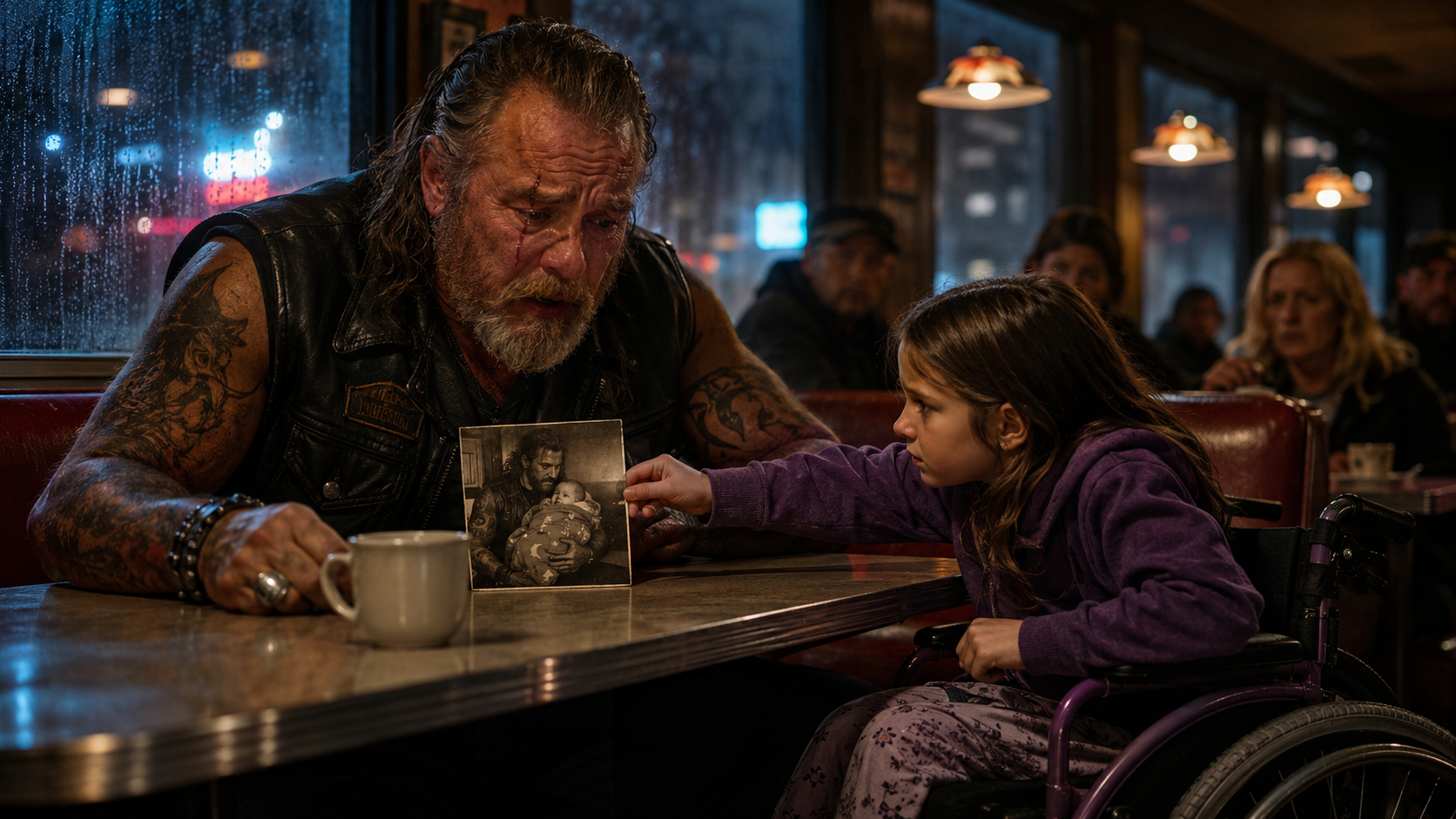
Your wheelchair changed from purple to blue, then back to purple because you decided purple had been right all along.
Ryder learned how to braid your hair badly.
Cora taught him properly after one school picture where your braid looked like a rope that had lost a fight.
You visited your mother’s grave every Sunday.
Ryder always brought yellow flowers.
The first time he stood there, he could not speak.
So you spoke for him.
“Mom, I found him. He’s grumpy. He burns eggs. He bought me a stuffed fox. I think you were right.”
Ryder cried with both hands on the back of your wheelchair.
The wind moved through the cemetery grass.
For one second, you imagined your mother laughing.
Years later, when you were older, you learned the full truth.
Beatrice had lost a child years before your mother was born. She had become obsessed with Maeve’s baby. With help from a corrupt hospital administrator, she changed records, forged documents, and made a newborn disappear into an illegal private adoption.
She renamed her Elise.
Raised her on lies.
Told her the scarred biker in the photograph was dangerous.
But your mother never fully believed her.
Because blood is not magic.
But truth has a pulse.
Your mother kept the photograph.
She kept the blanket.
She kept the feeling that somewhere, before all the fear and silence, someone had loved her.
When she became sick, she started searching.
Hospital records.
Old newspapers.
Names.
Towns.
Motorcycle patches in faded photographs.
She found Ryder too late for herself.
But not too late for you.
That was the part of the story people loved most.
The dying mother who sent her daughter to find the man with the scar.
The feared biker who became a grandfather overnight.
The diner where everyone watched a child roll into a twenty-eight-year lie and break it open with a photograph.
But you knew the real story was quieter.
It was Ryder learning which cereal you liked.
It was Cora sewing bigger pockets onto your blankets.
It was bikers building ramps at the school playground.
It was Mrs. Porter moving into the guest room after she broke her hip because Ryder said, “Family doesn’t expire after the emergency.”
It was the first time you called him Grandpa without thinking.
You were nine.
You were furious because a teacher said maybe you should sit out during field day.
You rolled into the garage where Ryder was fixing his bike and shouted, “Grandpa, tell them I can race if I want to!”
He froze.
The wrench slipped from his hand.
You did not realize what you had said until he turned around.
His eyes were wet.
You sighed because adults were always crying at inconvenient times.
“Are you going to help or not?”
He wiped his face.
“Yes, ma’am.”
He helped.
You raced.
You did not win.
You came in fifth.
Ryder cheered like you had taken Olympic gold.
At twelve, you asked him why people called him Iron.
He told you he got the name because after Maeve died, nothing seemed to bend him anymore.
You studied him from across the kitchen table.
“But you bend now.”
He looked at you.
“Yeah,” he said. “I do.”
At sixteen, you got a custom wheelchair with yellow moons and white stars painted along the frame.
Ryder pretended not to cry when he saw it.
Cora said, “For heaven’s sake, Ryder, just cry. Everyone knows.”
So he cried.
At eighteen, you crossed the graduation stage with braces locked around your legs, one hand gripping a special walker, the other holding Ryder’s arm.
You did not have to stand.
No one asked you to.
But you wanted to cross that stage that way.
Ryder walked beside you, slow and steady, wearing his leather vest over a white shirt because you had made him promise to look “a little less like he was arriving to collect a debt.”
He failed.
But he tried.
When your name was called, the auditorium erupted.
Not because people pitied you.
Because everyone in town knew what it had taken for you to arrive there.
You looked into the crowd and saw bikers, teachers, Mrs. Porter, Deputy Hank, Cora, and Ryder’s entire club standing like a wall of leather and tears.
Your mother’s photograph was in your pocket.
After graduation, Ryder gave you a cedar box.
Inside was the original moon-and-star blanket, preserved carefully behind glass, except for one loose corner left uncovered so you could touch it.
Beside it was the photograph from the diner.
Young Ryder holding baby Elise.
Maeve smiling beside him.
On the back, in Maeve’s handwriting, were four words:
Our girl. Our moon.
You held the photograph and finally understood.
Your mother had been loved.
Before Beatrice.
Before the lies.
Before sickness.
Before you.
She had been loved.
And somehow that love had traveled through twenty-eight years, through a dying woman’s hands, through a folded letter, through a rainy diner, through a scarred man’s grief, and back into your own.
When people later asked if you had been scared that night, rolling up to the most dangerous man in town, you told the truth.
Yes.
Of course you were.
You were eight years old.
Your mother had died.
Your whole world had become motel rooms, legal papers, whispers, and adults deciding where you belonged.
But fear is not always a warning to run.
Sometimes fear is the doorway to the truth.
And the truth was this:
The old biker with the scar was never the monster in your story.
He was your grandfather.
He had been waiting at the last booth of the Red Lantern Diner for twenty-eight years, drinking black coffee beside an empty seat, never knowing the person meant to fill it was rolling toward him on purple wheels covered in moons and stars.