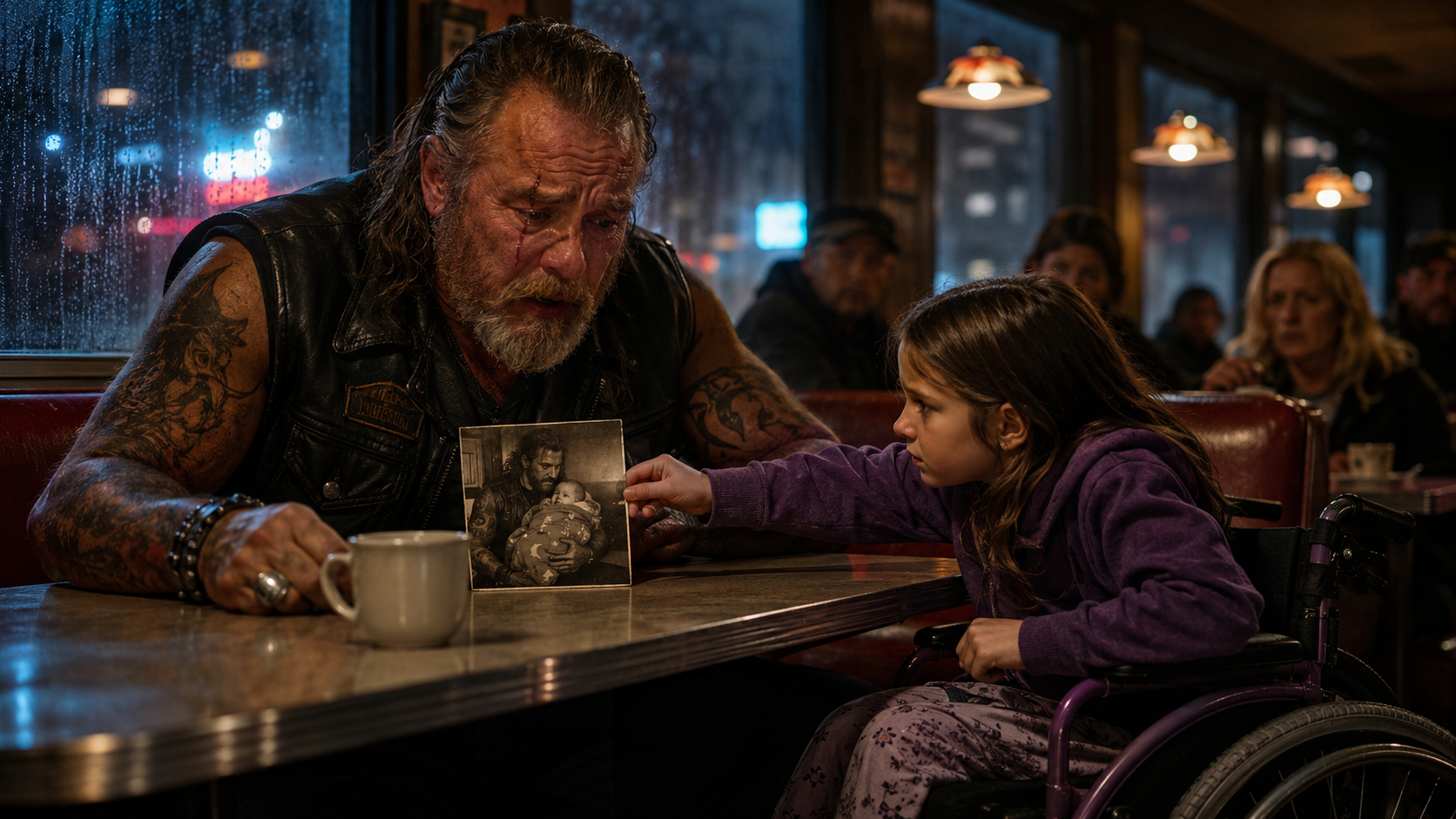
The Most Feared Biker in Town Believed His Baby Girl Died 28 Years Ago — Until a Child Rolled Into the Diner Holding Her Photograph

You were eight years old the night you learned that a terrifying man could look as if someone had shattered him from the inside.

Ryder “Iron” Hale sat in the last booth of the Red Lantern Diner, the same booth everyone in town avoided unless they had a death wish or a badge. He had one scar cutting through his left eyebrow, a gray beard, hands like cracked leather, and a black motorcycle vest covered in patches that made grown men lower their voices.

People said he had done terrible things.

People said he had once broken a man’s jaw with a coffee mug.

People said he never smiled after his wife died.

People said children should cross the street if they saw him coming.

But when you rolled your wheelchair up to his table and placed the old photograph beside his coffee cup, all the frightening stories about him seemed to fall apart.

The diner went quiet.

Not the normal kind of quiet.

Not the kind that happens when someone drops a plate or a stranger walks in.

This was the kind of silence that made the air feel heavy, like every person in the room had suddenly realized they were watching something they were never meant to see.

Ryder stared at the photograph.

His coffee trembled in his hand.

A drop spilled over the rim and landed on the table, spreading slowly across the chrome edge, but he did not notice.

In the picture, a much younger version of him stood outside a hospital, holding a newborn baby wrapped in a blanket covered with yellow moons and tiny white stars. Beside him stood a woman with dark hair and tired eyes, smiling like the baby in his arms was the entire world.

Ryder did not speak for a long moment.

Then his voice came out rough and low.

“Where did you get this?”

You gripped the wheels of your purple chair.

Your mother had warned you about this part.

She had told you his voice might scare you.

She had told you his face might scare you.

She had told you people would try to stop you before you reached him.

But she had also told you one more thing.

If the man in the photograph looks at you like you matter, stay.

So you stayed.

“My mom gave it to me,” you said.

Ryder’s face changed.

Not much.

Just enough.

A tiny break near his mouth. A flicker in his eyes. A hard swallow that made the muscles in his throat move.

“Your mom,” he said.

You nodded.

“Her name was Elise Marlow.”

The moment you said her name, his hand went flat against the table.

The waitress behind the counter covered her mouth.

A trucker near the window stopped chewing.

Deputy Hank Bell, who had been sitting two stools away with a slice of pie, slowly turned around.

The elderly woman standing behind your wheelchair, Mrs. Naomi Porter, placed one hand on your shoulder.

“Lila,” she whispered, “maybe we should step outside.”

“No.”

Ryder did not shout.

He did not have to.

The word landed hard enough to freeze everyone in place.

Mrs. Porter’s fingers tightened gently on your shoulder, but she did not move.

Ryder looked at her first, and for one second you understood why people feared him. His eyes were pale and sharp, like storm clouds seen through broken glass.

Then he looked back at you.

The danger did not disappear.

It changed direction.

It folded itself away from you.

“What did Elise tell you?” he asked.

You reached into the small cloth pouch tied to the side of your chair.

Ryder watched your hand like whatever you pulled out next might kill him.

Maybe it almost did.

You took out a folded letter.

The paper was soft at the corners. It had been opened and closed so many times that the crease was nearly white. Your mother’s handwriting covered both sides, thin and uneven from the days when her hands shook too badly to hold a pen for long.

You held it for one second before giving it to him.

Because your mother had kept this secret your whole life.

Because she had carried it through sickness and fear.

Because once Ryder read it, you would not be the only person alive who knew the truth.

He took the letter as if it were made of glass.

His hands were too large for it.

Too scarred.

Too used to engines, chains, handlebars, and hard work.

But he unfolded it carefully.

The diner waited.

You did not know how many words he managed to read before his face broke. You only knew the moment it happened because his shoulders dipped, as if an invisible weight had suddenly been placed across his back.

Then he read one line aloud.

Barely.

Almost without sound.

Dad, if Lila found you, then I’m gone.

The word hit the room like thunder.

Dad.

Someone gasped.

The waitress began crying quietly.

Deputy Hank stood up.

Ryder stopped reading. His fingers shook so hard the paper rattled.

He looked at you.

“You knew?”

You nodded.

“Mom said you were my grandfather.”

Grandfather.

That word did what fists, prison, knives, rumors, and twenty-eight years of rage had never done.

It made Ryder Hale cry.

Not loudly.

Not dramatically.

One tear slipped from his eye and followed the scar down the side of his face.

He wiped it away fast, like he was ashamed.

You were not ashamed of it.

You thought it made him look less like a monster and more like somebody who had lost too much.

Maybe somebody who had lost you before he had even known you existed.

Ryder lowered the letter and stared at the photograph again.

“Elise,” he whispered. “My baby.”

You looked down at your lap.

Your blanket was there, folded under your hands. It was faded from years of washing, but you could still see the yellow moons and white stars.

Your mother had wrapped you in that blanket when she told you the truth.

“She said you didn’t leave her,” you said. “She said somebody made you think she was dead.”

Ryder went very still.

The tearfulness vanished from his face. What replaced it was not anger exactly.

It was older than anger.

Colder.

“Who?” he asked.

Your mouth went dry.

You had practiced the answer all the way here. In Mrs. Porter’s old station wagon. In the motel room. In the diner bathroom while Mrs. Porter wiped your face and told you that you were brave even though your stomach hurt from fear.

“Beatrice Wynn,” you said.

At the name, the whole diner seemed to shrink.

Deputy Hank’s face turned gray.

Ryder’s eyes moved slowly toward him.

“Hank,” Ryder said.

The deputy swallowed.

“Iron.”

“You remember.”

Hank took off his hat.

That scared you more than Ryder’s scar.

Adults only removed hats when something had become too serious for pretending.

“Yes,” Hank said quietly. “I remember.”

“Tell her.”

The deputy looked at you, and suddenly he did not look like an officer. He looked like an old man carrying a secret that had grown too heavy.

“Your mother was born in County Mercy Hospital twenty-eight years ago,” he said. “Ryder and his wife Maeve were told she died three days later. There was paperwork. There was a sealed casket. There was a funeral.”

You stared at him.

“A funeral?”

Hank nodded.

“For an empty casket,” Ryder said.

His voice did not break this time.

It was worse because it did not.

You looked at the photograph. The baby in it had been your mother. Alive. Wrapped in stars. Held by a father who had believed he buried her.

No eight-year-old should have to understand that kind of cruelty.

So you said the only thing you could.

“Mom didn’t know either.”

Ryder closed his eyes.

“I know, little moon.”

The nickname made your chest ache.

Your mother had called you that when the nights were bad.

Little moon.

You whispered, “She called me that too.”

Ryder covered his mouth with one hand.

For a moment, there was no diner.

No bikers.

No deputy.

No whispering customers.

Only you, an old photograph, a dying woman’s letter, and a man who had lost his daughter twice.

First to a lie.

Then to death.

Mrs. Porter cleared her throat softly.

“Lila needs rest,” she said.

Ryder looked at her.

“Who are you?”

She stood a little straighter.

“Naomi Porter. I lived next door to Elise for six years. She asked me to bring Lila here when the time came.”

His jaw tightened.

“Why didn’t she call me herself?”

Mrs. Porter’s eyes filled.

“Because she was afraid Beatrice would find out. Elise said Beatrice had spent years making sure you never came near her. She thought if Beatrice knew she had found you, she might take Lila before Elise could stop her.”

Ryder leaned back slowly.

“Beatrice is still alive?”

You nodded.

“She came to the hospital after Mom got worse. She told the social worker she was my only family.”

Ryder’s hand curled into a fist.

The silverware beside his plate jumped when his knuckles touched the table.

Not hard.

Not enough to frighten you.

Just enough to remind the room that the man in front of you had not survived this long by being harmless.

“She stole my daughter,” he said.

Hank said nothing.

“She let my wife die believing our baby was in the ground.”

Still, Hank said nothing.

“And now she wants my granddaughter.”

This time Hank looked down.

You reached into your pouch again.

“There’s more.”

Ryder’s eyes came back to you instantly.

You pulled out another paper.

This one was new.

Official.

Folded around your hospital bracelet from the night your mother died.

Ryder took it from you.

He read the first page.

Your birth certificate.

Mother: Elise Marlow.

Father: Unknown.

Then he saw the second page.

A notarized emergency guardianship request.

Your mother had signed it twelve days before she died. In it, she wrote that if anything happened to her, Ryder Hale was to be located and given the chance to claim biological kinship before custody was granted to Beatrice Wynn.

Ryder read the document once.

Then twice.

Then a third time, like the words might change if he blinked.

Finally, he looked at you.

“Elise wanted me to take care of you?”

You nodded.

“She said if you were mean, I should leave with Mrs. Porter.”

A sound escaped him.

Not quite a laugh.

Not quite a sob.

“And if I wasn’t mean?”

You pulled the blanket from your lap and held up one corner.

“She said to show you the moons.”

Ryder stared at the blanket.

His face went pale.

“My wife made that.”

“Your wife?”

“Maeve,” he said, and his voice softened around her name. “Your grandmother. Your real grandmother.”

You looked at the faded fabric in your hands.

Your real grandmother.

That made the room tilt in a strange way.

You had grown up with your mother, her photographs, her cough medicine, her careful smiles, and her secrets. You had known Beatrice as a cold woman who visited twice a year and smelled like perfume and church candles.

But you had never had a grandfather.

Never had a grandmother.

Never had a family that felt like it reached backward farther than your mother’s hospital bed.

Ryder reached toward the blanket, then stopped.

“May I?”

You nodded.

He touched the corner with two fingers.

So gently.

Like it might vanish if he pressed too hard.

“Maeve sewed this the week before Elise was born,” he whispered. “She said every child needed something to recognize the sky.”

You blinked fast.

Your mother had said that too.

Ryder looked at you.

“No child should have had to carry this alone.”

That was the moment your fear loosened.

Not all the way.

Fear does not leave just because someone says the right thing.

But enough.

Enough to know your mother had not sent you to a stranger.

She had sent you to someone who had been waiting without knowing he was waiting.

Deputy Hank stepped closer.

“Iron, listen to me. You can’t just take her. If Beatrice has already filed, this has to go through court.”

Ryder turned his head.

The diner got cold again.

“She committed a crime.”

“I know.”

“You helped close the file.”

Hank flinched.

“I was twenty-three and stupid and I believed what the hospital gave us.”

“My wife begged you to look deeper.”

“I know.”

Ryder stood.

Every person in the diner tensed.

He folded your mother’s letter and the documents carefully, then placed them inside his vest pocket like they were sacred.

“Call Judge Calder,” he said.

Hank exhaled.

“It’s almost midnight.”

“Then wake him.”

“Iron—”

“My daughter died thinking I abandoned her. My granddaughter is in a motel room while the woman who stole my child is asking a court to hand her another one.” Ryder’s voice dropped lower. “Wake him.”

Hank nodded once and took out his phone.

That was how everything began.

Not with a hug.

Not with a miracle.

Not with music or forgiveness.

It began with a dying woman’s letter, a diner full of witnesses, and the most feared biker in town staring at an eight-year-old girl like she was the last living piece of his heart.

Ryder did not take you home that night.

He wanted to.

You could see it in the way his eyes kept returning to you, as if he was afraid you would disappear the moment he looked away.

But Mrs. Porter said rules mattered.

Deputy Hank agreed.

And to your surprise, Ryder listened.

He followed the police cruiser back to the motel on his motorcycle. From the back seat, you watched his headlight in the rain. It followed close, steady and bright, like a storm had decided to guard you instead of hurt you.

At the motel, Ryder stayed outside while Mrs. Porter helped you change into pajamas.

You peeked through the curtain.

He was standing under the broken awning, speaking with Hank and a tired man in a suit who had arrived looking angry until he saw the documents.

Judge Calder.

You knew because adults kept saying his name like it could open locked doors.

Mrs. Porter noticed you watching.

“Come away from the window, honey.”

“Is he leaving?”

“No.”

“Will he leave later?”

Her face softened.

“I don’t think so.”

You did not say anything after that.

But for the first time since your mother died, you slept through the night.

Because someone dangerous was standing outside your door on purpose.

Morning arrived gray and wet.

You woke to engines.

Not one.

Many.

Your eyes opened.

Mrs. Porter hurried to the window and pulled the curtain back just enough to look outside.

“Oh my,” she whispered.

“What?”

She hesitated.

Then she opened the curtain.

The motel parking lot was full of motorcycles.

Dozens of them.

Black bikes shining with rain.

Men with gray beards and folded arms.

Women in boots, denim, leather, and silver jewelry.

Some held coffee.

Some stood under umbrellas.

Some simply watched the road like they expected trouble to come around the corner.

In the center stood Ryder.

He held two paper cups and a white takeout bag.

When he saw you at the window, he lifted the bag a little.

You looked at Mrs. Porter.

“What is it?”

She smiled, tired and amazed.

“I think your grandfather brought breakfast.”

Your grandfather.

The words felt too big.

Too new.

Too warm.

A minute later, Ryder knocked.

Mrs. Porter checked through the peephole before opening the door.

He stood there soaked from the rain, holding a box of pancakes.

“I didn’t know what you liked,” he said.

“I like pancakes.”

His shoulders lowered, as if you had just forgiven him for something.

“Good.”

He set the food on the little motel table, then stepped back to give you room.

That was the first thing you noticed about him in daylight.

He was large, but he made himself smaller around you.

He looked dangerous, but he never pointed that danger in your direction.

He looked at your wheelchair once, then quickly back at your face, like he did not want you to think the chair was the first thing he saw.

“My legs don’t work right,” you said.

Mrs. Porter murmured your name softly, but you kept your eyes on Ryder.

You were tired of adults whispering about your body like your chair was a sad ending.

Ryder nodded.

“Mine don’t work great when it rains.”

You blinked.

Then you laughed.

It surprised you.

It surprised him too.

A small smile appeared under his beard.

It changed his whole face.

The scar was still there.

The tattoos.

The heavy vest.

The tired eyes.

But suddenly you could see the young man from the photograph. The one holding your mother like he had been handed the sun.

After breakfast, Judge Calder and Deputy Hank arrived.

Words filled the motel room.

Emergency placement.

Temporary guardianship.

Background checks.

Medical documentation.

DNA testing.

Custody hearing.

Adults said them as if you were not listening.

But children who have lived around sickrooms, social workers, and whispered phone calls always listen.

You knew which words meant danger.

Custody.

Placement.

Petition.

Evaluation.

Next of kin.

Ryder noticed your face.

“She can hear you,” he said.

The room went quiet.

Judge Calder looked embarrassed.

“You’re right. I’m sorry.”

Ryder turned to you.

“Little moon, people are going to talk today about where you stay while the court sorts this out. You don’t have to answer anything you don’t want to. But if they ask what you want, tell the truth.”

You gripped your blanket.

“What if they don’t like my truth?”

His eyes darkened.

“Then they’ll have to survive it.”

That afternoon, you went to the courthouse.

You had never been in one before.

It smelled like paper, floor polish, old coffee, and grown-up fear.

The ramp outside was steep. Ryder stood behind your chair but did not touch it.

“Can I help?”

You nodded.

His hands closed carefully around the handles.

Outside the courtroom, the bikers waited in the hall.

They were not loud.

They were not threatening.

They were simply there.

People stared.

A woman carrying files nearly walked into a wall.

You whispered, “Are they your friends?”

Ryder looked at the line of leather, gray hair, tattoos, and rain-soaked boots.

“Family.”

You thought about that.

Then you asked, “Are they my family too?”

He stopped pushing the chair.

For a moment, something complicated passed over his face.

Then he bent so he could look you in the eye.

“If you want them to be.”

No one had ever told you family could wait for your permission.

You carried that sentence into the courtroom like armor.

Beatrice Wynn arrived ten minutes late.

You knew her before anyone said her name.

She wore cream from collar to shoes, the way some people wear innocence like a costume. Her silver hair was shaped into a perfect helmet. Her mouth had already arranged itself into sadness.

The last time you had seen her, she had stood beside your mother’s hospital bed and said, “A child needs stability, Elise. Not motorcycle ghosts and old fantasies.”

Your mother had squeezed your hand so hard it hurt.

Now Beatrice opened her arms.

“Lila, darling.”

You did not roll toward her.

You did not lift your hands.

Her face flickered.

Then she saw Ryder.

For the first time in your life, fear cracked through Beatrice Wynn’s polished face.

“Ryder,” she said.

Ryder said nothing.

That seemed to scare her more.

In court, Beatrice told a beautiful story.

She said she had rescued your mother from unfortunate circumstances.

She said Elise had always been fragile.

She said grief and illness had confused her at the end.

She said motorcycle clubs were no place for children.

She said Ryder was violent, unstable, and unfit.

She cried when she talked about protecting you.

But she did not cry when your mother’s letter was read.

That was when you knew.

Real love cries in the wrong places.

Fake love cries exactly on cue.

Then Ryder stood.

He did not tell a beautiful story.

He told an ugly one.

He was twenty-two when his daughter was born. His wife Maeve had nearly died in delivery. Beatrice Wynn, who worked in hospital records and had once known Ryder’s family, helped with paperwork.

Three days later, the baby was gone.

The hospital said complications.

There was a sealed casket.

There was a funeral.

There were signatures Ryder barely remembered giving because grief had made him blind.

But Maeve never believed the baby was inside that box.

So Ryder searched.

For months.

Then years.

He asked questions.

He knocked on doors.

He made enemies.

No one listened.

Because Ryder wore leather.

Because Beatrice wore pearls.

Because some people can steal a child more easily when they look respectable.

Deputy Hank testified next.

He admitted the investigation had been rushed.

He admitted Ryder and Maeve had been dismissed because of the motorcycle club.

He admitted Beatrice had access to records she should never have been able to change.

Beatrice stopped crying.

Your mother’s letter was given to the judge.

Then the photograph.

Then hospital records.

Then the emergency DNA test Ryder had taken that morning after Judge Calder made one phone call and the entire county suddenly moved faster than it had in twenty-eight years.

The result was preliminary.

But clear enough.

Biological relation.

Grandfather.

The courtroom blurred.

Not because you were sad.

Because your mother had been right.

The man with the scar was real.

The lie was real.

And now the truth had paperwork.

Judge Calder looked at you.

“Lila,” he said gently, “do you understand what we’re discussing?”

“Some.”

“Do you want to say anything?”

Beatrice turned toward you with wet eyes.

“Sweetheart, remember what your mother would have wanted.”

You looked at her.

“My mom wrote what she wanted.”

The courtroom went silent.

Ryder lowered his head. His hand shook beside his leg.

You took a breath.

“She told me if I found him, I should show him the photograph. She said he wasn’t bad the way people said. She said someone stole her from him. She said if he looked at me like I was a burden, I should leave.”

You looked at Ryder.

His face looked like breathing hurt.

“He didn’t.”

Beatrice whispered your name.

You kept going.

“I don’t want to live with someone who lied to my mom.”

There it was.

The whole truth in one child’s sentence.

Beatrice sat back like you had slapped her.

Judge Calder granted temporary guardianship to Mrs. Porter for seven days, with Ryder allowed daily supervised visits while the final DNA report and background checks were completed.

Ryder’s jaw tightened.

You knew he wanted to argue.

But he looked at you first.

You shook your head a tiny bit.

Not because you did not want him.

Because you were tired.

Because seven days felt survivable.

Because your mother had taught you that winning too fast sometimes made dangerous people run.

Ryder understood.

He nodded.

He accepted.

Outside the courthouse, the rain had stopped.

The bikers were still there.

When Ryder came out beside you, they stood straighter.

A woman with silver braids knelt in front of your chair.

“I’m Cora,” she said. “Your grandmother Maeve was my best friend.”

Your chest tightened.

“You knew her?”

Cora smiled sadly.

“I loved her.”

You looked at Ryder.

He nodded.

“Cora was there when Elise was born.”

Cora reached into her coat pocket and pulled out something tiny.

A knitted yellow hat.

Faded.

Soft.

“This was hers,” Cora said. “Maeve made it to match the blanket.”

You took it carefully.

It fit in your palm.

You had never owned anything from Maeve before.

Now you had a hat, a blanket, a grandfather, and a hallway full of people looking at you like you were not a problem to solve.

You were someone returned.

The next seven days were strange.

Ryder visited every afternoon at Mrs. Porter’s small yellow house.

He brought things.

Not expensive things.

Careful things.

A ramp for the porch.

A stuffed fox wearing a tiny leather vest.

A photo album of Maeve.

A music box that had belonged to your mother for three days before she was taken.

When the music box played, Ryder cried again.

This time he did not hide it.

One evening, you sat with him on Mrs. Porter’s porch while the sky turned orange.

“Did you love my mom?” you asked.

He looked at you like the answer was too large for words.

“I loved her before I knew her name.”

“But you didn’t know her.”

“No,” he said. “And that will hurt until the day I die.”

You thought about that.

Then you put your hand on his.

“My mom liked pancakes.”

He looked at you.

“She hated peas.”

A tear slid down his face.

“She sang in the car even when the song was bad.”

His hand turned under yours and held it carefully.

“She said thunder was just the sky dragging chairs around.”

Ryder laughed through tears.

“Maeve used to say that.”

You smiled.

The lost pieces began finding one another.

At the end of the week, the final DNA report arrived.

There was no doubt.

Ryder Hale was your grandfather.

Beatrice Wynn was placed under investigation for kidnapping, fraud, falsified records, and custodial interference. Because she was old and sick, some people expected Ryder to soften.

He did not.

He told the prosecutor, “Age doesn’t turn theft into kindness.”

But when Beatrice was arrested, he did not go watch.

He stayed with you at Mrs. Porter’s house and helped build a cardboard castle because you said every princess in a wheelchair needed wider doors.

That mattered to you.

Revenge was loud.

Love stayed and cut windows into boxes.

One month later, you moved into Ryder’s house.

It was not what you expected.

You thought it would be dark.

Scary.

Full of motorcycle parts and shadows.

It was old, wooden, and full of morning light.

There were engine pieces in the garage, books stacked in corners, tools on the kitchen counter, and a freshly painted room at the end of the hall.

The walls were pale blue.

Yellow moons and white stars had been stenciled near the ceiling.

The doorway was wider.

The bathroom had rails.

The porch had a ramp so smooth your chair rolled over it like water.

A purple quilt lay on the bed.

On the dresser stood three photographs.

Ryder holding your mother as a newborn.

Your mother smiling in a green sweater.

Maeve standing beside a motorcycle, laughing at something outside the frame.

Three generations of women who had never been given enough time together.

You touched the quilt.

“I like it.”

Ryder exhaled like he had been holding his breath for a month.

That night, he burned dinner.

Badly.

Smoke filled the kitchen.

The alarm screamed.

Four bikers rushed in from the porch because apparently every loud noise in Ryder’s house was now treated like an attack.

You laughed so hard your stomach hurt.

Ryder stood in the smoke holding a black pan and said, “Pizza?”

You nodded.

“Pizza.”

That became your first real night at home.

Not perfect.

Not soft like a storybook.

But full of smoke, laughter, and people who came running when the alarm went off.

Months passed.

You started school.

At first, kids stared at your wheelchair.

Then Ryder came one afternoon to pick you up on his motorcycle with seventeen bikers behind him because the club was “already in the neighborhood.”

After that, nobody made fun of your wheels.

But Ryder knelt beside you later and said, “You tell me if anyone bothers you. Not so I can scare them. So we can handle it right.”

You narrowed your eyes.

“You already scared them.”

He glanced toward the row of motorcycles.

“Accidentally.”

You giggled.

He did not always get things right.

Sometimes he went too quiet when you asked about your mother.

Sometimes he stood in your doorway at night after you fell asleep, and you woke to see him there, making sure you were still real.

Sometimes he cried in the garage.

You pretended not to hear until one night you rolled out with your blanket across your knees.

He was sitting beside his motorcycle, holding your mother’s photograph.

“I didn’t get to save her,” he said.

You rolled closer.

“You saved me.”

His face crumpled.

You did not know if that healed him.

But you knew he slept better after that.

The town changed too.

People who once crossed the street to avoid Ryder now brought casseroles.

Some did it from guilt.

Some did it from curiosity.

Some did it because a little girl in a purple wheelchair had made them realize the monster in their stories had been a grieving father all along.

Ryder accepted the food.

He did not forgive easily.

You learned that from him.

Forgiveness was not a door people could kick open just because they felt bad.

Sometimes it was a window.

Sometimes it was locked.

Sometimes it opened only after years.

Deputy Hank visited often.

He apologized more than once.

Ryder never said it was okay.

He said, “Do better now.”

So Hank did.

He reopened old cases.

He checked forgotten reports.

He started listening when poor women, bikers, addicts, widows, and people without polished voices said something was wrong.

You heard him tell Ryder once, “I should have believed you.”

Ryder answered, “You should have believed Maeve.”

That sentence stayed with you.

Because women like Maeve and Elise were too often treated like whispers until a man decided their pain had evidence.

You grew.

Your wheelchair changed from purple to blue, then back to purple because you decided purple had been right all along.

Ryder learned how to braid your hair badly.

Cora taught him properly after one school picture where your braid looked like a rope that had lost a fight.

You visited your mother’s grave every Sunday.

Ryder always brought yellow flowers.

The first time he stood there, he could not speak.

So you spoke for him.

“Mom, I found him. He’s grumpy. He burns eggs. He bought me a stuffed fox. I think you were right.”

Ryder cried with both hands on the back of your wheelchair.

The wind moved through the cemetery grass.

For one second, you imagined your mother laughing.

Years later, when you were older, you learned the full truth.

Beatrice had lost a child years before your mother was born. She had become obsessed with Maeve’s baby. With help from a corrupt hospital administrator, she changed records, forged documents, and made a newborn disappear into an illegal private adoption.

She renamed her Elise.

Raised her on lies.

Told her the scarred biker in the photograph was dangerous.

But your mother never fully believed her.

Because blood is not magic.

But truth has a pulse.

Your mother kept the photograph.

She kept the blanket.

She kept the feeling that somewhere, before all the fear and silence, someone had loved her.

When she became sick, she started searching.

Hospital records.

Old newspapers.

Names.

Towns.

Motorcycle patches in faded photographs.

She found Ryder too late for herself.

But not too late for you.

That was the part of the story people loved most.

The dying mother who sent her daughter to find the man with the scar.

The feared biker who became a grandfather overnight.

The diner where everyone watched a child roll into a twenty-eight-year lie and break it open with a photograph.

But you knew the real story was quieter.

It was Ryder learning which cereal you liked.

It was Cora sewing bigger pockets onto your blankets.

It was bikers building ramps at the school playground.

It was Mrs. Porter moving into the guest room after she broke her hip because Ryder said, “Family doesn’t expire after the emergency.”

It was the first time you called him Grandpa without thinking.

You were nine.

You were furious because a teacher said maybe you should sit out during field day.

You rolled into the garage where Ryder was fixing his bike and shouted, “Grandpa, tell them I can race if I want to!”

He froze.

The wrench slipped from his hand.

You did not realize what you had said until he turned around.

His eyes were wet.

You sighed because adults were always crying at inconvenient times.

“Are you going to help or not?”

He wiped his face.

“Yes, ma’am.”

He helped.

You raced.

You did not win.

You came in fifth.

Ryder cheered like you had taken Olympic gold.

At twelve, you asked him why people called him Iron.

He told you he got the name because after Maeve died, nothing seemed to bend him anymore.

You studied him from across the kitchen table.

“But you bend now.”

He looked at you.

“Yeah,” he said. “I do.”

At sixteen, you got a custom wheelchair with yellow moons and white stars painted along the frame.

Ryder pretended not to cry when he saw it.

Cora said, “For heaven’s sake, Ryder, just cry. Everyone knows.”

So he cried.

At eighteen, you crossed the graduation stage with braces locked around your legs, one hand gripping a special walker, the other holding Ryder’s arm.

You did not have to stand.

No one asked you to.

But you wanted to cross that stage that way.

Ryder walked beside you, slow and steady, wearing his leather vest over a white shirt because you had made him promise to look “a little less like he was arriving to collect a debt.”

He failed.

But he tried.

When your name was called, the auditorium erupted.

Not because people pitied you.

Because everyone in town knew what it had taken for you to arrive there.

You looked into the crowd and saw bikers, teachers, Mrs. Porter, Deputy Hank, Cora, and Ryder’s entire club standing like a wall of leather and tears.

Your mother’s photograph was in your pocket.

After graduation, Ryder gave you a cedar box.

Inside was the original moon-and-star blanket, preserved carefully behind glass, except for one loose corner left uncovered so you could touch it.

Beside it was the photograph from the diner.

Young Ryder holding baby Elise.

Maeve smiling beside him.

On the back, in Maeve’s handwriting, were four words:

Our girl. Our moon.

You held the photograph and finally understood.

Your mother had been loved.

Before Beatrice.

Before the lies.

Before sickness.

Before you.

She had been loved.

And somehow that love had traveled through twenty-eight years, through a dying woman’s hands, through a folded letter, through a rainy diner, through a scarred man’s grief, and back into your own.

When people later asked if you had been scared that night, rolling up to the most dangerous man in town, you told the truth.

Yes.

Of course you were.

You were eight years old.

Your mother had died.

Your whole world had become motel rooms, legal papers, whispers, and adults deciding where you belonged.

But fear is not always a warning to run.

Sometimes fear is the doorway to the truth.

And the truth was this:

The old biker with the scar was never the monster in your story.

He was your grandfather.

He had been waiting at the last booth of the Red Lantern Diner for twenty-eight years, drinking black coffee beside an empty seat, never knowing the person meant to fill it was rolling toward him on purple wheels covered in moons and stars.

The Most Feared Biker in Town Believed His Baby Girl Died 28 Years Ago — Until a Child Rolled Into the Diner Holding Her Photograph
His eldest son died at the age of 16, and his wife was taken by cancer. The 71-year-old Travolta showed his heirs.