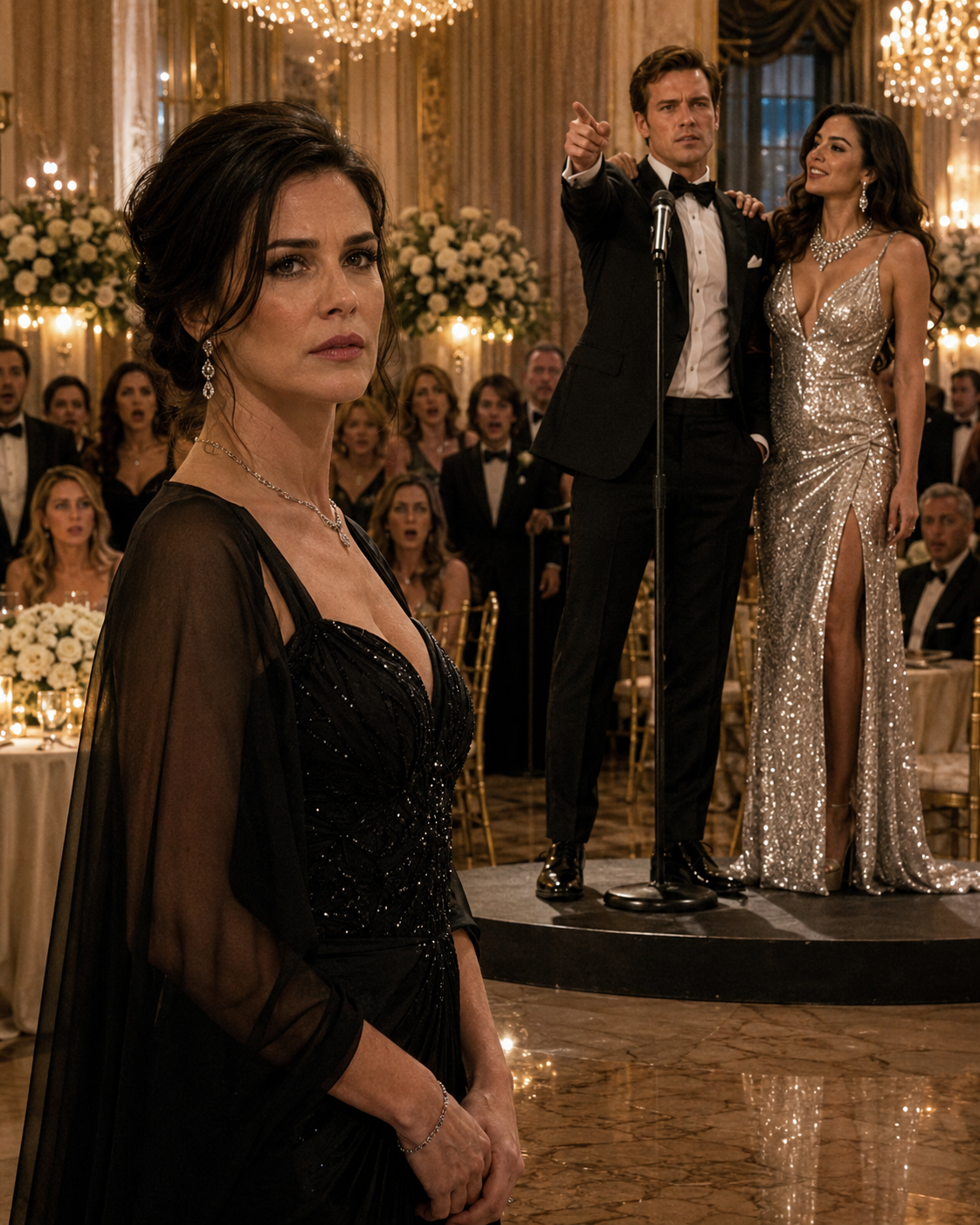
“You planned to humiliate me. You planned to strip me of a home that never belonged to you. You planned to let her wear my family’s necklace while calling me a parasite. The only thing you failed to plan for was the possibility that I had finally stopped protecting you.”
Celeste’s voice trembled. “I didn’t know.”
I turned to her.
For the first time all evening, her confidence was gone. Under the makeup, the diamonds, the expensive dress, she looked very young and very frightened.
“You knew enough,” I said. “You knew you were wearing another woman’s jewelry. You knew you were standing beside a married man. You knew cruelty was part of the performance, and you accepted the role because you thought the ending would benefit you.”
She looked down.
Security approached respectfully.
“Ma’am,” one of them said, “the necklace.”
Celeste unclasped it with shaking hands.
For a second, I thought I would feel satisfaction when it left her throat.
I didn’t.
I only felt tired.
So deeply, unbearably tired.
The necklace was placed in a velvet pouch and handed to Miriam. My father watched silently, his face unreadable except for the grief in his eyes.
He had warned me about Marcus once.
Only once.
On the morning of my wedding, he had stood beside me outside the chapel and said, “A man who needs you to shrink will call it love when you bend.”
I had been too proud to listen.
I had mistaken Marcus’s hunger for ambition. I had mistaken his attention for devotion. I had mistaken my ability to fix his problems for evidence that we were building something together.
We were not.
I was building.
He was taking credit.
Marcus moved closer, but one of the security men stepped gently between us.
No aggression. No drama.
Just a boundary.
The kind I should have placed years earlier.
“Evelyn, please,” Marcus said. “You can’t destroy everything over one mistake.”
I looked around the ballroom.
At the flowers I had chosen.
At the guests who had watched me be insulted and waited to see whether I would break.
At Lydia, whose face had gone gray.
At Celeste, who could no longer meet my eyes.
Then I looked back at my husband.
“One mistake?” I asked. “Marcus, the affair was not the wound. It was only the light that showed me how infected the marriage had become.”
He flinched.
“I gave you loyalty,” I said. “You turned it into invisibility. I gave you help. You turned it into entitlement. I gave you silence. You mistook it for permission.”
The room was so quiet I could hear the candles flicker.
I removed my wedding ring.
It was a simple band, far more modest than anything Marcus had ever given Celeste. I had loved that about it once. I had thought simplicity meant sincerity.
I placed it on the table beside the untouched champagne.
“I’m not fighting for this marriage,” I said. “I’m ending my participation in your performance.”
Marcus’s voice broke. “Where am I supposed to go?”
For nine years, I would have answered that question.
I would have solved the problem. Called someone. Arranged a car. Smoothed the scandal. Protected his pride.
This time, I let the silence answer first.
Then I said, “Ask someone who still believes you’re helpless.”
My father extended his arm to me.
I took it.
As we walked toward the doors, people stepped aside. Some looked ashamed. Some curious. Some impressed. I no longer cared which.
At the threshold, Marcus called my name.
I stopped, but I did not turn around.
“I loved you,” he said.
Maybe he even believed it.
That was the tragedy of men like Marcus. They could confuse possession with love so completely that losing control felt like heartbreak.
“No,” I said quietly. “You loved being forgiven.”
Then I left.
Outside, the night air was cold and clean. Rain had begun to fall lightly over the city, turning the pavement silver beneath the hotel lights. My father’s car waited at the curb.
For a moment, I stood beneath the awning and let myself breathe.
No cameras.
No applause.
No dramatic music.
Just air.
My father stood beside me without speaking. He had never been good with emotional speeches, but he had always understood presence. After my mother died, he had sat outside my bedroom door every night for two weeks because I did not want company, but I did not want to be alone either.
Finally, he said, “I should have come sooner.”
I shook my head. “I had to choose it myself.”
He nodded.
Miriam stepped outside behind us. “The car is ready. The necklace is secure. We’ll file the appropriate motions in the morning.”
“In the morning,” I repeated.
It sounded strange.
There would be a morning after this.
For months, I had imagined the end of my marriage as a collapse. I had pictured myself ruined, embarrassed, abandoned, spoken about in whispers.
But standing there in the rain, I understood something.
What ended in that ballroom was not my life.
Only the lie that had been standing in its place.
The next morning, Marcus called forty-three times.
Celeste called once.
Lydia sent a message that began with, “For the sake of the family…”
I deleted it before reading the rest.
Because the family she meant had never included me.
By noon, the board had confirmed interim leadership. By three, the audit team had entered Marcus’s office. By evening, the gossip pages had the story wrong in six different ways, which was almost funny.
They called me cold.
They called me ruthless.
They called me secretly powerful, as though power only becomes real when someone else notices it.
But the headline I cared about never appeared anywhere.
It was quiet, private, and belonged only to me.
A woman who had been publicly discarded walked out before anyone could decide what she was worth.
And she never looked back.