The Maid’s Necklace Stopped the Wedding

No one noticed Nora Hayes until the music stopped.

Before that, she had been exactly what the staff of Marroway House were expected to be—quiet, efficient, and almost invisible.

The old estate stood above the Atlantic like something preserved from another century. White columns rose against a darkening summer sky, hundreds of candles flickered beneath glass lanterns, and long tables covered in ivory linen stretched across the garden terrace.

More than three hundred guests had arrived for the wedding of Lillian Sterling and Owen Cade.

Politicians, investors, lawyers, doctors, television personalities.

People who owned buildings, companies, vineyards, private aircraft.

People whose names appeared on plaques.

Nora knew none of them personally.

And none of them knew her.

She had been working since six that morning.

At thirty-three, Nora had learned that wealthy people rarely looked directly at the person carrying their empty glasses.

She moved between the tables in a simple charcoal-gray service uniform, collecting abandoned champagne flutes and replacing folded napkins while the string quartet played near the fountain.

“Table twelve needs water.”

Nora turned.

Her supervisor, Mrs. Delgado, was standing behind her with a tray.

“And someone spilled wine near the dance floor.”

“I’ll take care of it.”

“You’ve been on your feet all day.”

“I’m fine.”

Mrs. Delgado studied her.

“You always say that.”

Nora smiled.

“It usually becomes true.”

She took the tray and walked toward the ballroom.

Inside, the celebration had become louder.

The ceremony was over. The photographs were finished. The bride had changed into a second dress covered with tiny crystals, and the groom had removed his jacket.

Guests laughed beneath enormous chandeliers.

A jazz band had replaced the quartet.

Nora crossed the marble floor carefully.

Near the center of the room, a man stepped backward without looking and collided with a waiter.

A glass of red wine fell.

It shattered beside Nora’s shoes.

“Oh, wonderful,” the man said.

He wasn’t speaking to the waiter.

He was looking at Nora.

His name, she would later learn, was Grant Mercer, one of Owen Cade’s business partners.

Grant was perhaps forty-five, broad-shouldered and perfectly dressed, with the relaxed arrogance of someone who had never been required to apologize to service staff.

Nora immediately knelt.

“I’ll clean it.”

Grant glanced at his wet trouser cuff.

“This suit cost more than your car.”

Nora reached for the broken glass.

“I’m sorry, sir.”

“You didn’t spill it,” the young waiter whispered.

Grant heard him.

“I wasn’t talking to you.”

The waiter went pale.

Nora looked up.

“He’s right. He didn’t do anything.”

Grant gave her an amused smile.

“And now the maid is giving testimony.”

Several people nearby turned.

Nora wished they wouldn’t.

She had spent most of her life learning how to survive uncomfortable rooms by becoming smaller inside them.

“I’m only trying to prevent someone from stepping on the glass,” she said.

Grant laughed.

“Then perhaps you should focus on cleaning.”

A woman standing nearby frowned.

“Grant.”

It was Lillian, the bride.

She had approached without anyone noticing.

Her new husband followed several steps behind her.

Grant lifted his champagne glass.

“I’m joking.”

“It isn’t funny.”

“Oh, come on, Lillian.”

Nora lowered her eyes and continued gathering the pieces.

She wanted the conversation to end.

That was when Grant noticed the necklace.

“Wait.”

Nora froze.

Around her neck was a narrow silver chain.

At the end hung an old gold ring.

The ring had slipped from beneath the collar of her uniform while she was kneeling.

Grant pointed toward it.

“You’re wearing jewelry?”

Nora instinctively covered it with her hand.

“It’s personal.”

“I thought staff weren’t supposed to wear anything flashy.”

“It isn’t flashy.”

Grant bent slightly closer.

“Looks expensive.”

Nora stood.

Something changed in her expression.

“Please don’t touch it.”

“I wasn’t going to.”

But his hand was already moving.

Nora stepped backward.

Her shoe caught the edge of the broken glass tray.

The tray fell.

The crash cut through the music.

Several musicians stopped playing.

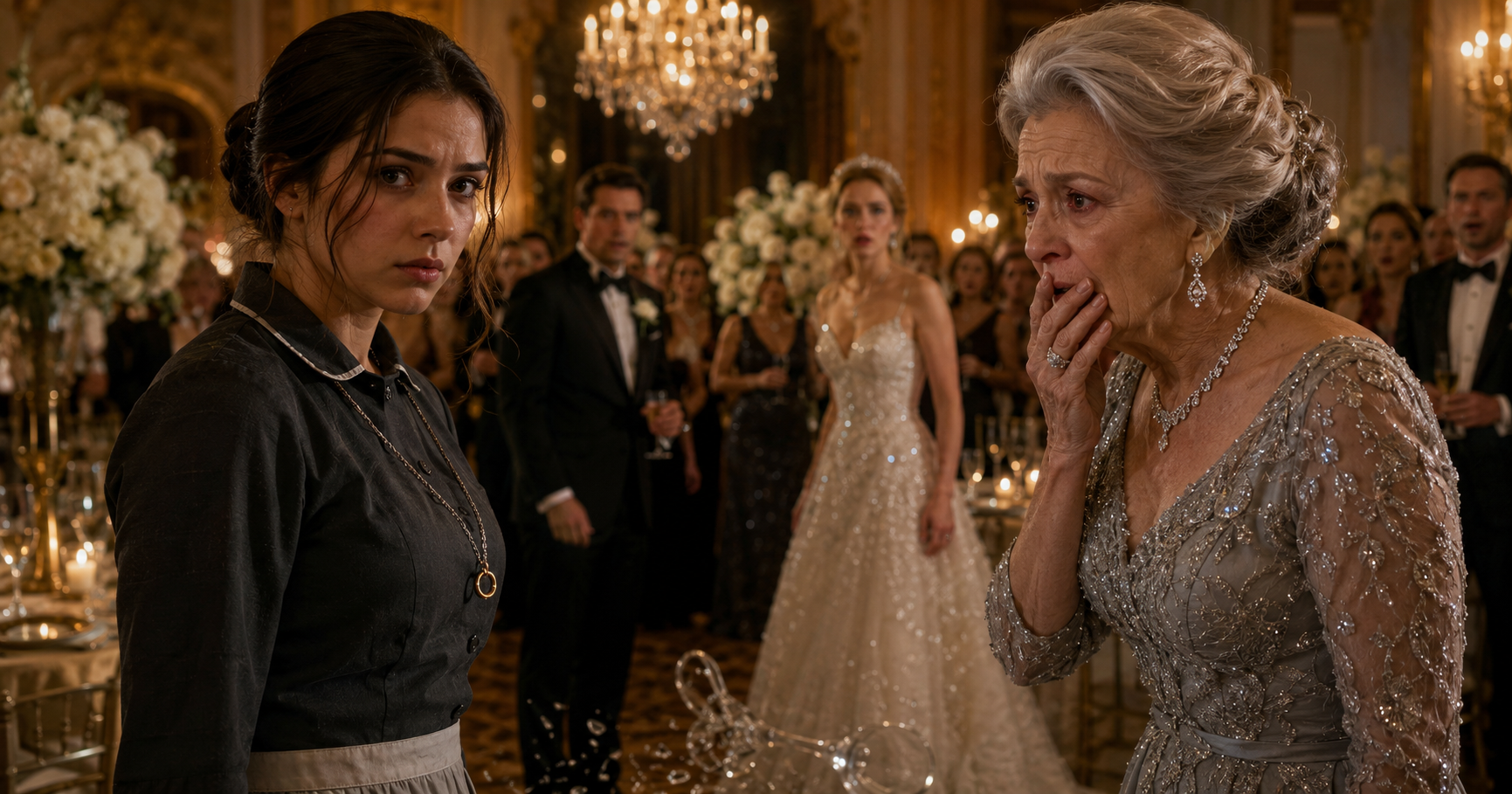
And suddenly, the ring hanging against Nora’s uniform was exposed beneath the chandelier light.

Across the ballroom, an elderly woman dropped her champagne glass.

It shattered.

Nobody moved.

Eleanor Sterling, Lillian’s grandmother, was eighty-one years old and still carried herself like the room belonged to her.

In many ways, it did.

Marroway House had belonged to the Sterling family for four generations.

Eleanor had arrived at the reception in a silver gown and had spent most of the evening seated near the windows, receiving guests like a queen receiving diplomats.

Now she was staring at Nora.

Not at her face.

At the ring.

Eleanor slowly stood.

“Where did you get that?”

Her voice was quiet.

But the silence in the room made it carry.

Nora looked around.

“Excuse me?”

“The ring.”

Eleanor stepped away from her table.

Her daughter, Patricia, reached for her arm.

“Mother?”

Eleanor ignored her.

“Where did you get that ring?”

Nora closed her fingers around it.

“It belonged to my mother.”

Eleanor stopped.

For several seconds, her face revealed nothing.

Then she whispered one word.

“What?”

Nora could feel hundreds of eyes on her.

“My mother gave it to me.”

Eleanor came closer.

“May I see it?”

Nora hesitated.

Grant was no longer smiling.

Lillian looked confused.

Owen quietly asked, “Grandmother, what is happening?”

Eleanor held out her hand.

“Please.”

Something in the old woman’s voice changed Nora’s mind.

She removed the chain.

The ring fell into her palm.

Eleanor took it with trembling fingers.

The gold was scratched from decades of wear. A tiny blue stone sat beside a much smaller diamond.

Eleanor turned it over.

There were three letters engraved inside.

M. E. S.

Her breath caught.

Patricia stepped closer.

“What is it?”

Eleanor looked at Nora.

“Your mother’s name.”

Nora swallowed.

“Marianne Hayes.”

Eleanor’s eyes filled with tears.

“No.”

The single word seemed to frighten everyone around her.

Nora frowned.

“Yes.”

“No,” Eleanor repeated. “Before Hayes.”

Nora stared at her.

“My mother never talked about her family.”

Eleanor closed her eyes.

When she opened them again, she looked suddenly older.

“What year was she born?”

“1967.”

Patricia covered her mouth.

Lillian turned toward her mother.

“Mom?”

Patricia shook her head.

“No. That’s impossible.”

“What is impossible?”

Eleanor looked down at the ring.

Then she said, “Marianne Sterling.”

Nobody spoke.

Nora almost laughed because the statement made so little sense.

“I think you’re mistaken.”

“I gave this ring to my daughter on her eighteenth birthday.”

Nora’s hand went cold.

Eleanor continued.

“The blue stone came from a brooch that belonged to my mother. Marianne hated expensive jewelry. She said diamonds made people behave strangely.”

A broken smile appeared on Eleanor’s face.

“So I had this made for her.”

Nora stared at the ring.

She had seen her mother wear it every day.

Cooking breakfast.

Driving to work.

Sitting beside Nora’s hospital bed when she had pneumonia at nine.

Signing school papers.

Planting tomatoes behind their small house.

Dying in a hospice room with Nora holding her hand.

Three weeks before her death, Marianne had removed the ring and pressed it into Nora’s palm.

“Keep this,” she had said.

“Why?”

“Because one day someone may recognize it.”

Nora had assumed the medication was confusing her.

Now she could barely breathe.

“My mother died eight months ago,” Nora said.

Eleanor’s face collapsed.

“Eight months?”

“Yes.”

“You’re certain?”

Nora stared at her.

“I buried her.”

Eleanor turned away.

For a moment, Nora thought she might fall.

Patricia caught her arm.

“Mother, sit down.”

“No.”

“Please.”

“I said no.”

Eleanor faced Nora again.

“I was told Marianne died thirty-one years ago.”

The ballroom seemed to shrink.

Nora whispered, “Who told you that?”

No one answered.

Then a man near the windows stood.

Charles Sterling.

Eleanor’s younger brother.

Seventy-six years old. Retired judge. Family patriarch. The man who had given the ceremonial toast less than an hour earlier about honor, tradition, and the Sterling name.

He looked at Eleanor.

“Not here.”

Eleanor stared at him.

“Charles.”

“Ellie, this is Lillian’s wedding.”

“I know exactly where I am.”

People began whispering.

Charles walked toward them.

“We can discuss this privately.”

Nora saw something in his expression.

Fear.

Not surprise.

Fear.

Eleanor saw it too.

“You knew.”

Charles stopped.

Patricia whispered, “Uncle Charles?”

Eleanor took another step.

“You knew Marianne was alive.”

Charles lowered his voice.

“Your husband made decisions he believed were necessary.”

“My husband?”

“He was protecting the family.”

Eleanor laughed once.

It was a terrible sound.

“From my daughter?”

Charles looked around at the guests.

“Please.”

Nora suddenly understood why her mother had never spoken about her childhood.

She remembered small things.

How Marianne refused to watch society weddings on television.

How she became quiet whenever someone mentioned Charleston.

How she once burned an unopened envelope without showing Nora what was inside.

Nora looked at Charles.

“What happened?”

He studied her.

“You shouldn’t be involved in this.”

Nora almost smiled.

“My mother was involved.”

Charles said nothing.

“So tell me.”

Eleanor turned toward her brother.

“Yes. Tell her.”

Charles exhaled slowly.

“Marianne fell in love with someone your father considered inappropriate.”

Nora’s heart began beating faster.

“My father?”

“A mechanic named Thomas Hayes.”

Nora knew that name.

A photograph sat beside her bed at home.

A young man with curly dark hair holding a baby.

He had died in a highway accident when Nora was two.

Charles continued.

“Your grandfather demanded that Marianne end the relationship.”

“She refused,” Eleanor said.

Charles looked at her.

“She left.”

“You told me she was dead.”

“I told you what your husband instructed me to tell you.”

Eleanor slapped him.

The sound echoed across the ballroom.

Several guests gasped.

Charles did not move.

Eleanor’s hand remained in the air for a moment before falling to her side.

“You watched me mourn my living child.”

“I was trying to prevent a scandal.”

“For thirty-one years?”

Charles looked away.

Nora felt sick.

Eleanor turned back to her.

“I wrote to her.”

Nora frowned.

“What?”

“Every month at first. Then every birthday. Every Christmas.”

Tears ran openly down Eleanor’s face.

“I wrote for years.”

Nora remembered the burned envelope.

“Did she receive them?”

“I don’t know.”

Charles said nothing.

Eleanor looked at him.

“You intercepted them.”

His silence answered.

Patricia began crying.

Lillian stood motionless in her wedding dress, looking from her grandmother to Nora.

Then she slowly walked toward Nora.

“So…”

She struggled to form the words.

“Marianne was my aunt.”

Nora nodded faintly.

Lillian looked almost stunned by the absurd simplicity of what came next.

“Then you’re my cousin.”

Across the room, someone quietly began recording on a phone.

Lillian saw it.

Her expression hardened.

She turned toward the guests.

“Put your phones away.”

Nobody moved.

Lillian raised her voice.

“I said put them away.”

One by one, phones disappeared.

Then she looked at the band.

“Take a break.”

The musicians quietly left their instruments.

Owen approached her.

“Lil, maybe we should move everyone outside.”

“No.”

She looked at Nora.

“This woman has spent the entire day cleaning up after people who couldn’t even learn her name.”

Grant stared at the floor.

Lillian continued.

“And apparently she is family.”

Nora shook her head.

“You don’t have to do anything.”

“Yes, I do.”

Lillian turned to Grant.

“You owe her an apology.”

Grant blinked.

“Lillian—”

“Now.”

He looked toward Owen for support.

Owen gave none.

Finally Grant faced Nora.

“I behaved badly.”

Nora waited.

Grant swallowed.

“I’m sorry.”

She nodded once.

But Eleanor was still holding the ring.

She looked at Nora.

“Did Marianne ever speak about me?”

The question seemed harder than everything that had come before it.

Nora thought carefully.

“Not directly.”

Eleanor’s face fell.

“But when I was little, she used to tell me stories about a woman who taught her to swim.”

Eleanor looked up.

Nora continued.

“She said the woman would stand in the ocean and tell her not to be afraid of waves because waves only look powerful when you fight them.”

Eleanor covered her mouth.

“That was me.”

Nora’s voice softened.

“I think she remembered you more than she admitted.”

The old woman began to cry.

Not elegantly.

Not quietly.

She cried like someone who had finally discovered where thirty years of grief had been buried.

Nora stepped forward.

For a second she did not know what to do.

Then she embraced her.

Eleanor held her tightly.

Around them stood politicians, financiers, lawyers, celebrities and three hundred wedding guests.

For once, nobody mattered.

After a long moment, Eleanor whispered beside Nora’s ear.

“What was she like?”

Nora closed her eyes.

“She laughed too loudly.”

Eleanor laughed through her tears.

“Yes.”

“She hated roses.”

“Yes.”

“She put hot sauce on almost everything.”

Eleanor pulled back.

“Absolutely not.”

Nora smiled.

“She definitely did.”

“That must have come from your father.”

For the first time that evening, Nora laughed.

The tension in the ballroom loosened.

Lillian wiped her eyes.

Owen touched her shoulder.

“What do you want to do?” he asked.

Lillian looked around at the extravagant reception.

The untouched champagne.

The enormous cake.

The flowers flown in from another country.

The carefully planned perfection.

Then she looked at Nora and Eleanor.

“I think the wedding can survive being imperfect for one night.”

She walked to the microphone.

The speakers clicked softly.

“Everyone,” she said.

The room became silent again.

“We planned tonight for fourteen months.”

She looked toward Nora.

“Apparently our family has been avoiding something important for more than thirty years.”

A few uncomfortable laughs moved through the room.

Lillian smiled.

“So dinner is going to be late.”

This time people laughed openly.

“And if anyone has a problem with that, the exit is behind you.”

Owen leaned toward the microphone.

“The bar is still open.”

The room erupted in relieved applause.

Nora shook her head.

“This family is strange.”

Eleanor slipped the ring back onto the silver chain.

“You have no idea.”

She placed it around Nora’s neck.

Nora touched it.

“Shouldn’t you keep it?”

Eleanor shook her head.

“I gave it to Marianne.”

She closed Nora’s fingers around the ring.

“And Marianne gave it to you.”

Outside the windows, thunder rolled across the ocean.

The first drops of rain began striking the glass.

Guests hurried to move decorations from the terrace.

Staff rushed toward the doors.

Nora automatically reached for a tray.

Eleanor caught her wrist.

“No.”

Nora looked at her.

“I’m working.”

“Not tonight.”

Mrs. Delgado appeared from behind the catering station.

She had heard everything.

For a moment, she tried to maintain her professional expression.

Then she smiled.

“Go.”

Nora hesitated.

“Are you sure?”

“I have two hundred temporary servers and one extremely confused event manager. We’ll survive.”

Lillian approached.

She held out her hand.

“Come sit with us.”

Nora looked at the bridal table.

At the crystal glasses.

At the white flowers.

At the place where people like her were usually expected to stand behind everyone else.

“I don’t think I belong there.”

Lillian smiled.

“Neither do half the people sitting there.”

Eleanor took Nora’s hand.

“Please.”

Slowly, Nora allowed herself to be led across the ballroom.

Guests moved aside.

Not because she was carrying a tray.

Not because something needed cleaning.

They moved because, for the first time all evening, they actually saw her.

Nora sat beside Eleanor.

Someone placed a glass of champagne in front of her.

She looked at it and laughed.

“What?”

Eleanor asked.

Nora shook her head.

“My mother hated champagne.”

Eleanor smiled.

“She hated weddings too.”

“Really?”

“Oh, passionately.”

Nora looked around at the chandeliers, flowers, musicians, cameras and hundreds of elegantly dressed strangers.

Then she touched the old ring resting against her chest.

“Well,” she said, “she would have enjoyed this one.”

Outside, the rain finally came down.

Inside, the music started again.

But the wedding everyone remembered afterward was no longer the wedding that had been planned.

People forgot the imported flowers.

They forgot the seven-tier cake.

They forgot the designer dresses and expensive champagne.

What they remembered was the moment an old woman looked across a crowded ballroom and recognized a tiny gold ring.

A ring that had spent thirty years carrying a secret.

And the quiet maid wearing it who arrived that morning as a stranger—

and left the wedding with a family.