Faintly.
Tiredly.
But it was there.
“You still sound like the stubborn man I married.”
“And you still sound like the woman who scared thieves more than any lock I ever bought.”
She laughed.
The laugh turned into a cough.
Mara moved quickly, but Silas was already calling for the nurse.
By dawn, Noelle was in surgery.
Mara sat in the hallway with her hands clasped so tightly her knuckles turned white.
Silas sat beside her.
Neither of them spoke for a long time.
At last, Mara whispered, “I almost sold the only thing that could prove who I was.”
Silas shook his head.
“No.”
She looked at him.
“You carried it exactly where it needed to go.”
The case spread quietly at first.
Then violently.
Roland Vale had not merely stolen a jewel. He had built an empire on forged inheritances, missing estate papers, bribed officials, and families too poor or too broken to fight back. The Veyne Ruby was only one thread in a much larger knot.
The locket contained the first proof.
Noelle remembered where the rest had been hidden.
For eighteen years, she had buried pieces of the truth in safe places no criminal would think to search. A church basement. A library book. A storage unit rented under a false name. A sealed envelope behind a loose tile in a rooming house bathroom.
Not because she believed revenge would come.
Because she believed her daughter might one day be safe enough to tell the truth.
Now she was.
Silas reopened locked cabinets in the pawnshop that had not been touched in years. He pulled ledgers from dusty shelves. He called lawyers he had once mistrusted. He gave statements until his voice went hoarse.
And Mara, the girl who had entered his shop soaked, hunted, and ready to trade her past for a handful of cash, stood beside him.
At first, neither of them knew how to belong to the other.
Silas did not know how to be a father to a grown woman.
Mara did not know how to be someone’s daughter without expecting to run.
They were careful with each other.
Too careful.
He asked if she liked sugar in her coffee, then looked wounded when she said she hated coffee.
She called him Mr. Merrick for three days until Noelle, still weak but recovering, told her from the sofa, “If you keep doing that, you may finish him off before my medicine does.”
The first time Mara called him Dad, it happened by accident.
They were in the shop after closing, sorting through boxes of old receipts connected to the case. Mara reached for a stack too quickly, and a tray of silver rings scattered across the floor.
“Dad, I’m sorry—”
Both of them froze.
Outside, rain tapped lightly against the glass.
Not fierce like the night she arrived.
Soft.
Almost kind.
Mara’s face turned red.
“I didn’t mean—”
“Yes,” Silas said quickly.
Too quickly.
His voice cracked.
“I mean… only if you want to.”
She looked at him for a long moment.
Then she smiled.
“Okay.”
That was all.
But to Silas Merrick, it felt as if the world had returned something no court, no money, and no apology ever could.
Months later, Noelle survived.
Not easily.
Not without scars.
But she survived.
She came back to the apartment above the shop in a wheelchair at first, then with a cane, then with slow, stubborn steps that made Silas hover until she threatened to throw a teacup at him.
Mara moved into the small room that had once been painted pale yellow for a child who disappeared before she could outgrow it.
The walls were repainted.
The cracked window was replaced.
The old cradle was gone.
But one mark remained.
A tiny line carved into the doorframe, with a date beside it.
Mara, age four.
Silas had made it three weeks before she vanished.
Mara touched that mark every morning.
Not because it hurt.
Because it proved something.
Before she was lost, she had been loved.
The shop changed too.
People came from across the city after hearing the story.
Some came to buy rings.
Some came to sell watches.
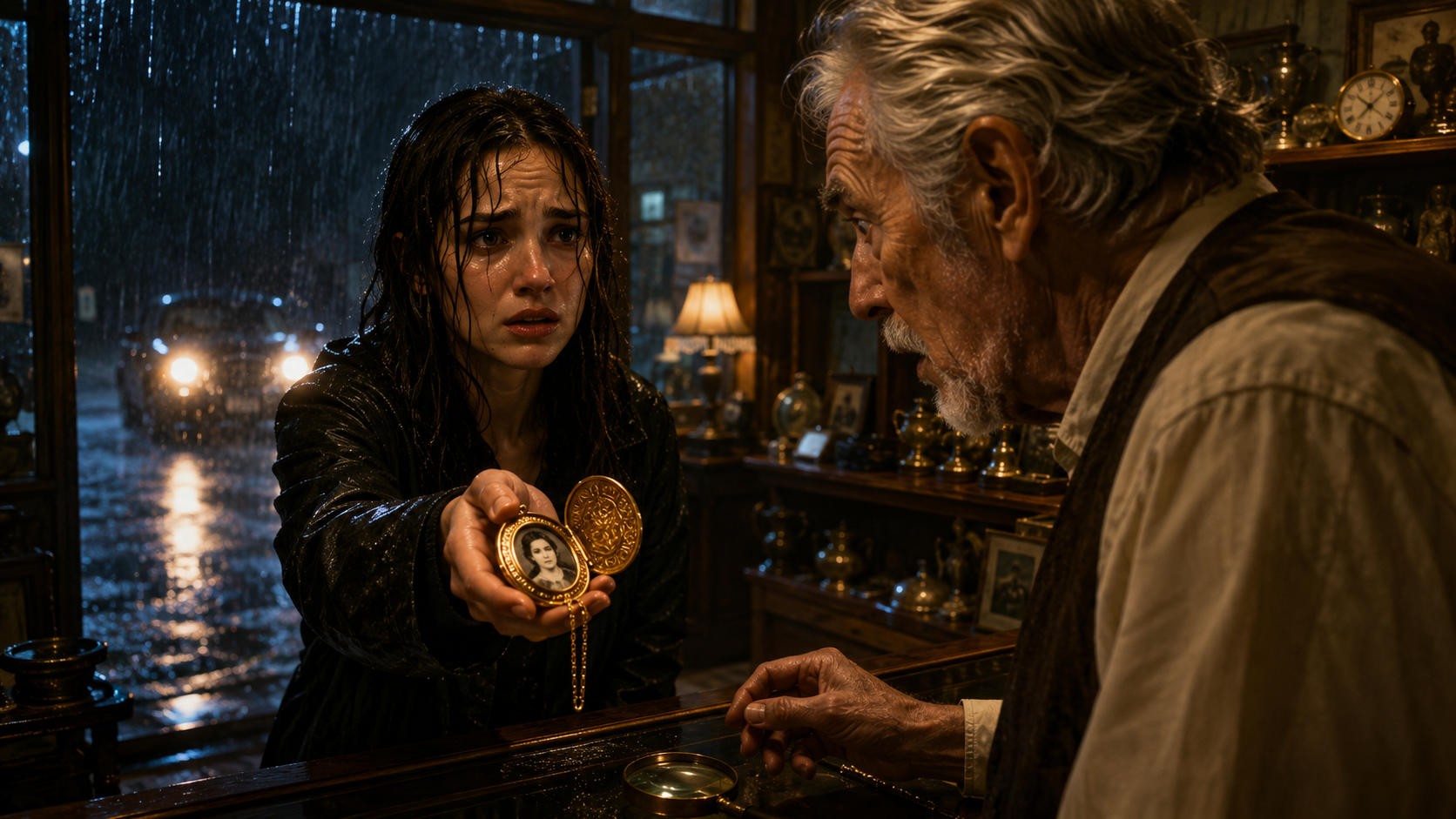
Some came only to stand beneath the yellow lamps and look at the counter where a soaked young woman had once tried to pawn a gold locket for emergency money and instead found the life stolen from her.
Silas placed a small sign in the front display case.
It did not mention Roland.
It did not mention the ruby.
It did not mention the arrests, the newspapers, or the families who finally got their names back.
It said only:
Some treasures are doors.
Mara learned the trade slowly.
How to weigh gold.
How to spot fake stones.
How to clean old silver without erasing the marks that made it human.
How to hear the difference between a liar and someone too ashamed to tell the whole truth.
Silas taught her patiently, as if every lesson returned one missing year.
One rainy evening, Mara held the locket under the lamp and studied the hidden hinge.