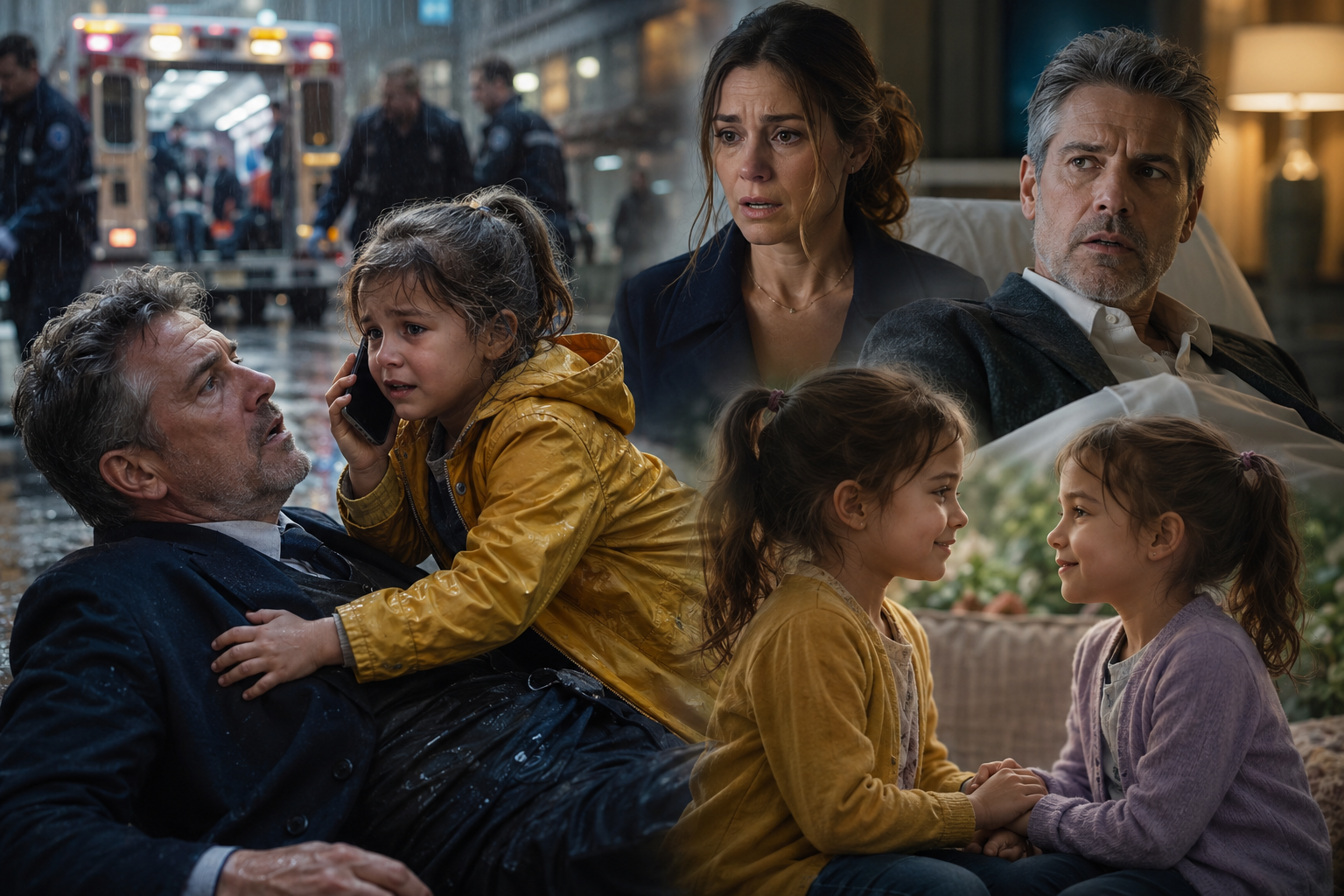
The first thing Cassian Vale remembered was the rain.
Not the pain in his chest. Not the crowd gathering around him. Not the glass roof of the old harbor market blurring above his face like a cracked aquarium. Only the rain, hard and cold, beating against the windows while the world around him folded into gray.
Then came a child’s voice.
Small. Clear. Shaking, but determined.
“Don’t close your eyes, mister. My mom says if people close their eyes too long, you have to keep talking to them.”
Cassian tried to answer, but his breath came in broken pieces. His right hand twitched against the wet pavement. His cane had rolled away. His body, which had carried him through boardrooms, private airports, hostile takeovers, and decades of men twice his size trying to destroy him, suddenly felt like something borrowed and failing.
The little girl leaned over him. She had dark curls stuck to her cheeks from the rain and a yellow coat too bright for such a gloomy afternoon. In one hand she held a stuffed rabbit with one button eye. In the other, she clutched Cassian’s phone.
“I called 911,” she said, as if reporting to a teacher. “They said help is coming. I told them you’re breathing weird.”
Somewhere behind her, people were shouting.
“Give him space!”
“Does anyone know CPR?”
“Is that Cassian Vale?”
Cassian heard his own name ripple through the crowd like a bad secret.
The little girl ignored them. She knelt beside him, her small knees pressing into a puddle.
“What’s your name?” she asked.
Cassian swallowed against the iron taste in his mouth.
“Cassian,” he managed.
“That’s a serious name.”
He almost smiled. Almost.
“What’s yours?”
“Juno,” she said. “But my real name is Juniper. Nobody calls me that unless I’m in trouble.”
“Are you in trouble now?”
“No,” she said firmly. “You are.”
A siren cried in the distance.
Cassian’s vision narrowed until the girl’s face became the only sharp thing left in the world. Her eyes were gray-green. Not just gray, not just green. Storm-colored. Familiar in a way that made no sense.
For one impossible second, he thought of Lyra.
Lyra Hart at twenty-five, standing barefoot in the kitchen of his first apartment, laughing because he had burned toast so badly the smoke alarm gave up and died.
Lyra Hart in the rain outside the university library, telling him that money made men lazy when it came to courage.
Lyra Hart disappearing from his life without one last call, one last explanation, one last chance.
The child squeezed his hand.
“Cassian,” she said, serious as a judge, “the ambulance is here.”
Then everything went white.
When Cassian opened his eyes again, the world smelled of disinfectant, plastic tubes, and expensive flowers.
He was in a private hospital room high above the city, connected to machines that made soft, accusing sounds. His chest ached. His throat burned. A nurse adjusted a line in his arm and told him he had suffered a major cardiac event in a very calm voice, as if his heart had simply missed an appointment.
His assistant, Corbin, stood near the window with a tablet against his chest.
“You are not allowed to die,” Corbin said. “You have three meetings Monday.”
Cassian closed his eyes.
“Fire everyone who scheduled them.”
“I already canceled them.”
“Then rehire them and fire them again.”
Corbin smiled, but it didn’t reach his eyes.
“You were lucky,” he said.
Cassian turned his head slowly. “The girl.”
“The child who called emergency services?”
“Juno.”
Corbin’s expression shifted.
“She’s become something of a local hero. Someone filmed part of it. The clip is everywhere.”
Cassian hated being filmed. He hated headlines. He hated public gratitude, public pity, public anything. But he held out his hand.
“Show me.”
Corbin hesitated.
“Now.”
The video was shaky. Rain streaked across the lens. A crowd had formed in a half circle. Cassian saw himself on the ground, pale and ruined, nothing like the man magazine covers insisted on calling untouchable.
And there she was.
The girl in the yellow coat, one hand pressed to his shoulder, the other gripping the phone.
“My name is Juno Hart,” she said into the device. “I’m seven. I’m at Harbor Market near the flower stand. The man is old but not too old, and I think his heart is mad.”
A paramedic’s voice from off-camera said, “Good job, sweetheart. Keep talking to him.”
Juno bent close to Cassian.
“You hear that? They said I’m doing good. You have to do good too.”
The crowd laughed nervously. Even in the video, Cassian could hear the fear underneath.
Then the camera swung toward a woman pushing through the crowd.
“Juno!”
The woman wore a navy raincoat, her hair twisted at the back of her neck, her face pale with panic.
Cassian stopped breathing.
The heart monitor complained sharply.
Corbin stepped forward. “Sir?”