The Little Girl Who Asked Me to End It Quickly
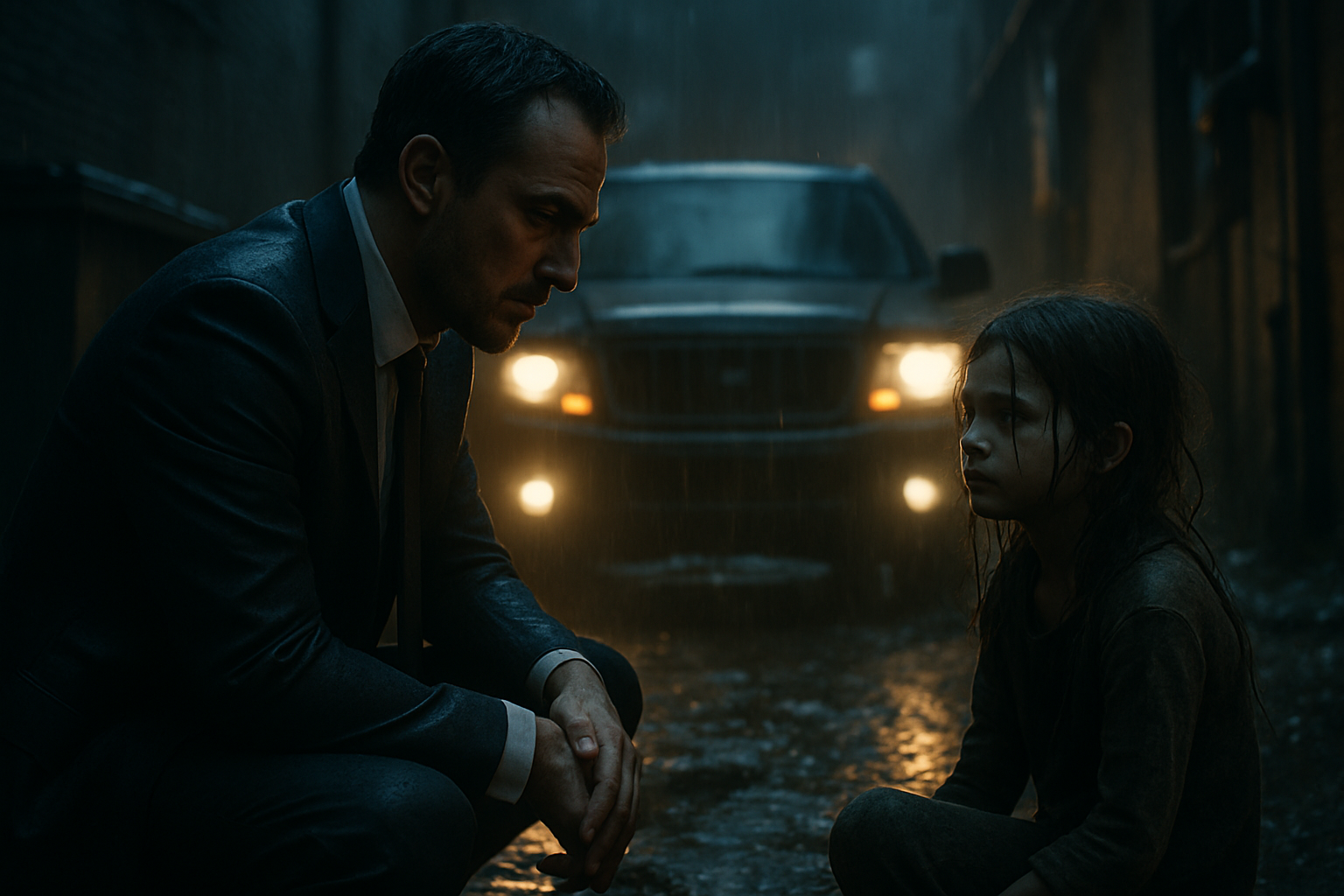
The first time a child asked me to kill her, I was kneeling in the mud behind an apartment building, wearing an Italian suit that cost more than she had probably seen in her whole short life.
The alley smelled of rainwater, spoiled garbage, and the greasy breath of a restaurant vent. Behind me, an old black SUV idled in the drizzle, its headlights cutting the dark into two pale blades.
I remember that night too clearly.
Because that was the night the man I had been for thirty years finally cracked.
She was filthy and thin, with wet hair stuck to her forehead and cracked lips that had forgotten how to be soft. In her arms, she held a baby so still he barely seemed alive.
She looked at me the way grown men never did.
No fear.
No respect.
No hope.
“Are you going to kill us?” she asked.
Her voice was calm.
That made it worse.
“If you are… do it fast. My little brother is hungry.”
I had heard men beg for mercy. I had heard them offer money, loyalty, names, anything for one more night of breathing.
But I had never heard a little girl ask for death the way another child might ask for bread.
Behind me, Gabriel, my right hand, stepped forward.
“Boss,” he said softly. “We good?”
I raised my hand.
“Don’t come near her.”
The girl tightened her arms around the baby.
The little boy was past crying. His eyes fluttered like candle flames in a draft.
And I felt sick.
Not because of them.
Because of me.
Because somewhere along the road, I had become the kind of man a child believed might finish what the world had already started.
“I won’t hurt you,” I said.
She didn’t believe me.
She was right not to.
In that neighborhood, people knew me as Victor Marlowe. They knew I owned repair shops, tow trucks, apartment buildings.
They also knew that when trouble came, people came to me before they called the police.
After my wife, Clara, and our unborn son died in a hospital twelve years earlier, I stopped believing in fairness.
So I built power instead.
Power could not bring back the dead.
But I thought it could keep the living from hurting me again.
I was wrong.
“What’s your name?” I asked.
“Lila.”
She looked down at the baby.
“He’s Milo.”
“Where are your parents?”
“My mama left.”
“And your father?”
“I don’t have one.”
Then I saw the bruises.
The burns.
The scars.
Old pain layered over fresh pain.
“Who did this to you?”
“My uncle Wade.”
No anger.
No tears.
Just acceptance.
Like rain. Like hunger. Like cold.
That answer hit harder than any fist ever had.
Gabriel shifted behind me.
“Victor,” he muttered, “this isn’t our problem.”
I stood slowly.
“It is now.”
No one argued.
At 11:42 that night, I looked back at Gabriel.
“Open the back door.”
The SUV unlocked with a click.
Lila stepped away at once.
“No.”
“If I wanted to hurt you,” I said, “I already would have.”
She still didn’t move.
So I took off my coat and held it out.
Not pushing.
Offering.
Milo whimpered, weak as a kitten.
Lila looked at the coat. Then at me. Then at the baby.
At last, after almost a full minute, she wrapped my coat around Milo.
Not herself.
Him.
That told me everything.
I was not looking at a frightened little girl.
I was looking at a child who had become a mother because every adult in her life had failed her.
“Gabriel,” I said.
“Yeah?”
“Get formula. Diapers. Blankets. Food.”
He blinked.
“Now?”
“Now.”
For the first time in years, my right-hand man looked lost.
But he went.
Lila watched him disappear into the rain.
“Why are you helping us?”
The question hurt.
Because she truly did not understand why anyone would.
I swallowed.
“Because somebody should have done it sooner.”
For a long moment, she stared into my eyes.
Then something changed.
Not trust.
Just exhaustion.
Her knees gave out.
I caught her before she hit the mud.
She weighed almost nothing.
As her head fell against my shoulder, she whispered so softly I nearly missed it.
“Please don’t let him find us.”
“Who?”
Her eyes closed.
“Uncle Wade.”
The baby began to cry.
And for the first time that night, I felt something colder than anger.
Purpose.
Because somewhere in that city, Wade Calder was sleeping easy.
And he had no idea he had just become the most important problem in my life.
By midnight, Lila and Milo were asleep in a private room above one of my repair shops.
It was not fancy.
A bed. A couch. A small bathroom. A refrigerator filled with food.
But compared to that alley, it might as well have been a palace.
Lila fell asleep sitting upright, one arm locked around Milo even after her eyes closed.
The emergency nurse I kept on call tried to move the baby.
Lila woke instantly.
Wild-eyed.
Terrified.
Ready to fight.
The nurse stepped back.
“It’s all right, sweetheart.”
Lila searched every corner of the room before her body slowly loosened.
I watched from the doorway.
The nurse glanced at me.
“How long has she been living like this?”
I did not answer.
I didn’t know.
And knowing would only have made the fire in me burn hotter.
At three in the morning, Gabriel came back with a thick folder.
He dropped it on my desk.
“Found your Wade.”
I opened it.
Wade Calder.
Thirty-eight.
Three arrests.
No convictions.
Drunk driving. Assault complaints. Domestic disturbance calls.
Nothing that stuck.
The system had seen him.
It simply had not stopped him.
“Neighbors?” I asked.
Gabriel nodded.
“They heard the screaming. Nobody wanted to get involved.”
“Family?”
“Mother died years ago. Sister disappeared about eight months back.”
Lila’s mother.
My jaw tightened.
“Disappeared?”
“That’s what everyone says.”
The room went quiet.
I knew what Gabriel was thinking.
It was the same thing I was thinking.
Women do not usually vanish and leave their children behind for no reason.
“Find her,” I said.
Gabriel nodded, then hesitated.
“Victor.”
“What?”
“You getting attached?”
I looked up.
He regretted the question at once.
But I answered him anyway.
“Yes.”
His face softened.
Because Gabriel had known Clara.
He had known the man I used to be.
The man before grief turned me into stone.
At sunrise, I went to see Lila.
She was awake, sitting on the edge of the bed, watching Milo sleep.
The nurse had cleaned her wounds and given her fresh clothes.
She still looked ready to run.
“Morning,” I said.
She nodded.
No smile.
No greeting.
Just careful watching.
“Hungry?”
She hesitated.
Then nodded again.
Twenty minutes later, she ate more pancakes than I thought her small body could hold.
But she kept sliding pieces onto a napkin beside her.
Saving them.
That old, terrible habit of a child who never knew when food would come again.
I pretended not to notice at first.
Then I said gently, “Lila.”
She froze.
“You don’t have to save food anymore.”
Her eyes filled.
Not with relief.
With fear.
Promises had failed her before.
“I know,” she whispered.
But neither of us believed that she knew.
Around noon, a black SUV pulled into the repair shop lot.
One of my men came into the office.
“Boss.”
“What?”
“There’s a guy outside asking questions.”
“Who?”
“Wade.”
The room went still.
Gabriel stood at once.
“So soon?”
I closed the folder on my desk.
“What does he want?”
“Says he’s looking for his niece.”
I stood.
My pulse stayed calm.
Inside, something dark woke up.
Through the office window, I saw him.
Tall. Unshaven. Cheap jacket. A belly shaped by beer and cruelty.
Ordinary enough to disappear in any crowd.
The most dangerous kind of man.
He leaned against his truck, smoking a cigarette.
Laughing.
Laughing while the little girl he had tormented sat upstairs terrified of his shadow.
I walked outside alone.
Wade spotted me.
“You Marlowe?”
“Yes.”
“People say you found my niece.”
His tone told me everything.
He wasn’t worried.
He wasn’t frightened for her.
He sounded annoyed.
Like he was looking for a misplaced tool.
“She isn’t here,” I said.
He squinted.
“Funny. I heard different.”
“Then you heard wrong.”
Wade took a long drag from his cigarette.
“Look, man. It’s a family matter. Kid stole money and ran off.”
A lie.
A lazy one.
The kind told by people used to not being questioned.
“She stole my brother’s baby too.”
Another lie.
I stepped closer.
“Interesting.”
“Yeah.”
“Because she told me something different.”
For the first time, uncertainty crossed his face.
“What’d she say?”
I looked straight into his eyes.
“She said she’s afraid of you.”
Wade laughed.
Actually laughed.
“Kids make stuff up.”
I did not smile.
I did not blink.
After a moment, his grin died.
“Listen,” he said. “You hiding them?”
“Why?”
“Because they’re mine.”
Mine.
Not family.
Not loved.
Not my responsibility.
Mine.
Possession.
Control.
Something inside me hardened.
“You should leave,” I said.
His face darkened.
“You threatening me?”
“No.”
I moved one step closer.
“I’m giving you the best advice you’ll get all year.”
For one second, I thought he might swing.
Then he saw something in my eyes.
Something that made him think better of it.
He backed away slowly.
“Fine.”
He climbed into his truck and started the engine.
Then he pointed at me through the window.
“You tell Lila she belongs with family.”
The truck pulled away.
I watched until it disappeared.
Behind me, Gabriel came out.
“How bad?”
I did not answer right away.
I kept staring down the road.
Because Wade was not scared enough.
Men like him grow dangerous when cornered.
And I had taken away the thing he loved controlling most.
That meant he was not finished.
Not even close.
That night, while Lila and Milo slept upstairs, Gabriel walked into my office with another file.
His face was pale.
“What now?” I asked.
“You wanted us to find Lila’s mother.”
“And?”
He placed a photograph on my desk.
A woman stared up at me.
Thin.
Bruised.
Terrified.
She had Lila’s eyes.
“Where was this taken?”
“Six months ago.”
My stomach dropped.
Gabriel swallowed.
“We found her, Victor.”
“Alive?”
The silence answered first.
“No.”
I stared at the picture.
Then at the report beneath it.
The room seemed to lose all warmth.
Lila’s mother had not abandoned her children.
Someone had made sure she never came back.
And every trail we found led toward one man.
Wade.
That photograph stayed on my desk all night.
I must have looked at it a hundred times.
Same eyes.
Same stubborn jaw.
Same face of someone carrying more pain than any soul should have to bear.
For years, I had told myself grief was private. Something you buried deep enough that no one could touch it.
But when dawn crept through the blinds, I understood.
Lila and Milo were not strangers anymore.
Their story had entered mine.
At seven that morning, there was a soft knock at my office door.
Lila stood there in an oversized sweatshirt the nurse had bought her.
For the first time since I had met her, she looked like a child.
Not all the way.
But a little.
“Can I ask you something?”
“Of course.”
She stepped inside.
“Are we staying here?”
I looked at her carefully.
“What do you want?”
She lowered her eyes.
“I don’t want Milo to be hungry anymore.”
That nearly broke me.
Not toys.
Not a big house.
Not pretty clothes.
Food.
Safety.
Sleep.
Things no child should ever have to beg for.
“You won’t be hungry again,” I said.
She studied my face, searching for the lie.
She didn’t find one.
“Promise?”
I swallowed.
“Promise.”
For a few seconds, she said nothing.
Then she nodded once and turned to leave.
At the door, she looked back.
“Thank you, Victor.”
It was the first time she had used my name.
The first time she sounded as if she believed I would not hurt her.
It meant more to me than any money I had ever made.
Three days later, everything exploded.
One of my men burst into the office.
“Boss!”
I stood.
“What happened?”
“Lila.”
My heart stopped.
“What about her?”
“She isn’t hurt.”
I let out the breath I was holding.
“Then tell me.”
“We found Wade.”
The room went silent.
“Where?”
“At a motel outside town.”
Gabriel was already grabbing his jacket.
“Let’s go.”
Once, I would have handled it my old way.
Fear had been my favorite tool for a long time.
But every time I looked at Lila and Milo, I remembered the promise I had made.
I would not become a monster to save them.
I would do it right.
No matter how badly I wanted revenge.
“Call Detective Nolan Pierce,” I said.
Gabriel blinked.
“The cop?”
“Yes.”
“You trust him?”
“No.”
“Then why?”
“Because Lila deserves justice. Not vengeance.”
Gabriel stared at me.
Then slowly nodded.
For the first time in years, I think he understood the man I was trying to become.
By evening, police vehicles surrounded the motel.
Detective Pierce met us outside.
“You sure about this?” he asked.
I handed him the files.
Witness statements.
Photographs.
Financial records.
Everything my people had gathered.
Enough to force the truth into the light.
Pierce turned the pages, his expression growing darker with each one.
“Why bring this to me?”
“Because a little girl deserves better than the adults who failed her.”
For a moment, neither of us spoke.
Then he closed the folder.
“We’ve got him.”
An hour later, Wade Calder was led out in handcuffs.
He looked terrified.
Not of me.
Of consequences.
For the first time in his life, they had finally arrived.
As the officers pushed him toward the police car, his eyes found mine.
“You did this!”
I looked at him calmly.
“No.”
He frowned.
“What?”
“You did.”
The door slammed.
And just like that, he was gone.
Not beaten.
Not buried.
Not threatened in some back room.
Gone because the truth had caught up with him.
Exactly as it should.
The months that followed felt strange.
Peace usually does when you have lived too long without it.
Lila started school.
The first week, she barely spoke.
The second week, she made one friend.
By the third month, her teachers could not stop talking about how bright she was.
Milo gained weight.
He learned to walk.
Then he learned to laugh.
That laugh filled rooms that had been silent for years.
Little by little, the building I owned stopped feeling like a fortress.
It began to feel like a home.
One afternoon, I came back from work and found crayons scattered across my dining table.
Construction-paper drawings covered every surface.
I picked one up.
A stick-figure man.
A little girl.
A baby.
And a large yellow sun above them.
“What’s this?” I asked.
Lila looked up from the floor.
“That’s us.”
“I’m that fellow?”
She giggled.
“You’re taller in real life.”
I laughed.
A real laugh.
The kind I had not heard from myself in more than a decade.
Then I noticed the words written under the picture.
The handwriting was crooked and uneven.
But I could read it.
My family.
The room went quiet.
“Lila.”
She looked nervous.
“You don’t like it?”
I could not answer right away.
Twelve years earlier, I had stood in a hospital hallway and lost everything.
Or I thought I had.
Life does not always return what it takes.
Sometimes it gives you something different.
Something unexpected.
Something you never saw coming.
I knelt beside her.
“No,” I said softly. “I love it.”
Her smile came slowly.
Then all at once.
The kind of smile a child wears when she finally feels safe.
Milo waddled across the room and crashed into my leg, laughing.
I lifted him into my arms.
His tiny fingers curled around my collar.
Holding on.
Trusting me completely.
And for the first time since Clara died, the emptiness in my chest did not feel endless.
It felt healed.
Not erased.
Never erased.
But healed.
That night, after Lila and Milo were asleep, I sat alone on the porch.
The sky was clear.
The city was quiet.
I looked up and thought of Clara.
Of promises.
Of second chances.
“I’m sorry it took me so long,” I whispered.
A gentle breeze moved through the trees.
And somehow, for the first time in twelve years, I felt as if she already knew.
Inside the house, two children slept peacefully.
Safe.
Warm.
Loved.
Exactly as children should be.
And in that quiet, I finally understood something all the money, power, and fear in the world had never taught me.
The strongest thing a person can do is not take control.
It is choose to care.
And sometimes, saving one child does not only change their life.
Sometimes it saves yours too.

