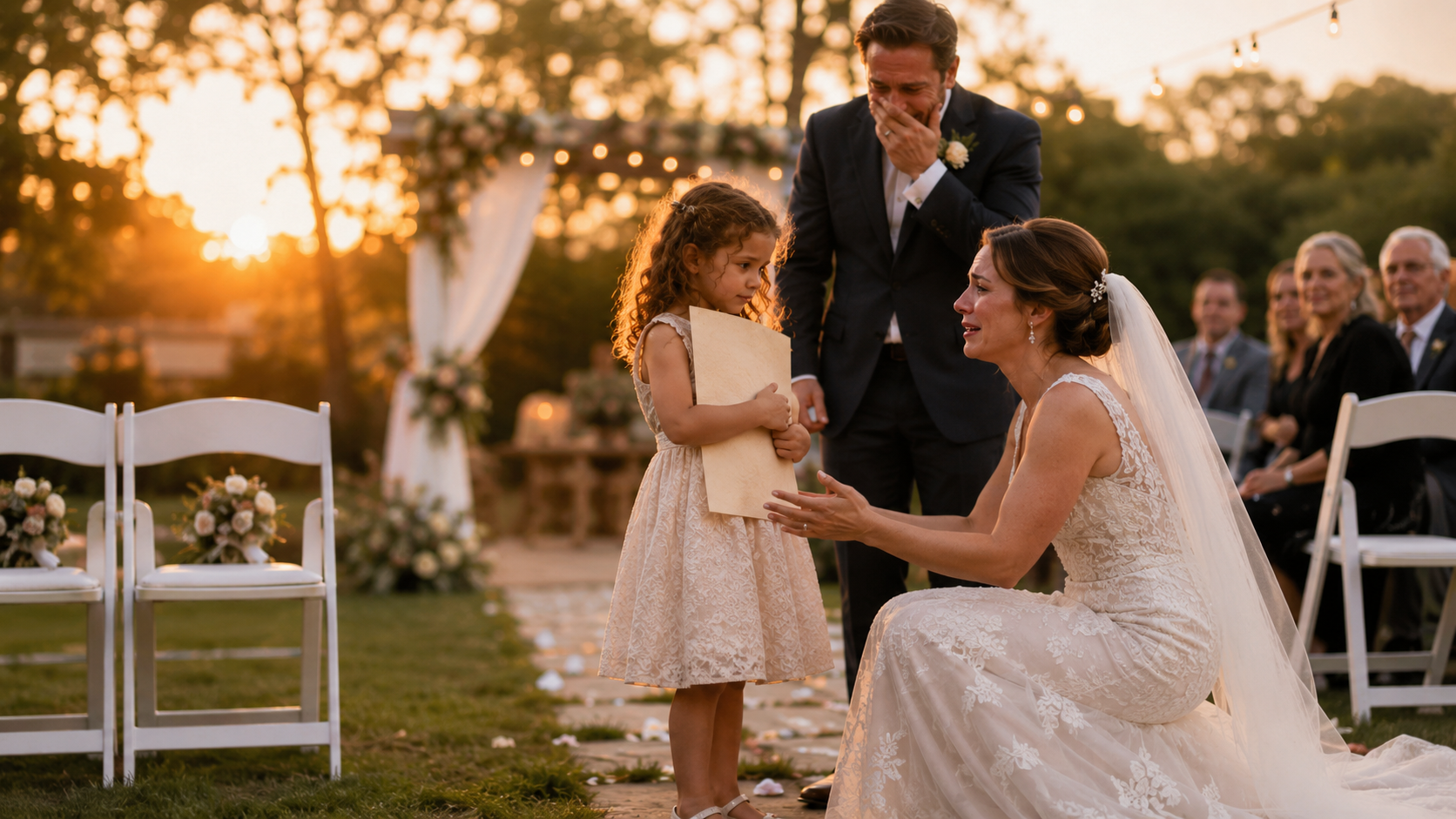
It was enough.
By morning, the wedding video had 9 million views.
By the next night, 15 million.
The story moved from short videos to morning shows to local news to national commentary. Headlines stretched Nora’s private pain into sentences strangers could argue about.
Pastor Refuses Daughter’s Wedding After Calling Widower’s Child “Unfinished Responsibility”
Little Girl’s Wedding Sign Sparks Outrage Against Famous Minister
Bride Defends Stepdaughter After Family Boycotts Ceremony
Nora hated it.
Caleb hated it more.
Maisie did not understand it.
She only knew people were sending drawings, teddy bears, and letters with hearts on the envelopes.
Caleb read every message first. Nora did too. They did not let Maisie see the cruel comments, the debates, the strangers who turned her pain into a battlefield.
But the kind letters, they saved.
One came from a woman named Tessa, who wrote that she had been eight years old when her stepmother called her “part of the package.” She said she spent thirty years trying to become easy to love. Then she saw Maisie’s sign and cried in her car before work.
Another came from a grandfather who had raised his daughter’s son after she died. He wrote, “Your vows told my grandson something I have been trying to say for ten years.”
Nora read that one three times.
Then she cried into Caleb’s shirt while he held her and said nothing, because he had learned that real comfort did not always need advice.
Four days after the wedding, Gideon Hale appeared on a livestream.
Nora watched from the kitchen table.
Caleb stood behind her with both hands on her shoulders. Maisie sat in the living room building a tower out of blocks, humming to herself.
Gideon sat in his office, framed degrees behind him, Bible open on the desk, wedding ring shining under the studio lights.
His face was serious.
Not sorry.
Serious.
“My family has recently become the subject of painful public attention,” he began. “As a father and shepherd, I have always sought to guide my daughter with wisdom, even when that wisdom is unpopular.”
Nora’s stomach twisted.
Caleb’s hands tightened gently.
Gideon continued.
“I regret that certain words were taken out of context and that a child has been placed at the center of a conversation she cannot possibly understand.”
Nora stood so fast the chair scraped against the floor.
“No.”
Caleb looked at her.
“Nora.”
“No,” she said again. “He does not get to do that.”
She grabbed her phone.
She did not fix her hair. She did not put on makeup. She did not choose a flattering corner. She stood in her kitchen with dishes in the sink, her wedding ring still new, her eyes swollen from days of crying.
Then she pressed record.
“My name is Nora Reed,” she said, voice shaking, “and the little girl in that wedding video is my daughter now.”
She stopped.
Because saying it out loud changed something.
Not legally.
Not yet.
But in the deepest part of her heart.
Completely.
“She understands more than adults want to admit,” Nora continued. “She understood when people stopped coming to our wedding. She understood when two chairs in the front row stayed empty. She understood when adults whispered about her like she was a problem. And she understood enough to walk down an aisle with a handmade sign and ask if love had room for her.”
Her eyes filled, but she did not stop.
“This is not about attacking a church. This is not about politics. This is not about a family disagreement. This is about a child hearing adults treat her grief like baggage because her mother died and her father loved her enough to keep going.”
Her voice cracked.
“My husband did not come with a burden. He came with a daughter. And Maisie is not the heavy part of my life. She is one of the brightest parts.”
Nora looked straight into the camera.
“So if anyone wants a statement from me, here it is. I will not apologize for marrying a good man. I will not apologize for loving his child. And I will not help powerful people turn cruelty into concern.”
She posted it before fear could stop her.
Then she placed the phone facedown on the counter and burst into tears.
Caleb crossed the kitchen in two steps and held her.
From the living room, Maisie called, “Are those happy tears or bad tears?”
Nora laughed through the tears.
“Both, baby.”
Maisie appeared in the doorway, holding a purple block.
“Do you need a hug?”
Nora opened her arms.
Maisie ran into them.
That video reached 20 million views.
And that was when Gideon Hale lost control of the story.
Not because strangers hated him.
Because people who knew him finally stopped pretending.
Former church employees began speaking anonymously. A youth leader said Gideon had fired him for questioning donation records. A former choir director said Marlene had pressured her to stay silent after Gideon publicly humiliated her teenage son. A retired assistant said the Hales cared more about protecting the image of the church than protecting the people inside it.