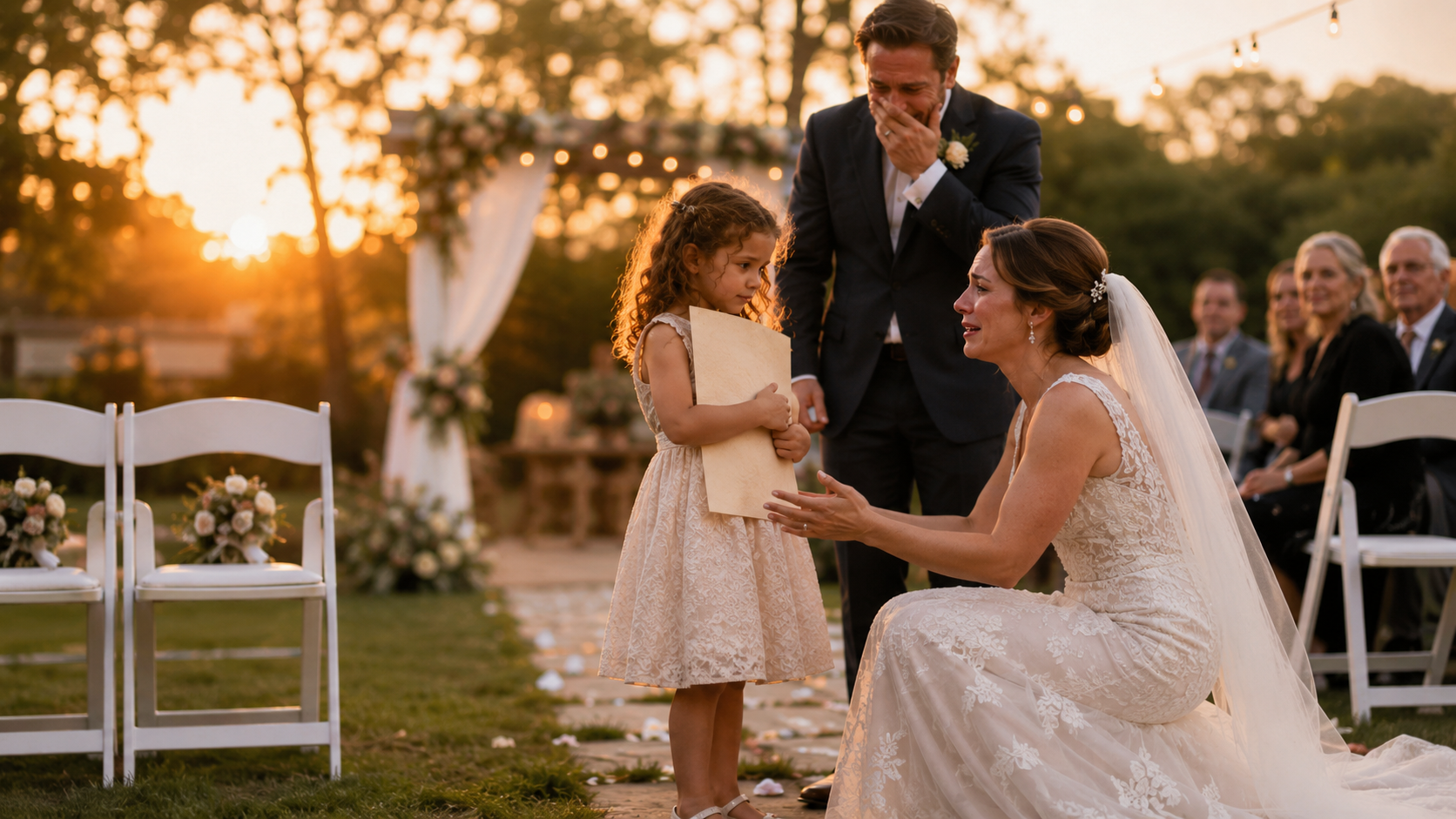
The Little Girl Held Up a Sign at Her Father’s Wedding — and One Powerful Man Lost Everything

Maisie’s small fingers trembled around the edges of the poster board.

It was almost bigger than her body.

The white cardboard bent in the breeze, and the silver stickers she had pressed along the border caught the late afternoon sun. Some of the letters were too big. Some were squeezed together because she had run out of room. A crooked yellow sun smiled in one corner. Beneath it, she had drawn three people holding hands.

One tall man.

One woman in a white dress.

One little girl with wild curls.

Nora saw the drawing first.

Then she saw the words.

And for one long second, the whole backyard disappeared.

The folding chairs.

The flower arch.

The guests.

The string lights.

The empty front row where her parents were supposed to be.

Everything vanished except Maisie, standing in the aisle with fear in her eyes and hope shaking in her hands.

The sign said:

She stayed even when everyone said I was too much. Can I stay with her too?

No one spoke.

Even the wind seemed to stop.

Caleb, standing beside Nora in his dark suit, pressed one hand over his mouth. His eyes filled before he could turn away. The officiant lowered his folder and looked down at the grass like he had suddenly forgotten how to breathe.

Maisie’s face changed.

She thought the silence meant she had done something wrong.

Her chin began to wobble.

Nora did not think. She did not ask permission. She did not look at the guests or the cameras or the two empty chairs waiting like accusations in the front row.

She dropped to her knees in her wedding dress.

The lace pooled around her in the grass.

“Maisie,” she whispered, holding out both hands. “Come here, sweetheart.”

The little girl looked at Caleb first.

Caleb nodded.

That was all it took.

Maisie ran.

She crashed into Nora’s arms so hard the poster folded between them. Nora wrapped herself around the child and felt those tiny fingers clutch the back of her dress like she was afraid someone might pull her away.

“I don’t want to be too much,” Maisie sobbed against her shoulder.

A sound broke out of Caleb’s chest.

Not a word.

Not a cry.

Something deeper.

Something he had been swallowing for three years while raising a little girl who still woke up at night asking if heaven had windows.

Nora held Maisie tighter.

“You are not too much,” she said.

Her voice shook, but it carried across the entire yard.

“You are not a problem. You are not extra. You are not something I accepted because I love your dad. Do you hear me?”

Maisie pulled back, cheeks wet, eyes searching Nora’s face.

“Then why didn’t they come?”

Nora knew exactly who she meant.

Her parents.

Her brothers.

Her aunts.

The church elders who had known her since she was born.

The people who had once promised to love her like family, until she chose a widower with a daughter and stopped asking permission to be happy.

Nora looked at the empty chairs again.

Then she looked back at Maisie.

“Because some grown-ups forget that love is not supposed to be easy only when it looks perfect.”

Maisie sniffed.

“Am I not perfect?”

Nora almost broke.

Caleb turned away, wiping his face with both hands.

“No, baby,” Nora said softly. “You are not perfect.”

Maisie’s lip trembled.

Nora smiled through tears.

“And that is my favorite thing about you.”

A confused little laugh slipped out of the child.

Nora placed both hands gently on Maisie’s cheeks.

“You leave crayons in the couch. You put ketchup on eggs. You ask questions during movies right before the important part. You hide socks in places no human being should ever hide socks.”

A small laugh moved through the guests.

Maisie’s shoulders relaxed.

“And I love you,” Nora continued. “Not because you are easy. Not because you are quiet. Not because you make my life simple. I love you because you are Maisie.”

Maisie stared at her.

“You promise?”

Nora’s answer came immediately.

“I promise.”

Then she looked at Caleb.

The man she was about to marry looked destroyed and grateful all at once.

Nora reached for his hand.

“I know this is not how the ceremony was planned,” she said, turning toward the guests. “But I think Maisie just made it better.”

The officiant wiped his eyes.

“Nora,” he said gently, “would you like a moment before we continue?”

Nora shook her head.

“No. This is the moment.”

She stood, still holding Maisie’s hand.

The original plan had been simple. Nora and Caleb would exchange vows. The officiant would pronounce them husband and wife. Everyone would clap. They would cut the cake that Caleb had tried to bake himself before finally accepting help from his neighbor, Mrs. Benitez.

And Nora would try not to look at the two empty chairs in the front row.

But Maisie had walked down the aisle with one handmade sign and changed everything.

So Nora changed everything too.

She turned to Caleb’s daughter.

“When I first met you,” Nora said, “you were wearing rain boots in July and carrying a stuffed fox named Captain Waffles.”

Maisie nodded seriously.

“He has a full name.”

“I know,” Nora said. “Captain Waffles Blueberry James.”

A few people laughed softly.

“You asked me if I was going to marry your dad and then leave after dinner.”

Caleb closed his eyes.

Nora’s throat tightened.

“I didn’t know what to say then. I was afraid of getting it wrong. I was afraid of loving you too quickly. I was afraid that if I stepped too close, it would feel like I was trying to take your mother’s place.”

Maisie lowered her eyes.

Nora bent slightly so the child would look at her again.

“But then one night, you woke up from a bad dream and came to the hallway. You didn’t ask for your dad. You didn’t ask for water. You just stood there with your blanket and said, ‘Can you stay until the dark gets smaller?’”

Caleb’s best man looked away, crying openly now.

“That was the night I understood,” Nora said. “I was not here to replace anyone. I was here to stay.”

Maisie’s eyes filled again, but this time she was smiling.

“So before I make vows to your dad,” Nora said, “I want to make one to you.”

The backyard fell completely silent.

Nora knelt again.

“I promise I will never treat you like you are part of a past I wish would disappear. I promise I will never make you feel like loving your mom means you have less room to love me. I promise I will say her name with kindness. I promise I will listen when you miss her. I promise I will not be jealous of a love that came before me.”

Caleb bowed his head.

Nora reached for Maisie’s hands.

“I promise I will mess up sometimes. I will pack the wrong snack. I will forget which pajamas are lucky. I will probably never learn how to braid your hair as well as Mrs. Benitez.”

Mrs. Benitez shouted from the second row, “That is true!”

Everyone laughed through tears.

“But I promise,” Nora continued, “that I will keep learning. I will keep showing up. And if you still want to choose me back, Maisie Reed, I would be honored.”

Maisie dropped the sign completely.

It landed in the grass.

Then she threw both arms around Nora’s neck.

“I choose you,” she cried. “I choose you, Nora.”

The whole yard broke open.

People stood.

People cried.

People clapped.

Caleb stepped forward and wrapped both of them in his arms. For a moment, there was no scandal. No family war. No missing parents. No whispers. No church board. No sermon that had cut a little girl into pieces before she even understood why adults could be cruel.

There was only a family beginning in the grass.

But by the next morning, the whole world knew.

Nora did not post the video.

Her friend Aubrey did.

Aubrey had asked first, of course. She had held up her phone after the reception and said, “This is beautiful. People need to see this.”

Nora had been too exhausted, too emotional, too full of cake and tears and relief to understand what “people” could mean.

By sunrise, the video had 90,000 views.

By noon, it had 700,000.

By evening, it had passed 3 million.

The caption was simple:

Pastor’s daughter marries a widower after her family rejects his little girl. Then the child walks down the aisle with a sign.

Nora watched the numbers rise from a small bed-and-breakfast two towns over, where she and Caleb had gone for a tiny honeymoon they could barely afford after rebuilding their wedding from scratch.

Maisie was asleep between them, one hand on Caleb’s sleeve and one foot pressed into Nora’s ribs.

Caleb stared at the phone screen.

“This is getting too big,” he said.

His voice held no excitement.

Only worry.

Nora scrolled through the comments.

That little girl is not too much. She is the whole blessing.

I was a stepchild. I wish someone had said this to me.

Whoever made that baby feel unwanted should be ashamed.

Then the comments began to name her father.

Reverend Gideon Hale.

Senior pastor of the biggest church in Briar County.

Author.

Speaker.

Radio guest.

A man who had built his life around being heard.

Someone found the sermon.

Someone clipped the exact moment.

There he was, standing behind the pulpit with soft lights behind him and a Bible open under his hand, warning his congregation about “confusing compassion with covenant.”

Nora watched her father on the tiny phone screen.

She had heard the sermon live.

She had sat in the third row while he spoke about her without saying her name.

“A man may come wrapped in grief,” Gideon Hale had said, “and bring with him unfinished responsibilities from another woman’s life. A daughter of faith must be careful not to mistake pity for calling.”

At the time, the room had gone still.

Nora had felt every eye move toward her.

Caleb had squeezed her hand.

Maisie had been in children’s class down the hall, coloring sheep with cotton-ball clouds, not knowing an adult with a microphone was turning her into a warning.

Now the internet had found the clip.

And the internet did not forgive quietly.

By breakfast, the church had turned off comments on every platform.

By lunch, reporters were calling the office.

By dinner, Nora’s mother called.

Nora stared at the screen.

MOTHER.

The word looked heavier than it should have.

Caleb saw her face.

“You don’t have to answer.”

“I know.”

But some daughter-shaped part of her still hoped.

Hoped her mother would say congratulations.

Hoped she would say the video made her cry.

Hoped she would say, “We were wrong.”

So Nora answered.

Her mother did not say hello.

“Nora,” Marlene Hale said, voice sharp and controlled, “what have you done?”

Not are you okay.

Not I saw the wedding.

Not tell Maisie she looked beautiful.

What have you done?

Nora closed her eyes.

“I got married.”

“You humiliated your father.”

Nora laughed once, but there was no humor in it.

“I humiliated him?”

“People are calling the church. Board members are demanding a meeting. Your father has spent thirty-five years building that ministry, and you allowed a private family matter to become public entertainment.”

Nora looked down at Maisie sleeping between them.

The child’s mouth was slightly open. Her curls were stuck to her cheek. She looked so small.

“She is not a private family matter,” Nora said quietly. “She is a child he publicly shamed.”

“He never meant it that way.”

“He said it from a pulpit.”

“He was trying to protect you.”

“No,” Nora said. “He was trying to own me.”

Silence filled the line.

It was the old silence.

The one from childhood.

The silence after Nora asked a question she was not supposed to ask. The silence before her father corrected her with scripture. The silence her mother used like a locked door until Nora apologized just to make the house feel normal again.

But Nora was not in that house anymore.

She was not sitting in the third row anymore.

She was not a little girl waiting for her father to decide whether her heart was obedient.

Her mother lowered her voice.

“Your father wants you at the church this afternoon.”

Nora sat up slowly.

Caleb did too.

“Why?”

“To make a statement.”

“What kind of statement?”

“A simple one,” Marlene said. “You will say the wedding was emotional, that people misunderstood your father’s message, and that you respect his guidance even though you chose differently.”

Nora stared at the wall.

“You want me to lie.”

“I want you to stop this before it destroys him.”

Something inside Nora became very still.

“Mom,” she said, “he tried to destroy my wedding.”

“That is dramatic.”

“He called our venue. He called the florist. He called my aunt and told her she would be supporting disobedience if she came. Half our family stopped answering me because they were afraid of him.”

“He has influence, Nora. That is not the same as force.”

Nora almost smiled.

Influence.

That was the clean word powerful people used when they did not want to say pressure.

“Did you watch the whole video?” Nora asked.

Her mother hesitated.

“That is not the point.”

“Did you hear Maisie ask if she could stay with me?”

“Nora—”

“Did you see her cry?”

No answer.

Nora knew then.

Her mother had not watched Maisie.

She had watched the comments.

“I’m not coming,” Nora said.

Marlene’s voice turned cold.

“Then do not expect your father to handle this quietly.”

“He should not handle it quietly,” Nora said. “He should apologize loudly.”

Then she ended the call.

Her hand was shaking.

Caleb gently took the phone and placed it on the nightstand.

Then he pulled her against him.

For once in her life, Nora did not apologize for crying.

The emergency church meeting happened that night.

Nora knew because someone leaked the audio before midnight.

Her father’s voice sounded different when he was not preaching.

Smaller.

Angrier.

Less holy.

“She has been manipulated by that man,” Gideon said. “A widower with a child knows how to exploit a woman’s tenderness. That is exactly why I warned her.”

A board member asked, “Reverend Hale, did you personally contact vendors connected to your daughter’s wedding?”

There was a pause.

Then Gideon said, “I advised members of our church not to participate in rebellion.”

Another voice asked, “Did your assistant tell the church security team to keep Mr. Reed off the property?”

“He was not welcome,” Gideon answered.

“He was invited by your daughter.”

Then Marlene’s voice came in, calm as polished glass.

“The issue is not whether feelings were hurt. The issue is whether this church will allow internet outrage to govern spiritual leadership.”

The recording ended there.

It was enough.

By morning, the wedding video had 9 million views.

By the next night, 15 million.

The story moved from short videos to morning shows to local news to national commentary. Headlines stretched Nora’s private pain into sentences strangers could argue about.

Pastor Refuses Daughter’s Wedding After Calling Widower’s Child “Unfinished Responsibility”

Little Girl’s Wedding Sign Sparks Outrage Against Famous Minister

Bride Defends Stepdaughter After Family Boycotts Ceremony

Nora hated it.

Caleb hated it more.

Maisie did not understand it.

She only knew people were sending drawings, teddy bears, and letters with hearts on the envelopes.

Caleb read every message first. Nora did too. They did not let Maisie see the cruel comments, the debates, the strangers who turned her pain into a battlefield.

But the kind letters, they saved.

One came from a woman named Tessa, who wrote that she had been eight years old when her stepmother called her “part of the package.” She said she spent thirty years trying to become easy to love. Then she saw Maisie’s sign and cried in her car before work.

Another came from a grandfather who had raised his daughter’s son after she died. He wrote, “Your vows told my grandson something I have been trying to say for ten years.”

Nora read that one three times.

Then she cried into Caleb’s shirt while he held her and said nothing, because he had learned that real comfort did not always need advice.

Four days after the wedding, Gideon Hale appeared on a livestream.

Nora watched from the kitchen table.

Caleb stood behind her with both hands on her shoulders. Maisie sat in the living room building a tower out of blocks, humming to herself.

Gideon sat in his office, framed degrees behind him, Bible open on the desk, wedding ring shining under the studio lights.

His face was serious.

Not sorry.

Serious.

“My family has recently become the subject of painful public attention,” he began. “As a father and shepherd, I have always sought to guide my daughter with wisdom, even when that wisdom is unpopular.”

Nora’s stomach twisted.

Caleb’s hands tightened gently.

Gideon continued.

“I regret that certain words were taken out of context and that a child has been placed at the center of a conversation she cannot possibly understand.”

Nora stood so fast the chair scraped against the floor.

“No.”

Caleb looked at her.

“Nora.”

“No,” she said again. “He does not get to do that.”

She grabbed her phone.

She did not fix her hair. She did not put on makeup. She did not choose a flattering corner. She stood in her kitchen with dishes in the sink, her wedding ring still new, her eyes swollen from days of crying.

Then she pressed record.

“My name is Nora Reed,” she said, voice shaking, “and the little girl in that wedding video is my daughter now.”

She stopped.

Because saying it out loud changed something.

Not legally.

Not yet.

But in the deepest part of her heart.

Completely.

“She understands more than adults want to admit,” Nora continued. “She understood when people stopped coming to our wedding. She understood when two chairs in the front row stayed empty. She understood when adults whispered about her like she was a problem. And she understood enough to walk down an aisle with a handmade sign and ask if love had room for her.”

Her eyes filled, but she did not stop.

“This is not about attacking a church. This is not about politics. This is not about a family disagreement. This is about a child hearing adults treat her grief like baggage because her mother died and her father loved her enough to keep going.”

Her voice cracked.

“My husband did not come with a burden. He came with a daughter. And Maisie is not the heavy part of my life. She is one of the brightest parts.”

Nora looked straight into the camera.

“So if anyone wants a statement from me, here it is. I will not apologize for marrying a good man. I will not apologize for loving his child. And I will not help powerful people turn cruelty into concern.”

She posted it before fear could stop her.

Then she placed the phone facedown on the counter and burst into tears.

Caleb crossed the kitchen in two steps and held her.

From the living room, Maisie called, “Are those happy tears or bad tears?”

Nora laughed through the tears.

“Both, baby.”

Maisie appeared in the doorway, holding a purple block.

“Do you need a hug?”

Nora opened her arms.

Maisie ran into them.

That video reached 20 million views.

And that was when Gideon Hale lost control of the story.

Not because strangers hated him.

Because people who knew him finally stopped pretending.

Former church employees began speaking anonymously. A youth leader said Gideon had fired him for questioning donation records. A former choir director said Marlene had pressured her to stay silent after Gideon publicly humiliated her teenage son. A retired assistant said the Hales cared more about protecting the image of the church than protecting the people inside it.

Then Gideon’s head of security, Pierce Dalton, made the mistake that changed everything.

He came to Nora’s house.

It was raining that afternoon, the kind of cold rain that makes the sky look bruised. Caleb was at work finishing parent-teacher conferences. Maisie was at the kitchen table making paper crowns for her stuffed animals.

Nora opened the door because she thought it was a delivery.

Pierce stood on the porch in a black jacket.

Her blood went cold.

“You need to come with me,” he said.

Nora did not open the screen door.

“No.”

“Your father wants a conversation.”

“My father has my number.”

“This is not a phone conversation.”

Nora stepped back.

“I’m calling Caleb.”

Pierce reached for the screen door handle.

That was when Mrs. Benitez opened her front door across the street.

“Nora?” she called.

Pierce froze.

Mrs. Benitez lifted her phone.

“I’m recording,” she said calmly. “And I have lived through two husbands, one hurricane, and a hip replacement. Do not make me your problem today.”

For one second, no one moved.

Then Pierce released the handle.

“This is not over,” he said.

Mrs. Benitez shouted, “For you it is, sweetheart.”

The video of that moment did not reach 20 million views.

Only 5 million.

Mrs. Benitez became an internet legend by dinner.

Caleb came home furious in a way Nora had never seen.

Not loud.

Not reckless.

Quiet.

Pale.

Shaking as he checked every lock twice.

“I should have been here,” he said.

“You were working.”

“He scared you.”

“He tried.”

Maisie stood at the bottom of the stairs holding Captain Waffles against her chest.

“Is the church man mad because of my sign?”

Caleb’s face crumpled.

Nora knelt in front of her.

“No, sweetheart. Grown-ups are responsible for their own choices.”

“But if I didn’t make the sign—”

“Listen to me,” Caleb said, kneeling too. “Your sign told the truth. Sometimes people get angry at the truth, but that does not mean the truth was wrong.”

Maisie looked from Caleb to Nora.

“Am I in trouble?”

They answered at the same time.

“No.”

She nodded slowly.

Then she whispered, “Can people be mad and we still be a family?”

Nora pulled her close.

“We already are.”

That night, long after Maisie fell asleep, Caleb sat at the kitchen table with an envelope in front of him.

Nora recognized it.

The adoption paperwork.

They had talked about it before the wedding, carefully and gently. Nora did not want Maisie to feel pushed. Caleb did not want his daughter to think her mother was being erased.

Caleb ran his hand over the envelope.

“Maybe we should wait,” he said.

“For things to calm down?”

“For her.”

Nora sat across from him.

“She asked if people being mad means we stop being family.”

Caleb’s eyes filled.

“I know.”

“She is scared love can be voted away.”

He flinched like the words hit him.

Nora reached across the table and took his hand.

“I’m not trying to replace Elena.”

Elena.

Maisie’s mother.

Nora always said her name gently.

Caleb looked toward the hallway where Maisie slept.

“I know,” he whispered. “That is why I trust you.”

Two weeks later, on a quiet Saturday morning, they sat Maisie down in the living room.

No cameras.

No guests.

No internet.

Just pancakes on the coffee table and Maisie wearing one striped sock and one sock with ducks on it.

Caleb held one of her hands.

Nora held the other.

“Sweetheart,” Caleb said, “Nora loves you. I love you. And if you want, one day a judge can make Nora your parent too. Not instead of Mommy Elena. Alongside her memory.”

Maisie stared at him.

Then at Nora.

“Like a second mom?”

Nora smiled carefully.

“Only if you want that.”

Maisie thought about it with the seriousness only a child can bring to the biggest questions.

“Would Mommy Elena be sad?”

Caleb’s eyes filled.

“No, baby. I think Mommy Elena would be glad that more love found you.”

Maisie looked down at her pancakes.

Then she whispered, “Can I have a sky mom and a home mom?”

Nora covered her mouth.

Caleb answered, voice breaking.

“Yes.”

Maisie nodded.

“Then I want Nora to be my home mom.”

Nora’s heart broke and rebuilt itself in the same breath.

The adoption did not happen overnight.

Real life is not a viral video.

There were forms, interviews, home visits, court dates, and careful sessions with a child therapist who helped Maisie understand that love could grow without erasing grief.

Meanwhile, Gideon Hale’s church continued to unravel.

The board placed him on “temporary leave,” which everyone knew meant they were deciding whether protecting him was worth the cost. Donations dropped. Protesters stood outside with signs that said Children Are Not Burdens. Former members began meeting at the community center across town.

Marlene sent Nora one email.

No subject line.

Just three sentences.

You have won. Your father is humiliated. I hope your new family was worth it.

Nora stared at the last sentence for a long time.

Then she typed back only two words.

They are.

Marlene did not reply.

For a while, Nora thought that was the end.

But endings rarely arrive honestly.

They usually come dressed as one more test.

Three months after the wedding, Nora received a call from the hospital.

Her father had collapsed during a private meeting with the church board.

Minor heart attack.

Stable condition.

Room 318.

Her first feeling was not compassion.

It was exhaustion.

Then came guilt, because daughters are trained to feel guilty even when fathers build the cages themselves.

Caleb found her standing in the hallway with the phone in her hand.

“What happened?”

She told him.

He did not tell her to go.

He did not tell her not to.

He only asked, “What do you need?”

That question almost made her cry.

No command.

No pressure.

No sermon.

Just choice.

“I don’t know,” she said.

Maisie peeked around the corner.

“Is Grandpa Church sick?”

Nora swallowed.

“Yes.”

Maisie came closer.

“Are you sad?”

Nora looked at that small face and realized she could not lie to a child who had already been hurt by adult dishonesty.

“I’m confused.”

Maisie nodded like that made perfect sense.

“When I’m confused,” she said, “Daddy says I can be kind and still have rules.”

Caleb turned away, crying silently.

Nora laughed softly.

“Daddy is right.”

She went to the hospital alone.

Not because Caleb would not come.

Because she needed to know who she was without anyone standing between her and the people who raised her.

Marlene was waiting outside room 318, pearls on her neck, lipstick perfect, posture sharp.

But she looked older.

That startled Nora.

For the first time, her mother did not look untouchable.

She looked like a woman who had spent her whole life polishing a glass house and was shocked that people could see through it.

“Nora,” Marlene said.

“Mom.”

Marlene looked behind her.

“You came alone.”

“Yes.”

“No husband?”

“No.”

“No child?”

Nora held her gaze.

“My daughter’s name is Maisie.”

Marlene’s mouth tightened.

“Your father is resting.”

“Then why did you call me?”

Marlene looked toward the closed door.

For one second, her face trembled.

Then the mask returned.

“He asked for you.”

Nora entered the room.

Her father looked smaller in the hospital bed. Without the stage, the microphone, the suit, and the applause of hundreds of people, Gideon Hale looked like an aging man with wires taped to his chest.

His eyes opened when she approached.

“Nora.”

His voice was weak.

She stood beside the bed.

“Dad.”

He looked at her for a long time.

Then his eyes filled.

Nora braced herself.

For the speech.

For the explanation.

For the twist that would somehow make his pain her responsibility.

But he only said, “I watched the whole video.”

Nora’s throat tightened.

She did not answer.

“I watched her hold that sign,” he whispered. “I watched you kneel. I watched Caleb cry.”

A tear slipped down his temple.

“I watched it without thinking about the church. Without thinking about the comments. Without thinking about myself.”

Nora gripped the strap of her purse.

Her father closed his eyes.

“And I saw what I had done.”

The room blurred.

Nora hated that she wanted those words.

She hated that they still mattered.

“I called a child a responsibility,” he said. “Like she was a debt. Like she was a warning. I did it from a pulpit and called it wisdom.”

His breath shook.

“I was cruel.”

Nora looked at the man who had taught thousands of people to repent.

For once, repentance looked like something that cost him.

“I need to say it to her,” he whispered.

Nora went still.

“No.”

He opened his eyes.

“Nora—”

“No,” she said again. “You do not get access to Maisie just because guilt finally reached you.”

He flinched.

“She deserves an apology.”

“She deserves safety more.”

Gideon swallowed.

Nora’s voice stayed steady.

“If you want to apologize, write a letter. Caleb and I will read it first. Her therapist can help us decide if and when she hears it. You do not get to make your guilt her responsibility.”

Her father stared at her.

Then he nodded.

Not happily.

Not easily.

But he nodded.

That was the first miracle Nora had ever seen him perform.

Not healing.

Not prophecy.

Not a church full of raised hands.

Just a powerful man accepting the word no.

Marlene was waiting in the hallway when Nora came out.

“Well?”

“He wants to write Maisie a letter.”

Marlene’s eyes flashed.

“You are making him beg to a child?”

Nora was tired.

So tired.

But she was also free.

“No,” she said. “I am making sure a child does not have to carry an adult’s shame.”

Marlene stared at her like she did not recognize her.

Maybe she didn’t.

Maybe that was the point.

The adoption hearing happened six months after the wedding.

It was a rainy Thursday morning.

Maisie wore a blue dress and carried Captain Waffles, whose left ear had become permanently bent. Caleb wore a tie covered in tiny stars because Maisie said court needed “happy space energy.”

Nora wore a pair of earrings Elena’s mother had mailed her with a handwritten note.

Elena would have loved you for loving them.

Nora had cried for twenty minutes after reading it.

In court, the judge was kind.

She asked Maisie if she understood why everyone was there.

Maisie nodded seriously.

“Yes. Nora is my home mom, and Mommy Elena is my sky mom, and Daddy says families can get bigger without anybody disappearing.”

The judge blinked fast.

“So this is what you want?”

Maisie looked at Nora.

Then at Caleb.

Then back at the judge.

“Yes. Because she stayed when I was scared.”

Nora’s hand shook in Caleb’s.

The judge signed the order.

Just like that, the child Gideon Hale had treated like an unfinished burden became legally, publicly, permanently Nora’s daughter.

Outside the courthouse, there were no reporters.

No viral cameras.

No shouting crowd.

Just rain, a few pigeons, and Mrs. Benitez waiting with balloons because apparently nothing on earth could stop that woman from becoming family.

Maisie held up a new sign for one picture.

This one said:

Officially staying.

Nora posted that photo herself.

Not for revenge.

Not for views.

For every child who had ever wondered if they were too hard to love.

It reached millions.

But this time, the number did not matter most.

What mattered was Maisie dancing in the kitchen that night with frosting on her nose.

What mattered was Caleb pulling Nora close after their daughter fell asleep and whispering, “Thank you for staying.”

What mattered was Nora answering, “Thank you for letting me choose.”

Gideon’s letter arrived two weeks later.

It was five pages long.

No excuses.

No scripture used as a shield.

No careful phrases like “if I hurt you.”

He wrote Maisie’s name over and over.

He said she was never too much.

He said he was wrong.

He said adults sometimes make fear sound holy because they are too proud to admit they are afraid.

Nora and Caleb read it with the therapist first.

Then, one quiet evening, Nora asked Maisie if she wanted to hear a letter from Grandpa Church.

Maisie thought about it.

“Is it mean?”

“No.”

“Is he still mad?”

“No.”

“Do I have to forgive him?”

Nora sat beside her on the couch.

“No, baby. Forgiveness is not homework.”

Maisie leaned against her.

“Okay. You can read it.”

Nora did.

Maisie listened silently, holding Nora’s hand.

At the end, she asked, “Can I draw him something?”

Caleb’s face softened.

“If you want.”

Maisie drew three houses.

One with stars above it.

One with flowers.

One with a big crooked heart on the roof.

Then she wrote, with help spelling the words:

I am not too much. I am Maisie.

They mailed it the next day.

Gideon framed it.

Marlene did not come around for a long time.

That hurt less than Nora expected.

Some doors stay closed because opening them would let the storm back in.

Nora stopped waiting outside them.

A year after the wedding, they stood in Caleb’s backyard again.

The same yard.

The same patch of grass.

But everything looked different.

There were string lights overhead, folding tables covered with food, children running through sprinklers, and a cake that leaned slightly to the left because Caleb insisted on baking it himself again.

It was Maisie’s seventh birthday.

She wore a paper crown and announced to everyone that she had “one sky mom, one home mom, one dad, three grandmas, and a neighbor who is basically the boss of everyone.”

Mrs. Benitez raised her lemonade.

“That is correct.”

Everyone laughed.

Then the gate opened.

Gideon stood there.

Not Reverend Hale.

Not the man from the stage.

Just Gideon.

He held one wrapped gift and looked like he might turn around if anyone breathed too loudly.

Nora had invited him after months of letters, therapy advice, and careful boundaries.

Marlene had refused to come.

That was her choice.

Nora did not chase her.

Maisie saw him.

The yard went quiet in that subtle way adults do when they are trying not to stare.

Gideon knelt before Maisie reached him.

Smart man.

He did not tower over her.

He did not open his arms.

He did not assume.

“Happy birthday, Maisie,” he said softly.

Maisie studied him.

“Are you still learning?”

Gideon’s eyes filled.

“Yes.”

She nodded.

“Okay.”

Then she took the gift.

That was all.

No dramatic hug.

No instant healing.

No perfect ending for people who wanted forgiveness to look pretty.

Just okay.

Sometimes okay is holy enough.

Later, after cake, Maisie ran across the yard holding another sign.

Nora groaned.

“Maisie Reed, what did you make now?”

Maisie grinned.

This sign had glitter, stickers, and letters so large they barely fit.

Love does not replace people. It makes more room.

Caleb put his arm around Nora.

Gideon stood near the fence, crying quietly.

Mrs. Benitez shouted, “Somebody record that baby!”

Everyone laughed.

But Nora did not reach for her phone right away.

For once, she wanted the moment to belong only to the people living it.

She looked at her husband.

She looked at her daughter.

She looked at the yard where her wedding had almost broken her heart and somehow built her life.

Then she looked at the two front-row chairs from the ceremony, now pulled near the birthday table and covered in frosting, juice boxes, and children’s drawings.

They were not empty anymore.

Not because everyone came back.

But because Nora had stopped saving seats for people who only knew how to love with conditions.

She had built a bigger table.

And at the center of it sat a little girl once told she was too much, laughing under string lights like the whole world had finally learned her name.

The Little Girl Held Up a Sign at Her Father’s Wedding — and One Powerful Man Lost Everything
14 iconic stars, one unforgettable color—white! Which of them looked best in it?