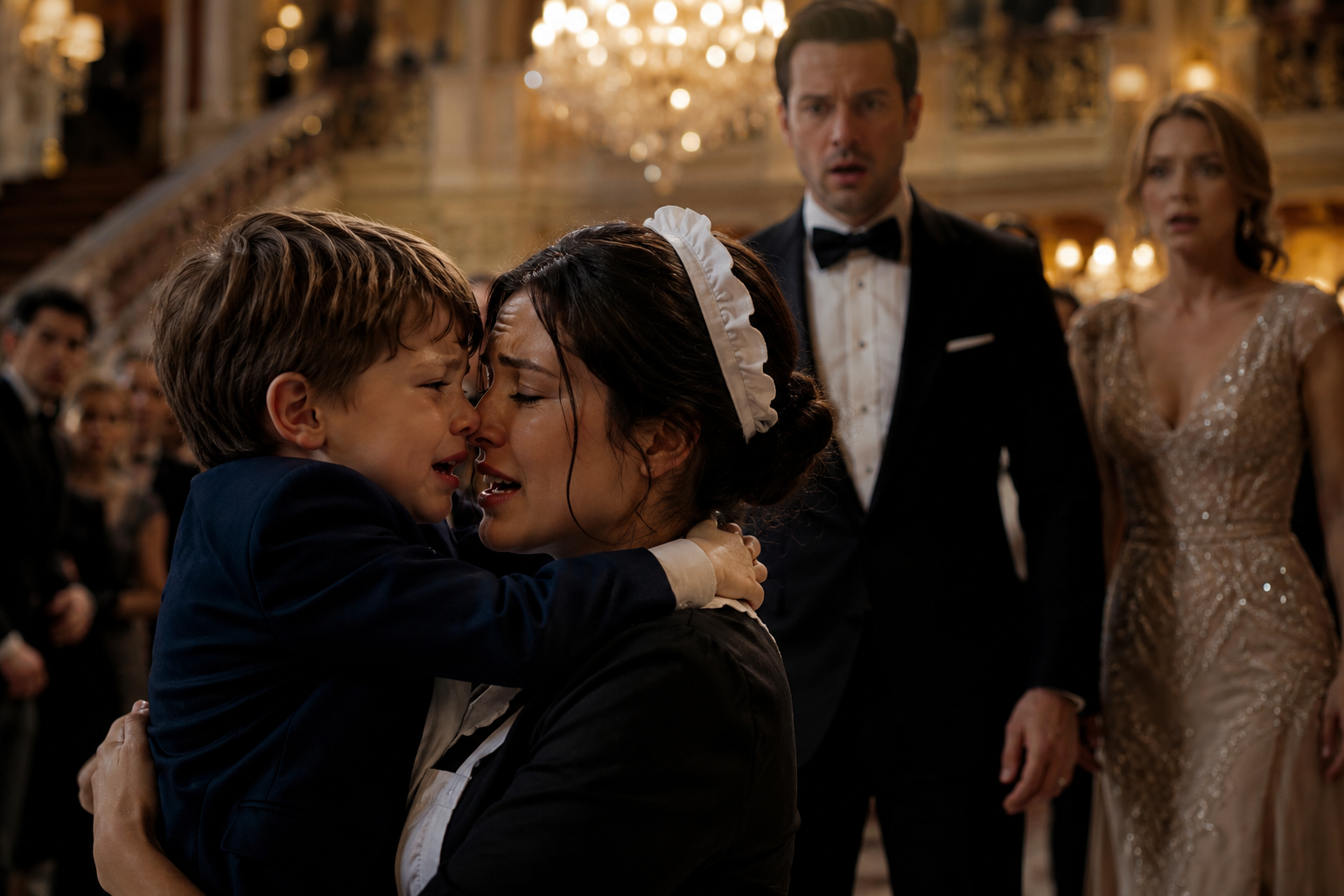
The orchestra was playing beneath a ceiling painted with pale clouds and golden angels when five-year-old Theo Carrow dropped his crystal glass of lemonade.
It struck the polished floor of Ashcombe House and shattered.
More than two hundred guests turned toward the sound. Politicians, bankers, actors, foundation directors, and old families whose names appeared on hospital wings watched the little boy step away from his nanny.
But Theo was not looking at the broken glass.
He was staring across the ballroom at one of the temporary housekeepers.
The woman stood near the service entrance with a tray balanced against her hip. Her uniform was plain, her dark hair was pinned beneath a white cap, and a thin scar crossed the skin beside her left eyebrow.
She had arrived at the estate only four days earlier.
Theo’s face changed.
His confusion disappeared first. Then his fear. Something brighter and more painful replaced both.
“Mom?”
The orchestra continued for two uncertain notes before the conductor lowered his hands.
The woman nearly dropped the tray.
Theo ran.
His nanny reached for him, but he slipped past her and crossed the ballroom between tables decorated with white roses.
“Mom!” he cried again.
The housekeeper sank to her knees just as he reached her. Theo wrapped his arms around her neck so fiercely that she lost her balance.
The silver tray struck the floor.
She held him instinctively.
Not like a stranger comforting a frightened child.
Like someone whose body remembered him before her mind did.
“Theo,” she whispered.
Jonathan Carrow heard his son’s name and stopped breathing.
He had been standing near the grand staircase beside his fiancée, Beatrice Wycliffe. A moment earlier, he had been preparing to announce the merger of two charitable foundations and, according to half the guests, the date of his second wedding.
Now he stared at the kneeling housekeeper.
Her face was thinner.
Her hair was darker.
The scar had not been there before.
But when she lifted her eyes, Jonathan felt the ballroom disappear around him.
He knew those eyes.
He had seen them laughing beside a lake.
Closing in sleep against his shoulder.
Filling with tears on the morning their son was born.
He had last seen them in a photograph placed beside an empty coffin.
“Lydia?”
The woman flinched as if the name had struck her.
Beatrice caught Jonathan’s sleeve.
“Jonathan, think carefully.”
He pulled his arm away without looking at her.
The housekeeper rose slowly, keeping Theo against her chest. The boy refused to release her.
“My name is Anna Hale,” she said.
Her voice was unsteady.
Jonathan took one step toward her.
“No. Your name is Lydia Carrow.”
A murmur moved through the ballroom.
Every guest knew the story.
Three years earlier, Lydia Carrow had disappeared during a winter storm. Her abandoned car had been discovered near a flooded railway tunnel. Search teams found her coat, one shoe, and traces of blood along the embankment.
No body had ever been recovered.
After four months, the authorities had declared that she could not have survived.
Jonathan had refused to hold a funeral until pressure from Lydia’s family and the trustees of Ashcombe House became unbearable. He had stood beside an empty grave while Theo, only two at the time, cried in the arms of his grandmother.
Now the dead woman was standing beneath the ballroom chandeliers.
Theo touched the scar beside her eyebrow.
“You came back,” he whispered. “I knew you would.”
Anna—or Lydia—looked at him with terror and tenderness.
“I don’t know how I know your name,” she said. “I don’t know why I remember the blue blanket in your room. I don’t know why I can hear you crying when I close my eyes.”
Theo leaned closer.
“You used to sing about the moon boat.”
The woman’s lips parted.
Without realizing it, she began to hum.
Only four notes.
Jonathan turned pale.
It was a melody Lydia had invented during Theo’s first winter. She had never recorded it. She had never sung it outside their home.
Theo rested his head against the woman’s shoulder.
“That’s my song.”
Beatrice stepped forward.
“This must be handled privately.”
Jonathan finally looked at her.
“Did you know?”
Her expression remained controlled, but her fingers had tightened around her evening bag.
“I knew the employment agency had sent a woman who resembled Lydia.”
“You approved her placement.”
“Yes.”
“Why?”
Before Beatrice could answer, an older man pushed through the guests.
Sir Malcolm Carrow was Jonathan’s uncle and chairman of the Ashcombe Trust. At seventy, he still carried himself like a judge entering a courtroom. His silver hair was perfectly combed, and his black dinner jacket seemed untouched by the confusion around him.
He looked at the housekeeper for less than a second.