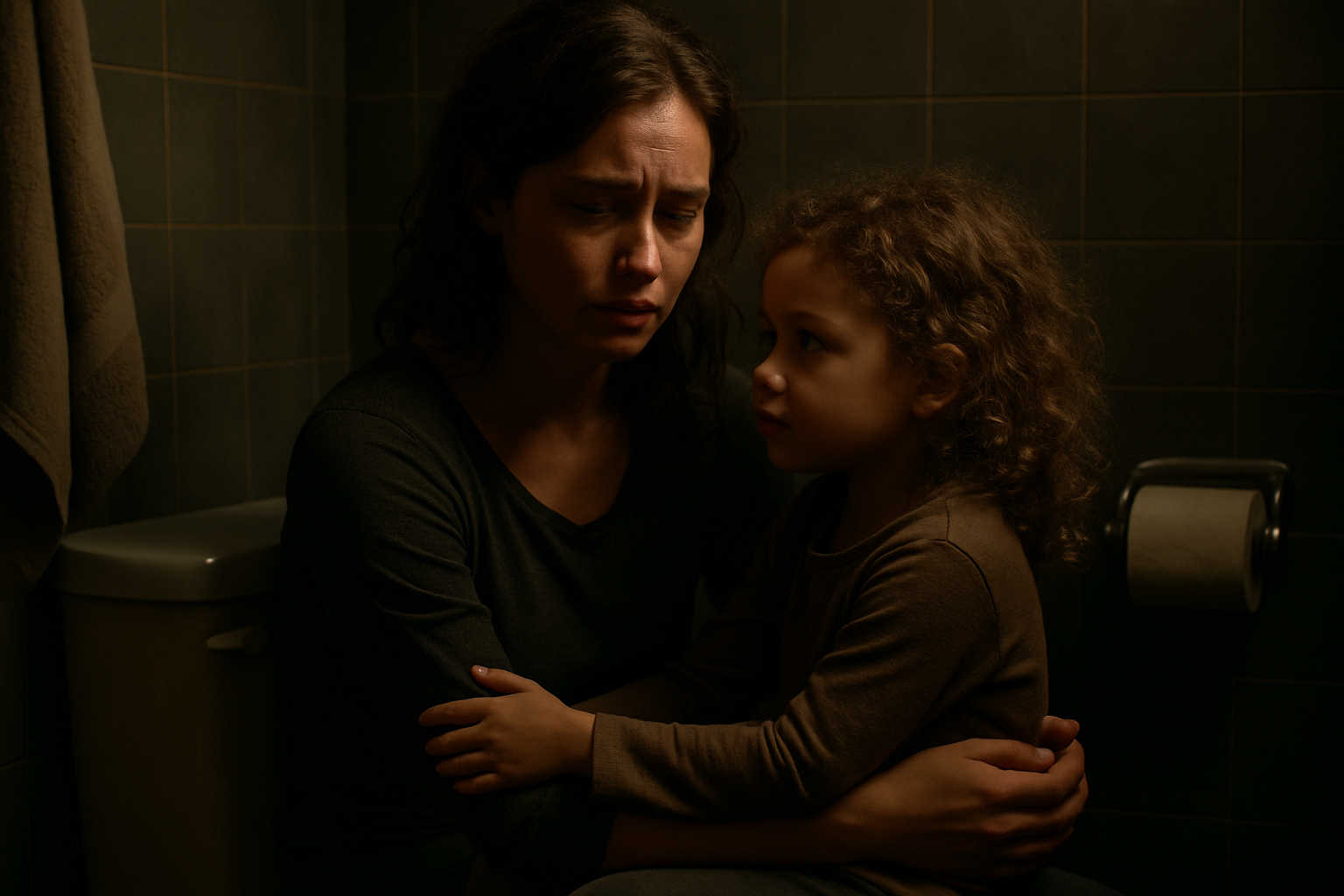
“She thought I’d explain,” he continued. “She thought we’d have a vicious fight, maybe delay the announcement, maybe I’d go to Tokyo to prove something. She didn’t know you were pregnant.” His voice broke. “Neither did I.”
Nora sank into the chair.
The betrayal she had carried for four years changed shape inside her.
It did not vanish.
It did not become harmless.
It became something worse in some ways.
Sadder.
More grotesque.
Adrian had not betrayed her with Vivienne.
Her fear had betrayed her.
And someone cruel had known exactly where to place the blade.
Nora saw it all again: the pregnancy test wrapped in tissue at the bottom of her purse, the nausea she had blamed on stress, the photograph glowing on her phone in the dark, Adrian coming home late, her own voice shaking as she asked him where he had been.
And Adrian—tired, distracted, secretive—saying, “Please trust me for one more day.”
One more day.
She had not given him even one more hour.
“Why didn’t you tell me?” she whispered.
The question sounded absurd the moment it left her mouth because she had been the one to disappear.
But Adrian did not punish her for it.
“I tried,” he said. “Your number was gone. Your email bounced. Your mother told me you were safe but refused to say where.”
“My mother thought she was protecting me.”
“I know.” He looked down. “At the time, I hated her for it. Now…” He swallowed. “Now I understand more than I want to.”
Nora pressed a fist against her stomach.
“I hired investigators,” he said. “My father’s security team fed them bad information for months. Every time I got close, the trail went cold. By the time I found out what was happening, you had changed your professional name and moved twice.”
“I thought you’d use your money to take the baby,” Nora said, the confession ripping out of her before she could soften it. “I thought if you found out I was pregnant, you would punish me for leaving.”
Adrian flinched.
She hated that he flinched.
She hated that she had once loved him enough to believe in his gentleness and feared him enough to run from his power.
“My father had a stroke,” Adrian said after a moment. “Then complications. When he died, I found the bank transfer to Vivienne in his private records, along with notes about the board vote and the Tokyo expansion.”
Nora covered her mouth.
“I confronted her,” he said. “She told me enough to confirm what he’d done. Not out of guilt. Out of fear that I’d ruin her.” His mouth hardened. “I could have.”
“Why didn’t you?”
“Because by then ruining people felt too much like him.”
The answer struck her somewhere tender.
“I kept looking,” Adrian said. “But I made myself one promise. If I found you and you had built a life without me, I would not destroy it just because I was hurt.” His eyes shone. “But I did not know about Maddie.”
Downstairs, Maddie laughed at something Russell said.
The sound floated up through the floorboards, bright and alive and impossible.
Adrian turned his face toward it as if drawn by gravity.
“I missed everything,” he whispered. “Did she walk early? Was she afraid of thunderstorms? What was her first word?”
Nora closed her eyes.
“Moon.”
A tear slipped down his cheek.
“She pointed at the moon from her crib and said it like she’d discovered it personally.” Nora’s voice trembled, but once she began, she could not stop. “She hates peas but eats broccoli if you call it tiny trees. She had night terrors when she was two. She asks about her father every few months, then pretends she didn’t because she thinks it makes me sad.”
Adrian pressed his fist to his mouth.
For a while, neither of them spoke.
Outside the office window, late afternoon traffic slid along Newbury Street in silver and red streaks. Somewhere below, the espresso machine hissed. A bell chimed as someone entered the café. Life continued with shameless indifference, as if the center of Nora’s world had not just split open.
Finally Adrian lowered his hand.
“Tell me everything,” he said.
Nora shook her head. “You don’t get everything in one afternoon.”
“I know.”
“You don’t get to walk into her life and become a father because biology says you are one.”
“I know.”
“And you don’t get to decide what happens next alone.”
His eyes found hers. “I would never.”
She almost laughed, but it came out broken. “You come from a long line of men who decide things.”
“I know that too.”
The answer was quiet, and because it was quiet, because it carried no defense, it unnerved her.
Nora looked toward the framed photograph again.
“How am I supposed to trust any of this?” she asked. “How am I supposed to know you’re not saying exactly what I need to hear?”
Adrian stood, crossed to the desk, and opened a drawer. He removed a thick folder bound with a black clip and placed it on the low table between them.
Nora did not touch it.
“What is that?”