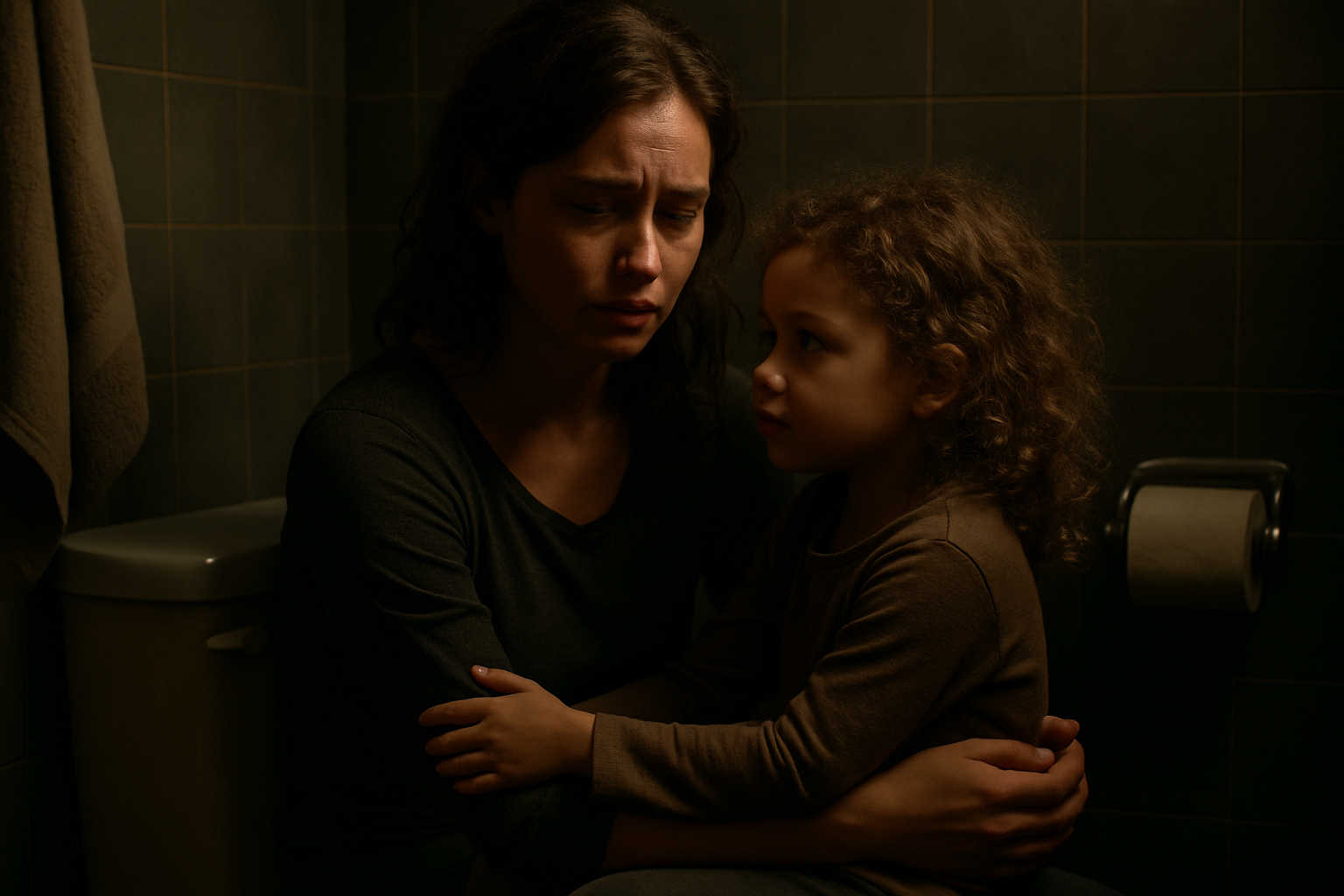
“Yes, Adrian.”
Adrian exhaled like a man set free.
For one suspended second, he did not move. He just stared at her, as if afraid joy might vanish if he reached for it too quickly. Then he laughed once, breathless and broken, and stood. The ring slipped onto her finger with a small, perfect weight.
Maddie cheered so loudly Russell dropped a tray downstairs.
The crash shattered the last of the tension. Children shrieked with delighted laughter. Someone applauded. Then everyone applauded. Russell yelled, “I’m fine!” in the tone of a man who absolutely was not fine and would be emotionally recovering near the pastry case.
Adrian kissed Nora on the landing of the building they had rebuilt from fear.
Not a movie kiss. Not the kind that erased everything before it. This kiss remembered. It held every apology spoken in the dark, every counseling session where one or both of them had left exhausted, every bedtime where Maddie had asked a question neither of them knew how to answer, every morning they had chosen honesty before pride.
Coffee brewed below them.
Children laughed around them.
Boston rain began tapping softly against the windows, gentle and persistent, like fingers on piano keys.
And for the first time in years, Nora did not hear the rain as a warning.
She heard it as music.
Five years later, the musical stairs chimed beneath three sets of small feet.
The building had learned their rhythms by then. It knew the rush of morning shoes, the careful steps of tired foster parents, the stampede of children racing toward hot chocolate, the slow tread of social workers carrying files and hope in equal measure. It knew Adrian’s measured pace when he was trying not to wake the baby, Nora’s quick one when she was late for a meeting, Maddie’s dramatic stomps whenever injustice had occurred, which was often and usually involved bedtime.
That morning, Maddie Vale—nine years old now and convinced that adulthood was something she could begin early if given the proper stationery—carried a stack of picture books toward the piano room.
“Christopher, no running near the corner!” she called over her shoulder with all the authority of a person who had once colored on that very wall and now considered herself reformed.
Behind her ran Christopher, four years old, curls bouncing, socks mismatched, and determination written across his face. His mission was simple: reach the piano keys before anyone stopped him. His method was chaos.
“I am not running!” he shouted while running faster.
“You are literally running!”
“I am fast walking with danger!”
From the doorway of the apartment, Adrian appeared with Clara tucked against his chest. Baby Clara blinked at the world with solemn gray eyes, one tiny fist caught in the collar of his shirt. She had the grave expression of a judge presiding over a complicated case.
“All Vale children,” Adrian had declared the week she was born, “look ready to negotiate.”
Nora, who had been awake for thirty-one hours at the time, had told him that if Clara negotiated one more feeding before sunrise, he would be representing the family alone.
Now Clara stared at Christopher as he skidded into the piano room and slapped both palms onto the keys.
The house answered in a great, ridiculous crash of sound.
Maddie groaned. “That is not music.”
Christopher beamed. “It is loud music.”
Adrian shifted Clara higher against his shoulder. “Technically, volume is not a genre.”
Christopher considered this with deep seriousness, then hit the keys again, harder.
“Now it is.”
Nora laughed from the kitchen, where the smell of cinnamon toast mixed with coffee and the faint lemon polish they used on the old wooden counters downstairs.
After Rain Family Center had become more than a café.
More than a clinic.
More than a home.
It had become the kind of place people described differently depending on what they had needed when they arrived.
To some, it was where foster parents learned how to answer impossible questions without flinching.
To others, it was where teenagers came after school and pretended they were only there for muffins, not because Russell knew how to sit beside grief without poking at it.
For little children, it was the building with the singing stairs and the tiny reading nook under the landing, where the pillows were soft and nobody got angry if you needed to hide for a while.
For social workers, it was where coffee appeared before they asked for it.
For Nora, it was proof that a life could be built from ruins without pretending the ruins had never existed.
For Adrian, it was the first place in years where success did not feel like armor.
The café still occupied the ground floor, though it had expanded into the neighboring space after the third year, when the line for weekend family workshops had begun curling out the door. The clinic offices were tucked behind frosted glass, painted in warm colors Maddie had once chosen from a sample book with the seriousness of an architect. The upstairs apartment remained theirs, though “apartment” had become a generous word for the cheerful sprawl of toys, books, laundry baskets, art supplies, musical instruments, and one long-suffering ficus tree that Christopher insisted was named Sir Leafy.