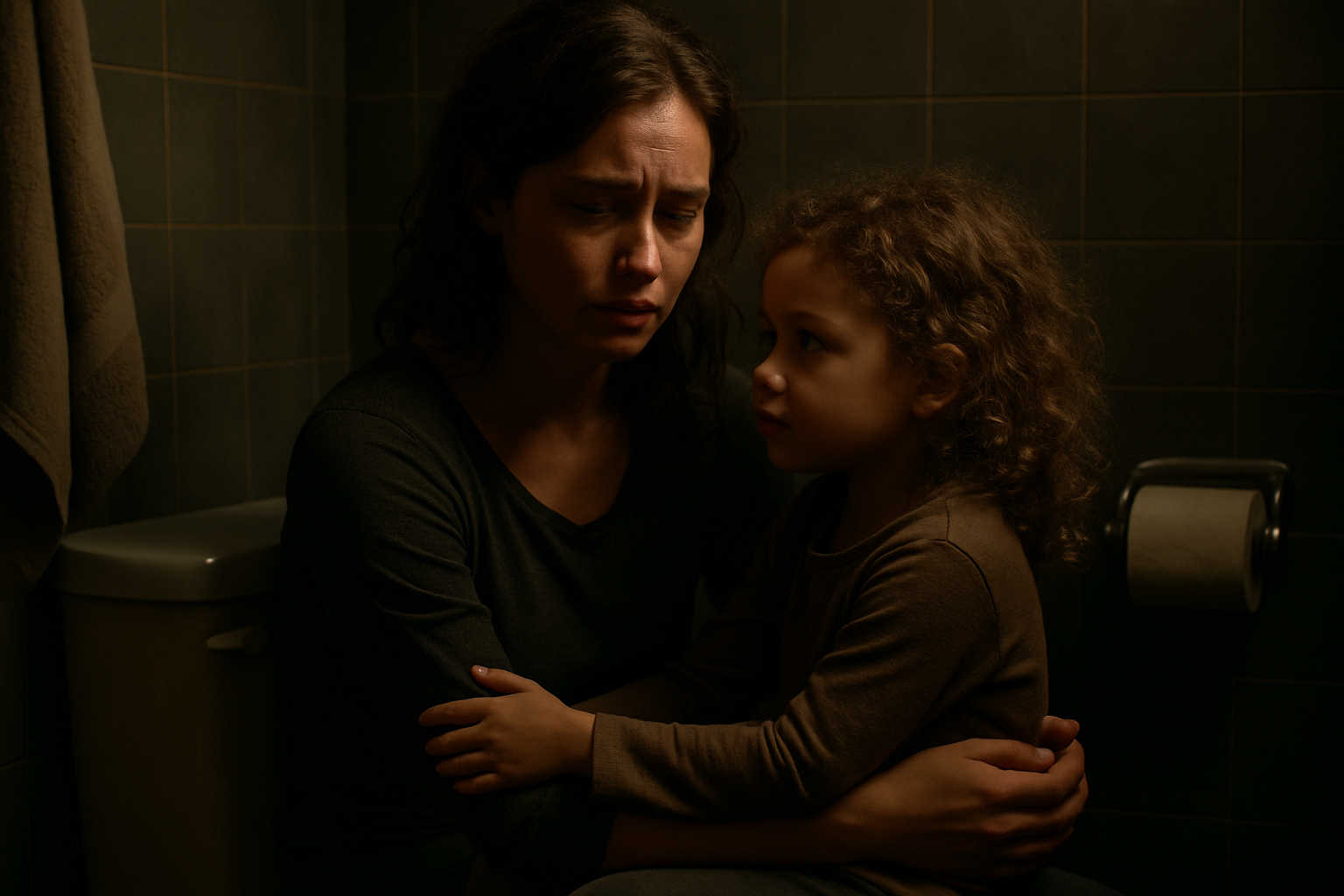
“You are far too smart.”
“Nana says I get it from you.”
“No,” Elara whispered, smoothing a curl behind Mira’s ear. “I think you got some of it from him.”
Before Mira could ask what that meant, a knock sounded at the hotel room door.
Elara went still.
The bathroom suddenly seemed too bright. Too small. Her skin prickled as if the past had found a way to reach through wood and brass and polite hotel carpeting.
The clock on the bedside table read 9:38 p.m.
She guided Mira back toward the bed and pulled the covers up around her, though neither of them pretended this meant anything was normal. Then Elara crossed the room on bare feet and looked through the peephole.
Maribel Sloane, the symposium coordinator, stood in the hallway holding a leather folder against her chest. She wore the apologetic expression of someone arriving with bad news and no graceful way to deliver it.
Elara slid the chain into place before opening the door a careful few inches. “Maribel?”
“I’m so sorry to disturb you this late, Dr. Vey.” Maribel lowered her voice, glancing down the hallway. “But after what happened at the arcade this afternoon, I thought you should know before morning. Cassian Thorne has registered for tomorrow’s keynote as a philanthropic sponsor.”
Elara’s fingers tightened against the doorframe.
“He what?”
“He made a donation substantial enough to fund the rural trauma outreach program for three years.” Maribel winced. “We can’t exactly deny him a seat.”
Of course they could not.
Cassian had always understood doors. If one would not open, he bought the building around it, renovated the entrance, and had his name engraved on the lintel.
“He’ll be there tomorrow,” Maribel said gently. “Third row, center. I thought you deserved warning.”
From behind Elara, Mira’s voice floated across the room, small and clear.
“Is my daddy coming to Mommy’s speech?”
Maribel’s eyes widened.
Elara closed the door as politely as panic allowed. Then she stood with her back pressed against it, breathing as if she had sprinted up ten flights of stairs.
Mira climbed onto the bed and hugged a pillow to her chest. “Are we leaving?”
The old answer rose inside Elara automatically, polished by years of use.
Yes. Pack your bag. We’ll call Nana. We’ll take the first train out before sunrise.
She could already imagine it: the suitcase snapped open, tiny socks swept into corners, Mira’s sleepy confusion, the desk clerk’s polite smile, the dawn station smelling of coffee and rain. Another exit. Another locked door. Another story told later in careful fragments.
But Mira was watching her.
And children did not only learn from speeches delivered behind podiums. They learned from suitcases. From silences. From the way their mothers looked over their shoulders in crowded rooms.
“No,” Elara said.
Mira’s face changed at once, softening with a relief that broke Elara’s heart.
“No more running?” she asked.
Elara crossed the room and sat beside her daughter, tucking the blanket around Mira’s knees.
“No more running without answers.”
It was not forgiveness.
It was not trust.
It was not a promise that the past could be mended, or that Cassian Thorne deserved anything from her beyond the truth he had crashed into by accident beneath the glass roof of a shopping arcade.
But it was honest.
And honesty, Elara realized, felt terrifyingly unfamiliar.
After Mira finally fell asleep, one fist curled beneath her cheek, Elara opened her laptop because the silence in the room had become unbearable. The screen painted the walls blue. Outside, the city moved behind thick curtains—horns, tires over wet pavement, the distant murmur of people who had no idea her life had split open again.
An email waited in her inbox from an address she did not recognize.
Subject: Not a wall. A bridge.
Elara nearly deleted it.
Then she saw the sender’s name.
Dr. Tobias Wren.
She knew that name.
Cassian had once mentioned him years ago, almost dismissively, as the family therapist his late mother had recommended and he had refused to see because Thorne men “did not pay strangers to excavate feelings.” Cassian had said it with that dry, aristocratic impatience that made emotion sound like a scheduling inconvenience.
Apparently, grief had changed his position.
Or perhaps losing her had.
Elara sat very still before clicking the message.
It was brief.
Dr. Vey,
I understand you have no reason to trust me, and I am aware that I am standing near the edge of my professional boundaries. I will not disclose private clinical details. I will say only this: Cassian has spent four years trying to understand why you left without allowing that pain to become cruelty.
Whatever you believe happened, there are facts you do not have.
He deserves a chance to know his daughter.
You deserve a chance to stop carrying a story that may not be true.
He will ask you for ten minutes tomorrow. Please consider giving him that much.
—T.W.
Elara read the email once.
Then again.
Then a third time, slower, as if the meaning might change if she approached it carefully enough.