The Lie That Stole Four Years

The Lie That Stole Four Years

Elara gave a laugh that broke halfway through, thin and wet as rain sliding down glass. “Is that what we’re calling it now?”

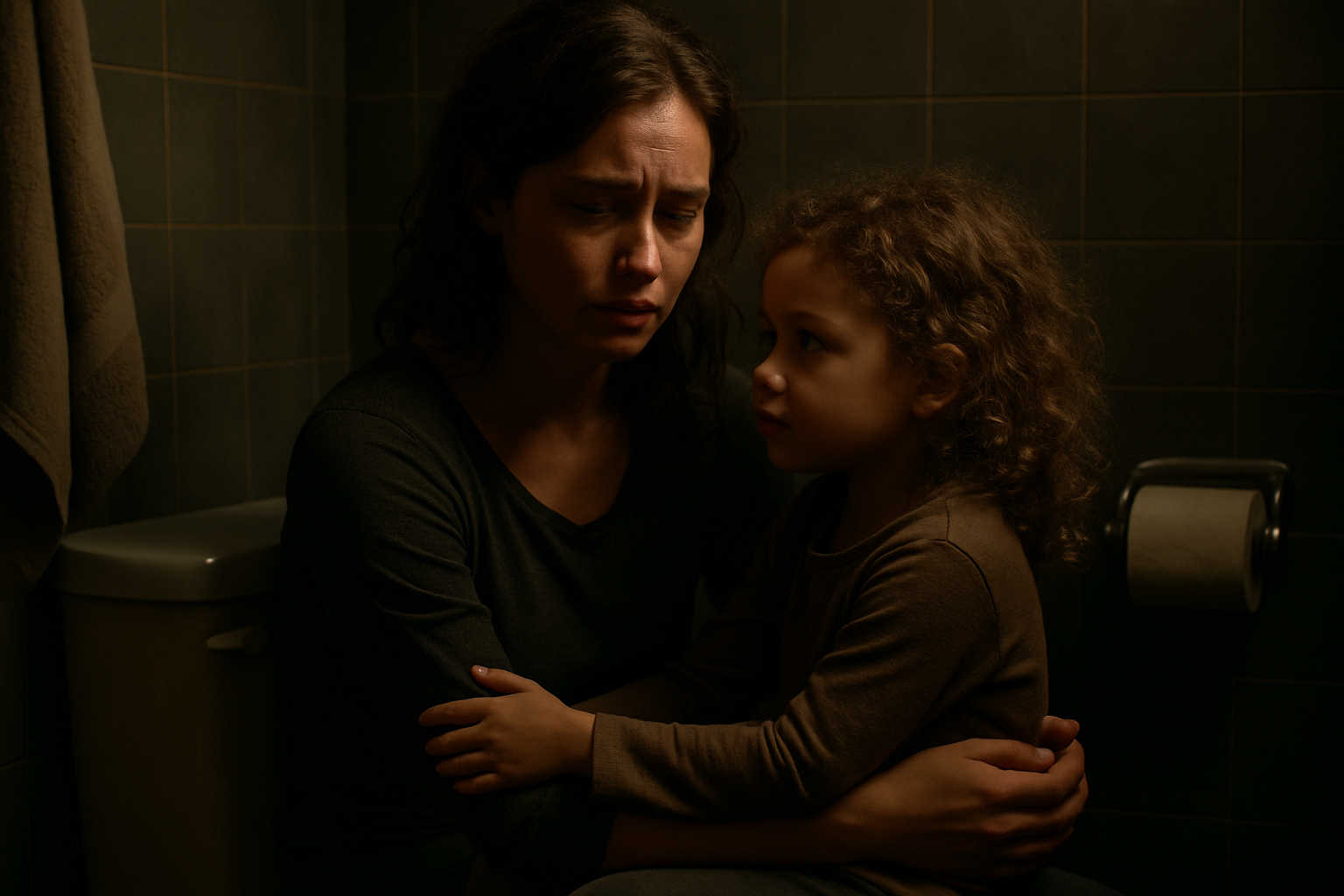
Mira, who at four years old had already mastered the art of appearing in doorways like a tiny judge with tangled curls, tilted her head. “You do bedroom crying too,” she said solemnly. “But bathroom crying means you don’t want me to know.”

Then she climbed into Elara’s lap with the unquestioning confidence of a child who had decided her mother was still a safe place, even if that mother had just been caught sitting on the closed toilet lid, mascara smudged beneath her eyes, failing spectacularly at adulthood.

“I know anyway,” Mira added.

Elara wrapped her arms around her daughter and pressed her lips to the warm crown of her head. She smelled like hotel shampoo, crayons, and the strawberry lip balm she had insisted was “grown-up makeup.”

“I’m sorry, sweetheart.”

Mira leaned back enough to study her. Her small face was serious in a way that always unsettled Elara, as if some ancient little soul had been tucked inside a child’s body by mistake.

“Was that man bad?”

The question landed harder than it should have.

For a second, Elara heard the chaos of the shopping arcade again—the bright music, the polished floors, Mira’s gasp over a window display full of mechanical butterflies. Then the world narrowing to one impossible figure across the atrium.

Cassian Thorne.

Four years gone, and yet there he had been, standing beneath a cathedral of glass and steel as though time itself had delivered him there. Older. Sharper around the edges. Still devastating in the quiet, ruinous way that had once made Elara forget how to breathe.

And then his eyes had dropped to Mira.

To the shape of her face.

To the storm-gray eyes that were not Elara’s.

Tell me she isn’t mine, he had whispered, so softly the words had seemed dragged out of him by pain.

Now, in the cramped warmth of the hotel bathroom, Mira waited.

Elara swallowed. “No,” she said at last.

Mira’s brow wrinkled. “Did he hurt you?”

It would have been easier to say yes.

So much easier.

That answer would have wrapped the past into something clean and useful. Bad man. Brave mother. Hidden child. A door closed because it had to be. A life rebuilt because there had been no other choice.

But Elara spent her days teaching families that lies, even the tender kind, left splinters. Lies told for protection still taught children to fear the truth. And Mira, with her grave eyes and merciless heart, deserved better than a story built only to spare Elara from shame.

“I thought he did,” Elara said quietly. “A long time ago.”

Mira considered that. “Did he?”

Elara looked beyond her daughter, toward the fogged hotel mirror. In the blurred silver surface, she saw herself not as she was now, but as she had been four years ago: twenty-eight, exhausted, secretly pregnant, standing barefoot in Cassian’s immaculate kitchen with a pregnancy test hidden at the bottom of her purse.

She had been waiting for him to come home.

She had planned to tell him everything that night.

She remembered the penthouse with cruel clarity—the black marble island, the city lights glittering like cold diamonds beyond the windows, the half-finished cup of tea she had forgotten to drink. She remembered Cassian’s phone buzzing on the counter where he had left it while rushing out to an emergency board meeting.

She had not meant to look.

Or perhaps she had.

The screen had lit with a name she knew too well.

Vesper Lorne.

The message had been short. Intimate. Damning.

And then the photo beneath it.

Cassian in a private room of a restaurant, Vesper’s hand on his chest, his mouth near her ear. A moment captured at just the right angle to look like betrayal made flesh.

Elara remembered the cold, clean snap inside her.

She remembered packing while Cassian was still trapped in that midnight boardroom, folding clothes with shaking hands, stuffing her passport and medical records into a weekender bag. She remembered leaving behind only a text message because if she had heard his voice, she might not have survived it.

I can’t do this anymore. Please don’t look for me.

Within an hour, she had changed her number.

By morning, she had left Halewick City behind.

In the coastal town of Briarport, she used her mother’s maiden name, rented a narrow apartment above a closed bakery, and built a new life with the fierce discipline of a woman convinced survival required locked doors, silent phones, and no forwarding address.

“I don’t know,” Elara admitted.

Mira frowned as if this answer offended the laws of the universe. “But you tell your kids at work that knowing is better than being scared.”

Elara stared at her.

“What?”

“You said it in your practice video,” Mira said. “Nana showed me. You said secrets make monsters bigger.”

For one breathless second, Elara could only look at her daughter. Then she closed her eyes and let out a laugh that almost became a sob.

“You are far too smart.”

“Nana says I get it from you.”

“No,” Elara whispered, smoothing a curl behind Mira’s ear. “I think you got some of it from him.”

Before Mira could ask what that meant, a knock sounded at the hotel room door.

Elara went still.

The bathroom suddenly seemed too bright. Too small. Her skin prickled as if the past had found a way to reach through wood and brass and polite hotel carpeting.

The clock on the bedside table read 9:38 p.m.

She guided Mira back toward the bed and pulled the covers up around her, though neither of them pretended this meant anything was normal. Then Elara crossed the room on bare feet and looked through the peephole.

Maribel Sloane, the symposium coordinator, stood in the hallway holding a leather folder against her chest. She wore the apologetic expression of someone arriving with bad news and no graceful way to deliver it.

Elara slid the chain into place before opening the door a careful few inches. “Maribel?”

“I’m so sorry to disturb you this late, Dr. Vey.” Maribel lowered her voice, glancing down the hallway. “But after what happened at the arcade this afternoon, I thought you should know before morning. Cassian Thorne has registered for tomorrow’s keynote as a philanthropic sponsor.”

Elara’s fingers tightened against the doorframe.

“He what?”

“He made a donation substantial enough to fund the rural trauma outreach program for three years.” Maribel winced. “We can’t exactly deny him a seat.”

Of course they could not.

Cassian had always understood doors. If one would not open, he bought the building around it, renovated the entrance, and had his name engraved on the lintel.

“He’ll be there tomorrow,” Maribel said gently. “Third row, center. I thought you deserved warning.”

From behind Elara, Mira’s voice floated across the room, small and clear.

“Is my daddy coming to Mommy’s speech?”

Maribel’s eyes widened.

Elara closed the door as politely as panic allowed. Then she stood with her back pressed against it, breathing as if she had sprinted up ten flights of stairs.

Mira climbed onto the bed and hugged a pillow to her chest. “Are we leaving?”

The old answer rose inside Elara automatically, polished by years of use.

Yes. Pack your bag. We’ll call Nana. We’ll take the first train out before sunrise.

She could already imagine it: the suitcase snapped open, tiny socks swept into corners, Mira’s sleepy confusion, the desk clerk’s polite smile, the dawn station smelling of coffee and rain. Another exit. Another locked door. Another story told later in careful fragments.

But Mira was watching her.

And children did not only learn from speeches delivered behind podiums. They learned from suitcases. From silences. From the way their mothers looked over their shoulders in crowded rooms.

“No,” Elara said.

Mira’s face changed at once, softening with a relief that broke Elara’s heart.

“No more running?” she asked.

Elara crossed the room and sat beside her daughter, tucking the blanket around Mira’s knees.

“No more running without answers.”

It was not forgiveness.

It was not trust.

It was not a promise that the past could be mended, or that Cassian Thorne deserved anything from her beyond the truth he had crashed into by accident beneath the glass roof of a shopping arcade.

But it was honest.

And honesty, Elara realized, felt terrifyingly unfamiliar.

After Mira finally fell asleep, one fist curled beneath her cheek, Elara opened her laptop because the silence in the room had become unbearable. The screen painted the walls blue. Outside, the city moved behind thick curtains—horns, tires over wet pavement, the distant murmur of people who had no idea her life had split open again.

An email waited in her inbox from an address she did not recognize.

Subject: Not a wall. A bridge.

Elara nearly deleted it.

Then she saw the sender’s name.

Dr. Tobias Wren.

She knew that name.

Cassian had once mentioned him years ago, almost dismissively, as the family therapist his late mother had recommended and he had refused to see because Thorne men “did not pay strangers to excavate feelings.” Cassian had said it with that dry, aristocratic impatience that made emotion sound like a scheduling inconvenience.

Apparently, grief had changed his position.

Or perhaps losing her had.

Elara sat very still before clicking the message.

It was brief.

Dr. Vey,

I understand you have no reason to trust me, and I am aware that I am standing near the edge of my professional boundaries. I will not disclose private clinical details. I will say only this: Cassian has spent four years trying to understand why you left without allowing that pain to become cruelty.

Whatever you believe happened, there are facts you do not have.

He deserves a chance to know his daughter.

You deserve a chance to stop carrying a story that may not be true.

He will ask you for ten minutes tomorrow. Please consider giving him that much.

—T.W.

Elara read the email once.

Then again.

Then a third time, slower, as if the meaning might change if she approached it carefully enough.

There are facts you do not have.

The phrase settled cold and heavy in her stomach.

She wanted to hate it. She wanted to decide Cassian had manipulated his therapist, the symposium, the hotel, the whole city. That he had found a polished way to corner her while pretending to be wounded. That every step he took was strategy because Cassian Thorne did not stumble through life—he conquered it.

But the sentence cracked open a memory she had buried because it did not fit the betrayal she had chosen to believe.

The night before she left.

Cassian standing in their bedroom doorway, his tie loosened, his face drawn with exhaustion but his eyes tender when they found her. He had crossed the room and kissed her forehead, lingering there in a way that felt almost reverent.

Keep Saturday free, he had said. I have something to tell you. Something that might change everything.

At the time, she had believed he meant the affair.

She had believed he meant confession.

Or divorce.

What if he had meant something else?

The room seemed to tilt around her.

Elara rose quietly and checked on Mira, whose hair fanned over the pillow like spilled ink. Her daughter’s mouth was slightly open in sleep. Her daughter, who loved pancakes cut into stars. Who cried when cartoon animals lost their mothers. Who had Cassian’s eyes and Elara’s stubborn chin. Who had learned far too early that some subjects made adults stop breathing.

Elara returned to the desk.

At midnight, with her hands trembling despite her best efforts, she typed a message to the number she still knew by heart.

Ten minutes after my keynote. Public place. No lawyers. No threats.

She stared at the words for almost a full minute before sending them.

The reply came so quickly she knew he had been sitting somewhere with his phone in his hand, waiting like a man afraid the world might disappear if he looked away.

Thank you, Elara. No lawyers. No threats. Just the truth.

She did not sleep after that.

The ballroom at the Aurelian Grand was full by nine the next morning.

Elara had spoken to rooms larger than this one. She had addressed hospital boards, academic conferences, state policy councils, and rooms full of skeptical clinicians who preferred data to feeling. But none of those rooms had ever contained the father of her child.

Backstage, she smoothed the sleeve of her navy dress until the fabric warmed beneath her fingers. Her notes waited on the lectern, printed, highlighted, useless. She knew the speech. She had written it months ago in Briarport, at her kitchen table after Mira had fallen asleep beside a half-finished puzzle.

Near the curtain, Mira sat with Maribel and a coloring book spread over her knees. The child minder assigned to them was a grandmotherly woman with kind eyes, silver curls, and a cardigan embroidered with tiny yellow flowers, but Mira had refused to leave Elara’s sight until the last possible second.

“Mommy,” Mira said without looking up from her purple crayon, “if he smiles, I want to see if his eyes do the crinkle thing.”

Elara crouched before her. “Sweetheart, after my talk, I need to speak to him first.”

Mira finally looked up. “Because grown-ups have to fix the big feelings?”

“Yes.”

“Then don’t forget the kid feelings,” Mira said, and returned to coloring as if she had not just reached inside Elara’s ribs and pressed her thumb directly against the bruise.

Elara kissed her forehead. “I won’t.”

When her name was announced and she walked onto the stage, the applause sounded strangely far away, like rain falling at the end of a tunnel. The lights were bright enough to blur the audience into shapes and shadows, but she found Cassian immediately.

Third row, center.

Exactly as Maribel had warned.

He wore a charcoal suit and no tie, the open collar making him look less like the ruthless young king of Thorne Meridian and more like a man who had spent a long time at war with himself. His dark hair was slightly longer than it had been four years ago. There were new lines at the corners of his eyes, not weakness, but weathering. Proof that even men made of steel could be marked by storms.

Beside him sat Isolde Marek, the poised woman from the arcade, her cream coat folded carefully across her lap. Beautiful. Composed. Watching everything.

Elara’s stomach twisted before she forced herself to look away.

Cassian did not smile.

He simply looked at her as though she were both the wound and the cure.

Elara reached the podium and adjusted the microphone. For one terrifying second, she was certain her voice would fail. Then training rose up inside her, steady as a hand at her back.

“Childhood trauma does not always begin with violence,” she said. “Sometimes it begins with silence. With a door closing. With a question adults refuse to answer because they believe fear is safer than truth.”

The ballroom quieted.

Her own words seemed to change as she spoke them.

They had been written for clinicians, polished for research, shaped for policy and practice. But now they slipped free of the page and entered her bloodstream. They were no longer only theory. They were Mira standing in a bathroom doorway. Mira asking if the man with her eyes was bad. Mira saying secrets make monsters bigger.

Elara spoke about children who sensed emotional weather before adults named the storm. About how a mother’s flinch could become a child’s map of danger. About how protective lies, even loving ones, could teach a child that truth was something too dangerous to touch.

She spoke about panic disguised as wisdom.

About love that became controlling when driven by fear.

About the way silence could harden inside a family until everyone mistook it for safety.

She avoided looking at Cassian through most of it. If she looked too long, she feared she would see not the billionaire who had broken her heart, but the man who once fell asleep with his hand spread protectively over her stomach before either of them knew Mira existed.

Then the question period began.

Hands rose across the ballroom. A pediatrician asked about screening protocols. A school counselor asked about children resisting disclosure. A hospital director wanted to know how to train staff in rural clinics.

Elara answered each one carefully.

Then Cassian raised his hand.

The moderator glanced down at the seating chart and nodded. “Mr. Thorne.”

Elara gripped the edges of the podium.

Cassian stood.

He did not rush. He did not perform. He merely rose from his seat with the quiet command that had once made entire boardrooms fall silent before he spoke. His voice carried easily through the ballroom, low and controlled, though Elara heard the strain beneath it because she had once known every hidden register of that voice.

“Dr. Vey,” he said, “you spoke about children inheriting adult fear. What would you tell a parent who hid a painful truth to protect a child, only to realize the silence might be hurting that child too?”

The room went utterly still.

It was professional enough to pass.

Personal enough to cut.

Elara met his eyes across the sea of faces, and for the first time in four years, she did not look away.

“I would tell that parent that protection is not the same thing as control,” Nora said.

Her voice did not rise, but the room seemed to quiet around it anyway.

A hundred people sat beneath the chandeliers of the Fairmont ballroom—therapists, teachers, foster parents, donors, social workers, people with pens paused above notebooks and coffee cooling in paper cups. Yet Nora’s answer was not for them anymore.

It was for the man standing near the aisle, asking a question with a voice she had spent four years trying not to remember.

“And I would tell them,” she continued, fingers tightening around the edge of the podium, “that children do not need perfect adults. They need brave ones. Adults who can kneel down, look them in the eye, and say, ‘I was scared. I was wrong. I am trying to tell the truth now.’”

Adrian Ellison stood very still.

For one suspended second, Nora saw not the billionaire in the dark tailored suit, not the man whose name had appeared in business magazines and charity bulletins and headlines she refused to read. She saw the husband who used to fall asleep with case files open on his chest because he wanted to understand her work. The man who had once driven across Boston at midnight because she said she wanted lemon gelato and then acted offended when she called him ridiculous.

Something in his face shifted.

Pain first.

Then hope.

Then restraint, as if he had trained himself not to reach for things he had no right to touch.

“Thank you,” he said.

Two words. Quiet. Ruined.

Then he sat down.

The applause rose around Nora like weather. People stood. Someone wiped their eyes. A woman in the second row pressed both hands over her heart. Nora heard none of it clearly. Her ears were full of her own pulse, full of the impossible fact of Adrian sitting ten rows away from their daughter.

Their daughter.

Maddie, who was twisting a purple ribbon around her finger beside Olivia. Maddie, who had Adrian’s eyes and Nora’s stubborn chin. Maddie, who still believed her father was a story without a name.

When the panel ended, Nora stepped down from the stage, smiling when people touched her arm, accepting praise she could barely process. Faces blurred. Compliments washed past her.

“Powerful talk.”

“Your daughter must be proud.”

“You’ve given so many families language for their pain.”

Language, Nora thought wildly. I have given everyone language except myself.

The crowd began to thin. Chairs scraped. Programs folded. The ballroom emptied in little streams of perfume, wool coats, and murmured conversations.

Nora remained near the stage because her knees did not feel trustworthy.

Then Adrian approached.

Slowly.

Carefully.

As though she were a frightened animal and he knew one wrong movement could send her running again.

Celeste lingered several yards behind him, near the aisle. Her arms were crossed, but not defensively. Almost deliberately. As if she wanted Nora to see that she was not part of whatever was about to happen. Not an eavesdropper. Not a shield. Not a witness unless invited.

“Nora,” Adrian said.

Her name in his mouth was almost unbearable.

She lifted her chin. “Ten minutes.”

He nodded at once. “Ten minutes.”

“No lawyers.”

“No lawyers.”

“No accusations.”

His throat moved. “Only answers.”

She glanced toward the side door. “Where?”

“There’s a conference room down the hall.”

“No closed rooms.”

“Then the lobby,” he said quickly. “The hallway. Outside. Anywhere you choose.”

Before Nora could answer, a small blur in a yellow cardigan escaped Olivia’s grasp.

“Maddie, wait—” Olivia called.

But Maddie Grace Ellison was already running down the aisle, curls bouncing, Mary Janes tapping against the carpet with decisive little thuds.

“Maddie Grace Ellison,” Nora warned, but her daughter did not slow.

Maddie stopped directly in front of Adrian and tipped her head back.

Nora’s heart stopped with her.

Adrian looked down at the child and went utterly still.

Not startled.

Not politely curious.

Still in the way a man might be if the world had cracked open beneath him and revealed something sacred.

Maddie studied him with the grave intensity of a child solving a puzzle adults had failed to explain.

“Do your eyes crinkle when you smile?” she asked.

The question landed like a glass breaking.

Nora reached them, breathless. “Maddie, sweetheart, this isn’t—”

“It’s important,” Maddie insisted, not looking away from Adrian. “Mine do, and Mommy said I got them from my daddy, but she never said his name.”

Adrian dropped to one knee.

The movement was slow, reverent. He came eye-level with Maddie, and Nora saw his hands tremble once before he folded them carefully in front of him.

“I think they do,” he said.

Maddie narrowed her eyes. “Show me.”

For the first time, Adrian smiled.

It was not the practiced expression Nora had seen on magazine covers. Not the sharp, controlled smile from acquisition interviews. Not the public face of Adrian Ellison, founder, investor, philanthropist, unreachable man of steel and charm.

This smile was broken.

Bright.

Terrified.

Full of wonder.

And at the corners of his eyes, the skin crinkled in the exact soft fan that appeared whenever Maddie grinned too hard.

Maddie gasped.

“Mommy.”

Nora could not move.

Maddie reached out one small hand and touched the corner of Adrian’s eye, as though checking a miracle for seams.

“You are him,” she whispered.

Adrian’s smile collapsed into tears he did not try to hide.

“Yes,” he said, voice unsteady. “I think I am.”

Nora turned away for half a second because the sight was too much. Too beautiful. Too cruel. Too late.

They did not go to a conference room.

They did not go to the lobby.

They went to Adrian’s café.

It stood two blocks from the Fairmont, tucked into the bottom floor of an old brick building on Newbury Street, beneath a black-painted sign with simple white lettering:

AFTER RAIN.

Nora had seen the name before. Of course she had. Boston had talked about it for months.

A billionaire former tech CEO abandoning a corner office to open an independent café and community bookstore? That was the kind of thing people either romanticized or mocked. Business columns called it an “unexpected pivot.” Lifestyle magazines called it “quietly revolutionary.” Social media called it everything from a redemption arc to a tax write-off.

Nora had never clicked the articles.

She had told herself it was vanity. Another rich man polishing his public image with reclaimed wood, fair-trade coffee, and a curated wall of books he had probably never read.

She was wrong.

Money could buy the brick building. The custom shelves. The polished espresso machine. The antique piano near the front windows.

But money alone could not create warmth.

This place had been built by grief. By longing. By hands that wanted to make shelter and did not know for whom.

Bookshelves climbed the exposed brick walls, crowded with novels, memoirs, poetry, children’s books, and worn paperbacks with handwritten staff recommendations tucked beneath them. A long communal table sat under amber lights, scattered with students’ notebooks and half-empty mugs. Children’s drawings had been pinned beside flyers for grief groups, poetry nights, foster family workshops, free tutoring sessions, and a support circle for fathers learning to parent after absence.

Nora saw that flyer and had to look away.

Behind the counter, a man in a Red Sox cap looked up when the bell over the door chimed.

His expression shifted instantly from cheerful to concerned.

“Adrian?”

“Russell,” Adrian said, his voice controlled but thin, “we’ll be upstairs for a little while.”

Russell’s gaze flicked to Nora, then to Maddie, then back to Adrian with the sharp understanding of someone who knew more than a casual employee should.

“Of course.”

Adrian crouched beside Maddie again. “Russell knows all the best books in the shop. Do you like unicorn stories?”

Maddie lifted her chin. “I like unicorn books, dragon books, and books where girls save people.”

Russell nodded solemnly. “Excellent taste. We have an emergency shelf for that.”

“I like hot chocolate too,” Maddie added.

“Then we’ll need to discuss marshmallow architecture,” Russell said. “It’s very serious. Load-bearing marshmallows are not a joke.”

Maddie looked to Nora.

For permission.

For reassurance.

For the answer to a question too big for her small body.

Nora hesitated.

Every instinct screamed no. Keep Maddie close. Keep Adrian at a distance. Keep the whole fragile world from changing too quickly.

Then she saw Olivia settling at a nearby table, laptop already open, eyes alert. Olivia gave Nora a small nod that said: I have her. I am right here. I will burn this building down before I let anything happen to your child.

Nora exhaled.

“All right,” she said. “You stay where I can see you from the stairs.”

Maddie beamed.

Adrian looked as though Nora had handed him something priceless simply by allowing the child to remain in his building.

Upstairs, Adrian’s office looked nothing like the glass cage he had once occupied at Vale Meridian.

There were no steel walls, no skyline arrogance, no sterile white leather or sculptural pieces chosen by a consultant. This room had slanted afternoon light, old wood floors, overflowing books, and a low sofa upholstered in faded green velvet. A kettle sat on a sideboard beside two mismatched mugs. Papers were stacked in imperfect piles. A wool coat hung from the back of a chair.

And on the desk, in a silver frame, was a photograph.

Nora recognized it before she meant to.

Boston Public Garden.

Their first year of marriage.

Adrian’s hair windblown. Nora’s scarf crooked. Both of them laughing because she had spilled coffee down the front of his shirt and her own coat, then declared the swan boats cursed and demanded they flee the scene of the crime.

She had taken that photo with her old phone.

He had kept it.

For four years.

Adrian saw her notice.

“I looked at it every day for a year,” he said quietly. “Then every week, because every day was killing me. Then every day again, because forgetting felt worse.”

Nora wrapped her arms around herself. “Adrian—”

“No lawyers,” he said. “No threats. No performance. Just truth.”

He crossed to a small cabinet near the bookcase and withdrew a blue velvet box.

Nora stared at it.

“I don’t want gifts.”

“It was never just a gift.”

He opened it.

Inside lay a necklace.

Three delicate stones formed the center setting, though one place on the side had been left empty, waiting. Tiny charms lay beneath the chain: a coffee cup, a book, a key, and a small silver cradle.

Nora’s breath caught hard enough to hurt.

“The messages you saw,” Adrian said, “were about this. This and the room at the Liberty Hotel, where I planned our anniversary dinner. Vivienne was coordinating with the jeweler, the event designer, and Dr. Lena Ortiz from Boston Children’s.”

Nora gripped the back of the nearest chair.

No.

She remembered the messages. The secrecy. The hotel name. Vivienne’s carefully casual tone. Adrian closing his laptop too quickly. Adrian saying, “It’s complicated,” when she asked why he had been meeting Vivienne after hours.

She remembered the photograph most of all.

A grainy image sent from an unknown number.

Adrian and Vivienne outside a hotel suite.

Vivienne’s hand on his arm.

Adrian looking down at her with an expression Nora had interpreted through the lens of her worst fear.

“I was going to announce a foundation in your name,” he said. “The Ellison Center for Child Recovery.”

Nora’s stomach dropped.

“No.”

“Yes.”

“The hotel photo—”

“Was taken after we toured the ballroom.” His jaw tightened. “Vivienne sent it to my father.”

The room chilled.

“Your father?”

Adrian closed the box as if the necklace had become too fragile to leave exposed.

“This is the part I didn’t know until six months after you left.” He sat on the edge of the desk, not close to her, never close enough to trap her. “My father wanted me in Tokyo for the expansion. He thought marriage made me soft. He thought your work made me sentimental. He thought I was becoming distracted by children who were not profitable and a wife who encouraged me to care about things he couldn’t quantify.”

Nora’s fingers dug into the chair.

“When he realized I was preparing to step back from daily operations and put real money into a child trauma foundation, he panicked.”

“He staged it?” she whispered.

“Not all of it.” Adrian’s face twisted with disgust. “That’s what made it work. The dinner was real. The secrecy was real. The messages were real, but selected, rearranged, and pushed where you would see them. Vivienne admitted he paid her to make sure you misunderstood enough to confront me or leave before the board vote.”

Nora could barely breathe.

“She thought I’d explain,” he continued. “She thought we’d have a vicious fight, maybe delay the announcement, maybe I’d go to Tokyo to prove something. She didn’t know you were pregnant.” His voice broke. “Neither did I.”

Nora sank into the chair.

The betrayal she had carried for four years changed shape inside her.

It did not vanish.

It did not become harmless.

It became something worse in some ways.

Sadder.

More grotesque.

Adrian had not betrayed her with Vivienne.

Her fear had betrayed her.

And someone cruel had known exactly where to place the blade.

Nora saw it all again: the pregnancy test wrapped in tissue at the bottom of her purse, the nausea she had blamed on stress, the photograph glowing on her phone in the dark, Adrian coming home late, her own voice shaking as she asked him where he had been.

And Adrian—tired, distracted, secretive—saying, “Please trust me for one more day.”

One more day.

She had not given him even one more hour.

“Why didn’t you tell me?” she whispered.

The question sounded absurd the moment it left her mouth because she had been the one to disappear.

But Adrian did not punish her for it.

“I tried,” he said. “Your number was gone. Your email bounced. Your mother told me you were safe but refused to say where.”

“My mother thought she was protecting me.”

“I know.” He looked down. “At the time, I hated her for it. Now…” He swallowed. “Now I understand more than I want to.”

Nora pressed a fist against her stomach.

“I hired investigators,” he said. “My father’s security team fed them bad information for months. Every time I got close, the trail went cold. By the time I found out what was happening, you had changed your professional name and moved twice.”

“I thought you’d use your money to take the baby,” Nora said, the confession ripping out of her before she could soften it. “I thought if you found out I was pregnant, you would punish me for leaving.”

Adrian flinched.

She hated that he flinched.

She hated that she had once loved him enough to believe in his gentleness and feared him enough to run from his power.

“My father had a stroke,” Adrian said after a moment. “Then complications. When he died, I found the bank transfer to Vivienne in his private records, along with notes about the board vote and the Tokyo expansion.”

Nora covered her mouth.

“I confronted her,” he said. “She told me enough to confirm what he’d done. Not out of guilt. Out of fear that I’d ruin her.” His mouth hardened. “I could have.”

“Why didn’t you?”

“Because by then ruining people felt too much like him.”

The answer struck her somewhere tender.

“I kept looking,” Adrian said. “But I made myself one promise. If I found you and you had built a life without me, I would not destroy it just because I was hurt.” His eyes shone. “But I did not know about Maddie.”

Downstairs, Maddie laughed at something Russell said.

The sound floated up through the floorboards, bright and alive and impossible.

Adrian turned his face toward it as if drawn by gravity.

“I missed everything,” he whispered. “Did she walk early? Was she afraid of thunderstorms? What was her first word?”

Nora closed her eyes.

“Moon.”

A tear slipped down his cheek.

“She pointed at the moon from her crib and said it like she’d discovered it personally.” Nora’s voice trembled, but once she began, she could not stop. “She hates peas but eats broccoli if you call it tiny trees. She had night terrors when she was two. She asks about her father every few months, then pretends she didn’t because she thinks it makes me sad.”

Adrian pressed his fist to his mouth.

For a while, neither of them spoke.

Outside the office window, late afternoon traffic slid along Newbury Street in silver and red streaks. Somewhere below, the espresso machine hissed. A bell chimed as someone entered the café. Life continued with shameless indifference, as if the center of Nora’s world had not just split open.

Finally Adrian lowered his hand.

“Tell me everything,” he said.

Nora shook her head. “You don’t get everything in one afternoon.”

“I know.”

“You don’t get to walk into her life and become a father because biology says you are one.”

“I know.”

“And you don’t get to decide what happens next alone.”

His eyes found hers. “I would never.”

She almost laughed, but it came out broken. “You come from a long line of men who decide things.”

“I know that too.”

The answer was quiet, and because it was quiet, because it carried no defense, it unnerved her.

Nora looked toward the framed photograph again.

“How am I supposed to trust any of this?” she asked. “How am I supposed to know you’re not saying exactly what I need to hear?”

Adrian stood, crossed to the desk, and opened a drawer. He removed a thick folder bound with a black clip and placed it on the low table between them.

Nora did not touch it.

“What is that?”

“Everything,” he said. “The bank transfer. Copies of Vivienne’s statements. The old hotel invoices. Emails between my father and his security chief. The original plans for the foundation. Lena’s correspondence. The jeweler’s sketches. My investigators’ reports.” His voice roughened. “And every unopened letter I wrote you before I realized your mother was sending them back.”

Nora stared at the folder as though it might bite.

“I’m not asking you to read it now,” Adrian said. “I’m not even asking you to believe me now. I’m giving you what I should have given you then. The truth in a form you can verify without trusting my face.”

That nearly undid her.

Because once, she had trusted his face more than any evidence in the world.

Then one photograph had taught her not to.

A soft knock sounded at the office door.

Nora turned.

Olivia stood there with Maddie in front of her. Maddie had a hot chocolate mustache, a unicorn book tucked under one arm, and a face full of too many questions.

“Sorry,” Olivia said gently. “She insisted.”

“I did not insist,” Maddie said. “I respectfully demanded.”

Despite everything, Adrian let out a small, startled laugh.

Maddie’s eyes flew to him.

There it was again.

The crinkle.

Her expression softened into awe.

“Mommy,” she said, stepping into the room. “Is he my daddy?”

Nora had imagined this question a hundred times.

In quiet rooms.

In grocery store aisles.

In bed at midnight with Maddie asleep beside her after a nightmare.

She had imagined crafting a careful answer someday, when Maddie was older, when Nora was ready, when the past felt less like an active wound.

But children did not wait for adults to become ready.

Nora knelt.

Adrian remained standing, rigid, as if afraid even his breathing could influence the answer.

Nora took Maddie’s sticky little hands.

“Yes,” she said, and the single word changed every wall in the room. “Adrian is your father.”

Maddie looked from Nora to Adrian and back again.

“Did you know?”

Nora’s throat tightened.

“I knew his name,” she said. “But I didn’t know everything I should have known.”

Maddie frowned. “Why didn’t he come?”

Adrian closed his eyes.

Nora could have answered alone. She had earned that right. But the words she had spoken on stage came back to her like a challenge.

Children do not need perfect adults. They need brave ones.

She looked up at Adrian.

His face was pale, but he nodded.

Nora turned back to Maddie.

“Because Mommy and Daddy got hurt,” she said carefully. “And scared. And confused. I thought something was true that wasn’t true. So I went away before we could talk about it.”

Maddie’s brow wrinkled.

“That was not a good choice?”

“No,” Nora whispered. “It was a choice I made because I was frightened. But it hurt people.”

Maddie looked at Adrian.

“And you didn’t find us?”

“I tried,” he said, voice unsteady. He lowered himself slowly to one knee again, keeping distance between them. “But I didn’t try in the right ways fast enough. And some people made it harder. That is not your fault. None of it is your fault.”

Maddie considered him.

Children could be merciful, but not because they were simple. Sometimes they saw the heart of a thing faster than adults, who buried truth beneath pride and history and fear.

“Were you sad?” she asked.

Adrian’s mouth trembled. “Very.”

“Did you know about me?”

“No,” he said. “I wish I had.”

“If you knew, would you have come to my birthday?”

His breath caught. “Every one.”

“I had a unicorn cake when I was four.”

“I would have loved that.”

“It had too much frosting.”

“I like too much frosting.”

Maddie took one step closer.

Nora’s body tensed.

Adrian did not move.

Maddie looked at his hands. “Are you allowed to hug me?”

The question destroyed him.

He looked at Nora.

Not at Maddie.

At Nora.

Asking permission with his whole face.

Nora’s heart cracked in two directions.

One half screamed no. Not yet. Too much. Too fast.

The other half saw Maddie waiting, saw Adrian trembling, saw four years stolen by fear and manipulation and silence.

She swallowed.

“If Maddie wants to,” Nora said, “and if it’s a gentle hug.”

Maddie needed no further encouragement.

She stepped into Adrian’s arms.

He folded around her carefully at first, as if she were made of spun glass. Then Maddie wrapped her little arms around his neck and patted his back with a seriousness that made Olivia turn her face away.

Adrian bowed his head over his daughter’s shoulder.

No sound came out of him.

But his shoulders shook.

Maddie pulled back after a moment and studied him.

“You cry a lot,” she observed.

Adrian laughed through the tears. “Today I do.”

“That’s okay,” she said. “Mommy says tears are your feelings spilling because your body got too full.”

“She’s right.”

“I know.”

Nora wiped her cheeks before Maddie could see too much.

Maddie held up the unicorn book. “Russell says I can borrow this if I bring it back.”

“You can keep it,” Adrian said.

Nora gave him a look.

He immediately corrected himself. “You can borrow it. With your mother’s permission. From the lending shelf.”

Maddie nodded approvingly. “Good listening.”

A real smile touched Nora’s mouth before she could stop it.

For a moment—one dangerous, luminous moment—the four of them stood in the office as if they were not surrounded by wreckage. As if a family could be spoken back into existence simply because a child asked the right questions and adults finally stopped lying.

Then Olivia’s phone buzzed.

She glanced down, and her expression changed.

Nora noticed at once. “What is it?”

Olivia hesitated. “Nora…”

Adrian stood slowly, still keeping one hand near Maddie but not on her.

“What happened?” he asked.

Olivia looked at him, then back to Nora.

“There are two reporters outside,” she said. “Maybe more. Someone tipped them off that Adrian Ellison left the conference with a child.”

Nora’s blood went cold.

Adrian’s face hardened in a way she recognized from another life, though it was not directed at her.

“Russell can take them through the back exit,” he said immediately. “No one speaks to anyone. No photos.”

Maddie looked confused. “Why are reporters here?”

“Because some grown-ups are nosy for money,” Olivia muttered.

Nora reached for Maddie. “Come here, baby.”

But before Maddie could move, footsteps sounded on the stairs.

Quick. Uneven. Familiar enough that Adrian turned before the knock came.

Russell appeared in the doorway, Red Sox cap in hand now, his face grim.

“Adrian,” he said, “I’m sorry. She pushed past me.”

Nora felt Adrian go still beside her.

A woman stepped into view behind Russell.

Elegant coat. Pale hair pinned at the nape of her neck. Red lipstick still perfect, though her eyes were frantic.

Nora knew her from a hundred nightmares.

Vivienne.

Her gaze swept the room—Adrian, Nora, Maddie, the folder on the table—and for the first time in all the years Nora had imagined confronting her, Vivienne did not look smug.

She looked terrified.

“I didn’t call the reporters,” Vivienne said quickly. “But I know who did.”

Adrian’s voice was ice. “Get out.”

Vivienne shook her head, eyes shining with panic. “You need to listen to me. All of you do.”

Nora pulled Maddie closer.

Vivienne looked at the child, and something like shame crossed her face.

Then she turned back to Adrian.

“Your father wasn’t the only one who lied.”

Nora’s body went cold in a way that did not belong to the café, or the rain-silvered windows, or the cup of hot chocolate cooling on a nearby table.

It belonged to memory.

To a sterile hospital room.

To Adrian’s ring on her finger feeling suddenly heavier than bone.

To a message that had not come from him.

To a lie crafted with such precision that grief had worn it like truth.

Maddie pressed closer to Nora’s side. “Mommy?”

Nora’s hand found her daughter’s hair automatically, but her eyes stayed on Vivienne.

Vivienne Cross had once moved through Adrian’s world like she owned part of the air he breathed. She had been his father’s favorite kind of person—polished, ambitious, useful. She had known what to say at charity dinners, how to laugh at board meetings, how to make a compliment sound like a contract. Nora remembered her as all sharp silk and smooth poison, the woman who had looked at Nora’s pregnancy with a smile too calm to be kind.

Now Vivienne looked different.

Not broken exactly.

Reduced.

As if whatever had once lacquered her had cracked and left only a tired woman standing inside it.

Adrian stepped between her and Maddie without thinking. “You do not get to walk in here and perform remorse.”

Vivienne flinched. “I know.”

“No, you don’t.” His voice turned low, dangerous. “You don’t know what you did.”

“I do.”

“You sent her away.”

Vivienne’s mouth trembled, but she did not look down. “Yes.”

Nora inhaled sharply.

Adrian turned, as if the word itself had struck him from behind. “What?”

Vivienne swallowed. “I sent the message.”

The café seemed to lose sound.

Russell’s hand tightened around the back of a chair. Dr. Hart went still at the base of the stairs. Nora felt Maddie’s small fingers curling into the hem of her sweater, confused by the adult silence, frightened by its size.

Adrian stared at Vivienne.

“No,” he said softly.

The word was not denial. It was a plea.

Vivienne’s eyes shone. “I used your phone.”

Adrian took one step back.

Nora could not breathe.

Vivienne continued before anyone could stop her, as if she had practiced the confession so many times that stopping now would kill her. “You were in London. There had been an issue with the merger documents, and your father called me into his office because he thought Nora was becoming a problem.”

“My father,” Adrian said.

“Yes.”

Nora’s vision blurred at the edges. She remembered Theodore Vale—Adrian’s father—standing in the hospital corridor two days after Maddie was born, not offering congratulations, only legal language disguised as concern. She remembered how his eyes had passed over the baby as if Maddie were a complication in a contract.

Vivienne looked at Nora then, and whatever pride she had once worn was gone.

“He said you were emotional, postpartum, unstable. He said the child would ruin Adrian’s future if you stayed. He said Adrian was too loyal to cut ties properly and that someone needed to make the decision for him.”

Adrian’s jaw flexed. “So you volunteered?”

“No.” Vivienne’s face tightened. “I wish I could tell you I fought him. I didn’t. I argued for about thirty seconds because I knew it was cruel. Then he reminded me my firm’s entire contract with Vale Group depended on his confidence. He reminded me my father owed him money. He reminded me I was replaceable.”

“And that was enough?” Nora’s voice came out thin, scraped raw. “That was enough to destroy a newborn’s family?”

Vivienne closed her eyes.

When she opened them, tears slipped down her face.

“No,” she whispered. “It wasn’t enough. Not morally. But it was enough for the person I was then.”

Nora almost laughed, but the sound would have been ugly.

Maddie looked up. “Mommy, who is she?”

Every adult froze.

Nora’s throat worked. She could not give her daughter the full truth. Not like this. Not in a café, surrounded by spilled secrets and grown-up devastation.

“She’s someone,” Nora said carefully, “who made a very bad choice before you were born.”

Maddie studied Vivienne with the solemn, unnerving attention children saved for adults they did not trust. “Did you make Mommy cry?”

Vivienne’s face folded.

“Yes,” she said. “I did.”

Maddie’s eyes narrowed. “Then you should say sorry.”

Vivienne sank as if the child had placed a hand on her chest and pushed.

“I’m sorry,” she said, but she was looking at Nora now. “I am so sorry. I know it doesn’t fix anything. I know you don’t owe me forgiveness. I’m not here for that.”

Adrian laughed once, humorless and broken. “Then why are you here?”

Vivienne reached into her coat and pulled out a manila envelope. Her hand shook.

“Proof.”

Adrian did not take it.

Nora stared at the envelope as if it were alive.

Vivienne set it on the nearest table. “Copies of emails between your father and me. Payment authorizations routed through a consulting account. The original message draft. Phone access logs. A memo from your father’s private counsel recommending a strategy to ‘discourage maternal dependency before reputational entanglement.’”

Nora felt the words like insects on her skin.

Maternal dependency.

Reputational entanglement.

Her newborn daughter, reduced to terms cold enough not to bleed.

Adrian’s voice had gone hollow. “How long have you had this?”

Vivienne’s shame deepened. “All along.”

Russell muttered something under his breath that sounded very much like a prayer trying not to become profanity.

Adrian did not move toward the envelope. “You let me hate myself for four years.”

Vivienne’s lips parted, but no defense came.

“You let her raise my daughter alone,” he continued, each word quieter than the last. “You watched my father talk about family legacy at shareholder dinners while my child called some imaginary man in a photo ‘the faraway daddy.’”

Nora’s hand covered Maddie’s ear on instinct, but Maddie was already watching Adrian, worried not by the words but by the way his face had changed.

“Daddy?” she whispered.

The word cracked something open.

Adrian turned immediately, dropping to one knee in front of her. “I’m okay, princess.”

“You don’t look okay.”

His mouth trembled. “I know.”

Maddie touched his cheek with the seriousness of a tiny doctor. “When Mommy looks like that, Nana says breathe in for flowers and out for soup.”

Despite everything, Nora almost broke.

Adrian managed a shaky inhale. “Flowers.”

Maddie nodded approvingly.

He exhaled. “Soup.”

“Good.”

Then Maddie turned back to Vivienne. “You need to do flowers and soup too. But maybe outside.”

Vivienne let out a small, fractured sound.

Dr. Hart stepped forward. “Maddie, why don’t we let Russell show you the new sticker drawer behind the counter?”

Maddie looked uncertainly at Nora.

Nora kissed her forehead. “It’s okay. I’m right here.”

Maddie hesitated, then pointed two fingers at the adults. “No yelling.”

Russell offered a solemn hand. “On my honor as keeper of the emergency marshmallows.”

That earned the faintest smile.

Maddie allowed herself to be led away, though she looked over her shoulder twice.

Only when she was behind the counter with Russell did Adrian turn back to Vivienne.

“What else?” he asked.

Vivienne went pale. “There’s more.”

Nora gripped the edge of the chair beside her.

Vivienne looked at Adrian, then Nora. “Your father knew about Maddie.”

Adrian’s expression emptied.

Nora’s breath stopped.

“He knew?” she said.

Vivienne nodded. “Not at first. Nora left before the private investigator found the hospital records. But afterward, yes. He knew she had been born. He knew her name.”

Adrian’s hand curled into a fist at his side.

“He told me not to tell you,” Vivienne continued. “He said if you knew, you would throw away the expansion, the board seat, everything. He said Nora had made her choice and that the child would be used against you.”

Nora could still feel Theodore’s cold hand on the hospital door. We all have to consider what is best for Adrian.

She had thought he meant money.

She had not realized he meant erasure.

Adrian looked toward the windows, but Nora could see he was not seeing the street. He was seeing years. Birthdays. First steps. Fevers. Christmas mornings. The empty spaces where his father had stood guard over a lie.

“My mother?” he asked.

Vivienne’s face shifted.

That was answer enough.

Adrian’s eyes cut back to her. “Did my mother know?”

“She suspected.” Vivienne’s voice was faint. “I don’t know how much. I heard her and your father fighting once. She said, ‘If there is a child, you have no right.’ He told her to stay out of business matters.”

Adrian shut his eyes.

Nora remembered Elise Vale, elegant and quiet, always seeming half a step behind her husband even when she stood beside him. She had sent Nora a cashmere blanket after the baby shower with a card that said, For softness when the world is not. Nora had kept it even after she fled. Maddie still slept with it folded at the foot of her bed in winter.

“Where is Theodore now?” Nora asked.

Adrian opened his eyes.

“He’s in Boston,” Vivienne said. “And he knows Adrian has found you.”

The air changed.

It was subtle but immediate, like a door opening somewhere in a dark house.

Adrian’s voice went lethal. “How?”

Vivienne shook her head. “I don’t know. Someone from the old office saw you together outside the hotel. Or he had people watching. He always had people watching when he thought control was slipping.”

Nora felt Maddie’s absence like a siren. She looked toward the counter, where Russell was helping her choose between glitter stars and tiny cats, deliberately animated, deliberately loud.

Vivienne followed her gaze. “That’s why I came now.”

“You came because he might expose himself?” Adrian asked bitterly. “Or because you’re afraid he’ll drag you down with him?”

Vivienne did not deny it quickly enough.

Adrian’s face hardened.

“There it is.”

“I am afraid,” she admitted. “But not only for myself.”

“No,” Adrian said. “You don’t get to claim concern now.”

Vivienne’s shoulders folded inward. “I deserve that.”

“You deserve worse.”

“Yes.”

The simple agreement seemed to rob Adrian of momentum. Rage needed resistance. Vivienne offered none.

Nora looked at the envelope.

Her whole life had split because of what was inside it. Or rather, because of what it proved. Yet the evidence looked ordinary. Paper. Ink. Corners. A thing that could be held in one hand after destroying four years.

She reached for it.

Adrian turned. “Nora—”

“I need to see.”

Her fingers trembled as she opened the flap.

The first page was an email printed in black and white.

From: Theodore Vale
To: Vivienne Cross
Subject: Containment

Nora read only fragments before her stomach turned.

Emotional leverage.
Unsuitable partner.
Post-delivery vulnerability.
Separation language must appear to originate from Adrian.
No direct threats unless necessary.
Protect him from sentimental impulse.

A sound escaped her.

Adrian was beside her instantly, but she could not look at him. She kept reading because pain, once opened, demanded witnesses.

The next page was worse.

A drafted text message.

Nora, I can’t do this. My father is right. The baby complicates everything. You and I were never meant for this kind of life. I’ll make sure you’re provided for if you stop contacting me.

Nora remembered receiving it at 2:13 a.m., sitting on the bathroom floor of her mother’s house with Maddie asleep in a laundry basket because they had arrived too suddenly to have a crib. She remembered reading the words until they blurred. She remembered whispering, Don’t beg, Nora. Don’t teach your daughter to beg.

And then she had changed her number.

Adrian read over her shoulder.

His face crumpled.

“I never wrote that.”

“I know that now,” Nora whispered.

“I never would have written that.”

“I know.”

But knowing now did not erase what not knowing had done.

Vivienne’s voice shook. “He made me send it from your phone during the London board dinner. You left it in the private room when you took a call from Frankfurt. I knew your passcode because—”

“Because I trusted you,” Adrian said.

“Yes.”

The words hung there, small and catastrophic.

Nora lowered the papers.

For four years, she had built a life around one message. Around one sharp, clean abandonment. She had told herself that certainty was a mercy. That Adrian had chosen his empire over his child and that nothing good could come from reopening the wound.

But certainty had been manufactured.

Her grief had been engineered.

Her loneliness had been useful to someone.

The realization did not make her feel vindicated. It made her feel invaded.

“I need air,” she said.

Adrian reached for her, then stopped himself. “Do you want me to come?”

Nora looked at him.

That question—so simple, so careful—nearly undid her more than the envelope had.

“Yes,” she said.

They stepped outside beneath the café awning.

Rain drifted lightly over the street, soft enough to silver hair and shoulders without soaking through. Late afternoon traffic hissed past. Somewhere down the block, a bicycle bell rang, bright and absurd in the middle of ruin.

Nora wrapped her arms around herself.

Adrian stood beside her, not touching, close enough that she could feel the heat of him.

For a while, neither spoke.

Then he said, “My father did this.”

Nora nodded.

“And I helped him without knowing.”

She turned. “No.”

“I left my phone. I trusted Vivienne. I let him keep so much power in my life that he could reach into my marriage and tear it apart.”

“You were manipulated too.”

“That doesn’t give Maddie back her first four years with me.”

“No,” Nora said softly. “It doesn’t.”

His eyes shone when he looked at her. “I don’t know what to do with this much anger.”

Nora thought of all the nights she had sat beside Maddie’s crib, too exhausted to cry properly, hating Adrian because hatred was sturdier than longing. She thought of the birthdays she had survived by telling herself he did not deserve to know. She thought of the tiny shoes he had never seen, the fever he had not held her through, the first time Maddie had called the moon “broken cheese.”

“I know,” she said. “I carried mine until it became furniture.”

A broken laugh left him. “Furniture?”

“You stop noticing you built your whole room around it.”

Adrian leaned back against the brick wall, looking like a man who had aged years in an hour.

“I want to destroy him,” he said.

The honesty did not frighten her. The calm did.

Nora watched the rain bead along the awning’s edge. “And then what?”

His jaw tightened.

“Then he can’t do this to us again.”

“He can’t undo what he already did.”

“No.”

“And if revenge becomes the center of everything, then Theodore still gets to decide what our family is built around.”

Adrian looked at her sharply.

Nora’s voice trembled, but she kept going. “I’m not saying let him walk away. I’m not saying forgive him. I’m saying Maddie cannot grow up inside another war started by the Vale family.”

“My family,” Adrian said bitterly.

“No.” She turned fully toward him. “Not hers unless we let it be.”

Something moved in his face.

A muscle jumped in his cheek. His eyes dropped to her hands, clenched white around her own elbows.

“I don’t want to become him,” he said.

The confession was so quiet she almost missed it beneath the rain.

Nora’s anger softened at the edges, not into forgiveness, not yet, but into recognition. She knew that fear. She had lived inside the opposite version of it: I don’t want to be the woman who stays. I don’t want my daughter to learn endurance as love. I don’t want the story to swallow her.

“You won’t,” she said.

“You don’t know that.”

“I know you’re afraid of it. That matters.”

He looked at her then, and for a moment the years between them felt not gone, but transparent. She could see through them to the man who had once burned toast every Sunday and called it rustic, who had danced with her in socks on the kitchen floor, who had pressed his palm to her stomach and whispered to their unborn child as if sharing state secrets.

Then the café door opened behind them.

Dr. Hart stepped out, closing it gently.

“I’m sorry,” he said. “But there’s something else you both need to hear before you decide what happens next.”

Nora’s stomach dropped. “What?”

Dr. Hart’s expression was grave. “Vivienne contacted me three days ago. She said she wanted to disclose information in a controlled setting, but she also said Theodore Vale had already taken steps.”

Adrian straightened. “What steps?”

“She believes he intends to challenge Nora’s fitness as Maddie’s sole custodial parent if Adrian pursues legal recognition.”

Nora went cold. “On what grounds?”

Dr. Hart hesitated.

“Say it,” Adrian demanded.

“Postpartum instability. Abrupt relocation. Alleged parental alienation. Failure to notify the biological father. She said he has been gathering records, or trying to.”

Nora stared at him.

The rain seemed to get louder.

“That’s insane,” Adrian said. “He caused the separation.”

“Yes,” Dr. Hart said. “But powerful people often trust confusion more than truth. They do not need to be right immediately. They need to make the process painful enough that everyone else becomes tired.”

Nora’s knees nearly gave.

Adrian reached for her then, and this time she let him take her elbow.

“He can’t take her from me,” Nora said.

“No one is taking Maddie from you.” Adrian’s voice was fierce.

“You don’t know what he can do.”

“I know what I can do.”

She turned on him, panic flashing hot. “Do not make promises you can’t keep.”

His face tightened, but he did not snap back. He looked at Dr. Hart. “What does Vivienne have that helps?”

“Enough to show a conspiracy to separate you,” Dr. Hart said. “Possibly enough for civil action. Maybe criminal exposure, depending on what was accessed and how. But you need an attorney immediately. Family law and corporate litigation. Separate counsel, coordinated strategy.”

Nora closed her eyes.

Papers about love.

Papers about lies.

Papers about whether a little girl could safely adore both parents.

Inside, Maddie’s laughter rang out briefly—Russell must have done something ridiculous—and the sound sliced through Nora with tenderness so sharp it hurt.

Adrian heard it too. His expression changed.

Not softer.

Clearer.

“I’m done letting my father define the terms,” he said.

Dr. Hart nodded once. “Then be careful not to let rage define them either.”

Adrian absorbed that.

Nora looked through the window at Maddie, who was now sticking glitter stars on Russell’s sleeve while he pretended not to notice.

“My mother needs to know,” Nora said.

“Yes,” Adrian replied.

“And your mother.”

His face flickered. “Yes.”

“And Maddie needs to be protected from adult truth while not being lied to.”

Dr. Hart’s expression warmed with sad approval. “Exactly.”

Nora took a breath. Flowers. Soup.

“We tell her that some grown-ups made bad choices that kept her dad away, and we’re fixing it,” she said. “We don’t tell her monsters are coming.”

“No monsters,” Adrian agreed.

But his eyes said he knew one was.

When they went back inside, Vivienne was sitting alone at a table, hands clasped so tightly her knuckles were bloodless. Maddie was behind the counter with Russell, now wearing three stickers on her forehead and declaring herself “Queen of Hot Chocolate Land.”

Nora paused at the sight of her daughter—small, bright, beloved beyond sense.

Then she walked to Vivienne.

Adrian came beside her.

Vivienne stood quickly. “I’ll go.”

“No,” Nora said.

Vivienne froze.

Nora’s voice shook, but she kept it steady enough to hold. “You will give everything you have to our attorneys. Not summaries. Not selected documents. Everything.”

Vivienne nodded. “Yes.”

“You will make a sworn statement.”

“Yes.”

“You will not contact Maddie. You will not come near her unless we agree.”

Pain crossed Vivienne’s face. “Of course.”

“And you will not use your confession to make yourself the victim.”

Vivienne looked down. “I understand.”

Nora stepped closer, lowering her voice.

“You took my choice,” she said. “You helped convince me the man I loved had abandoned me at the most vulnerable moment of my life. You let my daughter lose her father because protecting your position mattered more than our humanity.”

Vivienne’s tears fell silently.

“I cannot forgive you today,” Nora said.

Vivienne nodded, trembling. “I know.”

“I may never forgive you.”

“I know.”

“But you can still tell the truth.”

Vivienne looked up then.

There was relief in her face, and Nora hated it a little. But there was also something like resolve.

“I will,” Vivienne said. “Whatever it costs.”

Adrian spoke next. “It will cost.”

Vivienne met his eyes. “I know.”

“No,” he said. “You don’t. But you will.”

For the first time, she looked afraid of him.

Not because Adrian was shouting. He wasn’t.

Because he was calm.

Because the boy Theodore Vale had molded into an heir was gone, and in his place stood a father.

Maddie came running then, arms full of stickers. “Daddy! Mr. Russell says you need a sticker because you look like thunder.”

Adrian turned, and every hard line in him altered.

Maddie pressed a glittery purple star onto the front of his coat.

“There,” she said. “Less thunder.”

Adrian looked down at it.

Then he covered it with his hand as if it were a medal.

“Thank you, princess.”

Maddie leaned around him and saw Vivienne still crying. Her little brow furrowed.

“Do you need a sticker too?”

Vivienne looked as though the offer hurt more than any accusation.

Nora almost said no.

Then she saw Maddie’s face—not forgiving, not understanding, just young enough to believe comfort could be distributed like paper stars.

Vivienne whispered, “Only if your mommy says it’s okay.”

Maddie turned to Nora.

The room held its breath.

Nora looked at Vivienne, then at Adrian, then at the envelope on the table.

She thought of what it meant to raise a child after betrayal. The danger was not that Maddie would become too soft. It was that all the adults around her would teach her hardness and call it wisdom.

Nora nodded once.

Maddie selected a small silver sticker shaped like a raindrop and held it out.

Vivienne did not step closer. She extended her hand, palm up, and let Maddie place it there.

“It’s a rain sticker,” Maddie explained. “Because our café is After Rain, and after rain you’re supposed to be better.”

Vivienne closed her fingers around it and began to cry in earnest.

Maddie looked alarmed. “That was a nice sticker.”

“It was,” Vivienne choked. “It was very nice.”

Russell appeared behind Maddie, gently steering her away. “Your Majesty, the marshmallow inventory awaits inspection.”

Maddie gasped and ran back to the counter.

Nora watched her go, heart aching.

Adrian leaned toward her. “Are you okay?”

“No.”

He nodded. “Me neither.”

There was comfort, strangely, in not pretending.

By evening, the café had emptied except for the people tied to the wreckage. Russell locked the front door and flipped the sign to CLOSED. Rain had thickened, blurring the windows until the city beyond looked painted in water.

Vivienne had left with Dr. Hart, who promised to secure copies of the documents and contact a legal colleague before morning. Russell took Maddie upstairs to the little office loft with a movie and a bowl of popcorn, though Maddie insisted she was “not tired at all,” which meant she would be asleep in fifteen minutes.

Nora and Adrian remained at the table beneath the soft yellow pendant lamp.

Between them lay Maddie’s drawing.

After Rain Home.

Beside it lay the envelope.

Two possible futures, side by side.

One imagined by a child.

One exposed by betrayal.

Adrian ran a hand over his face. “I need to call my mother.”

Nora nodded.

“I don’t know what she’ll say.”

“Do you think she knew enough to be responsible?”

He stared at the table. “I think in my family, not knowing was often a skill.”

Nora understood that too well.

He took out his phone, hesitated, then set it down again.

“If I hear her defend him,” he said, “I don’t know what I’ll do.”

“You don’t have to call tonight.”

“Yes,” he said. “I do.”

Nora studied him. “Why?”

“Because if Theodore already knows, then silence helps him. It always has.”

He picked up the phone again.

This time, he called.

Nora could hear the ringing through the quiet.

Once.

Twice.

Three times.

Then a woman’s voice, elegant and careful.

“Adrian?”

His face shifted.

“Mother,” he said. “I need to ask you something, and I need the truth.”

A pause.

Then Elise Vale said, “Is this about Nora?”

Nora’s spine stiffened.

Adrian’s eyes met hers.

“Yes,” he said.

Another silence.

Longer.

When Elise spoke again, her voice was different. Smaller. Frightened.

“Then you found them.”

Them.

Not her.

Them.

Adrian closed his eyes.

Nora looked away, one hand pressed against her mouth.

“How long?” Adrian asked.

“Adrian—”

“How long did you know I had a daughter?”

Elise began to cry.

Not loudly. Not dramatically. But the sound was unmistakable, a quiet unraveling on the other end of the line.

“I wasn’t certain,” she whispered. “Not at first.”

Adrian’s voice hardened. “How long?”

“A year.”

The word landed like a second betrayal.

Adrian stood so abruptly the chair scraped back.

“A year?” he repeated.

Nora’s heart pounded.

Elise sobbed once. “Your father said Nora wanted nothing from us. He said she had married someone else. He said the child might not even—”

“Do not finish that sentence.”

“I’m sorry.”

“You knew for a year?”

“I suspected. Then I found the investigator’s report.”

“And you said nothing.”

“I was afraid.”

Adrian laughed bitterly. “Of him?”

“Yes,” Elise said. Then, after a painful pause, “And of you.”

That silenced him.

Elise continued, voice breaking. “You worshiped your father once. Then you hated him. But either way, he was always the center of the room. I thought if I told you, he would destroy Nora to keep control. I told myself I was waiting for the right time. Then time kept passing, and my cowardice learned to sound like caution.”

Nora closed her eyes.

There it was again.

The language of people who had stood near the truth and chosen survival.

Adrian’s voice was raw. “Her name is Maddie.”

“I know.”

His grip tightened around the phone. “Don’t say that like a comfort.”

“I have a photograph,” Elise whispered.

Nora’s eyes snapped open.

Adrian went very still. “What?”

“Your father had one in the file. From outside a preschool. She was wearing yellow rain boots.” Elise broke on the next words. “She looked like you at three years old.”

Nora remembered those boots. Maddie had refused to take them off for an entire week, even indoors.

Adrian turned away, shoulders shaking once.

Elise said, “I kept a copy.”

Nora could barely process the tenderness and violation tangled together in that sentence.

“You kept a photo of my daughter,” Adrian said, “and never told me she existed?”

“I know,” Elise whispered. “I know what that makes me.”

“No,” Adrian said. “You don’t.”

Nora rose slowly and crossed to him. She did not touch him at first. Then, gently, she placed her hand between his shoulder blades.

He shook beneath her palm.

The contact steadied him and wounded her at the same time.

“Does he know I’m calling?” Adrian asked.

“No. He’s in a meeting.”

“Good. Listen carefully. You will not warn him. You will not speak to him about Nora or Maddie or me. You will send me everything you have. Every report. Every photograph. Every message. If you choose him now, Mother, you lose us permanently.”

Elise made a sound like someone who had been waiting years to be sentenced.

“I’ll send it,” she said.

“Tonight.”

“Yes.”

Adrian ended the call.

For several seconds, he stood motionless.

Then he set the phone on the table with deliberate care, as though if he moved too quickly he might throw it through the window.

Nora’s hand remained on his back.

“I’m sorry,” she said.

His laugh was almost soundless. “Everyone keeps saying that.”

“I know.”

“I don’t know where to put it all.”

Nora looked down at the drawing on the table.

“Not on Maddie,” she said.

He turned to her then.

His eyes were red, but clear.

“No,” he said. “Never on Maddie.”

Above them, from the loft, Maddie’s sleepy voice drifted down. “Mr. Russell, if I live in a coffee shop, can I have pancakes every day?”

Russell replied, “As your legal counsel, I advise negotiating weekends first.”

Maddie said, “What’s legal counsel?”

“A person who ruins fun with paperwork.”

Nora and Adrian both laughed.

It came out broken, brief, but real.

Then silence returned, gentler this time.

Adrian looked at the drawing again. “The building next door wasn’t just an idea.”

Nora exhaled. “Adrian…”

“I know. Too much. Too fast.”

“It’s not only that.”

“What is it?”

She sat back down, exhausted all at once. “I don’t know how to trust a future that comes from you fixing things with money.”

He absorbed that without flinching.

“Fair,” he said.

“I’m not accusing you.”

“You are, a little.”

She almost smiled. “Maybe a little.”

“I deserve a little.”

Nora studied him. “I need to know that if we build something, it’s not another Vale project. Not a grand solution dropped onto grief. Not you buying redemption.”

Adrian sat across from her.

“Then you control the pace,” he said. “You choose what your practice needs. We get independent advice. Separate lawyers. Separate finances where they should be separate. If the brownstone makes sense, we explore it. If it doesn’t, we find another way.”

“And if I say no?”

His throat moved.

“Then I stay near Maddie another way,” he said. “I rent an apartment. I adjust my work. I show up. I don’t disappear because the answer isn’t what I wanted.”

Nora wanted to believe him so badly it frightened her.

She looked toward the stairs.

“She called you Daddy,” she said.

His face softened with wonder and pain. “I know.”

“She may stop sometimes.”

“I know.”

“She may get confused, angry, clingy. She may test you.”

“I hope she does.”

Nora blinked.

Adrian’s mouth lifted sadly. “Testing means she wants to know if I’ll stay.”

Nora’s eyes filled again.

“And will you?” she asked, though the question sounded smaller than she wanted.

Adrian leaned forward, elbows on knees.

“Yes,” he said. “But I know my word isn’t enough anymore. So I’ll stay in ways that can be seen. Boring ways. Repeated ways. School pickup. Doctor forms. Bad pancakes. Bedtime dragons. Court filings. Therapy appointments. The unromantic architecture of trust.”

Nora let out a breath that trembled.

“That sounds like something Dr. Hart would say.”

“I’m stealing from professionals now.”

“It suits you better than stealing companies.”

He almost smiled. “I’ll put it on a business card.”

The moment was fragile, but it held.

Then his phone buzzed.

Both of them looked down.

A message from Elise.

Three attachments.

Then another message.

I am sorry. I should have been braver.

Adrian did not open them immediately.

Instead, another call came in.

Unknown number.

Nora’s blood chilled.

Adrian stared at the screen, and she knew he knew.

The phone buzzed again and again, vibrating across the wooden table like something trapped.

“Don’t answer,” Nora whispered.

Adrian’s face had gone still.

The call ended.

A voicemail appeared.

Then a text.

No name. No greeting.

Just one sentence.

You should have come to me before digging up graves.

Nora’s hand flew to her mouth.

Adrian picked up the phone, and for one terrible second she thought he might call back.

Instead, he took a screenshot.

Then another text arrived.

Bring Nora and the child to dinner tomorrow. We will discuss how to correct this privately.

The child.

Not Maddie.

Not his granddaughter.

The child.

Adrian’s expression changed in a way Nora had never seen before.

Not rage.

Not grief.

A door closing.

He typed one reply.

Her name is Maddie. You will speak through attorneys.

He sent it.

Almost instantly, three dots appeared.

Then vanished.

Then appeared again.

No message came.

The silence after was worse.

Upstairs, something thumped softly, followed by Russell whispering, “Your Majesty, the couch is not a trampoline if you are asleep.”

Maddie giggled drowsily.

Nora stared at Adrian’s phone. “He knows where we are.”

“Yes.”

“He knows about the café.”

“Yes.”

“He had someone watching preschool.”

Adrian’s voice turned hard. “Not anymore.”

Fear rose so fast Nora almost choked on it. “Adrian—”

“I’m not going to do something reckless.” He looked at her. “But tomorrow, Maddie doesn’t go to school until we speak to a lawyer. Russell locks the café back entrance. We document every message. I’ll hire security discreetly.”

“No men in black cars frightening my daughter.”

“No,” he said at once. “Someone quiet. Someone who looks like a retired gym teacher and knows where exits are.”

Despite herself, Nora gave a weak laugh.

He held her gaze. “We do this your way where Maddie is concerned.”

“Our way,” she corrected before she could stop herself.

Something flickered in his eyes.

“Our way,” he said.

The words settled between them, not as a promise of romance, not as a solution, but as a line drawn around a small sleeping girl with stickers on her forehead.

A line Theodore Vale had not been invited to cross.

Later, after Russell carried Maddie down from the loft wrapped in the cashmere blanket from Elise—the irony of it so sharp Nora could barely look—Adrian insisted on walking them to Nora’s car.

Maddie was half-asleep against his shoulder, one arm looped loosely around his neck.

He held her like she was both treasure and glass.

At the car, Nora opened the back door and watched him lower Maddie carefully into her booster seat. Maddie stirred.

“Daddy?”

“I’m here.”

“You doing dragon tomorrow?”

His voice caught. “If your mommy says yes.”

Maddie frowned without opening her eyes. “Mommy say yes.”

Nora leaned into the car. “Mommy says we’ll talk in the morning.”

“That means yes but tired,” Maddie mumbled.

Adrian smiled, devastated.

He buckled her in with clumsy care, checked the strap twice, then stepped back.

Nora closed the door softly.

Rain misted between them in the parking lot.

“I don’t want you driving home alone,” Adrian said.

“I’ll call my mother on the way.”

“That’s not the same.”

“I know.” She wrapped her coat tighter around herself. “But I need to go home. I need to hold my daughter in the house where I survived this before I decide what comes next.”

Adrian’s face twisted.

He nodded. “Text me when you get there?”

“Yes.”

“Please.”

“I will.”

She started toward the driver’s door, then stopped.

“Adrian.”

He looked up.

“I believed that message because it sounded like every fear I already had.”

His brow furrowed. “Nora—”

“No. I need to say this. Theodore and Vivienne lit the match, but the room was full of gas. Your father’s control. Your silence when he pushed me. My pride. My terror. We can expose what they did and still tell the truth about what we didn’t protect.”

Adrian was quiet.

Then he said, “You’re right.”

She almost wished he had argued. Agreement left nowhere to hide.

“I don’t want to rebuild on a prettier lie,” she said.

“Neither do I.”

Nora nodded.

Then, before she could lose courage, she stepped forward and wrapped her arms around him.

Adrian went completely still.

For one heartbeat, he did not seem to know what to do.

Then his arms came around her with such careful force that she felt his restraint more than his strength.

They stood there in the rain, holding the ruins between them.

Not lovers again.

Not strangers.

Something harder to name.

When Nora pulled back, Adrian let her go immediately, though his hands trembled at his sides.

“Goodnight,” she said.

“Goodnight, Nora.”

She drove away with Maddie asleep in the back seat and Adrian standing beneath the café light until the rain swallowed him from view.

At the first red light, Nora looked in the rearview mirror.

Maddie’s face was turned toward the window, peaceful, one sticker still clinging stubbornly to her forehead.

Nora’s phone buzzed.

A message from Adrian.

I’m still here.

Three words.

Not enough to fix anything.

Enough, maybe, to begin.

Nora typed back with one hand when the light changed.

So are we.

Then she drove home through the rain, unaware that across town, in a penthouse office overlooking the city, Theodore Vale stood before a wall of glass with his phone in his hand, reading Adrian’s message again and again.

Her name is Maddie.

His mouth tightened.

Behind him, a silver-haired attorney waited with a folder marked VALE FAMILY MATTER.

Theodore turned at last.

“File nothing yet,” he said. “First, find out what Vivienne gave them.”

The attorney nodded. “And the child?”

Theodore’s eyes returned to the rain-streaked city.

For the first time in years, something like uncertainty moved across his face.

Then it was gone.

“Leverage,” he said coldly. “Everyone has some.”

Vivienne’s gaze shifted at last to Maddie, and the change in her face was almost unbearable.

Until that moment, she had looked frightened. Cornered. Like a woman who had rehearsed an apology a thousand times and still could not make it clean enough to speak.

But when she looked at Nora’s daughter—at Adrian’s daughter—something in her expression collapsed.

Shame moved over her features like a shadow.

“I didn’t know about her,” Vivienne whispered.

Nora felt the words enter her body before her mind could make sense of them. They moved coldly through her chest, down into her hands, into the place beneath her ribs where all those years of grief had lived.

“You helped make me think he was cheating,” Nora said.

Her voice was quiet. Too quiet.

Vivienne closed her eyes.

“Yes.”

Adrian’s jaw tightened so sharply Nora heard his teeth click.

“Vivienne.”

“No.” Nora lifted a hand without looking at him. “Let her talk.”

The room went still.

Even Maddie seemed to sense that something enormous was standing among them, something invisible but heavy. She pressed closer to Nora’s side, her small fingers curling into the fabric of Nora’s sweater.

Vivienne swallowed. Her hands trembled as she folded them together, then unfolded them, then gave up on hiding it.

“Malcolm Vale came to me after he realized Adrian was serious about turning down Tokyo,” she said. “He said Nora was holding him back. That she was making him sentimental. Weak.”

Adrian flinched, but Vivienne kept going.

“He said Adrian was going to throw away the Tokyo deal, the board seat, everything the Vale family had built, because he wanted to fund some emotional little clinic.”

Her mouth twisted around the words.

“His phrase. Not mine.”

Nora’s pulse hammered in her ears.

The clinic.

The dream Adrian had once listened to as if it mattered. As if her softest wishes were blueprints. A place for frightened children. A place where therapy rooms did not smell like hospitals, where the walls were warm colors, where children who had seen too much could learn the world might still be safe.

She remembered telling Adrian about it late one night, barefoot in his kitchen, both of them eating takeout from cartons because neither of them knew how to cook anything that did not come with instructions. He had listened with his chin in his hand, eyes soft.

“That’s not a dream,” he’d said then. “That’s a plan waiting for money.”

And she had laughed because back then she still believed laughter could live anywhere.

Vivienne’s voice pulled her back.

“Malcolm paid me to make sure you saw enough to doubt him,” she said to Nora. “Not enough to prove anything. Just enough to hurt. Enough to make you suspicious. He said if you confronted Adrian, they would fight, and Adrian would realize how much chaos the relationship was causing. He said Adrian would choose the company once he saw the cost.”

Nora could barely breathe.

“The texts,” Vivienne continued. “The hotel photograph. The timing. The way I made sure you walked in at the wrong second, saw the wrong thing, heard the wrong part of a sentence.”

Adrian turned away for a moment, one hand at the back of his neck, his entire body drawn tight with rage.

“I told myself,” Vivienne said, her voice cracking, “that you would confront him. That he would explain. That you’d both be furious, but eventually you’d know the truth. I never thought you would disappear.”

Nora almost laughed. Not because anything was funny, but because the word was too small.

Disappear.

As if she had evaporated.

As if she had not sat on bathroom floors in cheap apartments while pregnant and shaking, gripping a phone she could not make herself use. As if she had not written Adrian’s name in unsent messages, then erased it, then hated herself for both. As if she had not given birth gripping a nurse’s hand while imagining the man who should have been there somewhere beneath another woman’s window.

Her hands began to shake.

Adrian saw it and moved one step toward her, then stopped. He had learned, over these last weeks, the terrible discipline of not assuming comfort was permission. Nora saw the restraint in him. Saw how hard-won it was.

Vivienne reached into her purse.

Adrian’s eyes sharpened. “What are you doing?”

“Giving you what I should have given you years ago.”

She removed a thick envelope, creased at the corners from being handled too many times. She held it out, but no one took it at first. It sat there between them, ordinary paper carrying extraordinary ruin.

“Bank records,” Vivienne said. “My signed statement. Copies of the original messages with full context. The edited versions Malcolm arranged for Nora to see. The photographer’s invoice. Everything.”

Dr. Hart, who had remained silent in the armchair, leaned forward slightly.

Vivienne’s eyes returned to Nora.

“The line you saw,” she said softly. “‘The little one changes everything.’ It wasn’t about a mistress. It wasn’t about a baby.”

Nora stopped breathing.

Vivienne’s hand trembled harder.

“It was about the pediatric wing Adrian wanted to build. The one he wanted to name after you because he knew you wanted a place where traumatized children didn’t feel like patients.”

For a moment, no one spoke.

The entire world seemed to narrow to the sound of Maddie’s breathing against Nora’s side.

Adrian’s face had gone gray.

Nora looked at him, and in his expression she saw the ghost of the man he had been four years ago—the man planning a future she had mistaken for betrayal.

“You should have told me sooner,” Adrian said, his voice raw.

Vivienne nodded. Tears slipped down her cheeks.

“I know.”

“Years sooner.”

“I know.”

“You let her leave.”

Vivienne pressed a fist to her mouth, then lowered it. “Yes.”

The word landed with no defense around it.

“I was afraid of prison,” she admitted. “Then ashamed. Then Malcolm died, and I told myself reopening it would only cause more pain. That maybe everyone had moved on. That maybe my confession would be selfish.” She gave a broken laugh. “It turns out guilt can make cowardice sound noble if you let it talk long enough.”

Nora’s anger rose so fast it nearly burned through her grief.

“You thought we moved on?”

Vivienne looked at her.

Nora’s voice shook now, but it did not break.

“I raised his daughter alone because of what you helped create. He missed her first steps. Her first fever. Her first word. Do you know what her first word was?”

Vivienne shook her head, crying silently.

“Light,” Nora said. “She pointed at the window and said light, and I laughed and cried for an hour because there was no one there to tell. No one who would understand why it mattered.”

Adrian made a sound like something had torn inside him.

Nora’s eyes filled, but she did not look away from Vivienne.

“So no. We did not move on. We survived. There is a difference.”

Vivienne bowed her head.

“I’m sorry,” she whispered. “Sorry is too small. I know that. It’s insulting, almost. But it’s all I have that isn’t another lie.”

Maddie shifted beside Nora.

Her small face was serious, solemn in the way only children could be when they understood the air before they understood the facts.

“Is she a bad guy?” Maddie asked.

Everyone froze.

Vivienne’s face crumpled.

Adrian closed his eyes.

Nora looked down at her daughter—this little girl who deserved a world simple enough to divide cleanly into heroes and villains, but who had already been born into the consequences of adult fear.

Nora knelt so she was eye level with her.

“She did a bad thing,” Nora said carefully. “A very bad thing.”

Maddie considered this with the grave attention she usually reserved for puzzles and pancakes shaped incorrectly.

“Can people who do bad things tell the truth after?”

Dr. Hart answered before anyone else could.

“Sometimes,” she said gently, “that is the first good thing they do.”

Vivienne covered her face and wept.

The envelope did not heal four years.

It did not turn back the clock and place Adrian beside Nora in the delivery room. It did not give him Maddie’s baby smell, her first tooth, her toddler songs, the night she had cried through a thunderstorm until dawn.

It did not erase Nora’s choices either. It did not absolve her of running without asking the question that might have saved them. It did not soften the truth that pain had made her both victim and architect of Adrian’s loss.

But it changed the ground beneath them.

Their tragedy had not been born because love failed.

It had been engineered.

Fed by fear. Protected by pride. Purchased by a powerful man who believed human hearts were acceptable collateral in a business plan.

And that truth, terrible as it was, gave shape to the monster that had haunted them.

Nora could stop wondering whether Adrian had chosen another woman.

Adrian could stop wondering whether Nora had left because their love meant nothing.

Both of them, however, still had to face what fear had made them do after.

And that was the harder work.

Three months later, Nora stood inside the empty brownstone beside After Rain while pale afternoon sunlight poured through newly washed windows and spilled across floors scarred by a century of other people’s lives.

The building smelled of dust, old wood, plaster, and possibility.

Maddie ran up the staircase, her sneakers thudding against the steps. Each stair gave a different creak, some high and sharp, some low and groaning, and by the time she reached the landing, she was breathless with delight.

“It’s a singing house!” she shouted.

Her voice echoed through the hollow rooms.

Adrian stood beside Nora, rolled blueprints tucked under one arm, his coat dusted with plaster from a morning spent with contractors. He had a pencil behind one ear and a smudge of something on his sleeve. Three months ago, Nora would have found that impossible to imagine—the immaculate Adrian Vale, heir to glass towers and boardrooms, standing in an old brownstone grinning because a child had declared its faulty stairs musical.

“The inspector says the structure is solid,” he said. “Electrical is ancient. Plumbing is worse. The roof needs work. The back wall has opinions about gravity.”

Nora smiled.

“So she’s a disaster.”

“She’s perfect.”

“You say that like a man who enjoys expensive problems.”

Adrian looked at the cracked crown molding, the water-stained ceiling, the sunlight catching dust in the air.

“I enjoy meaningful ones.”

Nora let the words settle.

The last three months had not been a fairy tale.

They had been meetings and paperwork and awkward pauses. They had been Maddie beginning transitional therapy with Dr. Hart and drawing pictures where houses had doors on all sides “so nobody gets locked out by accident.” They had been Nora slowly transferring patients in Portland, hiring a clinician to maintain her caseload, and crying in her parked car after telling Mrs. Alvarez that After Rain would no longer be just a café but something larger, something born from both loss and repair.

They had been Adrian completing legal paternity paperwork, not with triumph, but with quiet tears when the official document arrived and his name appeared beside Maddie’s.

Father.

He had touched the paper as if it were sacred and devastating at once.

They had signed a parenting agreement built around presence rather than punishment. Not because everything was healed, but because they refused to use Maddie as proof of anyone’s pain.

They had given Vivienne’s statement to attorneys. Not for revenge, though Nora would have understood revenge if Adrian had wanted it. But Adrian had surprised her.

“I don’t want my father’s ghost running our lives anymore,” he had said. “I want the truth on record. Then I want to build something he would have hated.”

Some days Nora still panicked.

Some nights Adrian still woke afraid they were gone.

But now fear had witnesses.

It had language.

It no longer drove alone.

From upstairs, Maddie called, “Daddy! There’s a closet big enough for dragons!”

Adrian tilted his head back. “Ask if they’re friendly dragons.”

A pause.

Then Maddie shouted, “They said depends on snacks!”

Nora laughed, and Adrian looked at her as if the sound itself had been returned to him after years underwater.

He reached into his coat pocket.

“I found something while cleaning out my old apartment.”

Nora turned.

In his hand was a blue velvet box.

Her heart stuttered.

“Adrian…”

“It’s not a proposal,” he said quickly, then gave her a crooked smile. “Not yet. Don’t look so terrified.”

“I do not look terrified.”

“You look like you’re calculating the nearest exit.”

“I’m a therapist. We’re observant.”

“You are also a flight risk with excellent cardio.”

She laughed despite herself, and some of the tension broke.

He opened the box.

Inside lay the necklace he had shown her months before, altered now. The original two stones remained, but beside them, where emptiness had once waited, sat a small storm-gray gem for Maddie. Around the delicate chain hung tiny charms: a coffee cup, a book, a key, a cradle, and a miniature umbrella.

Nora touched the umbrella with the tip of one finger.

“This?”

“For the day I finally understood that love isn’t stopping rain,” Adrian said. “It’s becoming someone safe to stand beside when it comes.”

Her throat tightened.

All her life, Nora had distrusted grand gestures. They had always seemed like theater, like men handing women flowers after breaking the vase.

But this did not feel grand.

It felt careful.

It felt witnessed.

“May I?” he asked.

Nora turned.

He stepped behind her and fastened the necklace at the nape of her neck. His fingers brushed her skin, warm and familiar and cautious. The metal settled against her chest, not as a claim, but as a record.

Not proof that pain had never happened.

Proof that pain had not received the final word.

Maddie thundered down the musical stairs so fast both adults turned at once.

“Mommy! Daddy! The top floor has a room with big windows. That should be where we read stories when it rains.”

Adrian caught her at the bottom and lifted her into his arms.

“Every rainy night?”

“Every rainy night,” Maddie declared.

Then she looked at Nora with shining seriousness.

“Is this really our forever wish?”

Nora looked around the unfinished brownstone.

The ground floor would become an expanded café and bookstore, with long tables where neighbors could gather, where grief groups could meet after hours, where teenagers could do homework and elderly regulars could argue about crossword clues.

The second floor would become the Ellison-Vale Center for Child Recovery, with soft chairs, playrooms, art therapy, warm lighting, and no cold waiting rooms. No stiff silence. No children wondering if they were broken because the room around them looked like something built for emergencies.

And the top floor would become home.

Not because a child’s drawing had magically solved adult pain.

But because the adults had finally become brave enough to build what the child had already seen.

“Yes,” Nora said. “But forever is something we practice every day.”

Maddie nodded solemnly.

“Like piano.”

“Exactly like piano,” Adrian said. “Bad notes and all.”

One year later, After Rain Family Center opened on a bright October morning.

The sky was the blue of washed glass. Maple leaves skittered along the sidewalk in little red and gold spirals, and someone had tied ivory ribbons around the railing outside. The sign above the door had been freshly painted, the letters dark green and elegant against cream:

After Rain Family Center

By eight o’clock, the café already smelled of cinnamon, espresso, butter, and fresh paint. Fairy lights curled around bookshelves. The piano near the front windows had been tuned, though Maddie insisted the stairs remained the better instrument.

Upstairs, Nora’s therapy rooms were filled with sunlight and baskets of toys chosen by Maddie herself. There were stuffed animals with different expressions so children could point to feelings when words were too hard. There were weighted blankets, art supplies, miniature houses, clay, puppets, and a blue rug patterned with clouds.

The apartment above was still half chaos. Boxes stood in the hallway. Adrian’s books had somehow multiplied overnight. Maddie’s drawings were taped to nearly every door: dragons drinking coffee, a house with umbrella wings, three stick figures under one enormous sun.

But it was theirs.

Not perfect.

Practiced.

The grand opening crowd filled the building by noon.

Former patients came with parents, some shy, some tearful, some carrying flowers wrapped in grocery-store cellophane. Coffee regulars brought homemade cookies and argued over where the poetry shelf should go. Olivia Grant gave a speech that made Nora cry by the second paragraph and Adrian pretend very hard that he had something in his eye.

Russell cried openly behind the counter and denied it loudly to anyone who mentioned it.

“I’m chopping onions,” he said.

“There are no onions,” Olivia pointed out.

“Emotional onions,” Russell snapped.

Celeste Roth arrived in a plum-colored coat and announced a foundation grant for children whose families could not afford trauma care. She handed Nora the envelope with a smile that looked almost maternal and said, “Your mother would have been proud of you,” which nearly undid Nora completely.

Vivienne did not attend.

But she sent a card.

It arrived in a plain white envelope, tucked between congratulatory notes and florist receipts.

Nora opened it alone in her office after the ribbon-cutting.

The handwriting inside was careful.

Thank you for letting truth matter more than punishment.

Nora read it twice.

Then she placed it in her desk drawer.

Not because she had forgiven everything.

Not because forgiveness was a light switch or a debt paid in one clean transaction.

But because healing required remembering honestly. It required refusing to turn villains into monsters when the truth was worse and more human: people could be cowardly, greedy, frightened, selfish—and still, one day, choose to tell the truth.

Near sunset, Adrian found Nora on the second-floor landing.

Below them, Maddie was demonstrating the musical stairs to a group of delighted children, assigning each step a note and insisting the third stair from the bottom was “definitely dramatic.”

“You disappeared,” Adrian said.

Nora glanced over her shoulder.

“Only upstairs.”

“Still not my favorite word.”

She leaned into him, feeling the solid warmth of his shoulder.

“I’m learning new habits.”

“So am I.” He took her hand. “For example, I’m learning not to solve emotional discomfort by buying real estate.”

“You bought one building.”

“A very emotionally significant building.”

“With plumbing that tried to ruin us.”

“It strengthened our bond.”

“It flooded the ceiling.”

“Shared adversity.”

She laughed, and Adrian looked at her with such open tenderness that the noise below seemed to blur at the edges.

“Nora,” he said.

Her smile softened.

“Yes?”

“I know we said slowly.”

Her heart began to pound.

She knew that tone. Not from the past, exactly, but from the future that had been circling them for months, patient and luminous, waiting for them to stop being afraid of naming it.

Adrian reached into his pocket.

Panic flashed through her before she could hide it.

He stopped immediately.

Then, instead of a ring box, he pulled out a folded piece of paper.

Nora blinked.

“What is that?”

“Maddie made me promise not to propose until she approved my speech.”

Nora burst out laughing.

“She what?”

“She said last time grown-ups made decisions without her, everyone cried for four years.”

“That sounds like Maddie.”

Adrian unfolded the paper with exaggerated care. Across the top, in Maddie’s large, uneven handwriting, were the words:

DADDY’S ROMANTIC SPEECH — APPROVED BUT NEEDS FEELINGS

Nora covered her mouth.

Adrian cleared his throat.

“I have been instructed to begin by saying you are prettier than pancakes.”

Nora laughed so hard she had to grip the railing.

“And,” Adrian continued, fighting a smile, “that I should mention I am sorry for being ‘sometimes bossy in a quiet suit way.’”

“She is terrifyingly accurate.”

“She also wrote that I should say I love you, but not in a boring grown-up voice.”

Nora’s laughter faded slowly, leaving something warmer and more fragile in its place.

Adrian lowered the paper.

For a moment, the humor remained between them like candlelight.

Then his expression changed.

Not serious in a frightening way.

Serious in a true way.

“I do love you,” he said. “Not the way I did before. Or maybe not only that way. I loved you then like a man who thought wanting a future was the same as knowing how to protect one.”

Nora went still.

“Now I love you with more fear,” he admitted. “But also more honesty. I love you knowing you can leave a room when you’re scared. I love you knowing I can go silent when I’m hurt. I love you knowing we are capable of wounding each other even when we don’t mean to.”

His thumb moved over her knuckles.

“And I love you because we came back anyway. Not perfectly. Not quickly. But deliberately.”

Downstairs, Maddie shrieked with laughter as Russell pretended to be startled by the dramatic stair.

Adrian glanced toward the sound, then back at Nora.

“I love our daughter,” he said, voice thickening. “I love that she makes rules for proposals and believes houses can sing. I love that she forgave me for missing years I would have given anything not to miss, even though I know she should never have had to.”

Nora’s eyes filled.

“And I love the life we are building here,” he said. “The bad notes. The rainy nights. The emotional real estate.”

A tear slipped down her cheek.

Adrian lifted his hand, then paused, asking without words.

Nora nodded.

He brushed the tear away.

“I’m not asking tonight,” he said softly. “Because Maddie also wrote that proposals should happen when everyone is wearing nice shoes, and mine apparently do not count.”

Nora laughed through tears.

“But I am asking something.”

“What?”

“Keep practicing forever with me.”

Nora looked down at the café, at the people moving through the space they had built from wreckage and stubborn hope. She looked at Maddie, their daughter, bright and fierce and whole in ways Nora had once feared impossible. She looked at Adrian, the man she had lost, the man who had lost her, the man standing before her now without armor.

Forever was not a promise made once.

It was a thousand small returns.

So Nora squeezed his hand.

“Yes,” she said. “Every day.”

Adrian closed his eyes for one brief second, as if receiving mercy.

Then Maddie looked up from the stairs.

“Did he do the speech?” she shouted.

Adrian leaned over the railing.

“Part of it.”

“Did Mommy cry in a happy way?”

Nora wiped her cheeks, laughing.

“Yes.”

Maddie pumped both fists in the air.

“Then it’s working!”

He unfolded the paper slowly, as if it were not a scrap of folded notebook paper but something sacred, something rescued from fire.

The edges were soft from being carried in a pocket. A faint smear of purple marker crossed one corner. Adrian glanced at it, and the breath he took trembled just enough for Nora to hear.

In Maddie’s uneven handwriting, it read:

Daddy should ask Mommy if she wants to keep practicing forever with him. Do not say “complete me” because Mommy says people are not puzzles.

For a second, the whole building seemed to hold its breath.

Nora covered her mouth.

Not because she was surprised by Maddie’s wording—of course their daughter would edit a proposal. Of course she would make a rule about metaphors. Of course she would take something as impossible and enormous as marriage and reduce it to the only thing that had ever made sense to her: practicing.

Practicing trust.

Practicing truth.

Practicing staying.

Adrian’s eyes shone as he looked up at her, the paper caught between his fingers, his other hand still curled around the small velvet box he had somehow managed to keep hidden from both Nora and their impossibly observant child.

“So I’m asking exactly that,” he said, his voice low but steady enough to reach every corner of the landing. “Not to erase the years we lost. Not to pretend we didn’t hurt each other. Not because Maddie wants a perfect story.”

His mouth tilted faintly at that, but the smile did not last. What remained was more honest than a smile. More vulnerable.

“I’m asking because every day since you came back,” he continued, “even the hard days—especially the hard days—I have wanted to practice forever with you.”

Nora’s fingers tightened against her lips.

Behind them, Maddie’s voice rang up from the stairs, bright and bossy and absolutely incapable of allowing a dramatic pause to survive.

“That means marry him, Mommy!”

The crowd below burst into laughter.

The sound rose through the stairwell like warmth. Employees, foster parents, children with chocolate on their fingers, neighbors who had wandered in for coffee and stayed for the chaos—everyone was gathered beneath them, craning upward. Someone sniffled. Someone clapped once and then stopped, realizing too soon. Russell, who had been pretending not to cry for the past ten minutes, muttered something about dust in the vents.

Nora turned.

Maddie stood halfway down the staircase with her hands planted firmly on her hips, curls wild around her face, her eyes crinkled with hope and impatience. She wore her yellow rain boots even though the sky had only just begun darkening outside, and the hem of her dress was tucked crookedly into one side of her tights. She looked like a child who had orchestrated destiny and expected the adults to keep up.

Nora saw her daughter there—half Adrian’s stubborn chin, half Nora’s fierce eyes, entirely herself—and something inside her loosened.

Four years ago, fear had made Nora run before the truth could reach her.

Four years ago, she had believed a lie because it fit too neatly into the shape of her terror.

Four years ago, Adrian had become a ghost she carried in every silence.

And now truth stood in front of her with trembling hands, no polished speech, no rehearsed perfection, and a child editor who had banned bad metaphors.

Nora looked back at Adrian.

His face held everything. Hope. Fear. Regret. Love. The quiet understanding that yes was not owed to him, that love was not a debt, that forgiveness did not automatically become forever unless both of them chose it with open eyes.

That, more than the ring, undid her.

“Yes,” she said.

The word came out soft.

Then again, stronger, because this was not a moment for half a voice.

“Yes, Adrian.”

Adrian exhaled like a man set free.

For one suspended second, he did not move. He just stared at her, as if afraid joy might vanish if he reached for it too quickly. Then he laughed once, breathless and broken, and stood. The ring slipped onto her finger with a small, perfect weight.

Maddie cheered so loudly Russell dropped a tray downstairs.

The crash shattered the last of the tension. Children shrieked with delighted laughter. Someone applauded. Then everyone applauded. Russell yelled, “I’m fine!” in the tone of a man who absolutely was not fine and would be emotionally recovering near the pastry case.

Adrian kissed Nora on the landing of the building they had rebuilt from fear.

Not a movie kiss. Not the kind that erased everything before it. This kiss remembered. It held every apology spoken in the dark, every counseling session where one or both of them had left exhausted, every bedtime where Maddie had asked a question neither of them knew how to answer, every morning they had chosen honesty before pride.

Coffee brewed below them.

Children laughed around them.

Boston rain began tapping softly against the windows, gentle and persistent, like fingers on piano keys.

And for the first time in years, Nora did not hear the rain as a warning.

She heard it as music.

Five years later, the musical stairs chimed beneath three sets of small feet.

The building had learned their rhythms by then. It knew the rush of morning shoes, the careful steps of tired foster parents, the stampede of children racing toward hot chocolate, the slow tread of social workers carrying files and hope in equal measure. It knew Adrian’s measured pace when he was trying not to wake the baby, Nora’s quick one when she was late for a meeting, Maddie’s dramatic stomps whenever injustice had occurred, which was often and usually involved bedtime.

That morning, Maddie Vale—nine years old now and convinced that adulthood was something she could begin early if given the proper stationery—carried a stack of picture books toward the piano room.

“Christopher, no running near the corner!” she called over her shoulder with all the authority of a person who had once colored on that very wall and now considered herself reformed.

Behind her ran Christopher, four years old, curls bouncing, socks mismatched, and determination written across his face. His mission was simple: reach the piano keys before anyone stopped him. His method was chaos.

“I am not running!” he shouted while running faster.

“You are literally running!”

“I am fast walking with danger!”

From the doorway of the apartment, Adrian appeared with Clara tucked against his chest. Baby Clara blinked at the world with solemn gray eyes, one tiny fist caught in the collar of his shirt. She had the grave expression of a judge presiding over a complicated case.

“All Vale children,” Adrian had declared the week she was born, “look ready to negotiate.”

Nora, who had been awake for thirty-one hours at the time, had told him that if Clara negotiated one more feeding before sunrise, he would be representing the family alone.

Now Clara stared at Christopher as he skidded into the piano room and slapped both palms onto the keys.

The house answered in a great, ridiculous crash of sound.

Maddie groaned. “That is not music.”

Christopher beamed. “It is loud music.”

Adrian shifted Clara higher against his shoulder. “Technically, volume is not a genre.”

Christopher considered this with deep seriousness, then hit the keys again, harder.

“Now it is.”

Nora laughed from the kitchen, where the smell of cinnamon toast mixed with coffee and the faint lemon polish they used on the old wooden counters downstairs.

After Rain Family Center had become more than a café.

More than a clinic.

More than a home.

It had become the kind of place people described differently depending on what they had needed when they arrived.

To some, it was where foster parents learned how to answer impossible questions without flinching.

To others, it was where teenagers came after school and pretended they were only there for muffins, not because Russell knew how to sit beside grief without poking at it.

For little children, it was the building with the singing stairs and the tiny reading nook under the landing, where the pillows were soft and nobody got angry if you needed to hide for a while.

For social workers, it was where coffee appeared before they asked for it.

For Nora, it was proof that a life could be built from ruins without pretending the ruins had never existed.

For Adrian, it was the first place in years where success did not feel like armor.

The café still occupied the ground floor, though it had expanded into the neighboring space after the third year, when the line for weekend family workshops had begun curling out the door. The clinic offices were tucked behind frosted glass, painted in warm colors Maddie had once chosen from a sample book with the seriousness of an architect. The upstairs apartment remained theirs, though “apartment” had become a generous word for the cheerful sprawl of toys, books, laundry baskets, art supplies, musical instruments, and one long-suffering ficus tree that Christopher insisted was named Sir Leafy.

On the brick wall behind the counter, framed between a local artist’s watercolor of the Boston skyline and a photo of the ribbon-cutting day, hung Maddie’s “forever wish.”

The original paper had faded slightly despite the protective glass.

Daddy should ask Mommy if she wants to keep practicing forever with him. Do not say “complete me” because Mommy says people are not puzzles.

Customers asked about it often.

Maddie, when present, would sigh and explain, “My parents needed editorial help.”

One afternoon in early spring, when rain traced silver lines down the windows and the center smelled of cocoa, wet coats, and new crayons, Maddie came home from school with her backpack bouncing and an announcement already bursting out of her.

“My teacher wants to publish my story in the class magazine,” she declared, before she had even removed her shoes. “It’s called The House That Learned to Sing.”

Adrian looked up from the counter, where he was helping Christopher arrange animal crackers into what Christopher claimed was a legal system.

“The house learned to sing?” Adrian asked. “Excellent title.”

Maddie lifted her chin. “I know.”

Nora, at the kitchen island upstairs sorting through forms for the next foster parent support group, smiled before she even heard the rest. Maddie’s confidence had once been a fragile thing hidden behind watchfulness. Now it marched into rooms ahead of her.

Adrian leaned back in his chair and raised an eyebrow. “Am I handsome in it?”

Maddie did not hesitate.

“You’re emotional in it.”

Nora laughed from the kitchen.

Adrian placed a hand over his heart. “Cruel but accurate.”

Christopher, who had just sentenced a giraffe cracker to exile, looked up. “Daddy cries at commercials.”

“Those penguins were separated,” Adrian said. “Anyone would cry.”

“Mommy didn’t.”

“Mommy has ice water in her veins.”

Nora called, “Mommy has seen that commercial thirteen times and knows the penguins reunite.”

Maddie climbed onto the piano bench beside Christopher, pushing aside a stack of beginner music books. The piano room had once been an office, then a storage room, then the place where children who did not have words yet could make sound anyway. Its walls were covered with drawings: storms turning into suns, houses with too many windows, families of every shape and color, dragons, stick figures, one surprisingly detailed portrait of Russell as a pirate.

Maddie opened her folder and smoothed the pages of her story on her lap.

“It’s about a girl who found her daddy because he dropped coffee,” she said. “Then all the grown-ups had to learn that being scared doesn’t mean you get to hide the truth.”

The room softened.

Adrian looked across the space at Nora.

It still happened sometimes. A sentence, a smell, a rainy afternoon, and the past would step quietly into the room. Not as a monster anymore. Not as something with teeth. But as a shadow they had learned to recognize.

Nora met his gaze.

No panic. No turning away.

Just the old ache, and beneath it, the life they had chosen afterward.

“Smart author,” Adrian said.

“She gets it from her mother,” Nora replied.

Maddie rolled her eyes with the exhaustion of a child forced to manage sentimental adults.

“I get it from both of you,” she said. “That’s the whole point.”

Christopher raised a cracker. “I get crackers from Russell.”

“Also true,” Adrian said solemnly.

At that exact moment, Russell appeared in the doorway holding a plate of cookies shaped like umbrellas.

“I heard my name and sensed slander.”

Christopher slid off the bench and ran toward him. “Cookie!”

Russell lifted the plate out of reach. “Password?”

Christopher narrowed his eyes. “Please?”

“Acceptable.”

Maddie took a cookie, inspected the icing, and said, “Russell, if I become a famous author, you can cater my book party.”

Russell bowed. “An honor. I’ll start emotionally preparing now.”

“Good,” she said. “There will be speeches.”

Adrian groaned. “She really does get that from both of us.”

The afternoon unfolded in the ordinary way that still sometimes felt miraculous to Nora. Children came and went. A foster father cried quietly in Adrian’s office and left with his shoulders a little less bent. Nora sat cross-legged on the rug with two sisters who refused to speak but were willing to draw thunderstorms in purple marker. Maddie read her story aloud to Christopher, who interrupted every page to ask if the house could also learn to roar. Clara slept through most of it, unimpressed by literature.

That evening, after dinner and baths and one intense argument about whether dragons needed pajamas, the children finally slept.

Maddie lay sprawled diagonally across her bed, one hand tucked beneath her cheek, a notebook open beside her as if she might wake in the night and revise the moon.

Christopher had collapsed clutching Sir Leafy’s fallen leaf, which he insisted had been given to him as a gift.

Clara slept in her crib with both fists raised beside her head, still looking as if she were prepared to negotiate terms with dawn.

The café lights below dimmed one by one.

The old building settled around them.

Nora stood by the apartment window, watching rain bead on the glass and slide down in crooked paths. Beyond the reflection of the room, Boston glowed in softened fragments—streetlamps, passing headlights, the blur of umbrellas moving below.

Her hand rose to the necklace at her throat.

The charms had multiplied over the years.

A tiny coffee cup, for the spill that had brought Adrian back into her life.

A book, for the stories Maddie loved and the truths Nora had finally learned to tell.

A key, for the first apartment that had become a sanctuary.

An umbrella, for the rain they had stopped fearing.

A cradle, added after Christopher’s birth, when Maddie had declared that their family needed a symbol for “loud babies and second chances.”

A ring, small and gold, for the day on the staircase.

Three tiny stars for their three children.

Adrian came up behind her without speaking. She knew him by the warmth before she felt his arms. He wrapped them around her waist and rested his chin lightly near her temple.

For a while, they watched the rain together.

There had been a time when silence between them had been dangerous, full of things unsaid. Now silence could be shelter.

“Any regrets?” he asked softly.

Nora’s fingers stilled against the charms.

The easy answer was no.

The loving answer was no.

The answer expected in a life this full, this hard-won, this beautiful, was no.

But they had not survived because they chose easy answers.

Nora considered lying because the truthful answer still carried ache.

“One,” she said.

Adrian’s arms tightened slightly, not in fear, but in presence.

“That I let fear steal four years.”

The words fogged the window faintly as she breathed them out.

Four years of first steps Adrian had not seen.

Four years of birthdays where Maddie’s candles had been blown out without him.

Four years of Nora carrying grief like proof that she had made the only choice she could.

Four years of Adrian not knowing he was a father.

Forgiveness had come. Healing had come. Joy had come.

But healing did not make loss imaginary.

Adrian turned his face and kissed her temple.

“Those years brought us Maddie,” he said. “They broke us open. They made us become people who could build this.”

Nora closed her eyes.

“I know.”

“And I hate them sometimes too,” he admitted.

That made her turn in his arms.

His face, older now than the one she had left behind, was dearer to her for every line time had written there. He did not pretend anymore, not even for comfort.

“I hate that I missed so much,” he said. “I hate that you were alone. I hate that someone else’s lie had enough power to shape our lives. But I don’t hate who we became after. I can’t.”

Nora touched his jaw.

“Neither can I.”

Below them, the café’s last lights glowed gold against the rain. Somewhere in the building, the old stairs settled with a faint musical creak, as if the house itself were humming in its sleep.

Nora leaned back against Adrian and listened.

Down the hall, their children breathed in three different rhythms.

Maddie, steady and deep.

Christopher, soft and whistling faintly through his nose.

Clara, tiny and quick, a new song still learning itself.

Their story had not ended when Nora ran.

It had not ended when Adrian found her.

It had not ended in courtrooms, counseling rooms, hospital rooms, or the crowded staircase where Maddie had shouted instructions at destiny.

It had not even ended when Nora said yes.

It continued every morning after.

In apologies made before breakfast.

In coffee poured for the person who had been up with the baby.

In bedtime stories told with terrible dragon voices.

In hard conversations held with open doors.

In Maddie learning that love could be safe without being perfect.

In Christopher banging piano keys until the house rang with noise.

In Clara’s solemn stare, as if she had arrived to make sure everyone upheld the family constitution.

It continued in the foster mother who whispered, “I don’t know if I can do this,” and left believing she could make it through one more day.

In the teenager who played the piano with angry hands until anger became music.

In Russell locking the café at night and pretending he had not slipped extra pastries into a box for the family upstairs.

In a child’s drawing that became a home.

In the simple courage of people who learned that love was not proven by never breaking.

Sometimes love was proven by rebuilding honestly from the pieces.

Sometimes it was proven by staying at the table when the truth was uncomfortable.

Sometimes it was a ring on a trembling hand.

Sometimes it was a note written in a child’s uneven handwriting.

Sometimes it was rain on old windows and no one reaching for a suitcase.

Adrian held Nora closer.

The building hummed.

The rain fell.

And this time, when the rain came, nobody ran.

They stayed.

Together.