The Letter Waiting in the Bakery

The Letter Waiting in the Bakery

The bakery smelled of butter, cinnamon, and warm bread.

It was the kind of little café where nothing ever seemed urgent. Soft music. Polished cups. Fancy coffee. Pastries bought by people who could afford to leave half of them behind.

Everything felt warm.

Safe.

Managed.

Then the door opened.

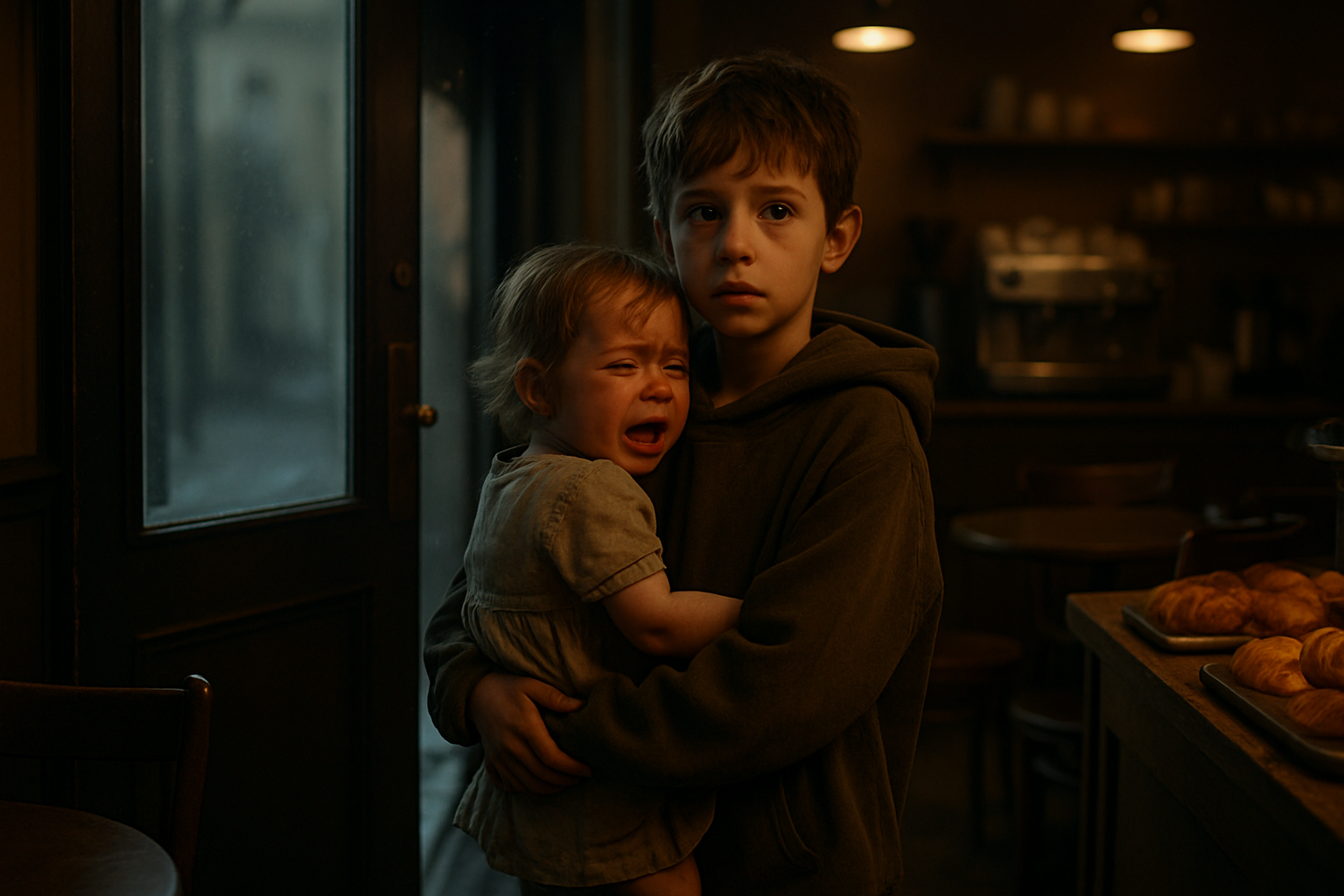
A thin boy stepped inside, no older than eight, carrying a crying toddler against his chest. His sweatshirt hung off him like it belonged to someone twice his size. The little girl’s beige dress was wrinkled and stained, and both children looked as if sleep had forgotten them.

The toddler pressed her wet face into his shoulder.

“I’m hungry,” she whimpered.

The boy swallowed hard. Then he walked to the counter.

Slowly.

Carefully.

As if hope were something breakable.

He looked up at the woman behind the register and asked, “Do you have any bread from yesterday that you sell for less?”

For one second, her face softened.

Then it closed again.

“We don’t sell leftovers here.”

She didn’t say it cruelly.

But it landed cruelly.

The boy did not argue. He did not beg. He only lowered his eyes and held the little girl tighter as her crying grew sharper.

By the window, an older man in a black suit set his coffee down.

Arthur Vale had been watching.

Listening.

And something in that boy’s quiet voice had already begun to trouble him.

Then Arthur stood.

His chair scraped across the floor, loud enough to still the room.

He walked to the counter with the calm of a man used to being obeyed.

“Pack everything,” he said.

The worker blinked. “Sir?”

“Everything.”

The café froze.

Hands stopped midair. Conversations died half-finished.

The woman turned quickly, gathering pastries, loaves, rolls, anything she could reach.

But Arthur was no longer looking at the food.

He stepped closer to the children.

“Come with me,” he said gently.

The boy moved back at once. Half a step. Arms tightening around the toddler.

His eyes were not grateful.

They were careful.

“Why?” he asked.

Arthur opened his mouth.

Then stopped.

His gaze had fallen on the little girl’s face.

First her eyes.

Then her mouth.

Then, as she turned through her tears, he saw it.

A small crescent-shaped birthmark near her temple.

Something inside him cracked.

Shock.

Pain.

Recognition.

His hand lifted, trembling, reaching toward her.

Then stopped just short.

As if he already knew the answer.

As if he was terrified to hear it.

The boy noticed.

“What?” he demanded.

Arthur struggled to breathe.

“What’s her name?”

The boy hesitated. His eyes flicked toward the door, then the worker, then back to Arthur.

“Rose,” he said.

The name struck Arthur like a voice returning from the dead.

Years ago, his daughter used to laugh and say, “If I ever have a little girl, I’ll name her Rose.”

Arthur’s face drained of color.

“And your mother?” he asked.

This time the boy froze.

That question hurt. Anyone could see it.

He looked down at the toddler, then back up.

“She’s gone.”

The bakery seemed to shrink around them.

“Gone how?” Arthur whispered.

The boy forced the words out.

“She got sick in the winter.”

Arthur closed his eyes for one second.

When he opened them, he looked at the children again.

And now he saw it.

Not only hunger. Not only dirt. Not only fear.

He saw his daughter in both of them.

The worker had stopped packing. Even she understood.

This was no longer about bread.

Arthur’s voice shook.

“What was your mother’s name?”

The boy watched him for a long, guarded moment.

Then he whispered, “Clara.”

The world tilted.

Arthur nearly fell.

Clara.

His daughter.

The one he had pushed away five years before because she chose love over his approval. Because she chose a man he refused to accept. Because Arthur had chosen pride over his own child.

He had not seen her since.

His hands shook openly now.

The boy saw it.

And something changed in his face.

Not trust.

Understanding.

Slowly, he shifted Rose on his hip and reached into his sweatshirt. He pulled out an old envelope, worn soft at the edges, protected for a very long time.

He held it out.

But he did not let go.

“Mom said,” the boy whispered, “if we ever got too hungry… and if a man looked at Rose like he knew her…”

He paused.

A terrible pause.

“I should give him this.”

Arthur stared at the envelope.

Four faded words were written across the front.

For my father.

His fingers trembled as he took it.

The whole bakery seemed to hold its breath.

He opened the letter.

His eyes dropped to the first line.

And everything inside him collapsed.

Dad, if you’re reading this… hunger reached your grandchildren before your pride did.

The paper shook in Arthur’s hands.

For a long moment, he could not breathe.

The music vanished. The coffee smell vanished. The warm light, the sugar, the people staring from their tables — all of it disappeared.

Only the letter remained.

Only Clara.

He read on.

Dad,

If you’re reading this, things became worse than I prayed they would.

And if Noah gave you this letter, then my children were hungry long before your heart softened enough to look for us.

Please don’t blame him.

He has been protecting Rose for a very long time.

Longer than any child should have to.

Arthur’s lips parted.

Noah.

So that was the boy’s name.

The child stiffened when he heard it, as if even his own name sounded dangerous in a stranger’s mouth.

Arthur looked up slowly.

Now he saw everything he had missed.

The shadows under Noah’s eyes. The sharpness in his little face. The way he stood like someone braced for trouble before it arrived.

Arthur hated himself then.

His grandson had learned survival before comfort.

Clara had suffered alone.

And pride had cost him years no fortune could buy back.

He returned to the letter.

I know you probably still think I ruined my life.

Maybe I was stubborn.

But Noah and Rose were never mistakes.

Not for one second.

I need you to know that.

Especially now.

Rose whimpered and curled her tiny fingers into Noah’s sweatshirt.

Noah rocked her automatically, as if his body had learned that motion by necessity.

Arthur noticed her shoes then.

The soles were splitting. Rain stains darkened the hem of her dress.

A cold question entered his mind.

How long had they been alone?

He kept reading.

After Rowan died, everything fell apart quickly.

I tried to keep the apartment. I tried to keep the bakery job. I tried to keep the children warm.

But hospitals don’t wait for rent money, and landlords don’t wait for grief.

By winter, Noah was pretending he wasn’t hungry so Rose could eat first.

He thought I didn’t notice.

I noticed everything.

A broken sound escaped Arthur’s throat.

Noah lowered his eyes at once.

Embarrassed.

Ashamed.

As if poverty were something a child should apologize for.

Arthur wanted to drop to the floor.

Instead, he forced himself to continue.

You once told me family should never have to beg strangers for kindness.

I believed you when I was little.

That is why this letter hurts so much.

Because I don’t know if you will help them.

And because I still remember the look on your face the day you told me not to come back.

The café had gone completely silent.

Nobody touched their food.

Arthur remembered that day with terrible clarity.

Clara standing in his office, crying. Begging him to understand. Begging him to meet Rowan before judging him.

And Arthur had been cold.

Proud.

Cruel.

“You are no longer my daughter if you walk out that door.”

Those had been his final words to her.

And she had walked out anyway.

He had told himself she would return.

But years passed.

Birthdays passed.

Silence passed.

Now all he had left of her was a letter written by dying hands.

Tears slid down his face.

Noah frowned slightly, not with pity, but confusion.

He did not know what to do with a crying adult.

Arthur looked at him.

“How long?” he whispered.

Noah hesitated.

Then answered, “Three months.”

Three months alone.

Three months trying to survive.

Three months carrying a little girl through a world that had not cared enough to stop and ask their names.

Arthur swallowed.

“Where have you been sleeping?”

Noah’s silence answered first.

Then he said, “Different places.”

Arthur closed his eyes.

Different places.

Bus stations. Benches. Shelters. Corners. Cold rooms. Maybe worse.

Rose stirred against Noah’s shoulder.

“I’m cold,” she whispered.

That finished him.

Arthur pulled off his coat at once and wrapped it around her tiny body. She blinked up at him with exhausted eyes.

And Clara’s smile.

Exactly Clara’s smile.

His face crumpled.

“I’m sorry,” he whispered.

Rose did not understand.

Noah did.

He stared at Arthur for a long time, measuring him.

Then, quietly, he asked, “Are you really our grandpa?”

Arthur dropped to his knees right there on the bakery floor.

A man with millions to his name.

Broken by one sentence from an eight-year-old boy.

“Yes,” he said hoarsely. “Yes, I am.”

Noah did not look relieved.

He looked tired.

“So what happens now?”

Arthur stared at them.

His daughter’s children.

His family.

And he understood something terrible.

They were waiting to see if he would abandon them too.

He pulled out his phone with shaking hands and made one call.

When the voice answered, he said, “Cancel my meetings.”

A pause.

“And prepare the house.”

Another pause.

His voice broke completely.

“My grandchildren are coming home.”

Noah’s expression shifted.

Not trust.

Not yet.

But the first tiny crack in the wall around his heart.

The café worker pushed a box of warm pastries toward them.

“On the house,” she whispered.

Noah looked at the food.

Then straight at Rose.

Not himself.

Never himself.

Arthur saw that too.

And silently vowed no child in his family would ever have to think that way again.

Rose reached weakly for a roll. Arthur helped her hold it. Her fingers were freezing.

He looked at Noah.

The brave little boy carrying a weight too heavy for most grown men.

“Why didn’t you come sooner?” Arthur asked.

Noah lowered his eyes.

“Mom said you loved us,” he answered softly.

A pause.

“But she wasn’t sure you loved her anymore.”

Arthur broke completely.

Because Clara had still defended him.

Even after he failed her.

And there, in that warm little bakery, surrounded by strangers and the smell of bread, Arthur finally understood.

Pride does not feel powerful when you are alone.

It feels expensive.

The drive to the mansion was silent.

Not peaceful.

Not uncomfortable.

Just fragile, as if one wrong word might frighten the moment away.

Rose sat wrapped in Arthur’s coat, half asleep, holding a pastry in both hands. She ate slowly, carefully, as if afraid someone might take it back.

Arthur noticed every bite.

Noah sat closest to the door.

Alert.

Watching the windows, the driver, the road.

Even now, he looked ready to grab Rose and run.

Arthur hated that instinct in him.

Children were not meant to live like hunted animals.

“You can sleep,” Arthur said gently.

Noah shook his head.

“I’m not tired.”

It was an obvious lie.

Arthur did not argue.

“You don’t have to protect her alone anymore,” he said.

Noah looked out the window and said nothing.

When the gates opened, Rose sat up.

The mansion glowed against the night, its tall windows bright with gold.

For a moment, neither child moved.

Noah stared at the house, not impressed, but suspicious. Beautiful things, his face seemed to say, often came with hidden conditions.

Arthur stepped out first and opened Rose’s door.

“It’s all right,” he said softly.

Rose looked to Noah before touching the ground.

Only when he nodded did she allow Arthur to lift her.

That nearly broke him again.

Even exhausted and hungry, she still waited for her brother’s permission before feeling safe.

Inside, the staff had gathered near the entrance.

Housekeepers. Cooks. Security.

All of them stared at the two children in the marble foyer.

None of them had ever seen Arthur Vale cry.

None had ever seen him hold anyone the way he held Rose.

The head housekeeper stepped forward.

“Sir, the guest rooms are prepared.”

Arthur’s voice sharpened at once.

“Not guest rooms.”

The woman blinked.

“These are my grandchildren.”

Silence filled the foyer.

Noah stiffened beside him.

Grandchildren.

The word sounded strange in that enormous house.

As if it had been waiting there for years.

Arthur looked down at the children.

“You’ll stay near my room,” he said. “Where I can hear if you need anything.”

Noah frowned.

“Why?”

The question hurt.

Children who had been loved properly did not ask why someone wanted them close.

Arthur knelt before him.

“Because I already lost your mother once,” he said, his voice cracking. “I cannot survive losing what is left of her.”

Noah looked away quickly.

Like tenderness made him uneasy.

Like feelings were dangerous.

Arthur recognized it.

Clara had done the same thing when she was hurt.

An hour later, Rose was asleep in a bed so large it made her look smaller than ever. She wore clean pajamas. Her hair had been brushed. Her cheeks had a little color again.

But even sleeping, her hand clutched Noah’s sleeve.

As if letting go meant waking up cold and alone.

Noah sat beside her on top of the blankets, still fully dressed.

Awake.

Watching the door.

Arthur stood there a moment.

“There’s a room for you too,” he said.

“I’ll stay here.”

“You can both stay here, if you want.”

Noah did not answer.

Arthur sat in the chair across from the bed.

For the first time all night, the room was quiet enough for grief to breathe.

“You really took care of her,” Arthur said.

Noah shrugged.

“She’s little.”

Such a simple answer.

As if it explained everything.

Maybe it did.

“When was the last time you slept properly?” Arthur asked.

Noah kept his eyes on Rose.

“I don’t know.”

The answer cut deep.

Arthur rubbed his shaking hands together.

“I should have found your mother.”

Noah finally looked at him.

Not angry.

Just honest.

“She waited for you.”

The words stole the air from the room.

Arthur’s face crumpled.

“She talked about me?”

Noah nodded once.

“Every birthday.”

Another crack through the heart.

“She kept your picture too.”

Arthur covered his mouth.

Noah continued, his voice quiet in that strange calm children have after they have already cried too much.

“She got really sick near the end. She tried not to show us.”

Arthur could barely speak.

“What happened?”

Noah looked down.

“She stopped eating first.”

Silence.

“Then she stopped getting out of bed.”

Another silence.

“She still smiled at Rose, though.”

Arthur lowered his head.

Tears fell onto his hands.

Noah watched him carefully, almost puzzled.

Adults were supposed to be strong.

Not broken.

“She made me promise something,” Noah whispered.

Arthur looked up.

“What promise?”

“That no matter what happened…”

For the first time, Noah’s voice wavered.

“I couldn’t let Rose see me scared.”

The sentence shattered the room.

Arthur understood then.

This child had been terrified for months.

But he had carried his fear alone.

For her.

“You don’t have to do that anymore,” Arthur said.

Noah’s face changed.

Just a little.

Then the softness vanished.

“What if you change your mind?”

Arthur stared at him.

“What?”

“What if one day you decide you don’t want us here either?”

There it was.

The real fear.

Not hunger.

Not cold.

Abandonment.

Arthur moved slowly. He reached into his wallet and pulled out an old photograph.

Clara.

Young and laughing, flour dusted across her face in a kitchen.

Noah stared at it.

“She was making my birthday cake,” Arthur whispered. “She ruined three before that one.”

A tiny smile almost touched Noah’s mouth.

Almost.

Arthur looked into his grandson’s eyes.

“I lost my daughter because I thought being right mattered more than being loving,” he said. “I will regret that until my last breath.”

He placed the photograph in Noah’s hands.

“But I will never send you away.”

Noah stared at the picture for a long time.

Then, very quietly, he said, “She missed you a lot.”

Arthur closed his eyes.

And cried harder than he had cried the day they buried Clara.